
TL;DR:
- Most businesses struggle with sustained profitable growth despite high revenue.
- Focusing on profit ensures better cash flow, owner pay, and business resilience.
- Implementing frameworks like Profit First and discipline in financial management drives profitability.
Most business owners chase revenue like it’s the finish line. But 85% of businesses never achieve sustained profitable growth, which means a packed order book can still leave you stressed, underpaid, and one bad month away from crisis. Revenue is vanity; profit is sanity. True business health is measured not by how much comes in, but by how much stays, compounds, and pays you reliably. This guide walks you through why profitability deserves your primary focus, what healthy numbers look like, which frameworks actually work, and when it makes sense to shift the balance. If you want clarity, resilience, and real freedom, this is where it starts.
Table of Contents
- Why profitability matters more than growth
- Benchmarks: What healthy profit looks like for SMBs
- How to prioritise profitability: Methods and frameworks
- When to balance profitability and growth: Nuance for modern businesses
- Proof in action: Case studies on profit focus
- The uncomfortable truth: Profit without discipline is rare
- Unlock expert support for your profitability journey
- Frequently asked questions
Key Takeaways
| Point | Details |
|---|---|
| Profit unlocks stability | Profitability gives businesses financial resilience and allows controlled growth without risky debt. |
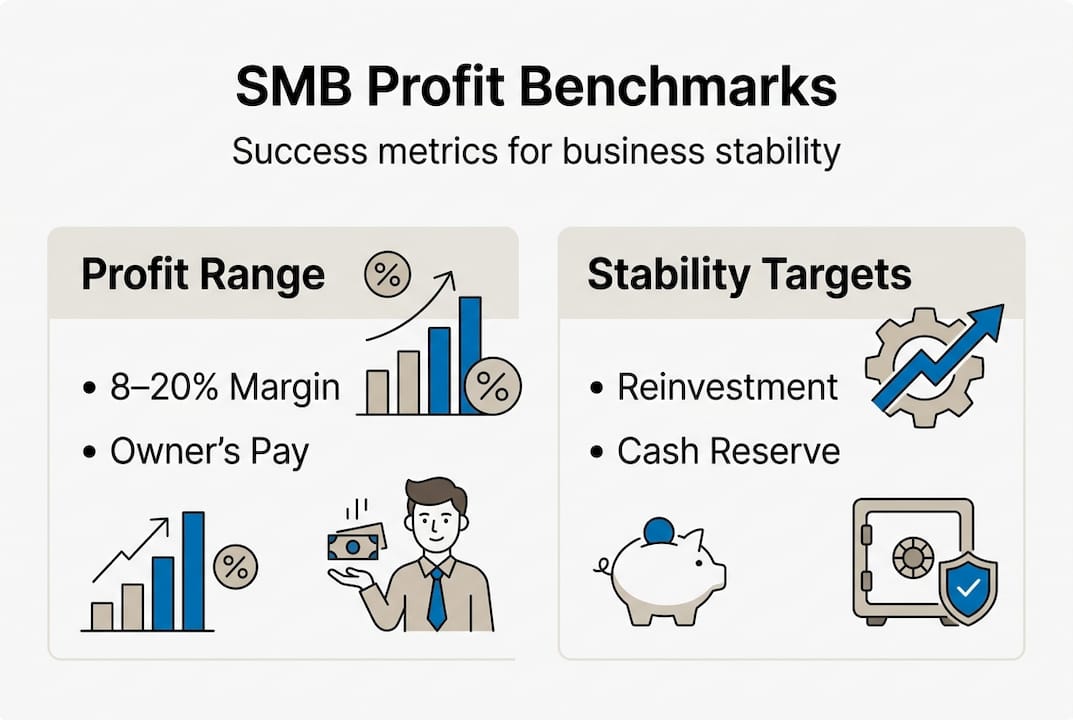
| Benchmarks set the bar | A healthy SMB targets at least 8-20% net margins with regular owner rewards and growth reserves. |
| Profit First works | Using disciplined systems like Profit First ensures you build margin into your daily business operations. |
| Know when to balance | At times, short-term growth matters, but lasting success depends on shifting focus back to profitability. |
| Proof is in action | Case studies prove that prioritising profit transforms businesses—even in tough markets. |
Why profitability matters more than growth
Profitability is not simply about making money. It is about building a business that can breathe. At its core, profitability means your net margin (what remains after all costs), your owner compensation, and the reserves you set aside for reinvestment. When those three elements are healthy, your business stops feeling like a treadmill and starts feeling like an asset.
Financial stability for SMBs comes directly from profitability: it governs your cash flow management and reduces your reliance on external funding. That matters enormously. Businesses that depend on loans or investor rounds to cover operating costs are fragile. One slow quarter, one lost client, and the whole structure wobbles.
Here is what a profitability focus actually delivers:
- Control over your decisions. You are not forced to take bad clients or underpriced contracts just to keep the lights on.
- Fewer sleepless nights. Cash reserves absorb shocks without panic.
- The ability to invest in opportunities. When a great hire or a new tool appears, you can act without taking on risky debt.
- A business worth selling. Buyers pay multiples of profit, not multiples of revenue.
- Reliable owner compensation. You built this business to pay you well, not to pay everyone else first.
Consider a simplified view of how the numbers can look:
| Metric | Growth-focused SMB | Profit-focused SMB |
|---|---|---|
| Annual revenue | £1,200,000 | £900,000 |
| Net margin | 4% | 16% |
| Owner’s pay | £28,000 | £85,000 |
| Reinvestment reserve | £5,000 | £45,000 |
| Stress level | High | Manageable |
The growth-focused business looks impressive on paper. The profit-focused business actually works for its owner.
SMEs with a profitability-first mindset are 2.5 times more likely to become high-growth companies over a five-year horizon than those chasing top-line revenue alone.
When you improve profitability first, you build the foundation that makes sustainable growth possible. Understanding why profitability matters is the first step towards building a business that genuinely works for you.
Benchmarks: What healthy profit looks like for SMBs
Now that the power of profitability is clear, what does ‘good’ look like for successful, stable small businesses?
Healthy SMB net profit margins sit between 8% and 20%, with businesses in the £2M to £4M revenue range typically reinvesting 30 to 50% of their net profit back into the business. Anything below 7% starts to feel precarious.
| Revenue band | Average net margin | Owner’s pay (% of revenue) | Reinvestment | Cash reserve target |
|---|---|---|---|---|
| Under £500k | 10–15% | 20–30% | 15–20% | 3 months’ costs |
| £500k–£2M | 9–14% | 15–20% | 20–30% | 3–6 months’ costs |
| £2M–£5M | 8–12% | 10–15% | 30–50% | 6 months’ costs |
| Over £5M | 7–11% | 8–12% | 40–60% | 6+ months’ costs |
These are not aspirational figures. They are what stable, well-run businesses actually achieve. The most successful businesses in the £1M to £5M range maintain net margins over 11%, investing heavily in future resilience rather than short-term appearances.
So how do you assess where you stand right now? Follow these steps:
- Calculate your current net margin. Divide net profit by total revenue and multiply by 100. Be honest; include your own salary as a cost.
- Compare against the benchmark for your revenue band. Are you above or below the healthy range?
- Review your owner compensation. Are you paying yourself what the market would pay a manager to do your job?
- Identify your reinvestment rate. What percentage of profit goes back into the business intentionally, not accidentally?
- Check your reserves. How many months of operating costs could you cover without a single sale?
Before a profit focus, many owners report paying themselves inconsistently, carrying high stress, and feeling trapped. After implementing a structured approach using the average profit margin guide, those same owners describe clarity, confidence, and the ability to plan ahead. When you optimise profitability with intention, the shift is tangible and fast.

How to prioritise profitability: Methods and frameworks
Understanding your numbers matters, but taking action with proven frameworks transforms your outcomes.
The most widely adopted system for small business profit discipline is Profit First, developed by Mike Michalowicz. The core idea flips traditional accounting on its head. Instead of Revenue minus Expenses equals Profit, Profit First works as Revenue minus Profit equals Expenses. You allocate profit first, then operate on what remains.
The Profit First methodology uses separate bank accounts for profit, owner’s pay, tax, and operating expenses. Each time revenue arrives, you distribute set percentages immediately. A typical starting allocation for a £500k business might look like this: 5% to profit, 50% to owner’s pay, 15% to tax, and 30% to operating expenses.
| Approach | Traditional accounting | Profit First system |
|---|---|---|
| Formula | Revenue – Expenses = Profit | Revenue – Profit = Expenses |
| Profit timing | End of year (if anything remains) | Every deposit, from day one |
| Owner’s pay | Variable, often last | Fixed allocation, non-negotiable |
| Discipline required | High willpower | Built into the structure |
| Cash visibility | Low | High |
Beyond Profit First, new tools are making margin protection easier. AI-powered platforms can now flag cost anomalies, model pricing scenarios, and identify your most and least profitable service lines. You can boost margin with AI by automating routine financial monitoring, freeing your attention for strategic decisions.
Here are simple actions you can take this month:
- Open a dedicated profit account and transfer even 1% of every deposit into it immediately.
- Review your three largest costs and ask whether each one directly drives revenue.
- Identify your most profitable product or service and consider whether you are selling enough of it.
- Set a monthly date to review your margin, not just your revenue.
Pro Tip: Start with a single percentage allocation, even if it feels small. Consistency matters far more than the size of the initial figure. Steady improvement, not perfection, is what builds lasting profit growth strategies.
When to balance profitability and growth: Nuance for modern businesses
Not every business follows the same path. The right focus changes with your market, stage, and ambitions.
Some businesses genuinely need to prioritise growth before profit. Early-stage technology companies, businesses entering new markets, and firms building network-effect products often operate at a loss intentionally. The key is having a credible, time-bound plan to reach profitability.
| Factor | Profit-first strategy | Growth-first strategy |
|---|---|---|
| Business stage | Established, stable | Early-stage, scaling |
| Market type | Competitive but mature | Hyper-competitive, winner-takes-all |
| Funding | Self-funded or lean | Investor-backed |
| Timeline to profit | Immediate | 18–24 months maximum |
| Risk level | Lower | Higher |
The Rule of 40 is a useful framework here. It states that a healthy business’s revenue growth rate plus its profit margin should equal or exceed 40%. A business growing at 25% with a 15% margin scores 40 and is considered healthy. This rule helps you decide whether your current trade-off between growth and profit is sustainable.
Here are signs your business should shift focus from growth to profitability:
- You have been growing for more than two years without improving your margin.
- Owner compensation has not increased despite rising revenue.
- Cash flow feels tighter even as sales increase.
- You are taking on debt to fund operations, not expansion.
- Your team is stretched and morale is declining.
Balanced firms that pursue both profitability and growth consistently outperform those that sacrifice one for the other indefinitely. Sustainable profit must eventually follow growth, regardless of sector.
If you are in a growth phase, accept lower margins for a maximum of 18 to 24 months, then pivot firmly. Learn how to boost profit margins once that window closes.
Proof in action: Case studies on profit focus
Theory and frameworks are essential, but nothing beats the clarity of seeing profit-first strategies in action.
Consider a UK-based service firm that was generating steady revenue but taking home almost nothing. By restructuring their pricing, cutting underperforming service lines, and implementing monthly profit reviews, they moved from £0 to £4,000 profit per month within six months. The owner described it as finally feeling like the business was working for them rather than the other way around.
A US manufacturing business tells a similarly powerful story. By implementing an ERP system, enforcing process discipline, and setting hard profit targets, they slashed costs by 43% and doubled EBITDA. The shift was not about working harder. It was about making deliberate, data-led decisions every single week.
What do these stories have in common? Look at the themes:
- Owner discipline. Both leaders committed to reviewing numbers regularly, not just at year-end.
- Strict allocation. Money was directed with intention before expenses had a chance to absorb it.
- Data-led decisions. Gut feel was replaced with lead indicators and clear targets.
- Willingness to cut. Both businesses removed services or costs that felt safe but were quietly draining margin.
Pro Tip: Choose one lead indicator, such as operating margin or gross profit per employee, and track it monthly. Share it with your team. Visibility creates accountability, and accountability drives results. Explore the full profit maximisation guide to identify which indicators matter most for your business model.
The uncomfortable truth: Profit without discipline is rare
Here is what experience and research tell us most clearly, even though it is often overlooked.
Only 15% of businesses achieve profitable growth, and those that do share one trait: conviction in allocation and margin discipline. Most owners know they should prioritise profit. Very few actually do it consistently.
The gap between knowing and doing is where businesses are won or lost. Owners who review their allocations monthly, question every expense with genuine rigour, and prioritise future stability over ego-led growth are the ones who build something truly valuable. They turn frustration into fuel by treating every financial review as a strategic advantage, not a chore.
AI and automation can now handle much of the monitoring. But the mindset, the willingness to make uncomfortable decisions, to say no to low-margin work, to pay yourself properly, to hold reserves sacred, that part is non-automatable. It requires discipline, and discipline requires support. The coaching benefits for owners who commit to this path are profound: clarity replaces confusion, and confidence replaces anxiety.
Winners use conviction in allocation, AI for margin monitoring, and multiple engines for profitability. They do not wait for perfect conditions. They build the discipline first.
Unlock expert support for your profitability journey
If you are ready to turn these insights into action, here is how expert support can make you the exception.
Knowing the frameworks is one thing. Embedding them into your daily business rhythm is another. That is precisely where coaching for profitability makes the difference. A skilled coach holds you accountable, challenges assumptions, and helps you see the numbers clearly without the emotional fog that comes from being too close to your own business.

At Summit SCALE, we work with owner-led businesses to build the profit discipline that creates real freedom. Whether you need help implementing Profit First, reviewing your pricing strategy, or building a long-term business planning framework, our tailored coaching programmes are designed around your specific goals. Investing in business coaching is not an expense. It is the most direct route to predictable, lasting profitability. Book your free 15-minute assessment call today and take the first step towards a business that truly works for you.
Frequently asked questions
What is considered a healthy profit margin for a small business?
Healthy SMB margins sit between 8% and 20%, with a recommended minimum of 7 to 10% to ensure your business can absorb setbacks and still pay you reliably.
Why do most businesses fail to achieve profitable growth?
Only 15% succeed because most owners lack consistent profit discipline, clear allocation systems, and the willingness to prioritise margin expansion over vanity revenue figures.
When is it sensible to pursue growth over profitability?
Growth can take priority during new market entry or in technology sectors, but sustainable profit must follow within 18 to 24 months, supported by a clear and credible plan.
How does the Profit First method help small business owners?
Profit First allocates set percentages to profit, owner’s pay, tax, and operating expenses from every deposit, building financial discipline into the structure of your business rather than relying on willpower.
What’s the fastest way to boost profitability in my SME?
Start by tracking operating margins monthly, then review all costs with genuine scrutiny. Businesses that implement disciplined profit allocations early see the fastest and most sustainable improvements in owner compensation and cash reserves.

