
Running a business in the UK or Australia comes with daily pressures, but knowing exactly what drives your company’s value can change your entire growth trajectory. Small and medium-sized owners often find it challenging to prioritise actions that truly make a difference when it comes to enhancing their valuation. By focusing on clear value drivers and making informed, strategic choices, you set your business up for greater resilience and stronger performance in any market.
Table of Contents
- Step 1: Assess Current Value Drivers And Financial Health
- Step 2: Implement Strategic Growth And Cost Control Measures
- Step 3: Strengthen Leadership And Team Performance
- Step 4: Validate Improvements With Regular Business Valuation Checks
Summary of Key Insights
| Main Insight | Detailed Explanation |
|---|---|
| 1. Identify Core Value Drivers | Understand key factors such as revenue growth and profitability that drive your business value to inform strategic decisions. |
| 2. Regularly Assess Financial Health | Track metrics like cash flow and profit margins consistently to monitor your business’s financial stability and growth potential. |
| 3. Implement Strategic Cost Management | Focus on eliminating wasteful expenses while protecting essential investments to strengthen your business’s financial health. |
| 4. Build and Develop a Strong Team | Invest in leadership and team performance to create a capable workforce that can contribute positively to business valuation. |
| 5. Conduct Regular Business Valuations | Make valuation checks a continuous practice to measure and understand the effects of your business strategies on its value. |
Step 1: Assess current value drivers and financial health
Knowing what truly drives your business value is the foundation of every strategic decision you make going forwards. Without this clarity, you’re essentially flying blind—making investments and changes without understanding their real impact on what your business is actually worth.
Start by identifying your core value drivers. Research shows that six critical factors account for most of the variation in company valuations across industries. These typically include revenue growth, profit margins, market position, customer retention, operational efficiency, and competitive advantage. Take a moment and honestly assess where your business stands in each area.
Next, gather your financial data. Pull together your last three years of accounts, including profit and loss statements, balance sheets, and cash flow reports. Look for patterns. Are revenues trending upward? Is your cash position stable? What’s happening with your costs?
Three key metrics deserve your close attention:
- Profitability: Calculate your net profit margin. This shows what percentage of every pound earned actually stays with you after all expenses.
- Cash flow: Track how much actual cash moves in and out of your business each month. Profit and cash flow aren’t the same thing.
- Growth rate: Measure your year-on-year revenue growth. Consistent, sustainable growth is worth significantly more than flat performance.
Understanding your cost of capital is equally important. This represents what it costs you to fund your business through debt or equity. Higher risk businesses typically have higher cost of capital, which reduces valuation. If you’ve been operating informally about this, it’s time to get precise.
The most valuable businesses have clarity about what drives their value—and they actively manage those drivers month after month.
Analyse your customer metrics as well. How many customers do you have? What’s your retention rate? Are you gaining or losing customers each quarter? Businesses with loyal, repeating customers are worth far more than those relying on one-off transactions.

Don’t skip the competitive landscape. Where does your business sit compared to your main competitors? Do you have genuine differentiation, or are you competing purely on price? Understanding your competitive positioning directly influences your valuation multiple.
Finally, look at your operational health. Are you over-reliant on a single customer, supplier, or person (including yourself)? Dependencies reduce value because they create risk. The stronger and more independent your operations, the higher buyers or investors will value your business.
Once you’ve assessed all this, write down your findings. You now have a baseline. This becomes your starting point for the work ahead.
Pro tip: Create a simple one-page summary showing your top three value drivers and your current performance in each. Review this monthly to track progress and spot where you need to focus improvement efforts.
Here is a summary of common business value drivers and how they impact valuation:
| Value Driver | Typical Measurement | Impact on Valuation | Improvement Focus |
|---|---|---|---|
| Revenue Growth | Year-on-year increase | Drives higher multiples | Expand markets, optimise pricing |
| Profit Margin | Net profit percentage | Enhances investor returns | Reduce costs, raise efficiency |
| Customer Retention | Annual retention rate | Reduces risk, boosts value | Strengthen loyalty programmes |
| Market Position | Industry share ranking | Secures competitive leverage | Differentiate offerings |
| Operational Efficiency | Cost/output ratio | Increases margins, lowers risk | Streamline processes |
| Competitive Advantage | Unique strengths | Supports premium valuation | Build and defend key assets |
Step 2: Implement strategic growth and cost control measures
Now you understand what drives your business value. The next phase is taking deliberate action to strengthen those drivers through smart growth and disciplined cost management. These two forces work together, not against each other.
Start with your growth strategy. Rather than chasing every opportunity, focus on what fits your strengths and resources. Effective business growth strategies include market penetration (selling more to existing customers), product development (creating new offerings), and market expansion (reaching new customer segments). Which approach aligns best with your current position?
Market penetration often delivers quick wins. If you have loyal customers, how much more could they buy from you? Sometimes the fastest path to growth is deepening relationships you already have rather than constantly acquiring new ones.
Below is a comparison of business growth strategies and their potential benefits:
| Growth Strategy | Key Approach | Primary Benefit | Typical Challenge |
|---|---|---|---|
| Market Penetration | Sell more to existing customers | Rapid sales boost | Limited customer base growth |
| Product Development | Launch new products or services | Diversifies revenue streams | Risk of product failure |
| Market Expansion | Enter new geographic/segment | Access to new customers | High costs, cultural hurdles |
Now shift your focus to cost control. Here’s what many business owners get wrong: they think cost cutting means slashing expenses across the board. That weakens your business. Instead, strategic cost management builds competitive strength by eliminating waste whilst protecting investments that matter.
Conduct a realistic expense audit. Categorise your costs into three groups:
- Essential investments: Spending that directly drives revenue or customer satisfaction. Protect these fiercely.
- Wasteful expenses: Money spent on habits rather than results. Cut these immediately.
- Discretionary spending: Nice-to-have items. Review carefully and reduce strategically.
Look for hidden costs. Are you paying for software nobody uses? Overstaffed in low-impact areas? Carrying inventory that doesn’t sell? These are your quick wins.
Balance growth with profitability. The strongest valuations come from businesses showing both revenue growth and improving margins. You can’t sacrifice one for the other.
Smart cost control frees up capital to invest in growth initiatives that actually matter to your customers and your bottom line.
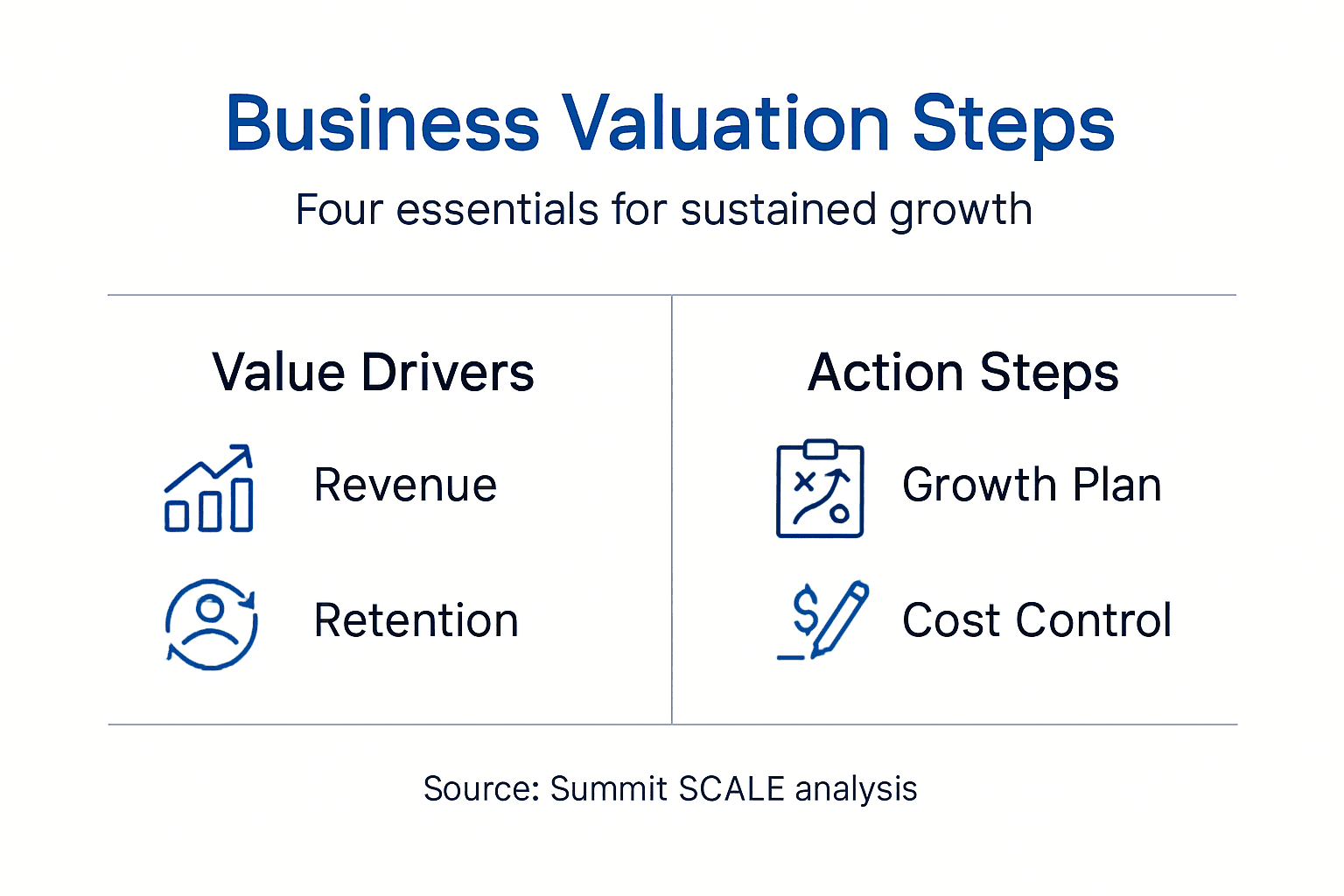
Create a simple growth plan identifying your top three priorities for the next twelve months. Then map your cost reductions directly to funding that growth. This shows discipline and purpose rather than panic.
Track both metrics monthly. Are you growing revenue whilst improving your profit margin? That’s the combination that dramatically increases business value.
Pro tip: Involve your team in identifying both growth opportunities and cost savings. They see waste and customer needs you might miss. People also own changes they helped create.
Step 3: Strengthen leadership and team performance
Your business will never outgrow you. This truth sits at the heart of valuation because buyers and investors assess the strength of your leadership and team before they assess anything else. A business dependent entirely on you is worth far less than one with a capable team and systems.
Start by honestly evaluating your own leadership capabilities. Leading authentically, championing inclusion, and demonstrating resilience are the skills that matter most in today’s business environment. Where do you genuinely excel? Where do you struggle? Don’t skip this self-assessment because it shapes everything else.
Next, assess your core team. Do you have the right people in the right roles? Are they clear on your business vision and their contribution to it? High-performing teams don’t happen by accident.
Three critical areas need your attention:
- Clarity of vision: Your team must understand where the business is heading and why it matters. Vague direction creates confusion and turnover.
- Role definition: Each person should know exactly what success looks like in their role. Ambiguity breeds frustration.
- Development investment: Strong teams improve when you invest in their growth. Training, mentoring, and feedback matter.
Building an effective leadership team requires more than individual talent. Leadership teams must balance innovation with execution, reimagine business purpose, and improve team health to drive sustained competitive advantage. This means your leadership group works as a cohesive unit, not as individual contributors competing for resources.
Identify the gaps in your leadership bench. Do you need stronger sales leadership, operational excellence, or financial discipline? Be specific about what’s missing because that guides your hiring or development focus.
Create accountability systems. Regular one-on-ones, clear key performance indicators, and transparent feedback build trust and drive performance. Team members perform better when they know exactly where they stand and what improvement looks like.
Your team reflects your leadership. Invest in their development and you simultaneously invest in your business valuation.
Don’t underestimate culture. Businesses with strong cultures attract better talent, retain their best people longer, and execute strategy faster. Culture isn’t soft stuff; it’s a competitive advantage.
Document your processes and decisions. When knowledge lives only in your head, your business becomes dependent on you. Written processes allow your team to operate independently and make your business more valuable.
Pro tip: Start a monthly leadership forum where your top team discusses strategy, challenges, and decisions collectively. This builds unity, surfaces problems early, and develops future leaders within your organisation.
Step 4: Validate improvements with regular business valuation checks
You’ve made real changes. Your costs are leaner, your team is stronger, and your growth strategy is clearer. But how do you know these efforts are actually increasing your business value? You measure it. Regular valuation checks keep you accountable and reveal what’s working.
Think of valuation not as a one-time event, but as an ongoing process. Most business owners conduct a valuation only when preparing to sell. That’s like checking your health only when you’re about to run a marathon. Instead, regular checks throughout your ownership help you track progress and adjust course.
Comprehensive valuation report frameworks ensure transparency, consistency, and reliability in assessing business improvements over time. A robust process documents your scope, purpose, and methodology so you can compare results year to year and understand what’s driving value changes.
Start with a baseline valuation if you haven’t conducted one. This establishes your starting point. Then schedule regular check-ins. Many successful owners conduct informal valuations annually and formal, professional valuations every two to three years.
During each valuation review, focus on these key areas:
- Revenue trends: Is your top line growing as planned? Are improvements sustainable or one-time spikes?
- Profitability improvements: Has your margin actually improved or just stayed flat despite higher sales?
- Risk reduction: Have you decreased dependency on key customers, suppliers, or yourself?
- Team capability: Is your business becoming less dependent on you personally?
Following thorough documentation and valuation methodology practices ensures your valuations are accurate and defendable. Keep detailed records of your financial performance, business changes, and strategic initiatives. This creates a clear story of how your business has evolved.
When you conduct a valuation, compare it to your previous assessment. What changed? Did your profit margins improve more than expected? Did revenue growth exceed or miss your targets? Understanding these variances tells you where your efforts succeeded and where you need to refocus.
Regular valuation checks transform gut feelings about business progress into measurable reality. They keep your strategy honest and your focus sharp.
Share valuation results with your leadership team. This creates alignment around what matters and reinforces your business priorities. When your team sees how their efforts translate into increased business value, engagement and accountability improve significantly.
Use valuations to inform decisions about investment. Should you hire more salespeople? Invest in systems? Expand into a new market? Knowing your current valuation helps you make investment decisions with confidence rather than fear.
Pro tip: Track five to seven key value drivers monthly (revenue, profit margin, customer retention, team turnover rate, and operational efficiency metrics). These become your early warning system, showing you whether you’re genuinely improving business value long before a formal valuation.
Unlock Your Business’s True Value with Expert Coaching
The article highlights the critical challenge of understanding and actively managing your core value drivers such as revenue growth, profit margins, and operational efficiency. Many business owners struggle to balance strategic growth with disciplined cost control while building leadership teams that reduce dependency on themselves. These pain points often lead to stagnation and undervalued businesses. Summit SCALE specialises in guiding entrepreneurs through these exact challenges with tailored business coaching designed to increase profitability and boost long-term valuation.
Transform your business by focusing on strategic actions like optimising customer retention, strengthening leadership, and implementing measurable growth plans. With Summit SCALE, you gain more than advice — you get a structured, personalised pathway to real improvements that increase your business’s worth and free up your time and resources.
Looking to turn insight into action today Visit Summit SCALE and discover how our expert coaching can help you develop a growth and cost control plan that boosts your valuation.
Take the first step toward higher business value by scheduling a free 15-minute assessment call. Harness practical strategies for sales growth, team building, and operational excellence now at Summit SCALE. Don’t wait — growing your business value starts with knowing where to focus and having the right support.
Frequently Asked Questions
How can I assess my business’s current value drivers?
To assess your business’s current value drivers, begin by identifying core factors such as revenue growth, profit margins, and customer retention. Gather your financial data from the past three years, including profit and loss statements, to analyse these metrics effectively.
What specific actions can I take to stimulate revenue growth?
To stimulate revenue growth, focus on market penetration strategies, such as selling more to your existing customers. Consider developing a simple growth plan to increase sales by 10% over the next 12 months through targeted promotions or improved customer relationships.
How do I effectively manage costs without harming my business?
Effective cost management involves categorising your expenses into essential investments, wasteful expenses, and discretionary spending. Audit your costs, aim to eliminate at least 15% of wasteful expenses, and reinvest those savings in areas that directly drive revenue.
What steps should I follow to strengthen my leadership and team performance?
Start by evaluating your own leadership capabilities and identifying gaps in your core team. Invest in training and development to enhance team performance, targeting measurable improvements, such as a 20% increase in team productivity over the next six months.
How often should I conduct a business valuation check?
Conduct a business valuation check annually for informal assessments and every two to three years for formal valuations. Schedule these valuations to ensure you are continuously tracking changes in your business value and can make informed strategic decisions.
What key metrics should I track to measure my business’s growth and valuation?
Track metrics such as revenue trends, profit margins, customer retention rates, and operational efficiency. Aim to monitor these five to seven key performance indicators monthly to quickly spot areas needing improvement and ensure sustained business growth.

