
Growing a profitable business is harder than it looks. Many SMBs struggle with sustained profitability due to lack of effective sales and cost strategies. You face tight margins, unpredictable cash flow, and constant pressure to balance revenue growth with expense control. This guide walks you through proven strategies to increase profitability by focusing on strategic sales growth and disciplined cost management, delivering measurable results within 6 to 12 months.
Table of Contents
- Introduction: Understanding Business Profitability
- Prerequisites and Financial Control
- Step 1: Enhance Sales via Customer Experience and Marketing
- Step 2: Set Clear, Measurable Profitability Goals
- Step 3: Implement Cost Control and Efficiency Measures
- Step 4: Increase High-Value Work by Outsourcing and Automation
- Troubleshooting & Common Mistakes
- Expected Results and Timelines
- Unlock Your Business Profitability Potential with Strategic Coaching
- Frequently Asked Questions
Key Takeaways
| Point | Details |
|---|---|
| Balance sales and costs | Strategic sales growth paired with disciplined cost control drives sustainable profit increases. |
| Set SMART goals | Specific, measurable profitability targets with quarterly milestones ensure focused execution and accountability. |
| Leverage technology | Automation and outsourcing free your team to focus on revenue-generating activities, boosting margins by 5-10%. |
| Monitor cash flow | 13-week rolling forecasts reduce cash flow failures by over 30% and enable proactive decisions. |
| Expect 6-12 months | Structured strategies typically deliver noticeable profitability improvements within this timeframe. |
Introduction: Understanding Business Profitability
Profitability measures how much money your business keeps after covering all expenses. For US SMBs, it determines your ability to reinvest, grow, and achieve financial freedom. Profitability metrics like profit margin, CAC, and CLTV are essential for SMBs to track financial health. Without clear metrics, you’re flying blind.
Three core metrics define profitability. Profit margin shows the percentage of revenue remaining after costs. Customer Acquisition Cost (CAC) measures what you spend to gain each new customer. Customer Lifetime Value (CLTV) estimates total revenue from a customer relationship. Track these consistently to spot trends and make informed decisions.
SMBs face recurring challenges that limit profit growth:
- Inconsistent cash flow disrupts operations and planning
- Pricing mistakes leave money on the table or scare customers away
- Manual processes waste time and inflate costs
- Lack of financial visibility prevents strategic decisions
- Competing on price alone erodes margins quickly
Addressing these obstacles requires a structured approach combining sales growth with cost discipline.
Prerequisites and Financial Control
Before implementing profit improvement strategies, establish a foundation of financial control. You need basic financial literacy to interpret reports and make smart decisions. Equip yourself and your managers with knowledge of income statements, balance sheets, and cash flow statements.
Invest in accounting software tailored to SMBs. Tools like QuickBooks or Xero automate bookkeeping, generate reports, and provide real-time visibility. Accurate, updated financial data is non-negotiable for effective profitability management.
Implement a 13-week rolling cash flow forecast immediately. This tool projects weekly cash inflows and outflows, highlighting potential shortages before they become crises. 13-week rolling cash flow forecasts reduce cash flow-related failures by over 30%. Update it weekly without exception.
Essential financial control prerequisites include:
- Reliable bookkeeping systems updated weekly
- Monthly financial statement reviews with your team
- Clear understanding of fixed vs variable costs
- Documented expense approval processes
- Commitment to data-driven decision making
Pro Tip: Schedule a standing weekly 30-minute meeting to review your cash flow forecast. This habit alone prevents most cash emergencies and builds financial literacy importance across your leadership team.
Step 1: Enhance Sales via Customer Experience and Marketing
Revenue growth starts with delighting customers and attracting the right prospects. Focus on improving customer experience to build loyalty and encourage repeat purchases. Investing in customer experience can increase retention rates by up to 10-15%, directly impacting profitability. Happy customers buy more and refer others.

Set SMART sales growth goals. Instead of vague targets like “grow revenue,” specify “increase monthly recurring revenue by 12% within Q2 2026 through improved customer retention and upselling.” Clear goals motivate your team and focus effort.
Deploy targeted digital marketing aligned with your ideal customer profile. Understand where your best customers spend time online and concentrate resources there. Targeted digital marketing increases acquisition efficiency and reduces costs by ~20%, delivering better returns than scattered efforts.
Simple improvements that boost sales:
- Personalize follow-up emails based on customer behaviour
- Streamline checkout processes to reduce cart abandonment
- Train staff to actively listen and solve customer problems
- Create loyalty programs rewarding repeat business
- Gather and act on customer feedback consistently
Increase customer value by understanding what drives their decisions. Survey customers regularly to identify pain points and opportunities.
Pro Tip: Map your customer journey from first contact to repeat purchase. Identify friction points where prospects drop off and fix them systematically. Small tweaks often yield outsized results.
Step 2: Set Clear, Measurable Profitability Goals
SMART goals transform vague aspirations into actionable plans. Specific, Measurable, Achievable, Relevant, and Time-bound objectives give your team clarity and accountability. Instead of “be more profitable,” commit to “increase net profit margin from 8% to 12% by December 2026 through cost reduction and sales growth.”
Breaking down annual goals into quarterly targets improves strategy execution success by 25%. Quarterly milestones create urgency and enable course corrections before small issues compound.
Follow this process for setting SMART goals:
- Define your annual profitability target with specific percentage or dollar increase
- Divide the annual target into four quarterly milestones
- Identify 2-3 key strategies per quarter to hit each milestone
- Assign ownership and deadlines for each strategy
- Review progress monthly and adjust tactics as needed
Track key financial KPIs weekly or monthly. Monitor profit margin, cash conversion cycle, revenue per employee, and customer acquisition cost. Goal tracking data reveals what’s working and what needs adjustment.
Avoid common goal-setting pitfalls. Don’t set unrealistic targets that demotivate your team. Don’t measure too many KPIs, which dilutes focus. Don’t skip regular reviews, which let problems fester. Keep it simple, measurable, and reviewed consistently.
Step 3: Implement Cost Control and Efficiency Measures
Cost control doesn’t mean slashing expenses recklessly. Strategic cost management preserves quality while eliminating waste. Start with regular expense audits reviewing every line item quarterly. Question whether each expense directly supports revenue generation or customer satisfaction.
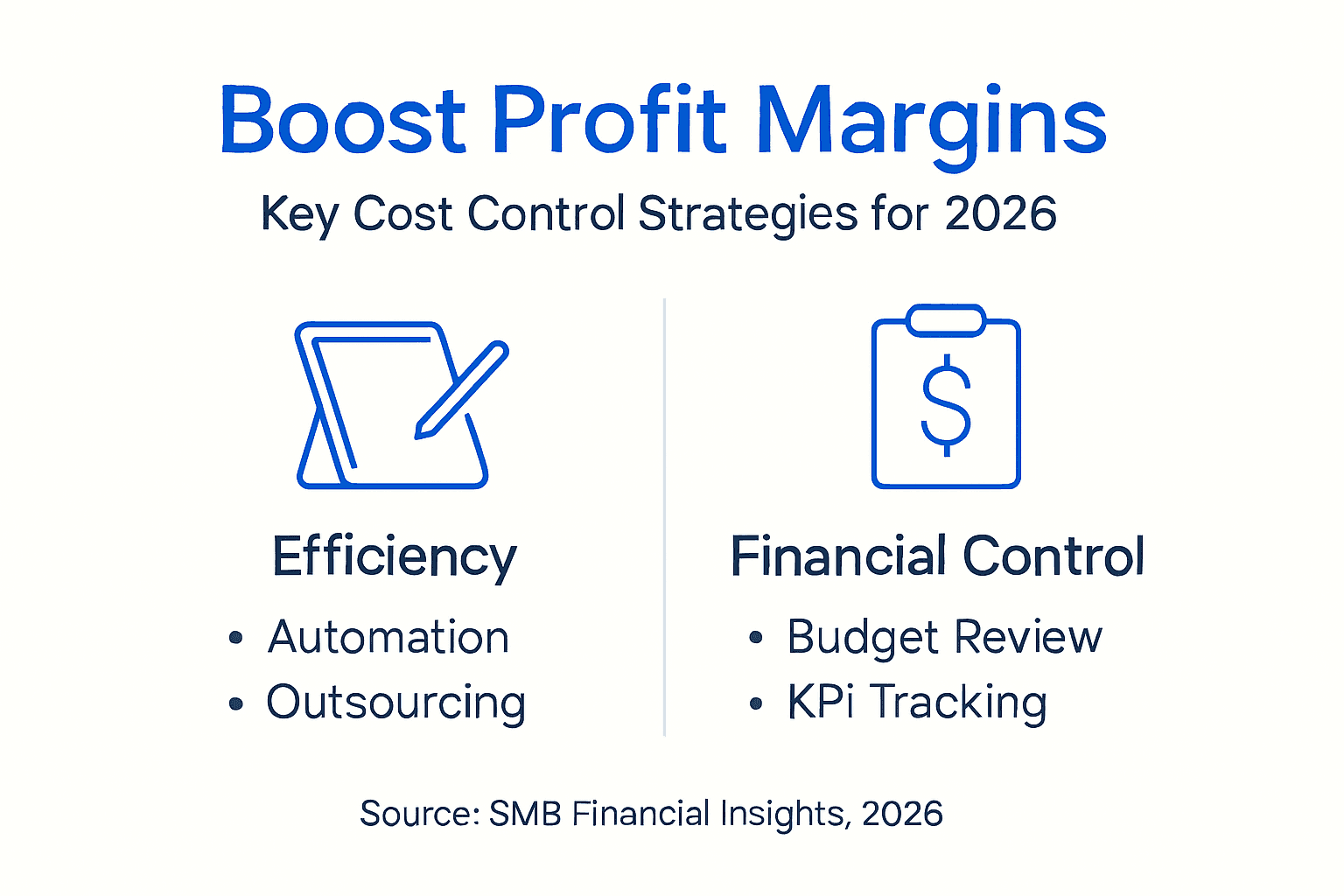
Review vendor contracts annually and renegotiate terms. Renegotiation can cut vendor costs by up to 15% without sacrificing service quality. Vendors often offer better rates to retain long-term clients, but you must ask.
Adopt technology adoption benefits that boost efficiency:
- CRM systems automate follow-ups and track customer interactions
- Inventory management software reduces overstocking and stockouts
- Accounting automation eliminates manual data entry errors
- Project management tools improve team coordination and reduce delays
Technology adoption can increase profit margins by 5-10% via improved efficiency, freeing staff to focus on high-value work.
Pro Tip: Before cutting any cost, ask “Will this harm customer experience or product quality?” Cuts that damage your brand cost more in lost revenue than they save.
Compare traditional versus strategic cost control approaches:
| Approach | Traditional Cost-Cutting | Strategic Tech-Enabled Control |
|---|---|---|
| Focus | Reduce expenses across the board | Eliminate waste, automate low-value tasks |
| Impact on quality | Often degrades customer experience | Maintains or improves service quality |
| Employee morale | Creates anxiety and resistance | Frees staff for meaningful work |
| Long-term results | Temporary savings, recurring problems | Sustainable efficiency gains |
Cost control strategies work best when paired with revenue growth initiatives, not applied in isolation.
Step 4: Increase High-Value Work by Outsourcing and Automation
Your team’s time is your most valuable asset. When employees spend hours on low-value administrative tasks, you’re wasting profit potential. Outsourcing low-value tasks enables employees to focus 2-3 times more on revenue activities, improving profit margins effectively.
Identify low-value versus high-value tasks ruthlessly. Low-value tasks are repetitive, manual, and don’t require specialized expertise. Examples include data entry, appointment scheduling, and basic bookkeeping. High-value tasks directly generate revenue, build customer relationships, or create competitive advantage.
Outsource low-value tasks to specialists or virtual assistants. Bookkeeping, social media posting, and routine customer service inquiries are prime candidates. Outsourcing benefits include cost savings, access to specialized skills, and flexibility to scale quickly.
Automate repetitive processes wherever possible. Email sequences, invoice generation, and appointment reminders run perfectly without human intervention. Automation impact compounds over time as systems handle growing volume without adding headcount.
Tasks ideal for outsourcing or automation:
- Payroll processing and tax filing
- Email marketing campaigns and social media scheduling
- Customer onboarding sequences and follow-ups
- Inventory tracking and reordering
- Basic technical support and troubleshooting
“The goal isn’t to do more with less. It’s to do more valuable work with the same resources. Outsourcing and automation make that possible.”
Pro Tip: Start small with one outsourced task or automated process. Measure time saved and quality delivered before expanding. This builds confidence and identifies the best opportunities.
Troubleshooting & Common Mistakes
Even well-intentioned SMB owners make predictable mistakes that undermine profitability. Recognizing these pitfalls early prevents costly delays.
Ignoring cash flow forecasting creates blind spots. You might show profit on paper while running out of cash to cover payroll. Implement that 13-week forecast and review it religiously.
Mispricing products or services kills profits silently. Price too low and you leave money on the table. Price too high and you scare prospects to competitors. Research competitor pricing, understand your cost structure completely, and test pricing adjustments systematically.
Employee overload with low-value tasks destroys productivity. Up to 35% revenue loss stems from poor task prioritization and lack of KPI monitoring, correctable with workflow redesign. Map how your team spends time and eliminate waste.
Avoiding technology adoption leaves efficiency gains on the table. Fear of change or upfront costs shouldn’t block long-term profitability. Start with one high-impact tool and expand as you see results.
Common common profitability mistakes to avoid:
- Neglecting monthly financial statement reviews
- Failing to track customer acquisition costs
- Cutting marketing budgets during slow periods
- Not documenting processes before automating or outsourcing
- Ignoring employee feedback on workflow inefficiencies
Fix these issues through workflow redesign tips that prioritize revenue-generating activities and eliminate bottlenecks systematically.
Expected Results and Timelines
Realistic expectations prevent frustration and keep you committed. Small businesses typically see measurable profitability improvements within 6-12 months of structured strategies implementation. Quick wins appear within weeks, but sustainable margin increases take consistent effort.
Track these success metrics monthly:
- Profit margin percentage trending upward
- Cost savings from vendor renegotiations and efficiency gains
- Customer retention rates and repeat purchase frequency
- Employee productivity measured by revenue per employee
Expected improvements over time:
| Metric | Baseline | 3 Months | 6 Months | 12 Months |
|---|---|---|---|---|
| Net Profit Margin | 8% | 9-10% | 11-13% | 14-16% |
| Customer Retention | 65% | 68-70% | 73-76% | 78-82% |
| Revenue per Employee | $150k | $155k | $165k | $180k |
| Operating Expenses | 100% | 95-97% | 88-92% | 85-88% |
Your profitability timeline depends on execution consistency and market conditions. If you’re not hitting targets within six months, review your strategy. Are you tracking the right KPIs? Is your team executing consistently? Are market conditions different than expected?
Adjust based on monitoring profitability progress data. Double down on tactics delivering results. Cut or modify approaches that aren’t working. Flexibility within a structured framework drives success.
Unlock Your Business Profitability Potential with Strategic Coaching
Implementing these strategies alone can feel overwhelming. Professional coaching accelerates your profitability journey by providing clarity, accountability, and expert insights tailored to your specific situation.

Coaching helps you identify blind spots, prioritize high-impact actions, and stay committed when obstacles arise. You gain an experienced partner who’s guided hundreds of SMB owners through similar challenges, avoiding costly mistakes and compressing timelines.
Explore how role of coaching in profitability transforms good intentions into measurable results. Discover why successful entrepreneurs invest in coaching to achieve faster growth with less stress. Learn structured approaches through our business growth workflow designed specifically for profit-focused SMBs.
Frequently Asked Questions
How quickly can I expect to see profit improvements after applying these steps?
Most SMBs see initial improvements within 3 months and measurable margin increases within 6-12 months. Quick wins from vendor renegotiations or automation appear faster, while cultural changes like improved customer experience take longer to compound.
What financial tools are best for managing my SMB’s profitability?
QuickBooks and Xero are industry standards for accounting and reporting. Pair these with a 13-week cash flow forecast template and dashboard tools tracking your key profitability metrics. The importance of profitability increases when you have real-time visibility.
How can I ensure the cost cuts I make don’t harm customer experience?
Before cutting any expense, ask whether it directly impacts customer satisfaction or product quality. Focus cost reductions on internal inefficiencies, vendor negotiations, and automation rather than customer-facing areas. Test changes on a small scale first.
Is outsourcing appropriate for every type of SMB function?
No. Outsource repetitive, low-skill tasks that don’t require deep company knowledge. Keep core competencies and customer relationship management in-house. Start with non-critical functions to build confidence and processes before expanding.
What metrics should I focus on to monitor profitability effectively?
Prioritize net profit margin, cash conversion cycle, customer acquisition cost, and customer lifetime value. Track revenue per employee to measure productivity. Review these metrics monthly and compare against your quarterly targets through tracking profitability progress systems.

