
TL;DR:
- True SME profitability depends on long-term viability, cash flow, reinvestment, and operational sustainability.
- Key drivers include pricing strategies, cost control, productivity, market competition, and external risks.
- Regular measurement and strategic management of metrics like profit margin and ROI are essential for growth.
Many small and medium-sized business owners assume that if the bank account looks healthy, the business must be profitable. But that assumption can quietly erode everything you have built. Micro-SMEs often have lower profitability/KfW-Mittelstandspanel-2024_EN.pdf) than commonly assumed, meaning the gap between appearing profitable and genuinely being profitable is wider than most owners realise. This guide cuts through that confusion. We will walk you through what profitability truly means for an SME, which drivers matter most, how to measure it accurately, and which improvement strategies actually move the needle. If you want clarity, confidence, and a path to lasting financial health, you are in the right place.
Table of Contents
- What profitability really means for SMEs
- The key drivers of SME profitability
- How to measure and interpret SME profitability
- Improvement strategies: Turning insight into action
- What most SME owners get wrong about profitability
- Take the next step towards lasting profitability
- Frequently asked questions
Key Takeaways
| Point | Details |
|---|---|
| Profit is more than numbers | True SME profitability includes sustainability, owner compensation and readiness to scale. |
| Know your biggest drivers | Both internal operations and external market changes influence your bottom line. |
| Measure, then act | Accurately tracking the right metrics leads to smarter, more profitable decisions. |
| Coaching unlocks growth | Expert coaching helps SMEs move from insight to lasting profit improvement. |
What profitability really means for SMEs
Profitability sounds straightforward. Revenue minus costs equals profit. Job done. But for SME owners, that simple equation misses enormous complexity hiding just beneath the surface. True profitability is not just a number on a report. It is a signal about the long-term viability and resilience of your business.
Consider two businesses, both reporting £50,000 net profit. Business A pays its owner a fair market salary, maintains healthy cash reserves, and reinvests regularly in systems and people. Business B shows the same figure but only because the owner draws no salary and defers all maintenance. On paper, they look identical. In reality, Business B is quietly consuming itself.
This is why learning to improve profitability requires looking beyond the bottom line. True SME profitability must account for:
- Net profit margin after a realistic owner salary is included
- Cash flow consistency, not just end-of-year snapshots
- Reinvestment capacity, the ability to fund growth without borrowing every time
- Scalability, whether profit holds up as the business grows
- Operational sustainability, avoiding burnout-driven output that cannot last
SMEs face unique constraints that larger businesses simply do not. Limited resources, thinner margins, and narrower market positions mean that every financial decision carries more weight. A bad quarter for a large corporation is a footnote. For your business, it can be a crisis.
“Micro SMEs’ average profitability/KfW-Mittelstandspanel-2024_EN.pdf) is considerably lower than scale-ups, highlighting a structural gap that strategic focus can close.”
The research is clear. Scale-up SMEs consistently outperform micro-businesses on profitability, and they do so because they treat profitability as a system, not a side effect. They are also recognised as key drivers of SME competitiveness across entire economies. If you want to align profitability and growth in a way that lasts, you first need to accept that profitability is a discipline, not an accident.
The key drivers of SME profitability
Once you understand what profitability really means, the next question is: what actually controls it? Profitability is shaped by both internal decisions you make every day and external forces you must learn to navigate.
Scalers show higher productivity and profitability compared to other SME types, and the reason is not luck. It is deliberate management of these drivers.

| Internal drivers | External drivers |
|---|---|
| Pricing strategy | Market competition |
| Cost control discipline | Economic conditions |
| Operational efficiency | Regulatory changes |
| Staff productivity | Customer demand shifts |
| Leadership and culture | Supply chain volatility |
Internal drivers are where your greatest leverage lies. Pricing, for example, is often underused. Many SME owners underprice out of fear, leaving significant margin on the table. Cost control is not about slashing everything in sight. It is about understanding which costs generate return and which simply drain resources. Understanding coaching’s impact on profitability can help you sharpen these internal levers with precision.
To audit your current profitability drivers, follow these steps:
- List your top five costs and assess whether each directly supports revenue generation.
- Review your pricing against competitors and your own cost base.
- Identify your three most time-intensive processes and ask whether they can be simplified.
- Assess staff output relative to wage cost for each team or role.
- Map your external risks: which market or regulatory changes could hit margins in the next 12 months?
External factors require a different approach. You cannot control them, but you can prepare for them. Diversifying your client base, building cash reserves, and staying close to industry news all reduce your exposure.
Pro Tip: Automate routine administrative tasks wherever possible. Outsourcing bookkeeping or using accounting software frees up hours each week, reduces errors, and gives you cleaner data for decision-making. Use our optimise profitability guide to explore which processes are worth streamlining first.
How to measure and interpret SME profitability
Knowing what drives profitability is only useful if you can measure it accurately. Many SME owners rely on gut feel or a quick glance at their bank balance. Both are unreliable. You need clear, consistent metrics reviewed on a regular cycle.
The three most important profitability metrics for SMEs are:
- Net profit margin: Net profit divided by revenue, expressed as a percentage. This tells you how much of every pound earned you actually keep.
- Return on assets (ROA): Net profit divided by total assets. This shows how efficiently your business uses what it owns to generate profit.
- EBIT (Earnings Before Interest and Tax): A cleaner view of operational profitability, stripping out financing and tax effects.
| Metric | Typical SME range | Healthy target |
|---|---|---|
| Net profit margin | 5% to 15% | Above 12% |
| Return on assets | 3% to 10% | Above 7% |
| EBIT margin | 6% to 18% | Above 10% |
German micro-SMEs averaged 11.3% profitability/KfW-Mittelstandspanel-2024_EN.pdf), which highlights just how carefully measurement must be applied. Sitting at the average is not a safety net. It is a warning sign that you have room to grow.
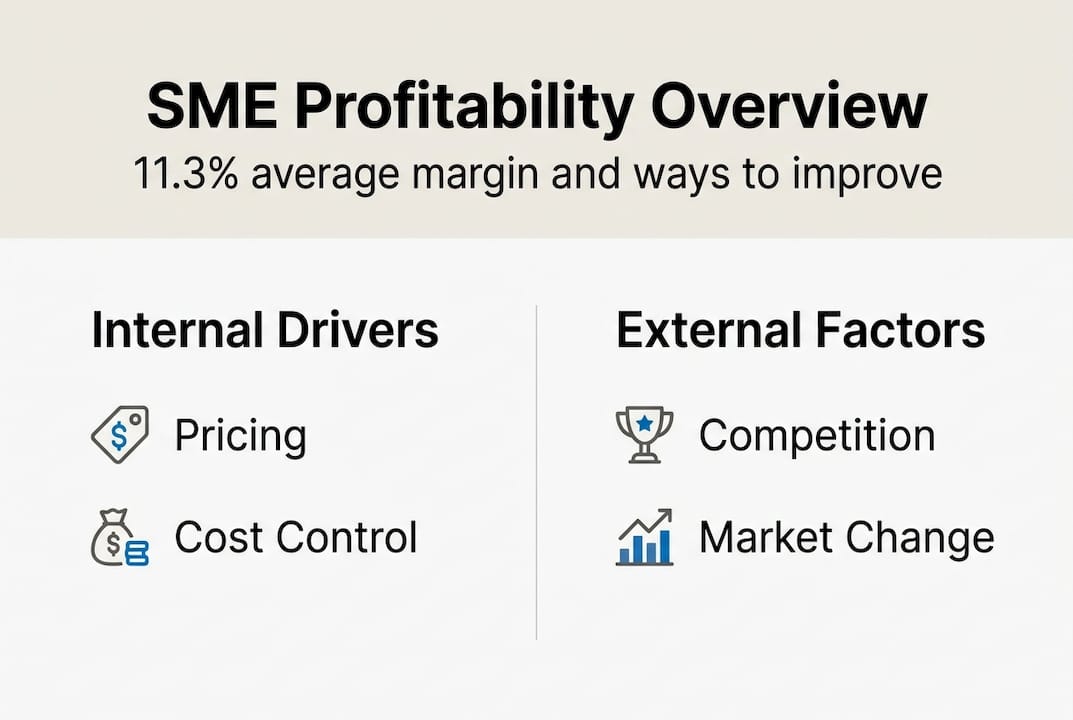
Common interpretation mistakes include ignoring seasonality, treating one-off windfalls as recurring income, and failing to account for owner withdrawals as a genuine cost. Each of these distorts your picture and leads to poor decisions.
Tools worth using include Xero, QuickBooks, and FreeAgent for real-time tracking. Pair these with bookkeeping automation to reduce manual entry errors and get cleaner data faster. Our guide on how to increase SME profit margins takes you deeper into using these figures strategically.
Pro Tip: Set a fixed date each month to review your key metrics. Consistency matters more than sophistication. Monthly reviews catch negative trends early, before they become crises.
Improvement strategies: Turning insight into action
Measurement without action is just observation. Once you know where your profitability stands and what is influencing it, the real work begins. Sustainable improvement requires both quick wins and longer-term structural change.
Scalers’ adoption of performance coaching drives superior profitability outcomes, and it does so because coaching creates accountability, clarity, and a system for continuous improvement rather than reactive firefighting.
Start with these quick-win strategies:
- Renegotiate supplier contracts: Even a 5% reduction in your top three supplier costs can meaningfully shift your margin.
- Revise your pricing: If you have not reviewed prices in 12 months, you are almost certainly undercharging relative to your current costs.
- Streamline workflows: Identify tasks that consume time without generating revenue and either eliminate or delegate them.
- Review subscription and overhead costs: Many SMEs carry unused software licences and services that quietly drain profit each month.
For embedding profitability targets into daily management, follow this process:
- Set a clear monthly profit target and share it with your leadership team.
- Break that target into weekly revenue and cost benchmarks.
- Hold a brief weekly review to track progress and flag deviations early.
- Adjust tactics within the month rather than waiting for end-of-month reports.
- Celebrate wins publicly and address shortfalls with curiosity, not blame.
Explore proven SME growth strategies and our business scale-up guide to build this into a repeatable system. Also, reviewing bookkeeping best practices ensures your financial data supports rather than undermines these efforts.
Pro Tip: Involve your team in identifying cost-saving ideas. Frontline staff often spot inefficiencies that management never sees. A simple monthly suggestion process can surface thousands of pounds in savings.
One critical risk to avoid: focusing exclusively on cost-cutting. Cutting costs can boost short-term margins but starve the business of the investment needed to grow. Balance is everything. Profitability and growth are not opposites. They are partners.
What most SME owners get wrong about profitability
Here is something we see repeatedly: business owners who work harder and harder, cut more and more, and still wonder why profitability stays stubbornly flat. The problem is rarely effort. It is almost always strategy.
Profitability is too often confused with short-term cost reduction or a single strong revenue month. Both feel like progress. Neither creates lasting change. The SMEs that genuinely thrive are the ones that invest in systems, develop their people, and build a strategy that connects daily decisions to long-term financial goals. They understand that aligning profit with growth is not a luxury. It is the foundation.
Short-termism is one of the most common and costly pitfalls we encounter. Owners chase the next sale, react to the latest cost pressure, and never step back to ask: is this business structurally set up to be profitable? That question changes everything. True scalers do not just manage their finances. They design them. And that distinction is what separates businesses that survive from those that genuinely thrive.
Take the next step towards lasting profitability
Understanding profitability is one thing. Embedding it into how your business operates every single day is another challenge entirely. That is where professional coaching makes a real difference.

At Summit SCALE®, we work with SME owners to turn financial insight into disciplined, sustainable growth. Our coaching programmes are designed to help you build the systems, habits, and strategies that move your business from average margins to genuine profitability. Whether you are just starting to measure your metrics or ready to scale with confidence, explore the role of coaching in profitability and discover why so many business owners invest in coaching as the most important decision they make. Book your free 15-minute assessment call today.
Frequently asked questions
What is the best way to define profitability for my SME?
Profitability for your SME should consider net margins, a realistic owner salary, and capacity for sustainable growth, not just the bottom line. Different profit definitions/KfW-Mittelstandspanel-2024_EN.pdf) significantly affect how SME performance is analysed and understood.
Which metrics should I use to track profitability in my business?
Key metrics include net profit margin, return on assets, and EBITDA, reviewed monthly for accuracy and trend detection. German micro-SMEs track profitability/KfW-Mittelstandspanel-2024_EN.pdf) using margin-based metrics as a baseline for performance comparison.
How much profit should a healthy SME aim for?
While targets vary by industry, a net profit margin of 10 to 20% is typical for sustainably healthy SMEs. Average profitability for micro-SMEs/KfW-Mittelstandspanel-2024_EN.pdf) sits around 11.3%, making anything above that a meaningful competitive advantage.
Does business coaching really improve SME profitability?
Yes. SME scalers using professional coaching consistently show higher productivity and sustained profit growth over time. Scaling SMEs employ coaching as a core driver of better profitability outcomes across industries.
Recommended
- Align profitability with growth for lasting SME success
- Why Improve Profitability: Unlocking Business Freedom
- Business Profitability: Boost Margins 15% in 2026
- SME growth strategies: Proven steps for business freedom
- Finnish SME bookkeeping guide: compliance and success
- How to Set KPIs for Business Success by 2025 | Gammatica

