
Most UK businesses face intense competition, yet fewer than half of small firms report consistent year-on-year profit growth. For entrepreneurs and business owners navigating this uncertainty, finding proven strategies to stimulate results is critical. Strategic coaching offers practical tools to pinpoint hidden inefficiencies and accelerate performance. This guide uncovers the ways professional coaching drives measurable profit impact, helping UK businesses turn ambition into lasting advantage.
Table of Contents
- Defining Coaching and Its Profit Impact
- Types of Coaching Relevant for SMEs
- How Coaching Drives Profitability
- Measuring Success: ROI and Case Studies
- Mistakes to Avoid in Coaching Engagements
Key Takeaways
| Point | Details |
| Coaching as a Strategic Asset | Invest in coaching programmes to unlock potential and drive organisational performance, ensuring that clear metrics are established for measuring success. |
| Diverse Coaching Approaches for SMEs | Consider various coaching types such as entrepreneurial, executive, and performance coaching, to address specific business challenges and enhance growth. |
| Measuring Coaching Impact | Implement rigorous tracking mechanisms to measure the tangible ROI of coaching initiatives, including both quantitative and qualitative performance indicators. |
| Avoid Common Pitfalls | Set clear objectives and maintain flexible, ongoing communication to maximise the effectiveness of coaching engagements and facilitate meaningful outcomes. |
Defining Coaching and Its Profit Impact
Business coaching represents a strategic partnership designed to unlock organisational potential through targeted professional development and performance enhancement. At its core, coaching is more than traditional training—it’s a personalised approach that systematically addresses organisational learning and growth by focusing on individual and collective performance improvement.
The profit impact of coaching extends far beyond conventional skill development. Professional coaching creates measurable value by addressing critical business challenges such as leadership effectiveness, team dynamics, strategic planning, and performance management. Organisations engaging in structured coaching programmes typically experience enhanced employee productivity, improved communication strategies, and more refined operational processes that directly contribute to bottom-line results.
At the strategic level, coaching facilitates transformative changes by helping business leaders identify hidden constraints, develop adaptive leadership skills, and create scalable growth frameworks. Research indicates that comprehensive coaching interventions can drive significant organisational performance improvements, with quantifiable impacts on revenue generation, cost management, and sustainable business development.
Professional Insight: Invest in coaching as a strategic asset by establishing clear performance metrics and tracking specific organisational outcomes to demonstrate tangible return on investment.
Types of Coaching Relevant for SMEs
Small and medium-sized enterprises (SMEs) benefit from multiple targeted coaching approaches that address unique organisational challenges. Entrepreneurial coaching represents a critical intervention specifically designed to support innovation and strategic growth by helping business owners develop adaptive skills and overcome operational constraints.
The primary coaching types most relevant for SMEs include entrepreneurial coaching, executive coaching, and performance coaching. Each approach offers distinct advantages: entrepreneurial coaching focuses on innovation and strategic vision, executive coaching targets leadership development and decision-making capabilities, while performance coaching addresses individual and team productivity challenges. Workplace coaching interventions have demonstrated significant positive impacts on organisational outcomes, enabling SMEs to develop more agile and responsive business strategies.
Moreover, these coaching models are not mutually exclusive but can be integrated to create comprehensive developmental frameworks. By combining different coaching approaches, SMEs can address multifaceted challenges ranging from personal leadership growth to systemic organisational improvements. The key is selecting coaching interventions that align precisely with the specific developmental needs and strategic objectives of the business.
Here’s a summary comparing coaching types relevant for SMEs and their distinctive business impact:
| Coaching Type | Core Focus | Key Benefit | Typical Application |
| Entrepreneurial | Innovation strategy | Cultivates adaptability | Start-up & growth planning |
| Executive | Leadership skills | Enhances decision-making | Senior management training |
| Performance | Team productivity | Boosts efficiency | Staff development programmes |
Professional Tip: Conduct a thorough organisational assessment to identify the most appropriate coaching approach, ensuring targeted investment in professional development that directly supports your business’s unique growth trajectory.
How Coaching Drives Profitability
Coaching fundamentally transforms business performance by creating strategic pathways that directly impact organisational profitability. Research demonstrates how coaching enhances critical leadership skills that translate into tangible financial outcomes, enabling businesses to develop more resilient and adaptive operational strategies.
The profitability mechanism of coaching operates through multiple interconnected channels. Coaching leadership approaches have been shown to significantly improve employee engagement and organisational performance, driving behavioural changes that result in enhanced productivity. Key profitability drivers include improved communication, more effective decision-making, increased team motivation, and more strategic goal alignment. These interventions help businesses identify and eliminate performance bottlenecks, optimise resource allocation, and develop more agile operational frameworks.

Moreover, coaching delivers measurable financial benefits by addressing both individual and systemic organisational challenges. By focusing on leadership development, skills enhancement, and strategic thinking, coaching creates a multiplier effect where improved individual performance translates into broader organisational efficiency. This approach enables businesses to unlock latent potential, reduce operational friction, and create more sustainable growth trajectories that directly contribute to improved financial outcomes.
Professional Tip: Implement quarterly coaching impact assessments to quantify the direct financial returns generated by your coaching investments, ensuring continuous alignment between developmental interventions and business profitability objectives.
Measuring Success: ROI and Case Studies
Quantifying coaching impact requires a systematic approach to measuring return on investment that goes beyond traditional financial metrics. Comprehensive case studies demonstrate how structured coaching interventions can be precisely evaluated for their business value, revealing nuanced pathways to organisational performance improvement.
Successful ROI measurement involves establishing clear baseline metrics, tracking specific performance indicators, and creating a robust evaluation framework. Key performance metrics typically include revenue growth, productivity improvements, leadership effectiveness, employee retention, and strategic goal achievement. Businesses should focus on both quantitative measures (financial performance, time savings) and qualitative indicators (employee engagement, leadership capacity, strategic thinking) to develop a holistic understanding of coaching’s transformative potential.
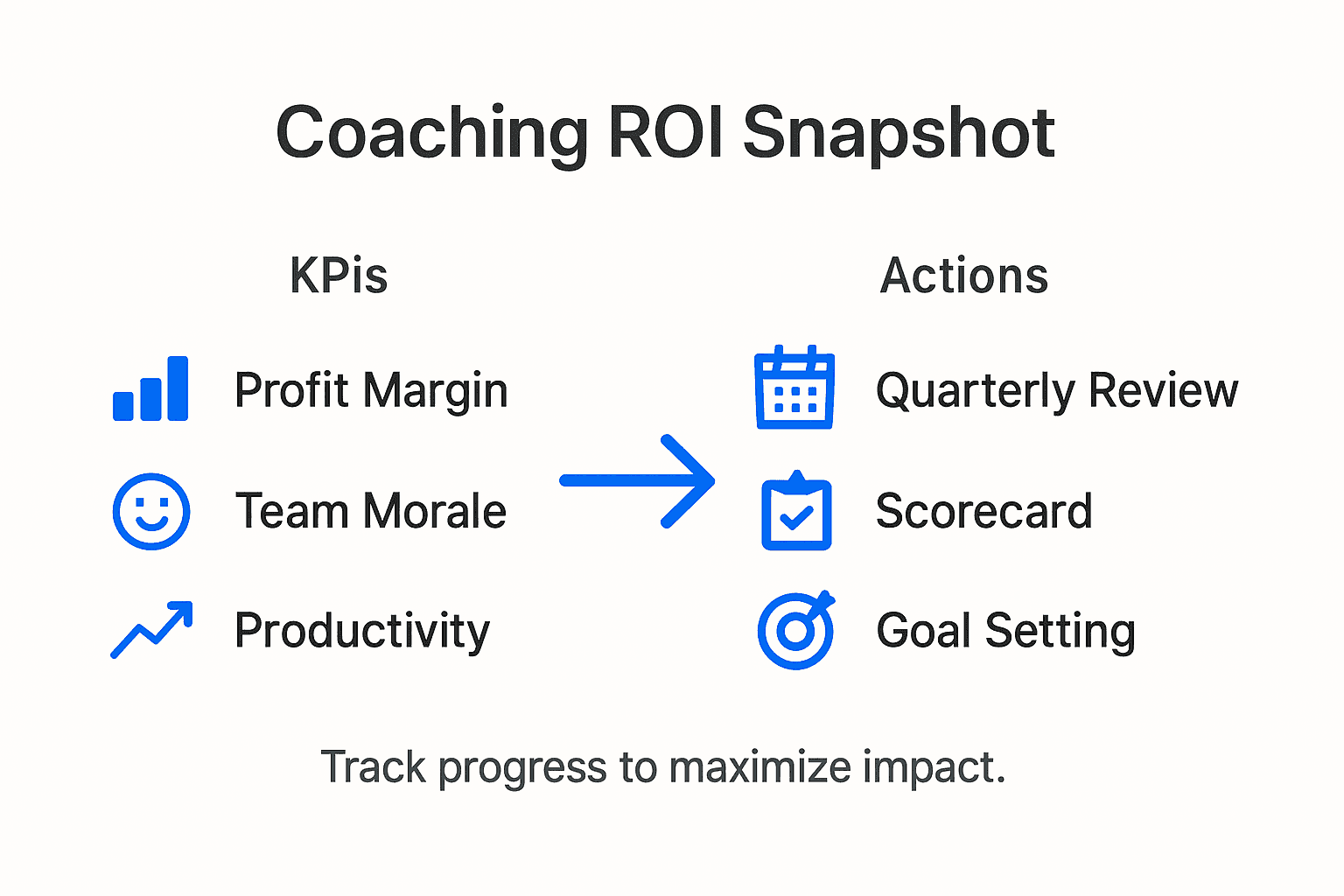
Practical ROI measurement strategies involve implementing rigorous tracking mechanisms that capture both immediate and long-term coaching impacts. This might include pre and post-coaching assessments, longitudinal performance tracking, comparative analyses between coached and non-coached teams, and detailed financial impact evaluations. By developing a multi-dimensional assessment approach, organisations can move beyond simplistic measurements and truly understand how coaching drives strategic value and sustainable business growth.
The following table highlights essential metrics commonly used to measure the ROI of business coaching:
| Metric | Description | Example Indicator | Assessment Frequency |
| Revenue Growth | Change in overall income | Monthly sales increase | Quarterly/Annually |
| Productivity Gains | Improvement in output quality | Fewer errors per project | Monthly/Quarterly |
| Retention Rate | Staff turnover reduction | Reduced resignations | Annually |
| Leadership Capacity | Increased strategic leadership | Promotion rates | Yearly/As needed |
| Goal Achievement | Success in strategic objectives | Percentage of targets met | Quarterly/Annually |
Professional Tip: Develop a standardised coaching impact scorecard that tracks at least five key performance indicators across financial, operational, and human capital dimensions to create a comprehensive view of coaching’s organisational value.
Mistakes to Avoid in Coaching Engagements
Professional coaching requires strategic precision to deliver meaningful business outcomes. Understanding common pitfalls in coaching engagements is crucial for maintaining high-quality developmental interventions, ensuring that businesses maximise their investment in professional growth.
One of the most significant mistakes businesses make is failing to establish clear, measurable objectives at the outset of a coaching relationship. Coaches must move beyond generic approaches and implement structured, client-focused methodologies that align with specific organisational goals. This requires developing comprehensive agreements that outline precise expectations, define success metrics, and create a roadmap for performance improvement. Without such clarity, coaching can become an unfocused exercise that fails to deliver tangible business value.
Additionally, businesses often underestimate the importance of ongoing communication and adaptive coaching strategies. Effective coaching is not a static process but a dynamic interaction that requires continuous recalibration. Coaches must remain flexible, actively listen to client needs, and be prepared to modify their approach based on emerging challenges and evolving business contexts. Rigidity in coaching methodology can lead to disengagement and reduced impact, ultimately undermining the potential transformative power of professional coaching interventions.
Professional Tip: Conduct a comprehensive initial assessment and quarterly review to ensure your coaching engagement remains aligned with your organisation’s strategic objectives and delivers measurable performance improvements.
Unlock Your Business Potential with Expert Coaching
The article highlights how effective coaching drives profitability by enhancing leadership, improving team performance, and aligning strategic objectives. If your business struggles with converting these concepts into actionable growth plans or faces challenges such as underdeveloped leadership capacity or unclear performance metrics, you are not alone. Many business owners find it difficult to systematically unlock their organisation’s potential or measure the real impact of coaching on their profitability.
At Summit SCALE, we specialise in tailored performance coaching designed specifically for small to medium-sized enterprises aiming to boost revenue, optimise team productivity, and gain long-term business freedom. Our approach combines entrepreneurial coaching, executive development, and performance enhancement strategies to address exactly the pain points of adaptability, leadership effectiveness and goal achievement discussed in the article.
Take control of your business growth trajectory now and experience measurable improvements in profitability and operational efficiency.
Need guidance on shaping a clear coaching plan that delivers tangible results?
Start your journey with a free 15-minute assessment call to uncover how professional coaching can transform your leadership impact and financial outcomes.
Explore coaching solutions that align with your growth goals and understand how strategic coaching can become a vital asset for sustainable success.
Discover real success stories and practical resources to fuel your business development and move from insight to action today.
Frequently Asked Questions
What is the main purpose of business coaching?
Business coaching is a strategic partnership aimed at unlocking organisational potential through targeted professional development and performance enhancement. It focuses on individual and collective performance improvement rather than conventional training methods.
How does coaching impact profitability in a business?
Coaching transforms business performance by improving leadership skills, enhancing team dynamics, and optimising operational processes, which can lead to higher employee productivity and ultimately increased profitability.
What are the types of coaching relevant for small and medium-sized enterprises (SMEs)?
The main types of coaching relevant for SMEs include entrepreneurial coaching (focusing on innovation), executive coaching (targeting leadership development), and performance coaching (addressing team productivity challenges).
How can businesses measure the return on investment (ROI) from coaching?
Businesses can measure ROI from coaching by establishing baseline metrics, tracking key performance indicators such as revenue growth and employee retention, and using a comprehensive evaluation framework to capture both quantitative and qualitative impacts.

