
Running a business in the United States or Australia often means facing moments where revenues rise yet profits do not keep pace. Profitability remains at the heart of long-term business health, not just survival. By understanding the difference between making money and building a truly sustainable operation, owners can uncover and address hidden growth barriers. This guide clarifies how business profitability works and why it is vital for making smarter, more strategic decisions.
Table of Contents
- Defining Business Profitability And Its Role
- Types Of Profit And How They Differ
- Key Metrics And Methods For Measuring Profitability
- Factors That Drive Or Limit Business Profitability
- Common Pitfalls And Ways To Improve Performance
Key Takeaways
| Point | Details |
|---|---|
| Understanding Profitability | Profitability is a critical metric that reveals a business’s ability to generate returns above expenses, guiding strategic decision-making and ensuring sustainability. |
| Types of Profit | Different profit classifications—such as Accounting, Economic, Normal, Supernormal, Gross, and Net Profit—offer unique insights into financial performance and help in informed strategic planning. |
| Key Profitability Metrics | Important metrics, including Return on Assets (ROA) and Return on Equity (ROE), provide essential insights into business efficiency and sustainability, aiding in performance evaluation. |
| Performance Improvement Strategies | Businesses should adopt comprehensive performance measurement systems and a culture of continuous learning to overcome common pitfalls and enhance overall financial performance. |
Defining Business Profitability and Its Role
Business profitability represents the fundamental financial performance metric that reveals how effectively a company generates earnings from its operations and investments. At its core, profitability measures the capacity of a business to generate financial returns above its total expenses, indicating the enterprise’s economic health and sustainability.
Profitability is not merely about making money, but strategically understanding how different business activities contribute to financial success. Comprehensive profitability analysis involves examining multiple financial dimensions, including:
- Operating profitability: Measuring earnings generated from core business activities
- Profit margins: Calculating the percentage of revenue retained after expenses
- Asset turnover: Assessing how efficiently resources generate revenue
- Funding ratios: Understanding financial structure and investment returns
The importance of profitability extends beyond simple income statements. Sustainable businesses use profitability metrics to:
- Assess current financial performance
- Project future growth potential
- Guide strategic decision-making
- Attract potential investors
- Ensure long-term organisational viability
Accurately measuring profitability allows business owners to understand not just how much money they are making, but why and how they are generating those earnings. This deeper insight enables more intelligent resource allocation, strategic planning, and continuous improvement.
Profitability is the primary financial goal that transforms entrepreneurial effort into measurable economic success.
Pro tip: Track your profitability ratios quarterly to identify trends and make proactive financial adjustments before small issues become significant challenges.
Types of Profit and How They Differ
Profits are complex financial metrics with multiple interpretations, each offering unique insights into a business’s financial performance. Different profit classifications reveal the nuanced ways businesses can understand their financial health and potential.
Businesses typically analyse several types of profit, each providing distinct perspectives:
- Accounting Profit: Calculated by subtracting explicit monetary costs from total revenue
- Economic Profit: Considers both explicit and implicit costs, including opportunity costs
- Normal Profit: The minimum earnings required to keep a business operational
- Supernormal Profit: Earnings exceeding the minimum required to sustain the business
- Gross Profit: Revenue minus direct production costs
- Net Profit: Total earnings after all expenses are deducted
Understanding the differences between these profit types is crucial for strategic financial management. Explicit costs represent direct monetary expenses like wages, rent, and materials, while implicit costs include opportunity costs such as potential earnings from alternative investments.

The strategic significance of these profit classifications extends beyond simple financial reporting. By examining different profit perspectives, business owners can:
Here is a comparison of common profit types and their strategic significance:
| Profit Type | Core Focus | How It Informs Strategy |
|---|---|---|
| Accounting Profit | Explicit financial costs | Assesses core financial performance |
| Economic Profit | Explicit and opportunity costs | Guides resource allocation decisions |
| Normal Profit | Minimum sustainability threshold | Evaluates long-term business viability |
| Supernormal Profit | Returns above sustainability needs | Indicates potential for expansion |
| Gross Profit | Direct production costs | Highlights efficiency of production |
| Net Profit | All expenses considered | Reveals true earnings and health |
- Identify true economic performance
- Make more informed investment decisions
- Understand potential opportunity costs
- Develop more robust financial strategies
- Assess business sustainability
Profit measurement is not a singular concept but a multifaceted approach to understanding financial success.
Pro tip: Regularly analyse multiple profit metrics to gain a comprehensive understanding of your business’s true financial performance and potential growth opportunities.
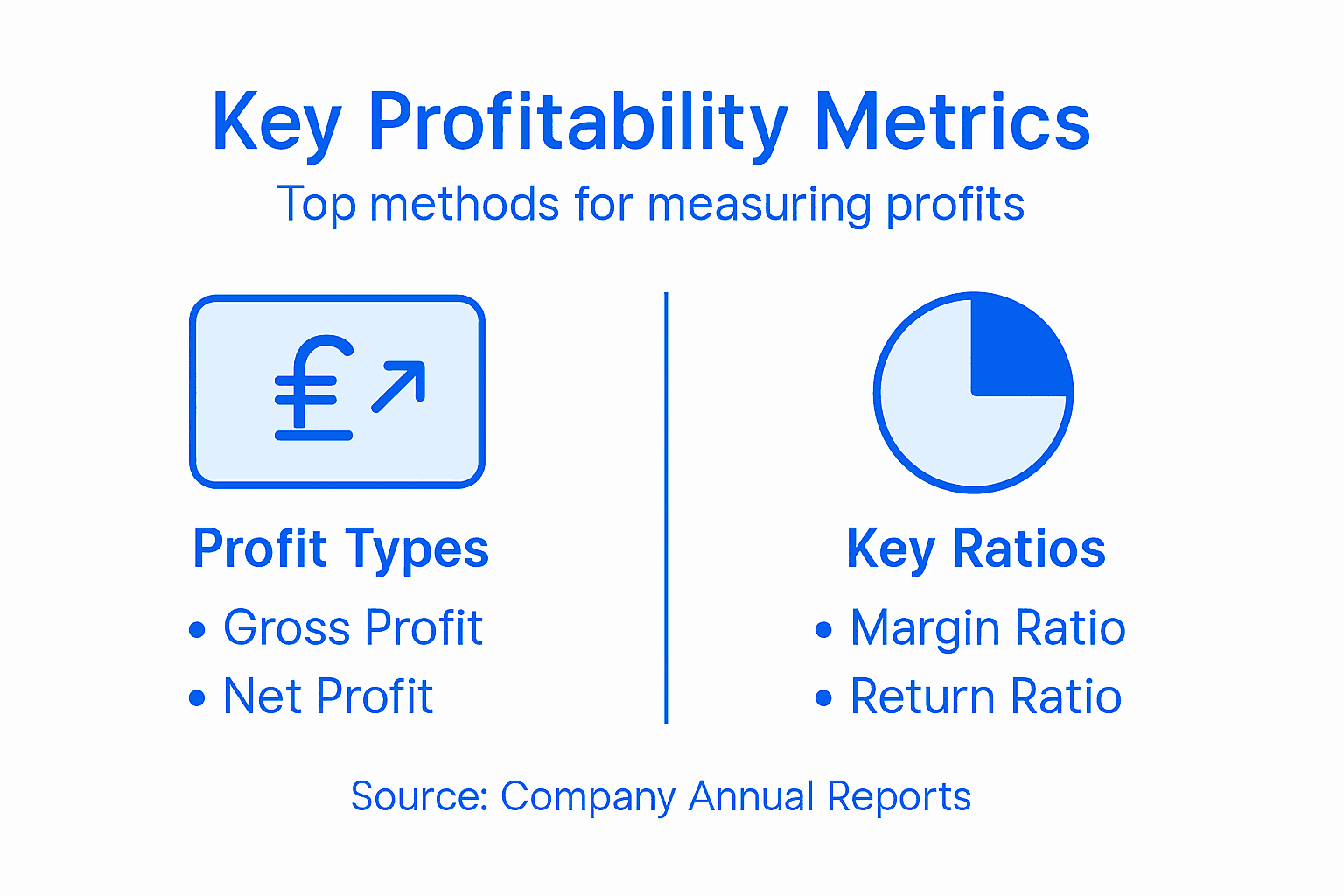
Key Metrics and Methods for Measuring Profitability
Measuring business profitability requires a comprehensive approach that goes beyond simple revenue calculations. Profitability metrics decompose financial performance into detailed components that reveal the true health of a business.
Key financial metrics for assessing profitability include:
- Return on Assets (ROA): Measuring efficiency of asset utilisation
- Return on Equity (ROE): Evaluating returns generated for shareholders
- Profit Margin: Percentage of revenue retained after expenses
- Operating Profit Ratio: Earnings from core business activities
- Net Profit Ratio: Total earnings after all expenses
- Gross Profit Margin: Revenue minus direct production costs
Understanding these metrics requires looking beyond surface-level numbers. Financial analysis involves examining how different business activities contribute to overall profitability, identifying strengths and potential improvement areas.
Business owners can leverage these metrics through systematic evaluation:
Below is a summary of key profitability metrics and what each reveals about business performance:
| Metric | What It Measures | Business Insight Provided |
|---|---|---|
| Return on Assets (ROA) | Asset usage efficiency | Effectiveness of asset deployment |
| Return on Equity (ROE) | Shareholder value creation | Attractiveness to investors |
| Profit Margin | Earnings as % of revenue | Operational efficiency and pricing power |
| Operating Profit Ratio | Core activity profitability | Strength of underlying business model |
| Net Profit Ratio | Total profitability | Overall business sustainability |
| Gross Profit Margin | Production cost management | Cost control and basic operating health |
- Collect comprehensive financial data
- Calculate specific profitability ratios
- Compare results against industry benchmarks
- Identify performance trends
- Develop targeted improvement strategies
Profitability measurement is not about a single number, but understanding the complex interactions driving financial performance.
Pro tip: Create a quarterly dashboard tracking your key profitability metrics to maintain consistent financial visibility and strategic insight.
Factors That Drive or Limit Business Profitability
Business profitability is influenced by a complex interplay of internal and external factors that determine an organisation’s financial performance. Sustainable business practices can significantly impact a company’s ability to generate consistent earnings and maintain competitive advantage.
Critical factors driving business profitability include:
- Operational Efficiency: Streamlining processes and reducing waste
- Cost Management: Controlling expenses without compromising quality
- Revenue Generation: Developing effective sales and marketing strategies
- Market Positioning: Understanding competitive landscape
- Innovation: Adapting to technological and market changes
- Human Capital: Investing in employee skills and productivity
Business owners must understand that profitability is not a static concept but a dynamic interaction of multiple strategic elements. External factors such as economic conditions, industry trends, and regulatory environments also play crucial roles in determining financial performance.
The most successful businesses focus on holistic approaches to profitability, recognising that limitations can emerge from various sources:
- Inefficient resource allocation
- Poor financial management
- Lack of strategic planning
- Insufficient market understanding
- Resistance to technological adaptation
Profitability is a journey of continuous improvement, not a destination.
Pro tip: Conduct a quarterly comprehensive review of your business’s key performance indicators to proactively identify and address potential profitability constraints.
Common Pitfalls and Ways to Improve Performance
Business performance improvement requires a strategic approach that addresses both systemic challenges and individual decision-making processes. Businesses frequently struggle with performance measurement by failing to establish comprehensive accountability frameworks that capture both objective and subjective metrics.
Common performance pitfalls include:
- Decision-Making Biases: Cognitive traps that distort strategic thinking
- Ineffective Performance Tracking: Lack of meaningful metrics
- Resource Misallocation: Poorly distributed organisational resources
- Communication Breakdowns: Siloed departmental interactions
- Resistance to Change: Organisational inertia
- Insufficient Data Utilisation: Undervaluing analytical insights
Understanding these challenges requires recognising the psychological barriers that impede business performance. Cognitive biases such as status quo bias, framing effects, and confirmation bias can significantly compromise strategic decision-making and organisational effectiveness.
Successful businesses develop robust strategies to overcome performance limitations:
- Implement comprehensive performance measurement systems
- Foster a culture of continuous learning
- Develop disciplined decision-making frameworks
- Encourage cross-departmental collaboration
- Invest in data-driven analytical capabilities
Performance improvement is not about perfection, but consistent, incremental progress.
Pro tip: Conduct regular cognitive bias training for leadership teams to enhance strategic thinking and reduce decision-making errors.
Unlock Your Business Profitability Potential with Expert Coaching
Navigating the complexities of business profitability requires more than just understanding numbers. As the article shows, challenges like operational efficiency, cost management and strategic decision-making can limit your growth and sustainability. If you struggle to identify clear profitability drivers or feel overwhelmed by financial jargon such as net profit ratios and economic profit, you are not alone. Many business owners urgently seek proven strategies to improve profitability, manage resources smarter and secure long-term success.
At Summit SCALE we specialise in empowering small to medium business owners to overcome these very challenges. Through personalised coaching focused on Business Finance, cash flow control and strategic growth planning, we help you transform complex financial insights into actionable steps. Our approach focuses on tailored performance improvements that deliver more time, money and freedom in your life.
Discover how targeted coaching can create measurable improvements in your profit margins and operational efficiency starting today.

Ready to stop struggling with profitability and start thriving? Explore our expert guidance and success stories at Summit SCALE. Take the first step now by scheduling a free 15-minute assessment call to unlock your business’s full financial potential.
Frequently Asked Questions
What is business profitability?
Business profitability refers to how effectively a company generates earnings from its operations and investments, indicating the company’s economic health and sustainability.
Why is profitability important for business owners?
Profitability is crucial for business owners as it helps assess current financial performance, guides strategic decision-making, and ensures long-term organisational viability.
What are the different types of profit?
The main types of profit include accounting profit, economic profit, normal profit, supernormal profit, gross profit, and net profit. Each type provides unique insights into the business’s financial health and sustainability.
How can profitability be measured effectively?
Profitability can be measured using various metrics, including Return on Assets (ROA), Return on Equity (ROE), profit margin, operating profit ratio, and net profit ratio, each revealing different aspects of business performance.
Recommended
- Why Improve Profitability: Unlocking Business Freedom
- The Key Financial Indicator You Probably Aren’t Looking At – Summit Scale
- Role of Coaching in Profitability: Unlocking Business Potential
- Cash Flow: Gross Margin vs. Markup | Summit SCALE® Coaching
- What Is Business Succession and Why It Matters – Kefihub

