
Most small business owners assume that formal long-term planning is a luxury reserved for corporate boardrooms. The reality is strikingly different. SMBs with strategic plans achieve 30% faster growth and a 300–500% return on investment within two years, yet the majority of small business owners still operate without a written plan. This guide cuts through the noise and gives you practical, evidence-based frameworks to plan for growth, protect your profits, and build a business that works for you rather than the other way around.
Table of Contents
- Why long-term planning matters for small businesses
- Proven frameworks for effective long-term planning
- Setting goals, measuring, and adjusting your plan
- Execution pitfalls and real-world advice for SMBs
- Embedding a long-term planning mindset
- Unlock strategic growth with expert support
- Frequently asked questions
Key Takeaways
| Point | Details |
|---|---|
| Formal planning drives growth | SMBs with strategic plans achieve much higher revenue growth and ROI than informal counterparts. |
| Focus on actionable frameworks | Tools like SWOT analysis, SMART objectives, and 90-day cycles make planning practical and adaptable. |
| Set metrics and review often | Tracking key numbers and revisiting plans quarterly ensures goals remain relevant and achievable. |
| Execution is the main challenge | Most failures are due to poor follow-through, resource limits, or too many priorities—keep it simple. |
| Support accelerates success | External expertise or coaching helps sustain planning momentum and implementation. |
Why long-term planning matters for small businesses
Long-term business planning means setting a clear direction for your company over a three to five year horizon, then working backwards to define the actions, resources, and milestones needed to get there. It is not about predicting the future with certainty. It is about making deliberate choices so that growth becomes intentional rather than accidental.
The numbers are hard to ignore. Formal planning delivers significantly faster revenue growth and stronger profit margins for SMBs compared to those running on instinct alone. Yet many owners dismiss planning as bureaucratic or time-consuming, believing their industry knowledge is sufficient.
“SMBs with strategic plans achieve 30% faster growth and 300–500% ROI within two years. And yet, some businesses do succeed informally, particularly at the micro level, where owner expertise and tight networks compensate for the absence of a written plan.”
The distinction matters. Informal success at the micro level is real, but it tends to plateau. Once you hire staff, add product lines, or pursue new markets, the absence of a formal plan becomes a genuine liability. Driving sales growth for business success without a strategic framework is like accelerating without a steering wheel.
Long-term planning helps you mitigate risks that catch reactive businesses off guard:
- Revenue swings caused by seasonal demand or client concentration
- Staff turnover from unclear roles, poor culture, or no growth pathway
- Missed market opportunities because there is no process to evaluate them
- Cash flow crises from unplanned capital expenditure or rapid hiring
- Owner burnout from being the sole decision-maker with no systems in place
To align profitability with growth, you need a plan that connects your daily operations to your long-term financial targets. Without that thread, effort and revenue rarely move in the same direction.
One important caveat: for a solo operator with a stable, low-complexity business and a strong personal network, a lightweight informal approach may suffice in the short term. But the moment growth becomes a goal, a written plan is your most powerful tool.
Proven frameworks for effective long-term planning
Knowing you need a plan and knowing how to build one are two different things. The good news is that you do not need to invent anything. Several proven frameworks exist specifically for SMBs, and the best results come from combining two or three rather than relying on just one.
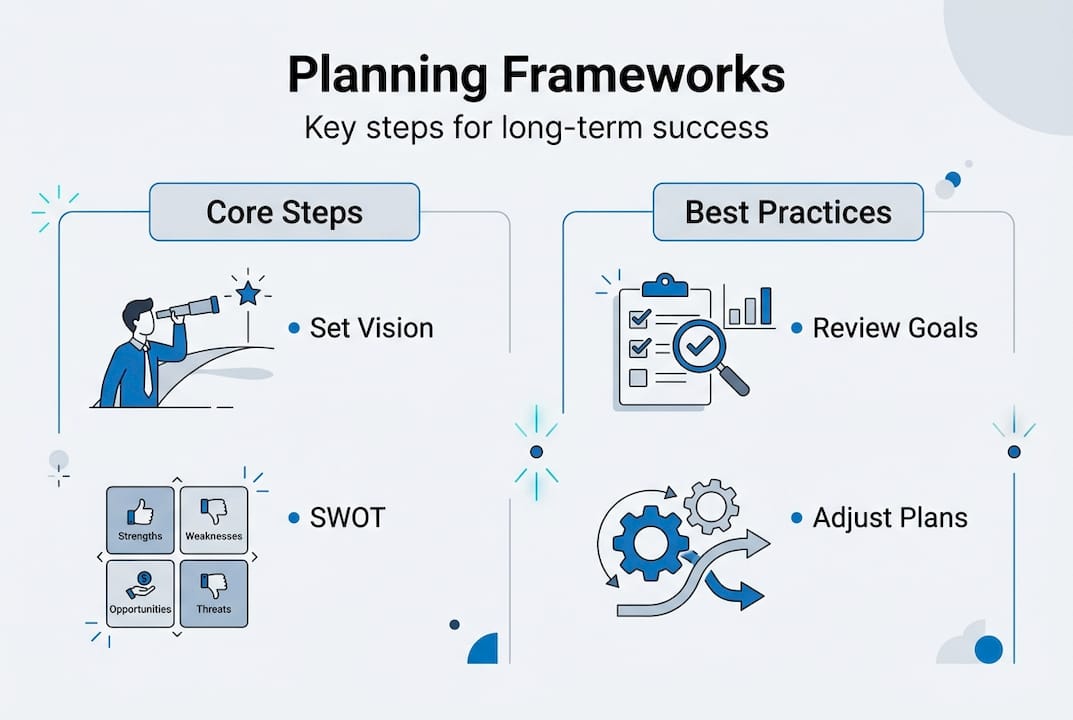
Strategic planning for SMBs typically follows a three to five year horizon using a combination of SWOT analysis, vision and mission development, SMART objectives, and 90-day execution cycles.
| Framework | Time horizon | Difficulty | Primary benefit |
|---|---|---|---|
| SWOT analysis | Ongoing | Low | Identifies strengths, weaknesses, opportunities, threats |
| Vision and mission | 3–5 years | Low to medium | Aligns team around a shared purpose |
| SMART objectives | 1–3 years | Medium | Converts strategy into measurable targets |
| 90-day cycles | Quarterly | Low | Maintains agility and accountability |
Here is a step-by-step approach to putting these frameworks into practice:
- Run a SWOT analysis. Spend two hours mapping your business honestly. What do you do better than competitors? Where are you exposed? What external trends could help or hurt you?
- Write a one-page vision and mission. Your vision is where you want to be in five years. Your mission is why you exist and who you serve. Keep both to two or three sentences.
- Set three to five SMART objectives. Each objective should be specific, measurable, achievable, relevant, and time-bound. Fewer objectives mean more focus and better execution. Review your business growth objectives explained to ensure they are genuinely strategic.
- Break objectives into 90-day priorities. Each quarter, identify the two or three actions that will move each objective forward. This keeps your long-term plan connected to your weekly schedule.
- Schedule a monthly check-in. Even 30 minutes a month reviewing progress against your 90-day priorities prevents drift and keeps the team aligned.
Pro Tip: If you are a solo operator or running a very small team, skip the elaborate planning retreat. A single afternoon with a whiteboard and the business development checklist is enough to produce a working first plan. Simplicity executed beats complexity ignored.
The right combination of frameworks depends on where your business sits today. Early-stage businesses benefit most from vision, mission, and SWOT. More established SMBs gain the most from SMART objectives and 90-day cycles embedded into a business growth workflow that the whole team follows.
Setting goals, measuring, and adjusting your plan
Frameworks only create value when they are connected to real numbers. The most common planning failure is setting objectives without defining how success will be measured or what data will be tracked.

Start with context. US SMB average revenue sits at approximately $1.2 million, with a recommended profit margin of 7–10%, and 77% of small businesses are profitable. These benchmarks give you a baseline to assess where you stand and what is realistic.
| Metric | US SMB benchmark | Review frequency |
|---|---|---|
| Revenue growth | 5–10% per year | Monthly |
| Net profit margin | 7–10% | Monthly |
| Customer acquisition cost | Varies by sector | Quarterly |
| Staff retention rate | 85%+ | Quarterly |
| Cash runway | 3+ months | Monthly |
What you measure shapes what you improve. Build a simple tracking habit around these categories:
- Monthly: Revenue vs. target, cash position, sales pipeline value
- Quarterly: Profit margin, customer retention, team capacity and morale
- Annually: Full SWOT refresh, objective review, three-year forecast update
Understanding why improve profitability goes beyond chasing a higher margin number. It is about building a business that can fund its own growth without constant external pressure.
Pro Tip: Limit yourself to three to five strategic objectives at any one time. Research consistently shows that businesses pursuing more than five simultaneous priorities execute none of them well. Fewer goals, pursued with full commitment, produce far better outcomes than a long list of half-finished initiatives. For practical guidance on profitability boost 2026, focus first on the metrics that directly affect your margin.
Building agility into your plan means scheduling a formal review at least twice a year where you ask honestly: is this plan still relevant? Markets shift, costs change, and customer needs evolve. A plan that cannot adapt is not a strategy. It is a wish list. The role of sales growth for profitability is a useful lens for these reviews, helping you assess whether your growth activity is actually translating into stronger margins.
Execution pitfalls and real-world advice for SMBs
Having a plan is not the same as executing one. Implementation fails 70–90% of the time due to poor leadership alignment, insufficient resources, and the absence of regular review. That is not a reason to abandon planning. It is a reason to plan for execution as carefully as you plan for growth.
Watch for these warning signs that your plan is at risk:
- Too many objectives: More than five strategic priorities signals a lack of focus
- Under-resourced plans: Ambitious targets with no budget or time allocated to achieve them
- No staff buy-in: Team members who do not understand or believe in the plan will not execute it
- No review rhythm: Plans reviewed less than quarterly drift into irrelevance
- Owner as sole driver: If only you care about the plan, it will stall the moment you are stretched
“For resource-limited SMBs, abbreviated diagnostics and a strict limit of no more than four strategic initiatives significantly improve execution rates and reduce planning fatigue.”
Micro-firms with limited bandwidth can still plan effectively. The key is ruthless simplicity. Choose one or two growth priorities, assign clear ownership, and review them monthly. Avoid the trap of building a sophisticated plan that no one has time to follow. Understanding why profitability matters for owners helps you prioritise the initiatives most likely to strengthen your financial position first.
Know when it is time to formalise. If you are hiring beyond five staff, entering a new market, seeking finance, or planning an exit, a written strategic plan is no longer optional. These are the growth signals that demand structure. A step by step business growth approach gives you a practical sequence to follow without overwhelming your team or your schedule.
Embedding a long-term planning mindset
A plan written once and filed away is not a strategy. The businesses that benefit most from long-term planning treat it as a living habit, not a one-time event. Building that habit into your business requires deliberate structure.
Here is how to institutionalise planning so it sticks:
- Schedule non-negotiable review dates. Block 90-day review sessions in your calendar at the start of each year. Treat them as client appointments you cannot cancel.
- Involve your team. Share the plan with key staff and assign ownership of specific objectives. People execute what they helped create.
- Appoint an accountability partner. This could be a business partner, a peer group, or an external coach. External accountability dramatically improves follow-through.
- Use available resources. The SBA (Small Business Administration) offers free planning tools, templates, and mentoring through SCORE. 78% of SMB owners plan to grow their business, yet far fewer use the structured support available to them.
- Revisit your vision annually. Your three to five year vision should evolve as your business grows. An annual refresh ensures your plan remains ambitious but grounded in reality.
Agility and commitment are not opposites. You can hold firmly to a three-year vision while adjusting your quarterly priorities in response to what the market is telling you. The goal is direction, not rigidity. Follow a business growth step by step process that builds momentum without locking you into a plan that no longer fits.
The owners who build genuinely great businesses are not necessarily the most talented. They are the ones who plan deliberately, review honestly, and adjust quickly.
Unlock strategic growth with expert support
You now have a clear picture of what long-term planning involves, which frameworks work, and how to avoid the pitfalls that derail most SMBs. Knowing the path and walking it confidently are two different things, and that gap is exactly where structured support makes the biggest difference.
At Summit SCALE, we work with business owners who are ready to move from reactive management to intentional, strategic growth. Our coaching helps you invest in the right foundations so that your plan does not gather dust. Whether you need help setting objectives, building accountability, or understanding how coaching drives profitability, we provide the structure and challenge that accelerates results. Explore our growth strategies for SMBs or book a free 15-minute assessment call to find out exactly where your business stands and what your next move should be.
Frequently asked questions
Is long-term business planning worth the effort for small companies?
Absolutely. SMBs with formal plans see up to 500% ROI within two years and grow significantly faster than those without a written strategy.
How often should long-term plans be reviewed?
Best practice is a light review every 90 days and a full update annually, as 90-day cycles are specifically designed to maintain agility within a longer strategic horizon.
What if I am too small or stretched for formal business planning?
Use simple diagnostics and limit your strategic initiatives to no more than four, as resource-limited SMBs consistently achieve better outcomes with focused, abbreviated approaches.
Which planning frameworks work best for US-based businesses?
US SMBs gain the most from combining SWOT analysis, a clear mission and vision, and three to five SMART objectives reviewed on a quarterly cycle.
Do I need outside help or can I plan solo?
Small teams can start solo, but implementation fails 70–90% of the time without external accountability, making coaching or peer support a worthwhile investment for sustained execution.
Recommended
- Optimize restaurant coffee service for 2026 profitability

