
Growing a business in the United Kingdom, Australia, or the United States often brings unique challenges that can leave even the most driven owner searching for answers. While many believe business coaching is only for struggling leaders, the reality is far different. Self-discovery and strategic thinking are at the heart of this valuable process, helping ambitious owners unlock new potential. This guide reveals the most common myths, clarifies what coaching truly means, and shows how targeted support leads to lasting business freedom.
Table of Contents
- Business Coaching Defined And Common Myths
- Types Of Coaching For Business Success
- How Coaching Transforms Business Performance
- Direct Financial Returns And Hidden Value
- Comparing Coaching With Self-Led Approaches
- Pitfalls To Avoid With Business Coaching
Key Takeaways
| Point | Details |
|---|---|
| Coaching as a Strategic Investment | Business coaching is a powerful tool for leadership development, offering measurable returns in performance and decision-making. |
| Diverse Coaching Approaches | Selecting the right type of coaching, such as individual or team coaching, is essential to address specific organisational challenges. |
| Transformative Impact on Performance | Coaching enhances employee motivation, communication, and innovation, leading to a more resilient organisational culture. |
| Importance of Accountability and Expert Guidance | Professional coaching provides structured support and accountability, significantly improving personal and organisational growth compared to self-directed methods. |
Business coaching defined and common myths
Business coaching represents a strategic partnership designed to unlock professional potential and organisational performance. Unlike popular misconceptions, coaching is not about providing quick solutions, but facilitating profound self-discovery and strategic thinking. Myths about executive coaching often obscure its true value as a transformative professional development tool.
At its core, business coaching involves a collaborative relationship where a professional coach works closely with business leaders to:
- Identify performance barriers and growth opportunities
- Develop targeted strategies for personal and organisational advancement
- Challenge existing mindsets and decision-making patterns
- Create accountability mechanisms for sustained progress
- Provide objective, external perspective on complex business challenges
Contrary to common belief, coaching is not exclusively for struggling leaders or underperforming teams. Proactive coaching practices demonstrate that high-performing executives actively seek coaching to sharpen skills, enhance strategic thinking, and maintain competitive edge.
Coaching is not about providing answers, but asking the right questions that lead to breakthrough insights.
Many business owners mistakenly perceive coaching as an expensive luxury or a sign of weakness. In reality, coaching represents a strategic investment in leadership development, offering measurable returns through improved decision-making, enhanced team dynamics, and accelerated business growth.

Pro tip: Schedule an initial consultation to understand how targeted coaching could specifically address your unique business challenges.
Types of coaching for business success
Business coaching encompasses a diverse range of approaches designed to address specific organisational and leadership challenges. Coaching leadership styles demonstrate remarkable potential for enhancing employee motivation and driving strategic growth across various business contexts.
The primary types of business coaching include:
- Individual Coaching: One-on-one sessions focused on personal leadership development
- Executive Coaching: Targeted support for senior leadership and strategic decision-making
- Team Coaching: Collaborative interventions designed to improve collective performance
- Performance Coaching: Skill-focused approach to addressing specific professional competencies
- Career Development Coaching: Guidance for professional progression and career trajectory
Business coaching modalities have evolved to accommodate modern workplace dynamics, offering flexible delivery methods including:
- Virtual video coaching sessions
- Telephone consultations
- In-person workshops
- Hybrid coaching approaches
- Online learning platforms
Effective coaching transcends delivery method, focusing on transformative insights and actionable strategies.
Each coaching type serves a unique purpose, enabling business leaders to address specific challenges, unlock potential, and drive organisational performance. The key is selecting a coaching approach that aligns precisely with individual and organisational objectives.
Here is a summary of how key coaching types align with business needs:
| Coaching Type | Best For | Typical Outcomes |
|---|---|---|
| Individual Coaching | Aspiring leaders | Enhanced self-awareness |
| Executive Coaching | Senior management | Strategic vision, sharper focus |
| Team Coaching | Cross-functional teams | Improved collaboration |
| Performance Coaching | Skill-focused professionals | Targeted competency development |
| Career Development Coaching | Employees planning career growth | Clearer career progression path |
Pro tip: Assess your specific business needs and leadership goals before selecting a coaching approach to ensure maximum strategic alignment.
How coaching transforms business performance
Business coaching has emerged as a powerful catalyst for organisational transformation, delivering far more than traditional performance management approaches. Coaching leadership styles fundamentally reshape how businesses develop talent, drive innovation, and build resilient organisational cultures.
The transformative impact of coaching on business performance manifests through several critical dimensions:
- Psychological Safety: Creating environments where employees feel empowered to take risks
- Employee Motivation: Driving intrinsic engagement and discretionary effort
- Leadership Development: Enhancing emotional intelligence and strategic thinking
- Communication Effectiveness: Improving cross-functional collaboration and transparency
- Adaptive Capacity: Building organisational agility and change responsiveness
Performance management practices demonstrate that coaching significantly improves team dynamics by:
- Clarifying organisational roles
- Enhancing communication protocols
- Supporting individual career progression
- Optimising scheduling and workflow
- Developing sustainable performance metrics
Coaching transforms performance by shifting from directive management to collaborative growth strategies.
Ultimately, coaching represents a strategic investment in human capital, enabling businesses to unlock latent potential, drive continuous improvement, and create sustainable competitive advantages in increasingly complex market environments.
Pro tip: Implement regular coaching check-ins to maintain momentum and continuously realign individual performance with organisational objectives.
Direct financial returns and hidden value
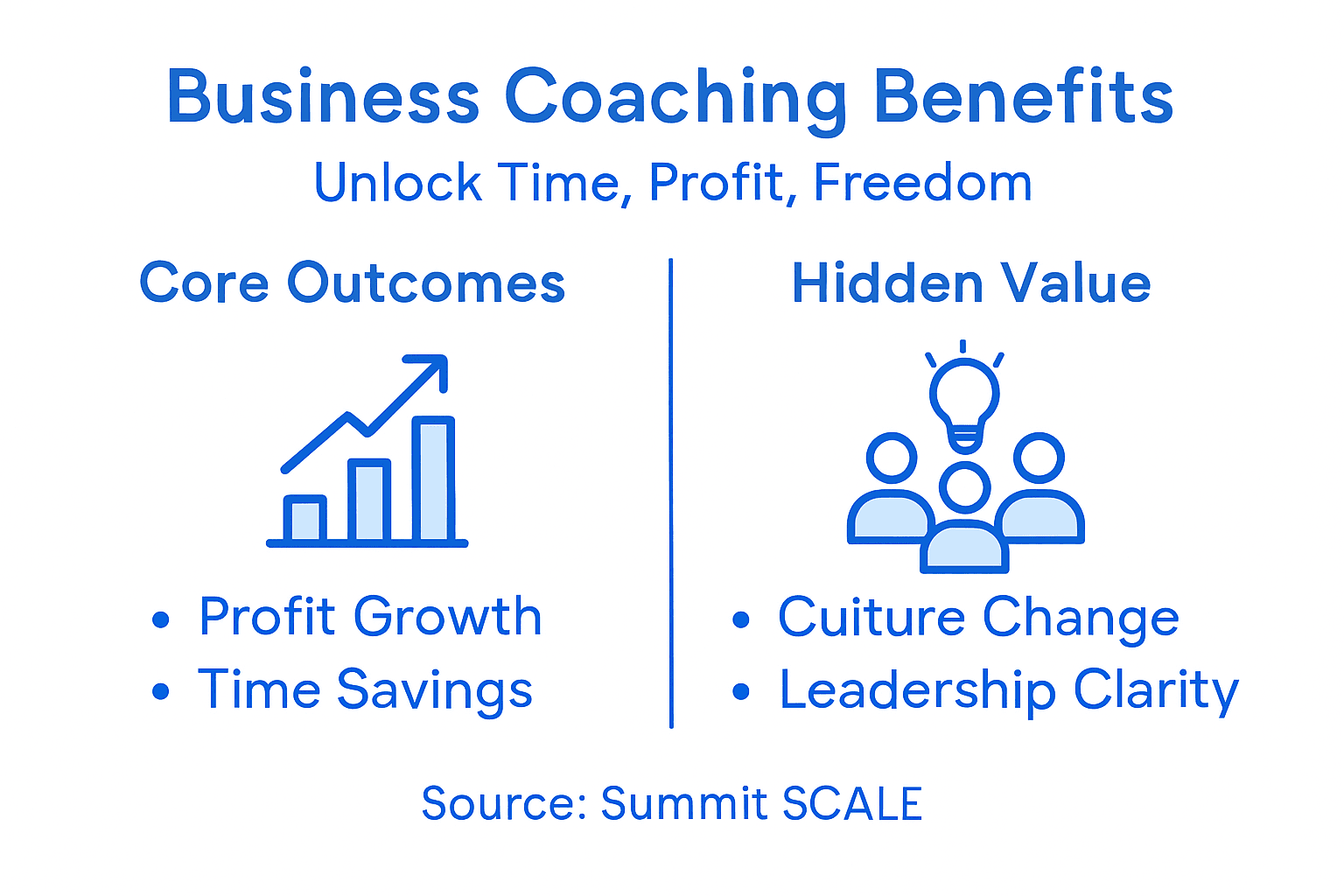
Business coaching represents a strategic investment that delivers both immediate and long-term financial benefits beyond traditional performance metrics. Business coaching benefits extend far beyond simple monetary returns, encompassing comprehensive organisational transformation.
The direct financial returns of coaching include:
- Revenue Growth: Increased sales performance and strategic revenue generation
- Cost Reduction: Optimising operational efficiency and minimising wastage
- Productivity Enhancement: Improving individual and team output
- Talent Retention: Reducing recruitment and training expenses
- Strategic Decision-Making: Minimising costly strategic errors
Hidden value emerges through less quantifiable but equally significant outcomes:
- Enhanced organisational adaptability
- Improved employee engagement
- Stronger leadership capabilities
- Better workplace communication
- Increased innovation potential
Coaching transforms financial performance by unlocking human potential and organisational capabilities.
While financial metrics provide clear evidence of coaching’s impact, the most profound returns manifest through cultural shifts, leadership development, and sustainable competitive advantages that compound over time.
Pro tip: Track both tangible financial metrics and intangible performance indicators to capture the comprehensive value of coaching interventions.
Comparing coaching with self-led approaches
Navigating personal and professional development requires a nuanced understanding of learning strategies. Coaching effectiveness research reveals significant differences between self-directed approaches and professionally guided interventions, highlighting the critical importance of structured support.
Key distinctions between coaching and self-led approaches include:
- Accountability: Coaches provide external accountability
- Expertise: Professional guidance versus independent exploration
- Objectivity: External perspective versus internal bias
- Skill Development: Targeted strategies versus generalised methods
- Motivation: Sustained engagement versus potential inconsistency
Coaching leadership styles demonstrate clear advantages in driving personal transformation:
- Structured learning pathways
- Personalised intervention strategies
- Adaptive feedback mechanisms
- Emotional intelligence development
- Performance optimisation techniques
Self-directed learning offers autonomy, but coached approaches provide strategic acceleration.
While self-led approaches have merit, they often lack the systematic approach, specialised insights, and transformative potential that professional coaching delivers. The interactive nature of coaching creates a dynamic learning environment that transcends individual limitations.
Below is a side-by-side comparison of professional coaching versus self-directed development:
| Attribute | Professional Coaching | Self-Directed Development |
|---|---|---|
| Feedback | Ongoing, expert-driven | Self-evaluation based only |
| Structure | Customised learning path | Unstructured, self-paced |
| Accountability | Guided by external party | Internally motivated |
| Objectivity | Neutral, external perspective | Personal biases often present |
| Results | Measurable, goal-focused | Variable and less predictable |
Pro tip: Combine self-reflection with professional coaching to maximise personal and professional growth potential.
Pitfalls to avoid with business coaching
Business coaching represents a sophisticated professional intervention, but not all approaches deliver equal value. Coaching challenges and empirical evidence reveal critical considerations for successful coaching engagements.
Common pitfalls that business owners must navigate include:
- Misaligned Expectations: Unrealistic outcomes and undefined goals
- Coach Credibility: Insufficient professional expertise or track record
- Contextual Misunderstanding: Coaches lacking organisational awareness
- Measurement Challenges: Inability to quantify coaching impact
- Communication Barriers: Ineffective rapport and trust development
Specific risks that can undermine coaching effectiveness involve:
- Choosing coaches without proper verification
- Neglecting organisational cultural nuances
- Failing to establish clear performance metrics
- Overlooking individual learning styles
- Resisting genuine personal feedback
Effective coaching demands mutual commitment, transparency, and strategic alignment.
Successful coaching transcends generic approaches, requiring personalised strategies that respect individual and organisational complexity. The most transformative coaching relationships emerge from deep understanding, mutual trust, and rigorous performance frameworks.
Pro tip: Conduct thorough due diligence when selecting a business coach, prioritising proven expertise and aligned methodology.
Unlock Your Business Potential with Tailored Coaching Solutions
The article “Why Invest in Coaching? Unlock Time, Profit, Freedom” highlights the critical challenges business owners face such as managing growth, improving profitability and gaining valuable freedom. It points out how strategic business coaching can break through common barriers like unclear goals and lack of accountability to deliver measurable improvements in sales, team performance and long-term value. If you are seeking personalised guidance that focuses on outcomes like more time, increased profit, and enhanced freedom, understanding coaching as a strategic investment rather than expense is key.
At Summit SCALE, we specialise in empowering small to medium-sized business owners through professional coaching approaches precisely aligned with your goals. Our tailored business coaching service helps you develop clear strategies for sales growth, cost control and team building while holding you accountable through every step. With expert support, you can shift from feeling overwhelmed to unlocking sustainable business success and personal freedom.
Ready to transform your business and life with coaching that delivers?
Discover how our customised coaching can accelerate your progress today. Schedule a free 15-minute assessment and start unlocking new levels of time, profit, and freedom now. Visit Summit SCALE and take the first step towards profound business transformation.
Frequently Asked Questions
What are the key benefits of investing in coaching?
Investing in coaching can lead to increased revenue growth, enhanced communication, improved employee motivation, and stronger leadership capabilities. These benefits cumulatively contribute to better overall organisational performance and adaptability.
How does business coaching differ from self-directed learning?
Business coaching provides structured learning pathways, expert feedback, and external accountability, which are often missing in self-directed learning. This professional guidance can accelerate personal and professional growth more effectively than independent exploration.
What types of coaching are available for business leaders?
There are several types of coaching available, including individual coaching for personal development, executive coaching for senior leaders, team coaching for collaboration, performance coaching for skill enhancement, and career development coaching for planning career progression.
How can coaching lead to financial returns for a business?
Coaching can improve financial performance by increasing sales, optimising operational costs, enhancing productivity, retaining talent, and facilitating better strategic decision-making. Both tangible financial metrics and intangible cultural benefits contribute to the overall value of coaching.

