
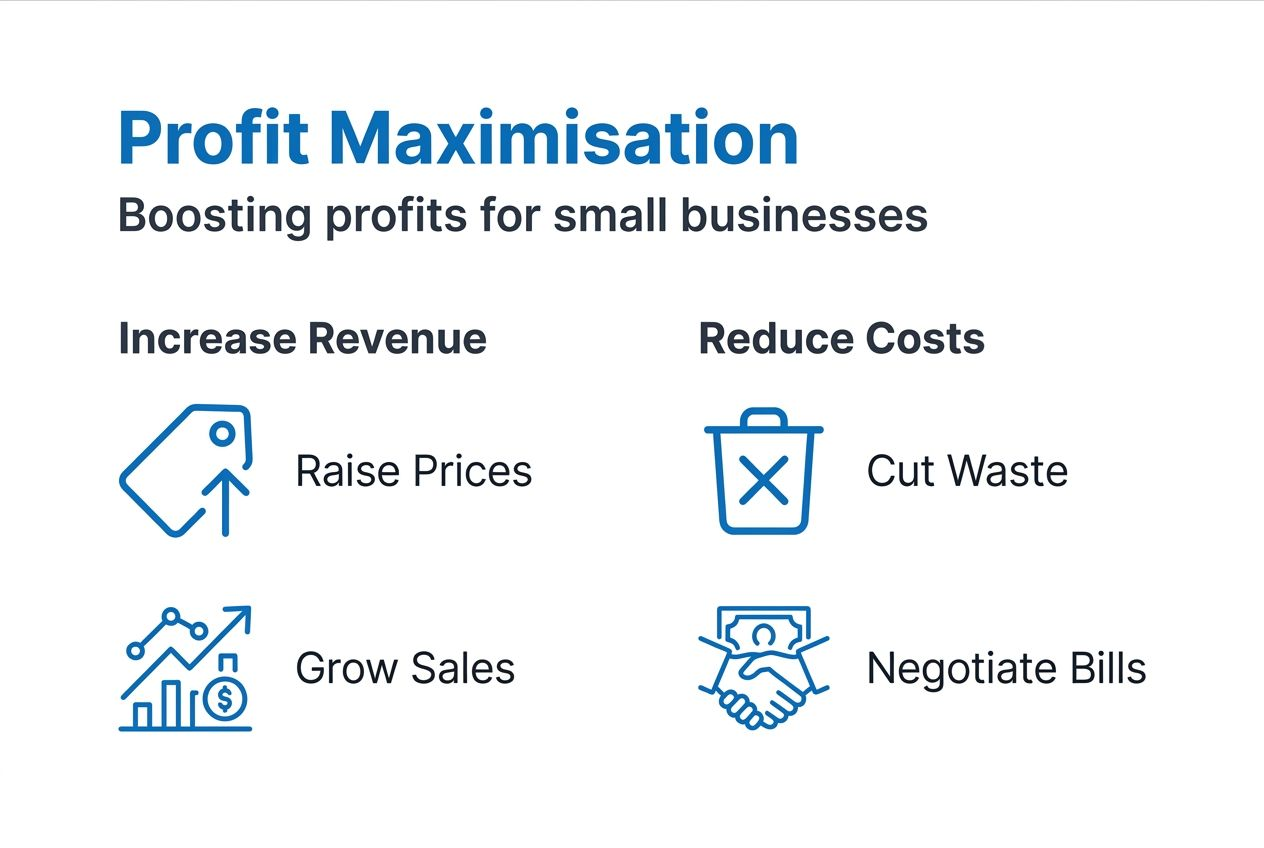
Many small business owners confuse revenue growth with true profit maximisation. Research shows 58% of SMBs err by focusing solely on increasing sales whilst ignoring rising costs. Profit maximisation involves optimising both revenue and expenses for sustainable success. This guide clarifies essential concepts and provides practical strategies to help SMB owners achieve genuine profitability and long-term growth.
Table of Contents
- Understanding Profit Maximisation: Definition And Importance
- Common Misconceptions About Profit Maximisation
- How Pricing Strategy Drives Profit Maximisation
- Effective Cost Control Techniques To Boost Profit
- Frameworks And Tools For Analysing Profit Drivers
- Balancing Profit Maximisation With Growth And Sustainability
- Practical Steps Small Business Owners Can Take Today To Maximise Profit
- Boost Your Business Growth With Expert Coaching
- Frequently Asked Questions
Key takeaways
| Point | Details |
|---|---|
| Understanding profit maximisation | Profit maximisation means maximising net profit by balancing total revenue against total costs for sustainable growth. |
| Common misconceptions | Focusing solely on revenue growth or ignoring indirect costs leads to overestimated profits and strategic errors. |
| Strategic pricing impact | Pricing strategies considering market elasticity can improve margins by up to 15% when implemented correctly. |
| Cost control techniques | Reducing fixed costs by 7-12% can increase profits by 5-10% without harming growth potential. |
| Balancing short and long-term goals | Short-term profit focus may reduce long-term valuation growth by 20%, making sustainability essential. |
Understanding profit maximisation: definition and importance
Profit maximisation involves maximising the difference between total revenue and total costs. For small businesses, this means finding the sweet spot where marginal cost equals marginal revenue. At this point, producing one additional unit generates exactly the same cost as the revenue it brings in.
This concept matters because genuine profitability drives sustainable growth. Revenue alone tells only part of the story. You might achieve record sales whilst watching profits shrink due to unchecked expenses. True profit maximisation requires balancing income generation with intelligent cost management.
Understanding why improving profitability matters helps SMB owners make smarter decisions. Consider these key distinctions:
- Revenue measures total sales before expenses
- Profit reflects what remains after all costs
- Profit margin shows profitability as a percentage
- Cash flow tracks actual money movement
- Net profit represents the true bottom line
For sustainable success, focus on optimising both sides of the equation. Increasing revenue whilst controlling costs creates genuine business value. This balanced approach enables reinvestment, attracts quality talent, and builds long-term resilience against market fluctuations.
Common misconceptions about profit maximisation
Many business owners fall into predictable traps when pursuing profitability. Research indicates 58% of SMBs focus solely on revenue growth, leading to overestimated profit projections. This narrow view ignores the cost side of the equation entirely.
Ignoring indirect and overhead costs creates another dangerous blind spot. Rent, utilities, insurance, and administrative expenses add up quickly. When these fixed costs rise faster than revenue, profit margins shrink despite increasing sales volumes.
Confusing short-term revenue maximisation with sustainable profit growth leads to poor strategic choices. Aggressive discounting might boost sales temporarily but erodes margins permanently. Here are common mistakes to avoid:
- Cutting costs indiscriminately without analysing impact on quality or customer satisfaction
- Raising prices without considering market elasticity or competitive positioning
- Focusing exclusively on top-line growth whilst neglecting bottom-line performance
- Ignoring the relationship between volume, pricing, and profitability
- Failing to reinvest profits strategically for future growth
Pro Tip: Before implementing any cost-cutting measure, calculate its impact on customer value and revenue generation. Some expenses directly support profit growth and should be protected.
Excessive cost-cutting poses particular risks. Slashing marketing budgets might improve short-term margins but strangles future revenue. Reducing staff compromises service quality, driving customers to competitors. Smart profit maximisation requires practical profit growth strategies that balance efficiency with investment.
How pricing strategy drives profit maximisation
Pricing represents your most powerful profit lever. Strategic pricing considering market elasticity can improve margins by up to 15% without changing costs or volume. Understanding how customers respond to price changes separates profitable businesses from struggling ones.
Market elasticity measures how demand shifts when prices change. Inelastic products tolerate price increases because customers need them regardless. Elastic products lose customers quickly when prices rise. Knowing your position guides smart pricing decisions.
| Pricing Approach | Advantages | Disadvantages |
|---|---|---|
| Static pricing | Simple to implement, predictable revenue | Misses opportunities, ignores market changes |
| Dynamic pricing | Maximises profit potential, adapts to demand | Requires monitoring, may confuse customers |
| Value-based pricing | Aligns with customer perception, supports premium positioning | Difficult to quantify, needs strong differentiation |
| Competitive pricing | Maintains market position, prevents customer loss | Triggers price wars, ignores unique value |
Dynamic pricing adjusts rates based on demand, competition, and market conditions. Airlines and hotels use this constantly. Small businesses can apply similar principles by monitoring competitor pricing and adjusting strategically during peak periods.
Risks of improper pricing include undervaluing your offering or pricing yourself out of the market. Test price changes incrementally. Monitor customer response closely. Track how adjustments affect both volume and profit margins.
Pro Tip: Calculate your price floor by adding all variable costs plus a minimum profit margin. This ensures you never sell at a loss whilst pursuing market share.
Implement profit growth practical strategies by analysing competitor positioning, understanding customer willingness to pay, and testing different price points. Small adjustments often yield significant profit improvements without affecting sales volume.
Effective cost control techniques to boost profit
Cost management directly impacts your bottom line. Reducing fixed costs by 7-12% can increase profits by 5-10% for SMBs without harming growth potential. Understanding the difference between fixed and variable costs guides effective control strategies.

Fixed costs remain constant regardless of sales volume. Rent, salaries, insurance, and equipment leases fall into this category. Variable costs fluctuate with production or sales levels, including materials, commissions, and shipping expenses.
Tactics for reducing fixed expenses include:
- Renegotiating supplier contracts annually
- Switching to flexible workspace arrangements
- Automating repetitive administrative tasks
- Consolidating software subscriptions
- Reviewing insurance policies for better rates
Variable costs require different approaches. Monitor cost per unit sold closely. Bulk purchasing reduces material costs but ties up working capital. Finding this balance protects cash flow whilst improving margins.
Pro Tip: Track your contribution margin (revenue minus variable costs) for each product or service. This reveals which offerings generate the most profit and deserve priority focus.
Balancing cost cuts with growth initiatives prevents damage to revenue-generating capabilities. Slashing marketing spend saves money today but costs customers tomorrow. Smart entrepreneurs use practical profit growth strategies that eliminate waste whilst protecting investments that drive future income.
Evaluate each cost-cutting proposal by asking: Does this expense directly support customer acquisition, satisfaction, or retention? If yes, proceed cautiously. If no, consider reduction or elimination.
Frameworks and tools for analysing profit drivers
Analytical frameworks transform guesswork into informed decision-making. Break-even and contribution margin tools increase decision efficiency by 30% when applied consistently. These frameworks reveal exactly where profit comes from and how to increase it.
Break-even analysis identifies the sales volume needed to cover all costs. Below this point, you lose money. Above it, you generate profit. This calculation guides pricing decisions, expansion plans, and cost management priorities.
Contribution margin shows profit generated per unit after variable costs. Higher contribution margins mean each sale contributes more towards fixed costs and profit. This metric helps prioritise products and services strategically.
| Tool | Formula | Application |
|---|---|---|
| Break-even point | Fixed Costs ÷ (Price – Variable Cost per Unit) | Determine minimum sales targets |
| Contribution margin | (Revenue – Variable Costs) ÷ Revenue | Assess product profitability |
| Profit margin | Net Profit ÷ Revenue | Measure overall efficiency |
| Return on investment | (Gain – Cost) ÷ Cost | Evaluate spending decisions |
These calculations drive better pricing and cost decisions by revealing true profitability. A product with high revenue but low contribution margin might deserve less focus than a smaller seller with better margins.
Key insights from these tools:
- Which products or services generate the most profit per sale
- How price changes affect break-even volume
- Where to focus cost reduction efforts for maximum impact
- Whether expansion investments will generate acceptable returns
Entrepreneurs can access profitability analysis tools and resources like the profit driver tool to conduct detailed assessments. Regular analysis keeps profit drivers visible and actionable.
Balancing profit maximisation with growth and sustainability
Pursuing short-term profits exclusively creates long-term problems. Short-term profit focus may reduce long-term valuation growth by 20% by starving investments that drive future success. Smart business owners balance immediate profitability with strategic reinvestment.
Maximising quarterly profits by cutting research, marketing, or training boosts today’s numbers whilst mortgaging tomorrow’s potential. Competitors who reinvest wisely gain market share, innovation advantages, and customer loyalty.
Sustainable profit strategies involve deliberate reinvestment in growth drivers:
- Product development that creates competitive advantages
- Marketing initiatives that build brand equity
- Team training that improves productivity and retention
- Technology upgrades that enhance efficiency
- Customer experience improvements that drive loyalty
Customer and market alignment ensures ongoing success. Profit maximisation works sustainably only when it delivers genuine value to customers. Exploitative pricing or quality cuts might boost margins temporarily but destroy reputation permanently.
Balancing profit goals with growth aspirations requires intentional planning. Set targets for both profit margins and reinvestment levels. Allocate resources strategically between immediate returns and future capabilities.
Maximising profit represents a strategic, ongoing process rather than a one-time achievement. Market conditions shift. Competitors evolve. Customer preferences change. Successful SMB owners continuously adapt their approach whilst maintaining focus on profit and growth alignment.
Practical steps small business owners can take today to maximise profit
Implementing profit maximisation starts with immediate, actionable steps. Real-time financial data and adaptive pricing improve profit outcomes significantly when monitored consistently. Here are evidence-based strategies you can implement now:
- Establish daily or weekly financial monitoring dashboards tracking revenue, costs, and margins
- Conduct quarterly pricing reviews comparing your rates against competitors and customer feedback
- Identify your three highest-margin products or services and focus marketing efforts accordingly
- Analyse your five largest expense categories and challenge each one for reduction opportunities
- Calculate contribution margins for all offerings to prioritise profitable activities
- Test small price increases on select products to gauge customer price sensitivity
- Automate routine tasks that consume staff time without adding customer value
Apply cost control measures strategically without harming core operations. Review subscriptions, renegotiate supplier contracts, and eliminate redundant processes. Protect investments that directly support customer acquisition and satisfaction.
Adaptive pricing responds to market changes in real time. Monitor competitor pricing weekly. Adjust rates seasonally based on demand patterns. Test different price points with small customer segments before rolling out changes broadly.
Pro Tip: Implement incremental changes rather than dramatic shifts. Test pricing adjustments of 5-8% on individual products before making company-wide changes. This limits risk whilst gathering valuable market feedback.
Regular review of profit metrics and customer feedback creates continuous improvement. Schedule monthly financial reviews examining trends in revenue, costs, and profitability. Survey customers quarterly about value perception and pricing sensitivity.
Successful profit maximisation combines analytical rigour with customer focus. Use profit growth strategies for 2026 that balance financial performance with market positioning and sustainable growth.
Boost your business growth with expert coaching
Maximising profit whilst building sustainable growth requires strategic thinking and expert guidance. Professional coaching helps SMB owners navigate complex decisions about pricing, costs, and reinvestment priorities.
Understanding the role of coaching for SMEs reveals how targeted support accelerates profit improvement. Experienced coaches provide frameworks, accountability, and insights that transform good intentions into measurable results. They help identify blind spots in your profit strategy and unlock opportunities you might otherwise miss.

The role of coaching in profitability extends beyond financial metrics to strategic positioning and operational excellence. Coaches bring external perspective, challenge assumptions, and introduce proven methodologies that drive sustainable profit growth.
Explore why investing in business coaching delivers measurable returns through improved decision-making, faster implementation, and avoiding costly mistakes. Professional guidance transforms profit maximisation from theory into practice.
Frequently asked questions
What is the difference between revenue growth and profit maximisation?
Revenue growth measures increases in total sales before expenses, whilst profit maximisation focuses on increasing net earnings after all costs. High revenue does not guarantee higher profit if costs rise disproportionately or pricing fails to cover true expenses.
How can small businesses use pricing strategies to improve profits?
Small businesses should analyse market demand, competitor prices, and customer willingness to pay when setting rates. Dynamic pricing allows adapting prices based on market conditions to maximise profit without losing customers. Testing small price adjustments reveals optimal pricing that balances volume and margins.
What tools can help analyse and improve profit drivers?
Break-even analysis identifies the sales level needed to cover all costs. Contribution margin analysis shows profit made on individual products or services after variable costs. Specialised resources like the profit driver tool support detailed profitability assessments.
Why is balancing profit maximisation with growth important?
Short-term profit focus can limit future growth opportunities and reduce overall business valuation. Balancing immediate profitability with strategic reinvestment in marketing, product development, and customer experience fosters sustainable success. This approach builds long-term value whilst maintaining healthy margins.

