
Many small and medium businesses work tirelessly yet struggle to achieve lasting profitability. The gap between effort and profit often stems from unclear strategies, inefficient cost management, or missed revenue opportunities. Professional coaching and targeted approaches can transform this challenge into sustainable growth. This guide delivers practical, actionable steps to optimise profitability in 2026, covering essential drivers, preparation methods, execution strategies, and ongoing measurement techniques that empower business owners to unlock their full profit potential and scale with confidence.
Table of Contents
- Understanding Profitability And Its Drivers
- Preparing Your Business For Profitability Optimisation
- Executing Strategies To Optimise Profitability
- Measuring Outcomes And Sustaining Profitability Improvements
- Unlock Your Business’s Profit Potential With Professional Coaching
- Frequently Asked Questions
Key takeaways
| Point | Details |
|---|---|
| Understand profitability drivers | Revenue streams, cost control, and operational efficiency form the foundation of sustainable profit growth. |
| Prepare with financial analysis | Establish a clear baseline using metrics and set measurable goals before implementing optimisation strategies. |
| Execute targeted strategies | Increase revenue through new markets, manage costs rigorously, and leverage coaching to refine decision making. |
| Measure and sustain improvements | Track key financial indicators continuously and adjust tactics to maintain long term profitability gains. |
Understanding profitability and its drivers
Profitability represents the lifeblood of any small or medium enterprise, measuring how effectively a business converts revenue into actual profit after covering all expenses. For SMEs, sustainable profitability ensures survival during economic shifts and funds future expansion without relying solely on external financing. Understanding what drives profit enables owners to make informed decisions that compound over time.
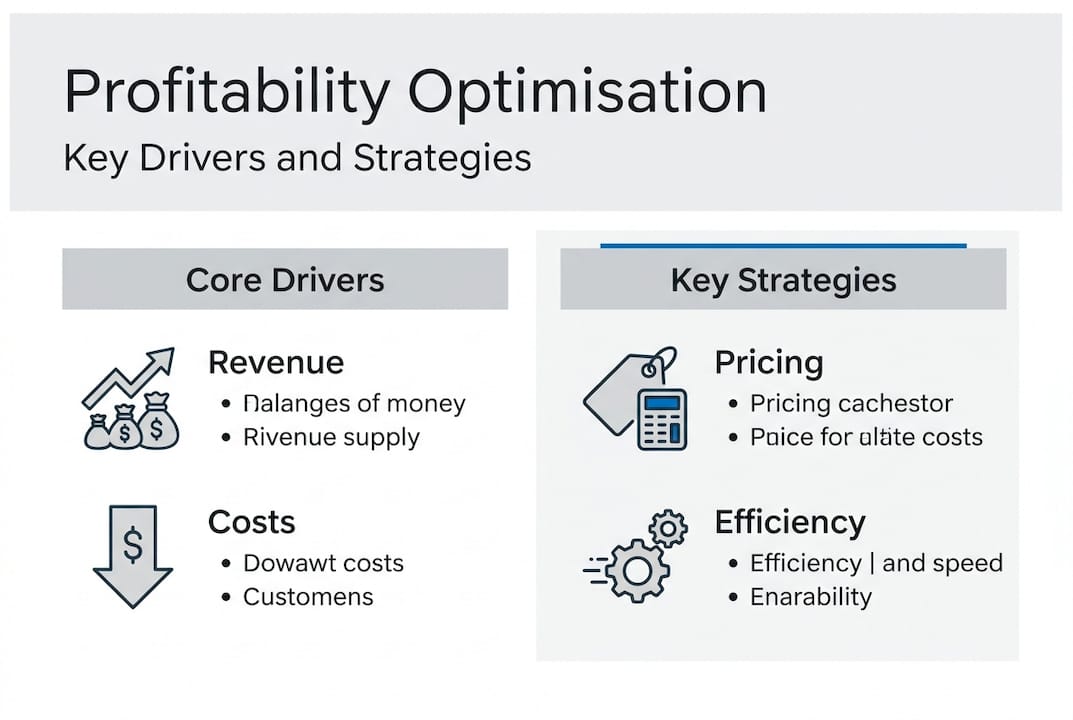
Three core drivers shape profitability outcomes. Revenue streams determine total income, whether from product sales, service fees, or recurring subscriptions. Cost management controls how much you spend to generate that revenue, including materials, labour, overheads, and marketing. Operational efficiency measures how well resources convert into output, reducing waste and maximising productivity. Profitability depends heavily on balancing revenue growth with cost control in SMEs, making this equilibrium critical for sustainable success.
Smart financial management creates opportunities for profit maximisation. Pricing strategies influence both revenue volume and margin per sale. Value based pricing captures customer willingness to pay, while cost plus pricing ensures margins cover expenses. Regular analysis of these drivers reveals hidden inefficiencies. You might discover that certain product lines drain resources without adequate returns, or that renegotiating supplier contracts could save thousands annually. Professional accounting benefits include identifying these opportunities through detailed financial reporting.
Key profitability drivers to monitor include:
- Revenue per customer and average transaction value
- Gross profit margin after direct costs
- Operating expenses as a percentage of revenue
- Cash conversion cycle and working capital efficiency
- Customer acquisition cost versus lifetime value
Pro Tip: Schedule quarterly profitability reviews to analyse each driver separately, comparing trends against industry benchmarks to spot improvement areas before they become critical issues.
Preparing your business for profitability optimisation
Before implementing optimisation tactics, you need a clear picture of current financial health. Start by calculating your net profit margin, which shows what percentage of revenue remains as profit after all expenses. Compare this against industry standards to gauge performance. Assess cash flow patterns to understand timing mismatches between income and outgoings. Review balance sheet strength, examining debt levels and asset utilisation. This diagnostic phase prevents wasted effort on strategies that address symptoms rather than root causes.
Establishing a clear profitability baseline using financial metrics is vital before implementing growth strategies. Without knowing your starting point, measuring improvement becomes impossible. Gather at least six months of financial data, including profit and loss statements, cash flow reports, and detailed expense breakdowns by category. Identify seasonal patterns that affect profitability, such as slower summer months or year end surges.
Setting realistic, measurable profitability goals transforms vague aspirations into concrete targets. Use the SMART framework: Specific (increase net margin by 3%), Measurable (track monthly), Achievable (based on historical data), Relevant (aligned with growth plans), and Time bound (within 12 months). Break annual goals into quarterly milestones to maintain momentum and enable course corrections.
Follow these preparation steps:
- Compile comprehensive financial statements for the past 12 months
- Calculate key profitability ratios including gross margin, operating margin, and net margin
- Benchmark your metrics against industry averages for similar sized businesses
- Identify your top three profit drains and top three revenue generators
- Document current pricing models and customer acquisition costs
- Set specific profitability targets with clear deadlines
Key tools and reports streamline ongoing monitoring. Financial dashboards provide real time visibility into revenue, costs, and cash flow without manual spreadsheet updates. Cloud accounting platforms automate data collection and generate instant reports. Optimise tax efficiency through proper record keeping and strategic planning, which directly impacts net profitability.
| Metric | Purpose | Target Frequency |
|---|---|---|
| Net profit margin | Overall profitability health | Monthly |
| Gross profit margin | Pricing and cost effectiveness | Monthly |
| Operating cash flow | Liquidity and sustainability | Weekly |
| Customer lifetime value | Revenue potential per customer | Quarterly |
| Break even point | Risk assessment | Quarterly |
Pro Tip: Implement financial dashboards that update automatically from your accounting system, allowing you to spot profitability trends within minutes rather than waiting for month end reports.
Executing strategies to optimise profitability
With preparation complete, focus shifts to active optimisation. Revenue enhancement forms the first pillar. Upselling encourages existing customers to purchase premium versions or complementary products, leveraging established trust. Cross selling introduces related offerings that solve adjacent problems. Expanding into new markets, whether geographic regions or customer segments, diversifies income streams and reduces dependency on single revenue sources. Developing new product lines addresses unmet customer needs while utilising existing operational capacity.

Cost management tactics deliver immediate profit improvements without requiring revenue growth. Eliminate waste by auditing processes for redundant steps or excessive material usage. Negotiate supplier terms annually, leveraging loyalty or volume commitments for better pricing. Automate repetitive processes to reduce labour costs and human error. Outsource non core functions when external specialists deliver better value than internal teams. Energy efficiency upgrades reduce utility expenses while supporting sustainability goals.
Pricing strategies profoundly impact profitability. Value based pricing sets prices according to perceived customer benefit rather than production costs, often yielding higher margins for differentiated offerings. Cost plus pricing adds a fixed percentage to total costs, ensuring profitability but potentially leaving money on the table. Dynamic pricing adjusts rates based on demand, seasonality, or customer segments, maximising revenue during peak periods while maintaining volume during slower times.
| Strategy | Advantages | Disadvantages |
|---|---|---|
| Value based pricing | Higher margins, reflects customer willingness to pay | Requires deep market understanding, harder to justify |
| Cost plus pricing | Simple to calculate, guarantees margin coverage | Ignores market conditions, may underprice value |
| Dynamic pricing | Maximises revenue across conditions | Complex to implement, risks customer perception issues |
| Competitive pricing | Easy market comparison, reduces price objections | Race to bottom, erodes differentiation |
Engaging professional coaching unlocks hidden profit potential and guides through complex optimisation decisions. Coaches bring external perspective, spotting blind spots that owners miss when immersed in daily operations. They accelerate decision making by providing frameworks and accountability, preventing analysis paralysis. Coaching supports profitable scaling by aligning growth initiatives with profitability goals rather than pursuing revenue at any cost.
Revenue enhancement methods:
- Launch tiered service packages to capture different customer segments
- Implement referral programmes that leverage satisfied customers
- Develop subscription models for predictable recurring revenue
- Bundle complementary products to increase average transaction value
- Explore strategic partnerships that open new distribution channels
Cost reduction approaches:
- Conduct annual supplier reviews and request competitive quotes
- Implement inventory management systems to reduce holding costs
- Negotiate flexible staffing arrangements during demand fluctuations
- Consolidate software subscriptions and eliminate unused tools
- Review insurance policies and professional services for better rates
Professional coaching accelerates this execution phase. Coaches help prioritise which strategies deliver maximum impact for your specific situation. They provide accountability structures that ensure follow through on implementation plans. Improve business profitability systematically rather than through random tactical experiments. The accountancy role in business growth complements coaching by ensuring financial accuracy and compliance throughout optimisation efforts.
Measuring outcomes and sustaining profitability improvements
Implementing strategies means nothing without measuring their impact. Track net profit margin as your primary profitability indicator, calculating it monthly to spot trends early. Monitor return on investment for specific initiatives, comparing costs against incremental profit gains. Gross profit margin reveals whether pricing and direct costs remain aligned. Operating expense ratio shows if overhead creep threatens gains. Cash flow from operations confirms that profit translates into actual liquidity rather than just accounting entries.
Ongoing measurement and adjustment are critical to maintaining profit improvements. Markets shift, competitors respond, and customer preferences evolve. What worked brilliantly in January may underperform by July. Establish regular review meetings, ideally monthly, where you analyse financial results against targets. Compare actual performance to forecasts, investigating variances above 5%. Document lessons learned and adjust tactics accordingly.
Common mistakes undermine profitability maintenance. Neglecting cost control after initial gains allows expenses to creep upward unnoticed. Ignoring market changes means missing competitive threats or emerging opportunities. Poor pricing discipline, such as excessive discounting to close sales, erodes margins faster than most owners realise. Failing to reinvest profits strategically leaves businesses vulnerable to disruption. Inadequate cash reserves force reactive decisions during downturns rather than proactive optimisation.
Evaluation and adjustment process:
- Review monthly financial statements within five business days of month end
- Compare actual results against profitability targets and prior year performance
- Identify top three positive variances and top three negative variances
- Investigate root causes of significant variances through detailed analysis
- Adjust pricing, costs, or operational approaches based on findings
- Update forecasts and targets to reflect new information
- Communicate results and changes to key team members
Quick profitability health checks:
- Is net profit margin stable or improving compared to last quarter?
- Are operating expenses growing slower than revenue?
- Does cash flow support profit figures or reveal collection issues?
- Are customer acquisition costs declining as marketing improves?
- Do top performing products maintain healthy margins?
- Have recent price changes impacted volume negatively?
Sustaining improvements requires discipline and systems. Automate financial reporting to eliminate manual effort and ensure consistency. Build profitability metrics into team performance reviews, aligning incentives with business outcomes. Schedule quarterly strategy sessions to reassess market conditions and competitive positioning. Maintain relationships with coaches and advisors who provide ongoing guidance. Celebrate wins while remaining vigilant about emerging challenges.
Pro Tip: Create a simple profitability scorecard tracking five key metrics, reviewing it weekly to maintain focus and catch issues before they compound into serious problems.
Unlock your business’s profit potential with professional coaching
Optimising profitability demands more than good intentions. It requires expert guidance, proven frameworks, and accountability to execute consistently. Summit SCALE coaching accelerates profit optimisation and scaling by providing tailored strategies that align with your specific business context and growth objectives. Our coaches bring decades of experience helping SME owners navigate the exact challenges you face, from pricing strategy refinement to cost structure optimisation.

Professional coaching in profitability transforms abstract concepts into concrete action plans with measurable results. We help you identify hidden profit leaks, prioritise high impact initiatives, and avoid costly mistakes that derail progress. Our approach combines financial analysis with operational improvements and leadership development, ensuring sustainable gains rather than temporary bumps. Explore our growth strategies for SMBs 2026 to see how tailored coaching packages address your unique profitability challenges. Discover why invest in coaching delivers returns that far exceed the investment, typically within the first quarter of engagement.
Frequently asked questions
What are the most effective ways to increase profit margins?
Increasing sales volume, reducing operating costs, and improving operational efficiency form the foundation for higher margins. Focus on value based pricing that captures customer willingness to pay rather than cost plus approaches. Eliminate waste in production or service delivery, negotiate better supplier terms, and automate repetitive tasks. Customer value focus through enhanced service quality often justifies premium pricing, directly boosting margins without proportional cost increases.
How does professional coaching enhance business profitability?
Coaching provides expert guidance tailored to your specific business context, identifying profit opportunities that owners miss when focused on daily operations. Coaches deliver accountability structures that ensure consistent execution of profitability strategies rather than sporadic efforts. They help refine decision making processes, avoiding costly mistakes while accelerating implementation of proven tactics. The role of coaching in profitability centres on unlocking hidden potential through external perspective and systematic approaches.
What common mistakes should businesses avoid when optimising profits?
Neglecting cost control after initial improvements allows expenses to creep upward, eroding gains. Ignoring market changes and competitive movements means missing threats or opportunities that impact profitability. Poor pricing discipline, particularly excessive discounting to close sales, destroys margins faster than most realise. Failing to measure results prevents learning from both successes and failures. Inadequate adaptation when strategies underperform compounds problems, turning small issues into major profitability drains that require extensive effort to reverse.
How long does it typically take to see profitability improvements?
Quick wins from cost reduction often appear within 30 to 60 days, such as renegotiated supplier contracts or eliminated waste. Revenue enhancement strategies typically require 90 to 180 days as new offerings gain market traction and customer adoption builds. Sustainable, structural improvements to profitability generally materialise over 6 to 12 months as multiple initiatives compound. Patience combined with consistent measurement ensures you capture both immediate gains and long term transformation rather than abandoning effective strategies prematurely.

