
Many SMB owners celebrate rising sales figures only to discover their profits haven’t budged. Over 40% of SMBs experience sales growth without profit gains due to poor cost management. This guide clarifies how sales growth directly impacts profitability and business freedom, revealing practical strategies to avoid common pitfalls and achieve sustainable expansion.
Table of Contents
- Understanding Sales Growth: Definition And Importance
- How Sales Growth Directly Impacts Profitability
- Strategic Approaches To Driving Sales Growth
- Common Misconceptions Hindering Sales Growth Success
- Measuring And Managing Sales Growth For Sustainable Success
- Linking Sales Growth To Business Freedom And Owner Lifestyle
- Practical Steps And Coaching Insights For SMBs
- Discover Coaching To Unlock Your Sales Growth Potential
- Frequently Asked Questions
Key takeaways
| Point | Details |
|---|---|
| Sales growth differs from revenue spikes | Sustainable expansion in value-generating activity, not temporary jumps. |
| Fixed cost leverage boosts margins | Growing sales spreads fixed costs thinner, raising profitability. |
| Strategic approaches maximise benefits | Data-driven frameworks balance acquisition cost against lifetime value. |
| Cost management is crucial | Controlling expenses alongside growth prevents profit erosion. |
| Growth drives business freedom | Reinvestment into systems and staffing frees owner time. |
Understanding sales growth: definition and importance
Sales growth represents a sustainable increase in both sales volume and value over time, not just a short-term revenue bump. Many SMB owners confuse temporary spikes with genuine growth, leading to disappointment when profits fail to materialise.
The distinction matters because sales growth reflects sustainable expansion in value-generating activity. A one-off promotion might boost this month’s revenue, but it won’t build the foundation for lasting profitability. True sales growth involves repeatable processes that consistently attract and serve customers while maintaining healthy margins.
SMBs benefit enormously from understanding this difference. Scalable, profitable growth creates multiple advantages:
- Enhanced business viability through consistent cash flow
- Greater appeal to investors and potential buyers
- Improved negotiating power with suppliers
- Stronger market positioning against competitors
- Foundation for sustainable expansion
Effective sales growth leverages fixed costs and builds enterprise value. When you spread overheads like rent, salaries, and equipment across more revenue, each sale becomes more profitable. This principle forms the cornerstone of business growth strategies for SMEs, enabling owners to scale without proportionally increasing expenses.
Understanding these fundamentals positions you to recognise opportunities that truly drive profitability rather than merely inflating top-line figures.
How sales growth directly impacts profitability
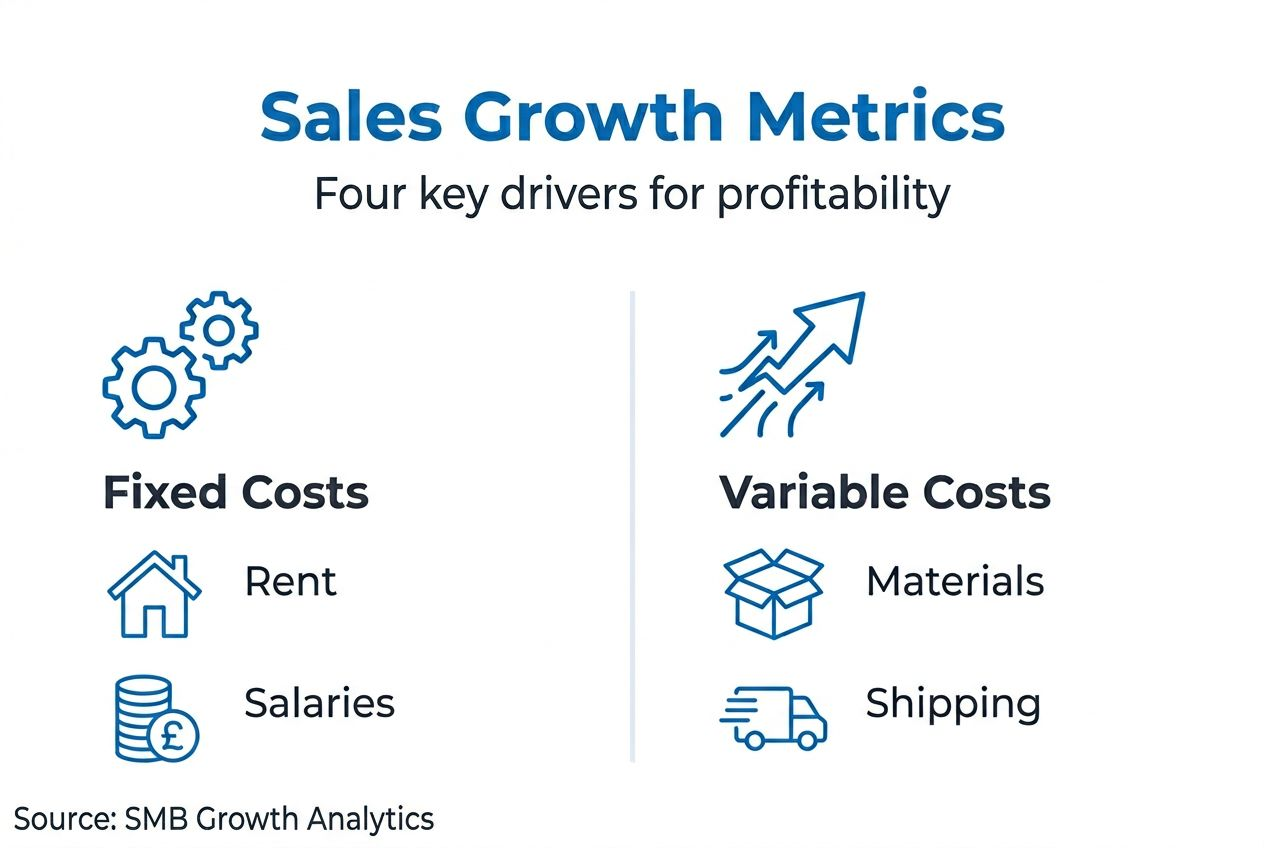
Fixed cost leverage stands as the primary mechanism through which sales growth improves profit margins. Your rent, core staff salaries, insurance, and equipment costs remain relatively constant whether you serve 50 or 500 customers monthly. When sales increase, these fixed expenses represent a smaller percentage of each transaction.
Consider a business with £10,000 monthly fixed costs and £50,000 in sales. Fixed costs consume 20% of revenue. Grow sales to £75,000 whilst maintaining those same fixed costs, and they drop to 13.3% of revenue. That 6.7% difference flows directly to your bottom line.
Profit margins improve by up to 15% following balanced 15% annual sales growth due to fixed cost leverage. This relationship creates a powerful multiplier effect that accelerates profitability as your business scales.
The relationship between sales growth and variable costs requires careful management. Variable costs like materials, shipping, and commission scale with sales, but strategic purchasing and operational efficiency can reduce their per-unit impact. Smart SMB owners negotiate better supplier terms as volumes increase, further enhancing margins.
| Growth Scenario | Sales Increase | Fixed Cost Impact | Variable Cost Control | Margin Improvement |
|---|---|---|---|---|
| Volume only | 20% | Positive leverage | No optimisation | 5-8% |
| Balanced growth | 20% | Positive leverage | Active management | 12-15% |
| Uncontrolled | 20% | Positive leverage | Cost creep | 2-4% |
Pro Tip: Review profit impact monthly, not just sales volume. Track gross and net margins alongside revenue growth to spot cost creep before it erodes your gains.
“The difference between sales growth and profit growth lies entirely in how well you manage the relationship between fixed and variable costs as you scale.”
Strategic alignment of profitability with growth transforms sales expansion into genuine financial health, creating the foundation for sustainable business freedom.
Strategic approaches to driving sales growth
A data-driven framework provides the foundation for sustainable sales growth. Start by establishing clear metrics that connect sales activities to profitability outcomes. This approach prevents the common mistake of chasing revenue without considering its quality or cost.

Balancing customer acquisition cost against lifetime value determines whether growth enhances or destroys profitability. Spending £200 to acquire a customer who generates £150 in lifetime value guarantees failure, regardless of sales volume. Smart SMBs calculate these metrics rigorously and adjust strategies accordingly.
Integrating sales plans into long-term business strategy ensures growth aligns with operational capacity and market positioning. Data-driven frameworks focusing on customer acquisition cost and lifetime value help SMBs build sustainable sales growth that supports rather than strains resources.
Follow these strategic steps to drive profitable sales growth:
- Assess current sales metrics including conversion rates, average transaction value, and customer retention
- Identify your most profitable customer segments and focus acquisition efforts there
- Develop scalable processes that maintain quality as volume increases
- Test pricing strategies to optimise the balance between volume and margin
- Reinvest growth cash flow into systems and capabilities that support further expansion
Pro Tip: Coaching helps refine strategy and execution by identifying blind spots in your growth approach. An experienced coach spots inefficiencies and opportunities you might miss whilst buried in daily operations.
Scalability and repeatability separate temporary success from lasting growth. Build systems that work whether you’re personally involved or not. Document processes, train team members, and create frameworks that new staff can follow. This foundation enables proven steps for business growth that don’t depend on your constant attention.
Explore types of business growth strategies to determine which approach suits your market position and resources. Some SMBs thrive through market penetration, whilst others succeed via product development or diversification. The right strategy depends on your specific circumstances and competitive landscape.
Understanding how to scale business growth and freedom simultaneously ensures expansion enhances rather than complicates your life.
Common misconceptions hindering sales growth success
Equating sales volume with profit remains the most damaging misconception plaguing SMB owners. Revenue growth means nothing if costs consume those gains. Many businesses celebrate record sales months whilst their bank balances shrink, confused about why success feels like failure.
Ignoring cost control alongside growth creates a dangerous spiral. Expenses often increase faster than revenue during expansion phases. New staff, larger premises, additional inventory, and expanded marketing budgets can quickly outpace sales gains if not managed strategically.
Focusing solely on top-line metrics without strategic context leads to poor decision making. A 30% sales increase sounds impressive until you realise it required 50% more marketing spend and delivered lower-margin products. Context matters enormously when evaluating growth performance.
Common false beliefs and their corrections:
- Misconception: More sales always mean more profit. Reality: Profitability depends on margin management and cost control, not just volume.
- Misconception: Growth should be pursued at any cost. Reality: Sustainable growth balances expansion with operational efficiency and cash flow health.
- Misconception: Top-line revenue is the key success metric. Reality: Net profit, cash flow, and return on investment matter far more than gross revenue.
- Misconception: Sales growth happens automatically in good markets. Reality: Strategic planning and execution drive growth regardless of market conditions.
Over 40% of SMBs mistake sales volume growth for profit growth, neglecting cost control. This confusion stems from focusing on vanity metrics rather than meaningful financial health indicators.
Adopting a balanced perspective values both growth and efficiency. The goal isn’t maximum sales but optimal profitability. Sometimes slower, more controlled expansion delivers better outcomes than aggressive growth that strains resources. Understanding why managing business costs matters as much as driving revenue prevents costly mistakes.
Strategies for boosting business profitability often involve refining existing operations rather than simply expanding sales volume.
Measuring and managing sales growth for sustainable success
Tracking the right metrics transforms sales growth from hopeful guesswork into strategic execution. Four critical measurements reveal whether expansion strengthens or weakens your business.
Revenue growth rate shows the pace of expansion. Calculate it by comparing current period sales to the previous period, expressed as a percentage. Consistent 10-20% annual growth often indicates healthy, sustainable expansion for SMBs.
Customer acquisition cost measures what you spend to win each new customer. Include all marketing, sales, and promotional expenses divided by new customers acquired. This metric prevents spending more to acquire customers than they’ll ever generate in profit.
Customer lifetime value estimates total profit a customer generates throughout their relationship with your business. Multiply average purchase value by purchase frequency and customer lifespan. This figure must exceed acquisition cost for sustainable growth.
Profit margins reveal whether sales growth translates to financial health. Track both gross margin (revenue minus direct costs) and net margin (revenue minus all costs). Tracking revenue growth rate, acquisition cost, lifetime value, and profit margins is vital for sustainable sales growth.
Key metric definitions and importance:
- Revenue growth rate: Indicates expansion pace and market traction
- Customer acquisition cost: Prevents unprofitable growth spending
- Customer lifetime value: Ensures long-term profitability of growth investments
- Gross profit margin: Shows pricing strategy effectiveness and cost control
- Net profit margin: Reveals true financial health after all expenses
| Metric Performance | Good Performance | Poor Performance | Sustainability Impact |
|---|---|---|---|
| Acquisition cost vs lifetime value | 1:3 ratio or better | 1:1 ratio or worse | Strong vs unsustainable |
| Revenue growth | 10-20% annually | Erratic or negative | Predictable vs chaotic |
| Profit margin trend | Stable or improving | Declining | Healthy vs deteriorating |
Regular measurement enables timely strategy adjustments. Monthly reviews spot problems whilst they’re still manageable. Waiting for quarterly or annual assessments often means discovering issues too late to correct easily.
Pro Tip: Dashboard tools provide ongoing monitoring without manual calculation effort. Many affordable options integrate with accounting software to track key metrics automatically, alerting you to concerning trends.
Understanding sustainable business growth principles helps maintain expansion that builds value rather than creating problems. Following a comprehensive business growth strategy guide ensures metrics connect to actionable decisions.
Linking sales growth to business freedom and owner lifestyle
Sustainable sales growth creates cash flow improvements that enable reinvestment into automation and staffing. This virtuous cycle gradually removes the owner from day-to-day operations, transforming the business from a demanding job into a valuable asset that runs without constant attention.
Fixed cost leverage reduces owner time spent on operations. As margins improve through growth, you can afford systems and team members that handle routine tasks. The business generates sufficient profit to pay for the infrastructure that frees your time.
Sales growth supports personal and financial freedom through multiple pathways. Increased profitability provides resources for hiring skilled managers. Better cash flow enables investment in technology that automates repetitive work. Stronger market position attracts talent who can operate independently.
Steps from sales growth to business freedom:
- Improved margins fund investment in operational systems and automation
- Documented processes enable delegation to capable team members
- Hiring qualified staff removes owner from daily task execution
- Systems-driven operations continue smoothly during owner absence
- Time freedom allows strategic focus rather than operational firefighting
Owners can reduce involvement by 15-25% through reinvestment from sales growth into automation and staffing. This reduction doesn’t mean abandoning the business but rather shifting focus from doing the work to guiding strategy and vision.
Coaching accelerates this transition by identifying opportunities to systematise and delegate effectively. An experienced coach helps structure growth investments for maximum freedom impact, ensuring expansion translates to lifestyle benefits rather than just increased busyness. The role of coaching for SMEs includes helping owners design businesses that serve their life goals.
Understanding how to approach scaling business for freedom ensures growth enhances rather than consumes your life. The goal isn’t building a larger cage but creating genuine independence.
Practical steps and coaching insights for SMBs
Integrating sales growth into business plans requires deliberate action, not hopeful thinking. Follow these practical steps to initiate profitable expansion:
- Audit current sales processes to identify bottlenecks and inefficiencies that limit growth
- Establish baseline metrics for revenue, costs, margins, and customer acquisition
- Set realistic growth targets that balance ambition with operational capacity
- Develop specific initiatives to reach those targets whilst controlling costs
- Create accountability systems to track progress and adjust strategies monthly
- Invest growth profits into capabilities that support further sustainable expansion
- Build team skills and systems that enable scaling without quality degradation
Balancing growth initiatives with cost control prevents profit erosion. Every expansion activity should include cost management considerations. Hire cautiously, negotiate supplier terms aggressively, and eliminate waste relentlessly. Growth spending must generate returns that exceed its cost.
Pro Tip: Expert coaching helps recognise blind spots and accelerate results. Most owners struggle to see their own business objectively. A skilled coach identifies inefficiencies, challenges assumptions, and suggests strategies you might never consider independently.
Tailored coaching helps SMBs align sales growth with profitability and owner goals efficiently. Rather than generic advice, coaching provides specific guidance based on your industry, market position, and personal objectives.
Tracking progress and adapting strategies regularly separates successful growth from stagnation. Monthly reviews reveal what’s working and what needs adjustment. Quarterly deep dives ensure strategic alignment with long-term goals. Annual planning sessions set direction whilst incorporating lessons learned.
Mindset shifts needed for sustainable scaling include moving from technician to strategist, embracing systems over personal heroics, and valuing profit over revenue. These changes feel uncomfortable initially but prove essential for lasting success.
Explore benefits of coaching for business growth to understand how expert guidance accelerates your journey. Following a step by step business growth approach prevents overwhelm whilst maintaining momentum. Implementing a proven business growth workflow ensures consistent progress towards your freedom and profitability goals.
Discover coaching to unlock your sales growth potential
Sustainable sales growth that enhances profitability and business freedom requires expert guidance to navigate successfully. Many SMB owners struggle alone, making costly mistakes that coaching prevents.
Tailored coaching accelerates profitable sales growth by providing proven frameworks and personalised guidance. Rather than guessing which strategies might work, you gain clarity from someone who’s guided dozens of businesses through similar challenges. Coaching helps overcome common growth pitfalls by spotting problems before they become expensive. An experienced coach identifies cost creep, margin erosion, and strategic misalignment whilst they’re still easily corrected.
Exploring why investing in coaching matters reveals how expert support transforms good intentions into measurable results. Understanding the role of coaching for SMEs clarifies how this investment delivers time, profit, and freedom. Discover proven steps for business growth that coaching helps you implement effectively, creating lasting success rather than temporary gains.
Frequently asked questions
What is the difference between sales growth and revenue increase?
Sales growth reflects sustainable increase in sales volume and value over time, not just temporary revenue jumps from promotions or one-off events. For SMBs, genuine growth means building repeatable processes that consistently attract and serve customers whilst maintaining healthy profit margins. Revenue can spike temporarily without indicating real business expansion or improved financial health.
How can sales growth improve my profit margins?
Growing sales spreads fixed costs like rent, salaries, and equipment across more revenue, making each transaction more profitable. When your overheads represent a smaller percentage of total sales, margins naturally improve. Controlling operating costs alongside growth through strategic purchasing and operational efficiency amplifies this benefit, potentially improving margins by 12-15% with balanced expansion.
Which metrics should I track to manage sales growth?
Track revenue growth rate to measure expansion pace, customer acquisition cost to prevent unprofitable spending, customer lifetime value to ensure long-term viability, and both gross and net profit margins to verify financial health. These metrics together reveal whether sales growth strengthens or weakens your business, enabling timely strategy adjustments before problems escalate.
What practical steps can I take to start growing sales profitably?
Begin by assessing current sales processes, costs, and margins to establish your baseline performance. Develop a strategic sales plan focusing on customer value and cost efficiency rather than just volume. Integrate regular metric tracking to spot issues early and adjust tactics monthly. Consider coaching to gain objective perspective and proven frameworks that accelerate results whilst avoiding common pitfalls that erode profitability during expansion.

