
Running a business without a clear grasp of where your money is going can quickly erode profits and growth potential. Many small and medium-sized companies across the United Kingdom and United States find that poor cost management leads to waste, missed opportunities, and unnecessary financial stress. By mastering cost classification and behaviour, business owners gain practical control over expenses, allowing for smarter decisions that fuel sustainable development and a healthier bottom line.
Table of Contents
- Business Cost Management Fundamentals
- Types Of Costs And Their Impact
- Core Principles Of Effective Cost Control
- Strategic Benefits For Growth And Competitiveness
- Common Pitfalls In Cost Management To Avoid
Key Takeaways
| Point | Details |
|---|---|
| Understand Cost Types | Distinguish between fixed, variable, implicit, and opportunity costs to make informed financial decisions. |
| Implement Rigorous Tracking | Regularly monitor actual spending against your budget to identify variances early and adjust your plans accordingly. |
| Encourage a Cost-Conscious Culture | Share cost information across teams to foster accountability and integrate cost management into daily operations. |
| Focus on Strategic Cost Management | Use cost discipline as a tool for growth by optimising spending that aligns with business objectives and market opportunities. |
Business Cost Management Fundamentals
Understanding your business costs is where profitability begins. Without knowing where your money flows, you’re essentially flying blind. Cost management isn’t about cutting every expense—it’s about making intentional decisions that protect your margins whilst fuelling growth.
Cost management serves three critical purposes in your business:
- Planning: Budgeting your resources and setting realistic financial targets
- Control: Monitoring actual spending against your plan to catch overspending early
- Decision-making: Using cost data to choose between different strategic options
When you understand cost classification and behaviour, you can distinguish between fixed costs (rent, salaries) and variable costs (raw materials, shipping). This distinction matters because it affects how your profit scales as revenue grows.
What Costs Matter Most?
Not all costs are equal. Some directly impact your product or service, whilst others support your operations. Direct costs tie straight to what you sell—materials, labour, packaging. Indirect costs keep the business running—utilities, administration, insurance.
You also have overhead costs, which can be your hidden profit killers. These creep upward gradually: an extra software subscription here, a consultant there, expanded office space. Before you realise it, your overhead has consumed 40% of your revenue.
Track overhead rigorously because small increases compound into significant profit erosion over months.
Here’s what matters when auditing your costs:
- Identify which costs vary with sales volume
- Separate costs that directly make your product from those that don’t
- List recurring monthly commitments separately from one-off expenses
- Calculate what percentage of revenue each cost category consumes
Cost Control Techniques That Work
Cost allocation and control means assigning costs to specific products, departments, or projects so you see the true profitability of each. Without this visibility, a struggling product line can hide inside healthy overall numbers.
Many business owners discover that their bestselling product is actually their least profitable because its production costs are higher than they realised. Once you allocate costs properly, you can make smarter pricing decisions.
Start with these practical control steps:
- Document every cost category in your business
- Review actual spending against budgeted amounts monthly
- Investigate variances—when actual differs from plan, ask why
- Adjust future plans based on what you learn
- Share cost information with team members responsible for those expenses
Pro tip: Set aside 30 minutes each week to review your top five cost categories; this simple habit prevents cost creep and keeps you connected to your financial reality.
Types Of Costs And Their Impact
Your business incurs different types of costs, and each behaves differently as your sales change. Understanding these distinctions shapes how you price, budget, and make growth decisions. Get this wrong, and you’ll either squeeze margins too thin or miss profit opportunities.
Fixed and variable costs form the foundation of cost analysis. Fixed costs stay constant whether you sell one unit or one hundred—your rent, insurance, salaries. Variable costs fluctuate with production—materials, packaging, commission payments.

This distinction matters because your profit margins change as volume scales. When you sell more, fixed costs spread across more units, lowering your cost per sale. This is why growing businesses become more profitable, even without cutting expenses.
The Cost Types That Drive Your Decisions
Explicit costs are straightforward—cash you actually spend. You write a cheque for rent, payroll, supplies. Implicit costs are hidden but real. When you use your own equipment instead of renting, or work unpaid hours, you’re bearing a cost.
Many business owners ignore implicit costs, overestimating profitability. Your time has value. Your capital deployed in the business could earn returns elsewhere. Count these to see your true profitability.
Opportunity costs represent what you give up by choosing one path over another. If you invest £10,000 in inventory instead of marketing, the potential sales you missed represent an opportunity cost. This concept shifts how you evaluate decisions.
Understanding various cost classifications helps you spot where money flows inefficiently and where it generates returns.
How These Costs Impact Your Business
Here’s how different cost types influence your decisions:
To clarify key cost types and their business impacts, see the table below:
| Cost Type | Typical Example | Impact on Profitability | Strategic Consideration |
|---|---|---|---|
| Fixed | Rent, salaries | Remain constant, pressure to grow | Require stable sales volume |
| Variable | Materials, packaging | Scale with sales, affect margin | Optimise unit economics |
| Implicit | Unpaid hours, use of own assets | Hidden, can overstate profit | Must be calculated accurately |
| Opportunity | Investing in one area over another | Potential missed revenue | Evaluate all alternatives |
- Fixed costs: High fixed costs mean you need strong sales volume to stay profitable; they create pressure to grow
- Variable costs: These scale with revenue; higher variable costs reduce profit per sale and leave less room for error
- Opportunity costs: These force you to evaluate whether your resources are deployed in your highest-return activities
- Implicit costs: Ignoring these leads to false profit calculations and poor valuation if you sell the business
A business with high fixed costs needs consistent revenue streams; one with high variable costs needs excellent unit economics.
Consider a service business with mostly variable costs (freelancers you pay hourly). You can scale down if revenue dips. Compare that to a product company with high fixed costs in machinery and facilities. Revenue drops hit profitability much harder.
This explains why some industries are naturally more profitable than others, and why your pricing strategy must match your cost structure.
Pro tip: Calculate your “breakeven point”—the revenue level where total fixed and variable costs equal income. This number reveals how much sales cushion you have before losses begin, and it should inform your minimum pricing.
Core Principles Of Effective Cost Control
Effective cost control isn’t about being cheap. It’s about being intentional. You make decisions based on data, monitor actual results against expectations, and adjust when reality diverges from plan. This systematic approach prevents surprises and protects profitability.
Cost monitoring and variance analysis form the backbone of cost control. You establish a budget, track actual spending, and investigate the gaps between them. This isn’t bureaucracy—it’s the only way to stay in control of your finances.
Most business owners feel a vague anxiety about costs. They don’t know if they’re overspending, by how much, or where. Proper monitoring transforms that anxiety into clarity and actionable insight.
The Three Core Principles
Effective cost control rests on three non-negotiable foundations:
- Plan ahead: Establish realistic budgets for each cost category based on your sales forecast and operational needs
- Monitor consistently: Track actual spending against your plan on a regular cycle—weekly for critical costs, monthly for others
- Investigate variances: When actual spending differs from budget, understand why before adjusting future plans
This creates a feedback loop. Your budget improves each month because you learn what actually happens versus what you expected.
Building A Cost-Conscious Culture
Cost management control systems work best when your entire team understands the importance of cost discipline. When your finance manager alone cares about costs, overspending happens elsewhere because nobody else is watching.
Share cost information with the people responsible for those expenses. Your operations manager should know the monthly facility cost. Your sales team should understand the cost of their discounts. Transparency creates accountability.
Cost control succeeds when it’s embedded in your culture, not imposed as a compliance burden.
Here’s how to build this foundation:
- Share monthly cost reports with department heads
- Link individual bonuses or targets to cost performance
- Discuss cost variances openly in team meetings
- Reward cost-saving ideas from frontline staff
- Celebrate wins when you maintain margins whilst growing revenue
Proactive Versus Reactive Control
Reactive cost control waits until you’ve overspent, then scrambles to cut. Proactive cost control anticipates cost pressure and prevents problems before they happen.
If you know seasonal demand drops in January, plan for it. Adjust hiring expectations, defer non-essential spending, and protect cash flow. Don’t wait until January when you’re desperate.
Proactive approaches include vendor negotiations before costs rise, equipment maintenance to prevent expensive failures, and capacity planning to avoid rush charges.
For a quick overview of proactive versus reactive cost control approaches, see the comparison below:
| Characteristic | Proactive Control | Reactive Control |
|---|---|---|
| Timing | Before cost issues occur | After problems emerge |
| Typical Actions | Regular review, planning, negotiation | Emergency spending cuts |
| Impact on Operations | Prevents overspending, improves stability | Causes disruption and crisis management |
| Long-Term Effect | Sustained profitability | Increased risk, inconsistent results |
Pro tip: Establish a monthly “cost meeting” every first Friday where you review the previous month’s spending against budget, discuss variances, and agree on adjustments; consistency in this habit drives continuous improvement and keeps costs visible.
Strategic Benefits For Growth And Competitiveness
Cost management isn’t purely defensive. It’s one of your most potent offensive weapons for growth and competitive advantage. When you control costs strategically, you unlock capital to invest in what matters—innovation, talent, market expansion. Your competitors paying full price for everything will never outpace you.
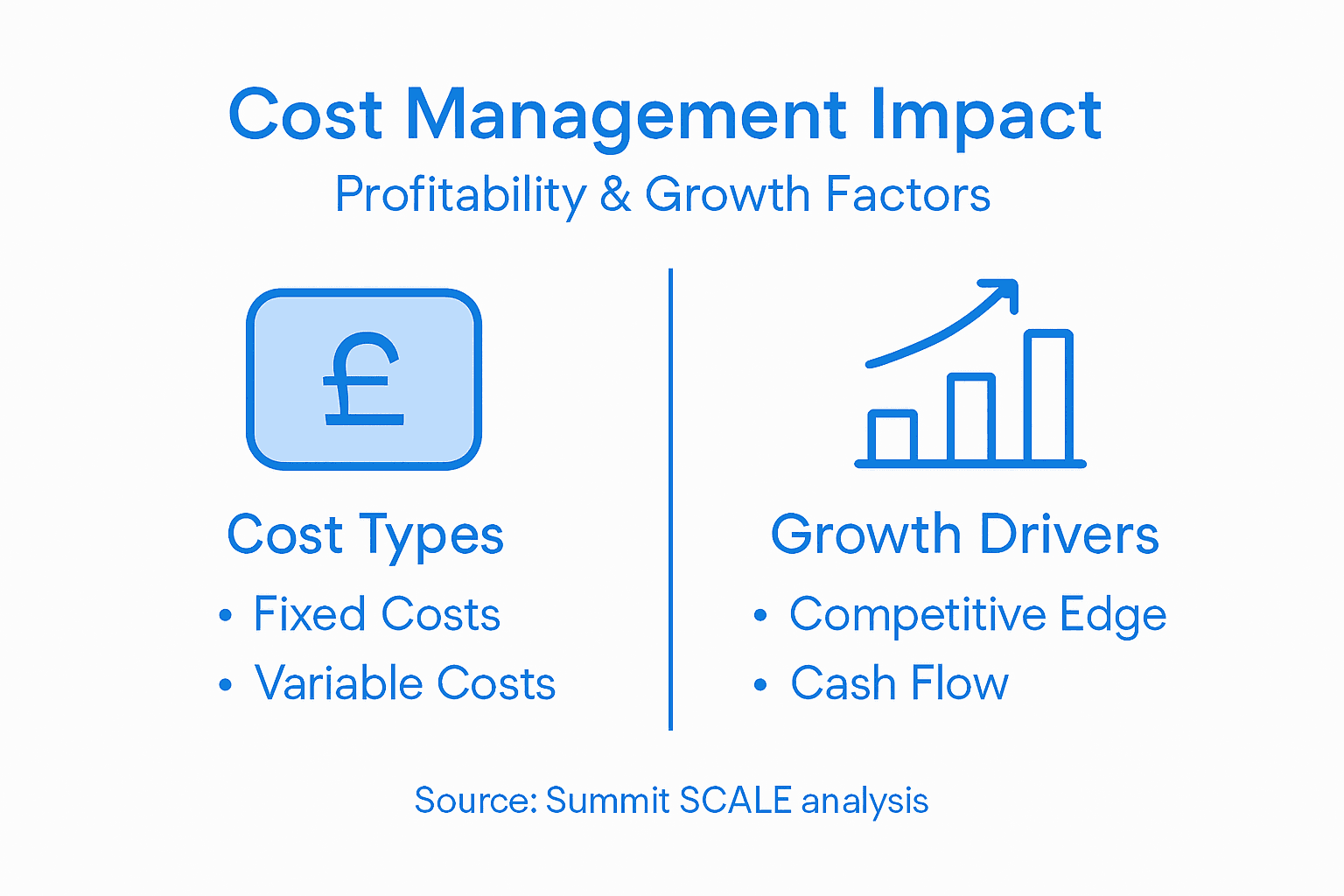
Strategic cost management aligns your cost strategies directly with your business objectives. Instead of cutting costs randomly, you optimise spending in ways that strengthen your market position. This transforms cost control from a burden into a growth engine.
Consider pricing flexibility. When your costs are transparent and well-managed, you can respond faster to market opportunities. A competitor pays 30% more for materials because they don’t manage supplier relationships. You negotiate better terms because you know exactly what you should pay. That margin difference lets you undercut competitors or invest in customer service.
How Cost Discipline Fuels Growth
Effective cost management creates three competitive advantages:
- Cash flow strength: Lower costs mean more cash to reinvest without borrowing
- Pricing power: You can compete on price, quality, or both whilst maintaining margins
- Speed to market: You’re not bogged down debugging cost overruns; you move faster
Businesses that manage costs well scale faster because they’re not constantly fighting cash crunches. Revenue growth actually improves profitability instead of creating stress.
Integration With Broader Strategy
Holistic cost management connects cost control to your supply chain, operations, and innovation strategy. It’s not siloed in finance. Your procurement strategy affects costs. Your product design affects manufacturing costs. Your customer service approach affects service delivery costs.
When these align, magic happens. You reduce waste, improve efficiency, and free resources for growth. Businesses that integrate cost management across functions outcompete those treating it as a compliance exercise.
Competitors obsessed with cutting costs fail. Competitors obsessed with optimising value while controlling costs win.
This distinction matters. Cutting costs blindly damages quality and customer experience. Optimising means keeping spending that drives revenue and eliminating spending that doesn’t.
The Long-Term Competitive Edge
Cost-managed businesses attract better talent because they’re stable and growing. They negotiate better supplier terms because they’re profitable and reliable partners. They invest in technology because they have the cash flow. Each advantage compounds.
Over five years, a business with disciplined cost management will outperform one that doesn’t by a significant margin—not just in profit, but in market position, innovation capacity, and resilience.
Pro tip: Benchmark your major costs against industry standards quarterly; this reveals whether you’re overpaying compared to competitors and identifies negotiation opportunities with suppliers.
Common Pitfalls In Cost Management To Avoid
Most cost management failures aren’t caused by complexity. They’re caused by preventable mistakes. You’ll watch other business owners repeat the same errors—poor estimation, data silos, knee-jerk cutting—and wonder why they don’t learn. Understanding these pitfalls protects you from becoming one of them.
Inaccurate cost estimation and poor planning are the most common culprits behind cost overruns. You estimate a project will cost £50,000 based on incomplete data, then actual costs hit £75,000. Now you’re scrambling. The problem started with sloppy estimation, not with execution.
Accurate estimation requires looking backward at what similar work actually cost, then adjusting for current conditions. Most owners skip this and guess. Build from historical data instead.
The Isolation Trap
Fragmented cost management systems create massive blind spots. Your accounting software tracks one thing, your project spreadsheet tracks another, and nobody knows the real picture. Data lives in silos, disconnected from decision-makers who need it.
When cost information doesn’t flow between departments, overspending happens silently. Operations doesn’t know finance is concerned about material costs. Sales doesn’t understand how their discounts affect profitability. Everyone acts independently, and costs spiral.
Fragmented cost data causes more damage than no cost data at all because it creates false confidence.
Integration solves this. Your accounting system, project tracking, and departmental budgets must connect. When they do, you see cost reality clearly.
Pitfalls To Watch For
These mistakes destroy cost management efforts:
- Cutting blindly: Slashing costs without understanding what drives profitability damages the business
- Ignoring context: Comparing your costs to competitors without understanding your different business model wastes time
- Reactive-only approach: Waiting until you’ve overspent before investigating creates crisis management
- No accountability: If nobody owns cost targets, nobody hits them
- One-time fixes: Cutting once and stopping lets costs creep back up; you need continuous monitoring
Bad hiring decisions create particularly expensive ripples. The wrong person in the wrong role wastes salary, reduces team productivity, and creates turnover costs. Understanding recruitment costs helps you avoid this expensive mistake.
The Biggest Mistake
Separating cost management from strategy is fatal. You can’t just “cut costs”—you have to cut costs in ways that strengthen your business. That requires understanding which costs drive revenue and which don’t.
Pro tip: Document assumptions behind every major cost estimate before the work begins; when actual costs emerge, compare them against documented assumptions to improve future estimates rather than treating overruns as surprises.
Take Control of Your Business Costs and Unlock Sustainable Growth
Managing business costs effectively is essential to boost profitability and maintain healthy cash flow. This article highlights the challenge many business owners face when they lack clear visibility into their fixed, variable, implicit, and opportunity costs. Without a strategic approach to cost control and allocation, growth becomes risky and margins shrink unexpectedly. You may be struggling with unpredictable expenses or feeling uncertain about where to focus your cost management efforts to achieve consistent profitability and competitive advantage.
At Summit SCALE, we understand these pain points and focus on empowering entrepreneurs with tailored coaching that transforms cost management from a burden into a powerful growth lever. Our expertise covers crucial topics such as cash flow management and business finance, helping you plan, monitor, and control costs with confidence. Through our proven coaching methods, you can build a cost-conscious culture within your team and integrate strategic cost management into your broader business systems for maximum impact.

Ready to move from uncertainty and overhead creep to clear cost control and profitable growth? Visit Summit SCALE today to schedule your free 15-minute assessment call. Take the first step towards transforming your business finances and securing more time, money, and freedom through professional guidance dedicated to your success.
Frequently Asked Questions
What is the importance of cost management in business?
Cost management is crucial because it helps businesses understand their expenses, allowing for effective planning, control, and decision-making. By managing costs, businesses can protect their profit margins and support growth initiatives.
How can identifying fixed and variable costs impact my business decisions?
Understanding the distinction between fixed costs (like rent and salaries) and variable costs (such as materials and shipping) helps businesses manage profit margins effectively. As sales volume changes, fixed costs remain constant while variable costs fluctuate, affecting overall profitability.
What methods can I use to control overhead costs in my business?
To control overhead costs, regularly track all expenses, identify which costs vary with sales volume, and monitor recurring versus one-off expenses. Implementing a strict budget and reviewing spending consistently can also help manage these costs.
Why should I consider opportunity costs in my business decisions?
Opportunity costs highlight the potential benefits you miss when choosing one investment over another. By evaluating opportunity costs, you can make more informed decisions about resource allocation, ensuring that funds are used in areas that maximise profitability.
Recommended
- Why Improve Profitability: Unlocking Business Freedom
- Business Profitability – Why It Matters for Owners
- Levers for Profit Growth | Summit SCALE® Coaching
- Are You Getting Crushed By Shrinking Margins? – Summit Scale
- Role of Growth Strategy: Complete Guide for B2B Leaders – Kadima

