
Every business owner reaches a point where ambition is not enough and clear direction becomes vital. Setting growth objectives is more than a formality—it transforms bold ideas into measurable targets that drive results. By connecting your team’s daily efforts to a well-defined vision, you move from hopeful plans to real progress. Discover how structured goal-setting frameworks and proven professional coaching workflows can help your American or Australian business gain the clarity, accountability, and alignment needed for genuine growth.
Table of Contents
- Step 1: Define Growth Objectives And Key Outcomes
- Step 2: Analyse Resources And Align Your Team
- Step 3: Implement Targeted Growth Strategies
- Step 4: Monitor Progress And Refine Systems
Summary of Key Insights
| Main Insight | Detailed Explanation |
|---|---|
| 1. Define specific growth objectives | Clear, measurable growth objectives create alignment and accountability within your team. Be specific about what success looks like. |
| 2. Assess resources thoroughly | Conduct an honest audit of your team’s capabilities and align resources with growth objectives to identify gaps and needs. |
| 3. Focus on targeted growth strategies | Select two to three strategic growth channels that match your capabilities, ensuring coherent objectives to avoid diluted efforts. |
| 4. Establish clear metrics for monitoring | Set measurable metrics for each growth strategy to track progress and facilitate timely adjustments in approach when needed. |
| 5. Regularly review and refine strategies | Establish a review rhythm, allowing you to detect issues early and adapt strategies based on market shifts and performance insights. |
Step 1: Define growth objectives and key outcomes
Defining growth objectives is where your business strategy transforms from vague aspirations into concrete, measurable targets. This step sets the foundation for everything that follows, connecting your team’s daily efforts to your larger business vision.
Start by identifying what growth actually means for your business. Are you aiming to increase revenue by a specific percentage, expand into new markets, build a stronger team, or improve profitability? Your growth objectives should reflect your unique business context and what matters most right now.
Objectives and key results (OKRs) provide a useful framework here. Objectives are qualitative, aspirational statements about what you want to achieve—think “become the market leader in our region” or “build a high-performing remote team.” Key results are the measurable outcomes that track progress toward those objectives, such as “increase market share by 15% in 18 months” or “retain 95% of new hires after year one.”
Your objectives should be:
- Specific and clear: Vague targets like “grow bigger” waste everyone’s time. Instead, define exactly what success looks like.
- Time-bound: Set realistic timeframes. Are you thinking 6 months, 12 months, or 3 years?
- Measurable: You need concrete numbers or outcomes to track progress. This ties directly to key performance indicators that reveal what’s actually working.
- Realistic and ambitious: Stretch yourself, but don’t set targets so far beyond reach that your team feels defeated.
Here’s a practical exercise: write down three to five growth objectives for your business over the next 12 months. For each one, identify two to three key results that would prove you’ve succeeded. Don’t overthink this yet—you’ll refine these as you move through the workflow.
Clear, measurable growth objectives align your team’s efforts and create accountability at every level.
Pro tip: Review your growth objectives quarterly, not just annually. Market conditions shift, and your top priorities may need adjusting—staying flexible whilst staying focused is what separates sustainable growth from burnout.
Step 2: Analyse resources and align your team
With your growth objectives defined, you now need to assess whether your current resources and team structure can actually deliver those goals. This step reveals gaps between where you are and where you want to be.

Start by conducting an honest audit of your people, processes, and capabilities. Do you have the right team members in the right roles? Are your systems and technology supporting your growth, or slowing it down? What skills exist within your organisation, and which ones are missing?
The McKinsey 7-S Model provides a comprehensive framework for examining seven interconnected elements: structure, strategy, systems, skills, staff, style, and shared values. By analysing how these seven elements align with one another, you can identify where misalignment is creating friction or limiting growth.
Here’s what to assess across your organisation:
Here’s a summary of how the McKinsey 7-S Model can influence organisational growth:
| 7-S Element | Impact on Growth | Typical Misalignment Problem | Improvement Recommendation |
|---|---|---|---|
| Structure | Facilitates scalability | Bottlenecks and slow decisions | Redesign hierarchy or reporting lines |
| Strategy | Directs market success | Conflicting objectives | Clarify and communicate priorities |
| Systems | Enables efficiency | Outdated tools and processes | Invest in modern technology |
| Skills | Drives capability | Skill gaps hinder execution | Upskill or recruit strategically |
| Staff | Powers performance | Wrong roles or weak morale | Realign roles, boost engagement |
| Style | Shapes leadership | Inconsistent management style | Foster unified leadership approach |
| Shared Values | Guides culture | Resistance to change | Align values with growth vision |
- Structure: Is your organisational design supporting your growth objectives, or is it creating bottlenecks?
- Skills and staff: Do your team members have the capabilities needed for your growth targets? Where are the gaps?
- Systems and processes: Are your operational systems efficient and scalable, or will they break under growth?
- Culture and values: Does your team’s working style and shared values support the direction you’re heading?
Once you’ve completed this analysis, identify your resource priorities. You probably can’t fix everything at once, so determine what matters most for hitting your growth objectives in the next 12 months. Perhaps you need to hire specific roles, invest in new software, or restructure how teams collaborate.
Then comes alignment. Your team needs clarity on how their work connects to your growth goals. When people understand the bigger picture, they perform better and stay more engaged.
Organisational alignment happens when every element—people, processes, culture—reinforces the same strategic direction.
Pro tip: Have honest conversations with your leadership team about resource gaps before rushing to hire. Sometimes restructuring existing talent or investing in training delivers faster results than adding headcount.
Step 3: Implement targeted growth strategies
Now that you understand your objectives and resources, it’s time to translate that clarity into action. A targeted growth strategy focuses your efforts where they’ll have the biggest impact, preventing the scattered efforts that waste time and money.
Start by selecting two to three specific growth channels based on your objectives and available resources. Will you focus on increasing sales to existing customers, acquiring new market segments, launching new products, or expanding geographically? You cannot pursue everything simultaneously and maintain quality.
A strong growth strategy serves as a compass, guiding your firm through uncertainty by setting clear ambitions and outlining how to achieve them. Your strategy should prioritise opportunities that align with your capabilities and resources whilst avoiding the diluted focus that exhausts teams and fragments progress.
Here’s how to structure your targeted approach:
- Define the specific opportunity: What exactly are you pursuing? Be precise rather than vague.
- Identify required actions: What steps must your team take to win in this area? Break it into quarters.
- Assign ownership: Who is accountable for driving this strategy forward?
- Set measurable targets: What does success look like? Revenue figures, customer numbers, market share gains?
- Allocate resources: Budget, team capacity, technology investments needed to execute.
Your growth strategies should reinforce one another rather than compete. If you’re targeting new customer segments, perhaps your product strategy and marketing approach both shift to serve them. This coherence creates momentum.
The following table outlines common growth strategies and their typical business impact:
| Growth Strategy | Target Area | Main Business Impact |
|---|---|---|
| Expand to new markets | Geographic presence | Increases revenue sources |
| Launch new products | Product portfolio | Diversifies income streams |
| Increase customer base | Market segments | Boosts sales volume |
| Improve team performance | Human resources | Enhances productivity |
Discipline matters here. You’ll face tempting opportunities that don’t fit your strategy. Having clarity about what you’re pursuing makes saying “no” easier and faster.
Focused, disciplined execution beats scattered efforts every single time.
Pro tip: Write your growth strategies down in one document so every team member can see them. Ambiguity kills momentum, whilst visibility creates accountability and alignment across your organisation.
Step 4: Monitor progress and refine systems
Execution is only half the battle. Without systematic monitoring, you won’t know if your growth strategies are working until it’s too late to course-correct. This step keeps you accountable and agile.
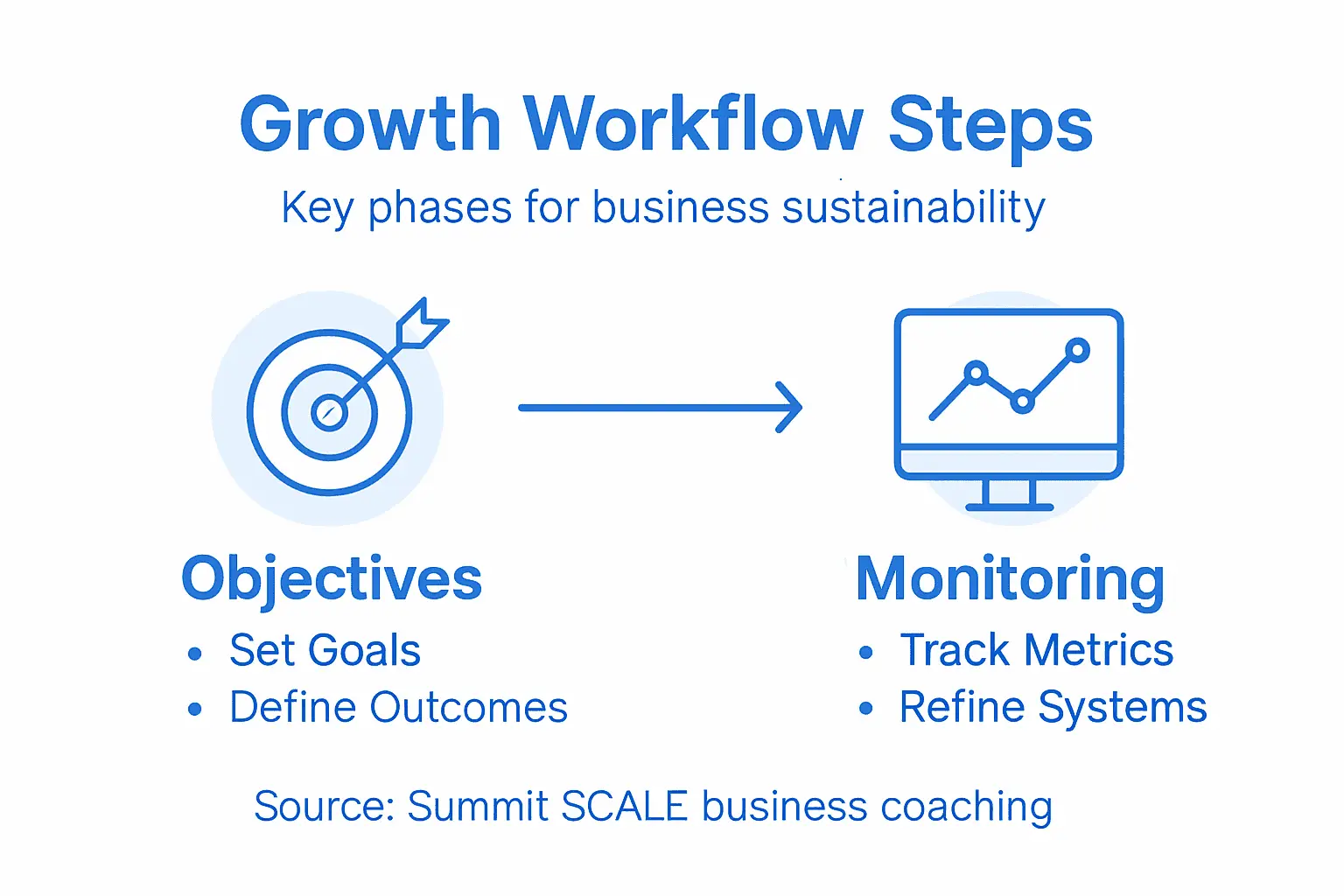
Begin by establishing clear metrics tied to each growth strategy. If you’re pursuing new customer acquisition, track conversion rates and customer acquisition cost. If you’re focusing on product launches, monitor adoption rates and revenue contribution. Your metrics should connect directly to your growth objectives.
Effective progress tracking involves systematically monitoring tasks with visual tools like dashboards and milestone checklists to ensure projects stay aligned with objectives and deadlines. Continuous tracking helps you identify issues early, enabling timely adjustments before small problems become major obstacles.
Set up a simple review rhythm. Monthly reviews work well for most businesses, though rapid-growth organisations may prefer fortnightly check-ins. During these reviews, examine your key metrics and ask three critical questions:
- Are we on track against our targets?
- Where are we experiencing bottlenecks or unexpected resistance?
- What adjustments do we need to make this month to stay aligned?
Business process monitoring provides real-time insights that enable teams to detect bottlenecks, make data-driven adjustments, and continually optimise processes. This ongoing refinement enhances productivity and supports sustainable growth.
Refinement means you don’t treat your strategies as fixed. Markets shift, customer preferences evolve, and unexpected opportunities emerge. Your willingness to adjust tactics whilst staying committed to your objectives separates thriving businesses from stagnant ones.
Document what’s working and what isn’t. Share these insights with your team so everyone understands the why behind any adjustments. Transparency builds trust and keeps everyone pulling in the same direction.
Regular, honest monitoring reveals what’s truly driving growth rather than what you hoped would work.
Pro tip: Create a simple one-page dashboard showing your top three to five metrics. Review it weekly yourself, discuss it monthly with your team, and use it to guide conversations about what needs to change.
Empower Your Business Growth with Proven Strategic Coaching
If you are tackling challenges like setting clear growth objectives, aligning your team and resources, or implementing focused growth strategies you are not alone. Many business owners struggle to connect their ambitious goals with actionable steps while maintaining organisational alignment and tracking progress effectively. By embracing frameworks such as OKRs and utilising tools to assess your business systems, you can transform abstract ambitions into sustainable, measurable growth.
At Summit SCALE, we specialise in guiding entrepreneurs through precisely these challenges. Our tailored coaching helps you clarify your unique growth objectives and identify the resource gaps holding you back from scaling successfully. With expert support you gain clarity and confidence to execute targeted strategies while monitoring key metrics that keep you ahead of obstacles. Start driving long-term business growth with a proven process at your side.
Take the next step now by exploring our comprehensive business growth insights or schedule a free 15-minute assessment call at https://summitscale.biz. Let us help turn your vision into lasting business freedom with strategic coaching designed for your success.
Frequently Asked Questions
How do I define clear growth objectives for my business?
Defining clear growth objectives involves identifying what growth means for your business. Write down specific, measurable targets like increasing revenue by 15% in the next 12 months or improving customer retention rates by 10%.
What framework can I use to structure my growth objectives?
You can use the Objectives and Key Results (OKRs) framework to structure your growth objectives. Set qualitative objectives alongside measurable key results to ensure you have a clear path to achieve your goals.
How can I assess if my team is aligned with my growth objectives?
Conduct an audit of your people, processes, and capabilities to assess team alignment with growth objectives. Use the McKinsey 7-S Model to evaluate key areas, such as skills, structure, and shared values, and identify any gaps that need addressing.
What steps should I take to implement targeted growth strategies?
To implement targeted growth strategies, start by identifying two to three specific growth channels that align with your objectives. Define the actions needed, assign ownership within your team, and set measurable targets for each strategy.
How often should I monitor progress towards my growth objectives?
You should monitor progress towards your growth objectives regularly, ideally on a monthly basis. Establish key metrics to track and review them to identify bottlenecks and make necessary adjustments to stay on track.
What should I do if I need to refine my growth strategies?
If you need to refine your growth strategies, regularly document what is working and what isn’t, and communicate these insights with your team. Adjust your tactics according to market shifts or unexpected opportunities to maintain alignment with your growth objectives.
Recommended
- Master Business Coaching Workflow for Growth Success
- Business Growth Strategy Guide for Sustainable Success
- Sustainable Business Growth – Unlocking Lasting Value
- How to Grow Business: Proven Steps for Sustainable Success
- Managed Service Provider: Boosting Business Efficiency – CinchOps, Inc.
- Team Engagement Workflow: Boosting Collaboration and Fun – Blog

