
Most british business owners discover that nearly 60 percent of small companies hit a ceiling before reaching their true potential. Achieving real growth means more than working longer hours or chasing bigger deals. By understanding what makes your business scalable and profitable, you can develop strategies that put control back in your hands—not the other way around. This guide lays out practical steps trusted by successful American and Australian entrepreneurs who want to expand operations while increasing profits and claiming more personal freedom.
Table of Contents
- Step 1: Assess Current Capacity And Goals
- Step 2: Develop Scalable Sales Strategies
- Step 3: Build High-Performing Teams
- Step 4: Optimise Processes And Control Costs
- Step 5: Track Performance And Refine Approach
Quick Summary
| Key Insight | Explanation |
|---|---|
| 1. Assess operational capacity | Conduct regular evaluations of financial resources, human capital, and market positioning to identify strengths and weaknesses. |
| 2. Create scalable sales strategies | Standardise service offerings to streamline sales and reduce dependence on individual team members, ensuring consistent revenue generation. |
| 3. Foster high-performing teams | Build cohesive teams with complementary skills and shared goals, supported by transparent communication and performance incentives. |
| 4. Optimise processes and costs | Perform regular audits of workflows and financials to eliminate inefficiencies and maintain fiscal discipline across the organisation. |
| 5. Implement structured performance tracking | Develop comprehensive dashboards to monitor key metrics, facilitating informed adjustments and promoting a culture of continuous improvement. |
Step 1: Assess Current Capacity and Goals
Identifying your business’s current capacity and strategic objectives is a critical foundation for sustainable growth. This assessment provides a clear snapshot of your organisation’s strengths, limitations, and potential trajectories.
To begin, you’ll want to conduct a comprehensive evaluation of your existing operational capabilities. Business capability models offer a structured approach to understanding precisely what your organisation can achieve. This involves mapping out key functions, examining resource allocation, and identifying potential performance gaps. Consider analysing critical areas such as financial resources, human capital, technological infrastructure, and market positioning.
Quantitative performance tracking becomes essential during this process. By evaluating strategic performance variables, you can establish concrete benchmarks that reveal your current operational effectiveness. This means developing specific, measurable indicators that reflect your business’s actual performance against intended goals. Track metrics like revenue growth, customer acquisition rates, operational efficiency, and profit margins to gain meaningful insights into your current capacity.
Top Tip: Conduct this assessment quarterly to maintain dynamic awareness of your business’s evolving capabilities and strategic alignment.
Here is a summary of key business areas to assess for sustainable growth:
| Area of Assessment | What to Evaluate | Potential Impact |
|---|---|---|
| Financial Resources | Cash flow, reserves, funding access | Determines scaling capability |
| Human Capital | Team skills, size, leadership | Drives innovation and delivery |
| Technological Infrastructure | System reliability, scalability | Enables efficiency and access |
| Market Positioning | Brand strength, competitor analysis | Shapes opportunities and risks |
Step 2: Develop Scalable Sales Strategies
Scaling your sales approach is fundamental to transforming your business from a personalised service model to a robust, sustainable growth engine. This step focuses on creating systematic methods that can consistently generate revenue without exponentially increasing your operational workload.
One powerful approach is to productise your professional services by developing standardised, repeatable offerings. This means breaking down your unique service delivery into structured, systematised processes that can be easily replicated across multiple clients. By creating a clear framework that reduces dependency on individual team members, you create opportunities for more predictable and scalable sales outcomes.
To support this strategy, develop a comprehensive marketing plan that outlines detailed sales and promotional tactics. This involves identifying your target markets, defining your competitive advantages, establishing clear pricing structures, and creating measurable sales goals. Critically, track your return on investment for each sales initiative to ensure you are consistently focusing resources on the most effective growth strategies.
Top Tip: Regularly audit and refine your sales processes, removing complexity and automating repetitive tasks to maintain strategic agility and scalability.
The following table contrasts two common approaches to scaling a business:
| Approach | Benefits | Drawbacks |
|---|---|---|
| Productising Services | Predictable revenue, easier sales | May limit customisation |
| Bespoke Service Delivery | Tailored client solutions | Difficult to scale efficiently |
Step 3: Build High-Performing Teams
Creating a high-performing team is pivotal to scaling your business effectively, transforming your organisation from a collection of individuals to a dynamic, collaborative powerhouse. This step focuses on deliberately designing a team environment that maximises collective potential and drives sustainable growth.
Understanding the fundamental characteristics of high-performing team dynamics is crucial. Successful teams are not simply groups of talented individuals but interconnected networks with complementary skills, shared goals, and a culture of mutual accountability. This means intentionally recruiting team members whose strengths complement each other, establishing crystal clear objectives, and fostering an environment of trust and open communication.
To achieve this, develop robust systems for team engagement that go beyond traditional management approaches. Implement regular performance discussions, create transparent goal-setting frameworks, and design reward structures that incentivise both individual excellence and collaborative achievement. Encourage cross functional communication, provide continuous learning opportunities, and develop leadership capabilities at every level of your organisation.
Top Tip: Conduct quarterly team health assessments to proactively identify and address potential collaboration barriers before they impact performance.
Step 4: Optimise Processes and Control Costs
Streamlining your business operations and maintaining rigorous financial discipline are critical steps in creating a scalable enterprise that generates consistent profitability. This stage is about transforming your organisational infrastructure into a lean, efficient machine that maximises output while minimising unnecessary expenditure.

Process optimization requires a systematic approach to identifying and eliminating inefficiencies across your entire operational landscape. This means conducting a comprehensive audit of your current workflows, examining every touchpoint where time, resources, or financial capital might be unnecessarily consumed. Look critically at equipment utilisation, operating procedures, and control mechanisms to standardise processes, automate repetitive tasks, and create clear performance benchmarks that drive continuous improvement.
Furthermore, developing robust cost management strategies demands meticulous attention to financial details. Implement detailed tracking mechanisms that provide real-time insights into spending patterns, revenue streams, and potential areas of financial leakage. Regularly analyse your cost structures, challenge existing assumptions about necessary expenses, and create a culture of financial accountability where every team member understands their role in maintaining fiscal discipline.
Top Tip: Establish quarterly cost review sessions where you forensically examine every line item and challenge its continued necessity and value to your business growth strategy.
Step 5: Track Performance and Refine Approach
Transitioning from strategic planning to measurable execution requires a disciplined approach to performance tracking and continuous improvement. This crucial step transforms your business objectives from theoretical concepts into tangible, actionable outcomes that drive sustainable growth.
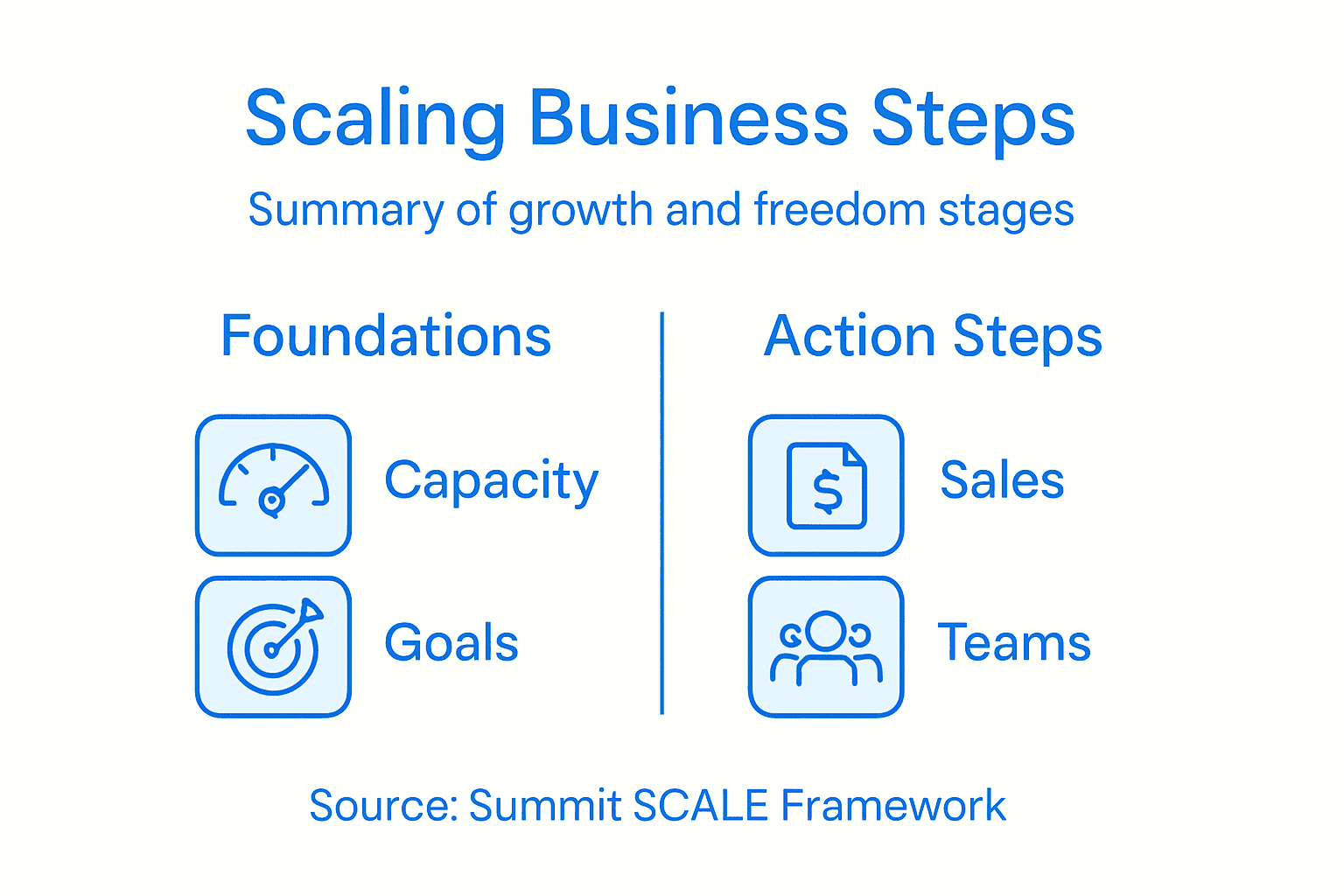
Performance management demands structured monitoring cycles that provide clear visibility into your organisational progress. This means establishing robust data collection mechanisms, creating meaningful performance indicators, and implementing regular review processes that allow for real-time insights and strategic adjustments. Focus on developing a comprehensive dashboard that captures key metrics across critical business dimensions such as financial performance, operational efficiency, customer satisfaction, and team productivity.
The art of refinement lies in transforming raw performance data into meaningful strategic intelligence. Conduct systematic quarterly reviews where you forensically analyse each performance metric, identifying not just the what of your results, but the underlying why. Create a culture of transparent feedback where team members are empowered to contribute insights, challenge existing approaches, and propose innovative solutions that can enhance overall business performance.
Top Tip: Implement a monthly performance retrospective where you celebrate wins, critically examine shortfalls, and collaboratively develop targeted improvement strategies.
Take Your Business Growth to the Next Level with Expert Coaching
Scaling a business presents complex challenges such as standardising sales processes, building high-performing teams, and maintaining cost control. If you find yourself struggling to move beyond daily management and want to create lasting growth and personal freedom, it is critical to adopt a systematic approach to these issues. Concepts like productising services, optimising processes, and tracking performance are essential but can be overwhelming without tailored guidance.
At Summit SCALE, we specialise in empowering business owners like you to overcome these exact pain points. Our professional coaching helps you focus on the strategic steps detailed in “How to Scale Business for Growth and Freedom” by streamlining sales, fostering team excellence, and driving financial discipline. Discover the freedom that comes from scalable, repeatable systems and targeted leadership development.
Start transforming your business today with our proven coaching framework.
Ready to scale effectively and reclaim your time and profits? Visit Summit SCALE now to schedule your free 15-minute assessment call and begin your journey towards sustainable growth and business freedom.
Frequently Asked Questions
What steps should I take to assess my business’s current capacity?
To assess your business’s current capacity, conduct a thorough evaluation of key operational capabilities, including financial resources, human capital, technological infrastructure, and market positioning. Begin by mapping out your existing functions and identifying performance gaps. Consider implementing this assessment quarterly to stay aligned with your evolving capabilities.
How can I develop scalable sales strategies for my business?
To develop scalable sales strategies, focus on productising your services by creating standardised offerings that can be easily replicated. Establish a comprehensive marketing plan that outlines your target markets and sets measurable sales goals. Regularly review and optimise your sales processes to enhance efficiency and adaptability.
What characteristics define a high-performing team?
A high-performing team is defined by interconnected members with complementary skills, shared goals, and a culture of accountability. To build such a team, intentionally recruit individuals whose strengths align, set clear objectives, and promote trust and open communication among members. Conduct quarterly team assessments to identify and address collaboration barriers.
How can I optimise my business processes and control costs?
To optimise business processes, conduct a comprehensive audit of workflows to identify inefficiencies and areas for improvement. Standardise processes and automate repetitive tasks to maximise efficiency. Establish quarterly cost review sessions to scrutinise every expense and promote a culture of financial accountability within your team.
What performance metrics should I track for refined approach?
For a refined approach, track key performance metrics related to financial health, operational efficiency, customer satisfaction, and team productivity. Create regular review processes to analyse these metrics in detail and identify areas for improvement. Implement a monthly performance retrospective to celebrate successes and collaboratively address any shortcomings.

