
Scaling a british service business often feels overwhelming when only one in ten companies consistently sustain growth past their initial expansion. For owners who have already beaten the odds and built a solid foundation, rising pressure to outperform competitors and achieve lasting profitability can lead to uncertainty. This guide lays out practical steps designed to help established british business owners pinpoint their growth stage, set clear targets, and confidently move toward strategic, sustainable success.
Table of Contents
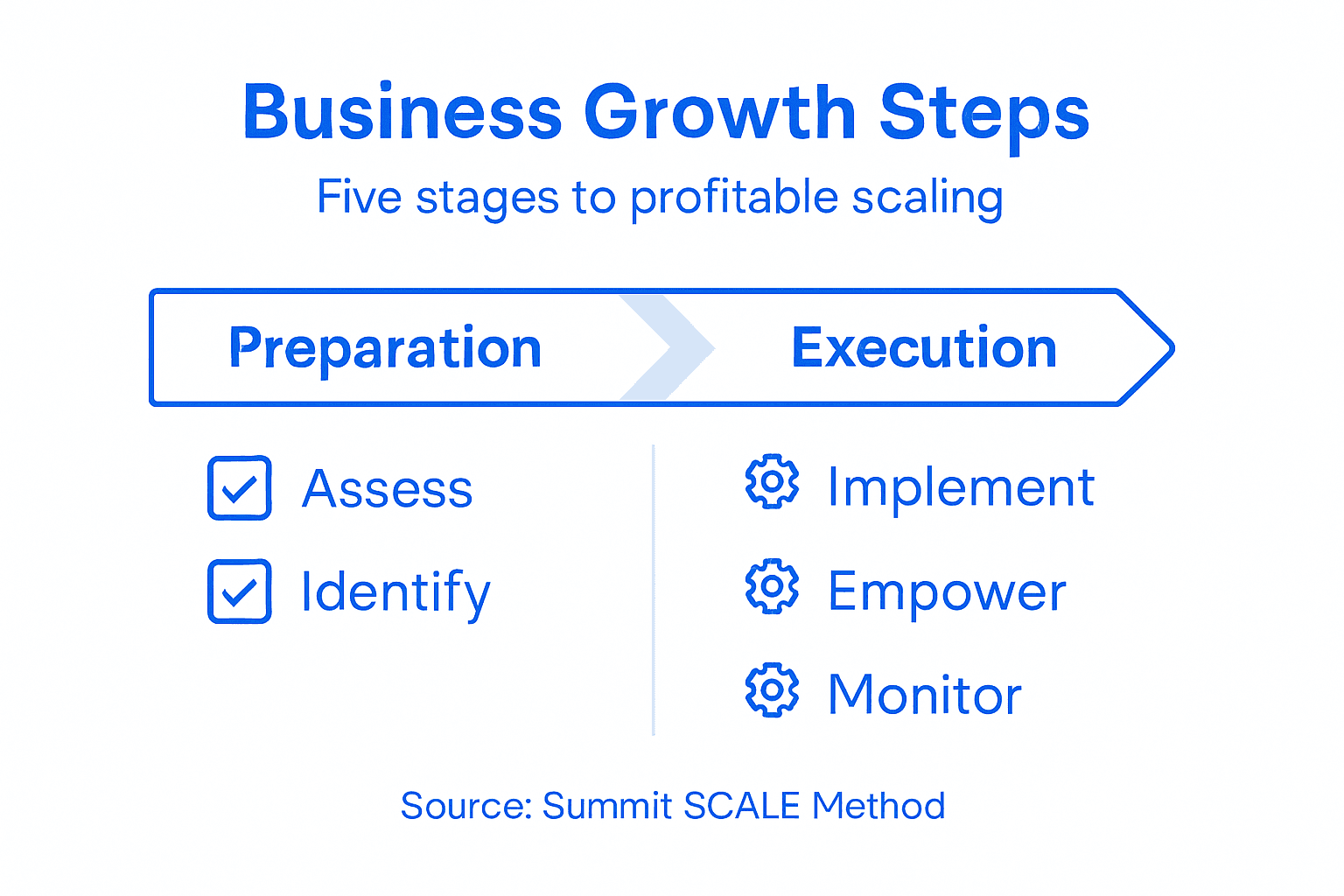
- Step 1: Assess Current Position And Set Growth Targets
- Step 2: Identify Key Areas For Strategic Improvement
- Step 3: Implement Targeted Systems And Processes
- Step 4: Develop And Empower High-Performing Teams
- Step 5: Monitor Progress And Refine Growth Strategies
Quick Summary
| Key Insight | Explanation |
|---|---|
| 1. Assess and Set Growth Targets | Conduct a comprehensive audit of performance to identify strengths and set realistic, measurable growth targets. |
| 2. Identify Strategic Improvement Areas | Use strategic frameworks to assess internal and external factors for targeting specific areas for improvement. |
| 3. Implement Flexible Systems and Processes | Document business processes and create adaptable systems that enhance efficiency while embracing continuous improvement. |
| 4. Develop High-Performing Teams | Foster trust and communication while investing in talent development to cultivate a motivated, high-performance workforce. |
| 5. Monitor and Adapt Growth Strategies | Establish a system for tracking performance metrics that informs strategic adjustments and supports an adaptive culture. |
Step 1: Assess Current Position and Set Growth Targets
Understanding your business’s current position is the foundation for strategic growth. By forecasting future performance, you will establish a clear roadmap for scaling your enterprise with precision and confidence.
Begin by conducting a comprehensive audit of your business performance. This means gathering data across multiple dimensions: financial metrics, sales performance, customer satisfaction, operational efficiency, and market positioning. Analyse your revenue streams, profit margins, customer acquisition costs, and team productivity. Look for patterns in your historical data that reveal strengths, weaknesses, and potential growth opportunities. Pay special attention to which products or services generate the most revenue and which customer segments demonstrate the highest potential for expansion.
Transition from analysis to strategy by developing a structured growth plan that connects your current position with ambitious yet achievable targets. Set specific, measurable goals that challenge your team while remaining realistic. These objectives should be time-bound and align with your broader business vision. Consider using the SMART framework (Specific, Measurable, Achievable, Relevant, Time-bound) to crystallise your growth targets and create a clear pathway for implementation.
Top Tip: Conduct a quarterly review of your growth targets to ensure they remain relevant and adjust your strategy proactively based on emerging market trends and internal performance metrics.
Here’s a summary of essential performance metrics for assessing business growth:
| Metric | Description | Business Value |
|---|---|---|
| Revenue Streams | Sources of income | Identifies growth engines |
| Profit Margins | Earnings after costs | Reveals profitability |
| Customer Acquisition Cost | Cost to win a new customer | Guides marketing spend |
| Team Productivity | Output per employee | Assesses operational health |
| Market Positioning | Standing relative to competitors | Shows competitive edge |
Step 2: Identify Key Areas for Strategic Improvement
Identifying strategic improvement areas is crucial for transforming your business from good to exceptional. By exploring applied research techniques, you will uncover precise opportunities for targeted growth and competitive advantage.
Begin by conducting a comprehensive strategic assessment using established frameworks that evaluate your business from multiple perspectives. Analyse strategic planning models to understand your organisation’s internal strengths and external market challenges. This involves examining key performance indicators across different business dimensions such as financial performance, operational efficiency, customer satisfaction, market positioning, and team capabilities. Look for gaps between your current performance and desired outcomes, identifying areas where strategic interventions could yield significant improvements.
Transform your insights into actionable strategies by prioritising improvement areas based on their potential impact and feasibility. Focus on initiatives that align with your core business objectives while offering meaningful growth potential. This might include investing in technology upgrades, refining marketing strategies, enhancing customer experience, optimising operational processes, or developing new revenue streams. Remember that strategic improvements are not about radical changes but calculated, incremental enhancements that compound over time.
Top Tip: Create a structured scorecard that tracks progress across your identified strategic improvement areas, enabling regular monitoring and adaptive adjustments.
This table compares popular strategic assessment frameworks and their suitable uses:
| Framework | Primary Focus | Best Use Case |
|---|---|---|
| SWOT Analysis | Strengths, Weaknesses | Internal/External review |
| PESTLE | Market and environment | External trend assessment |
| Balanced Scorecard | Performance metrics | Strategic KPI tracking |
Step 3: Implement Targeted Systems and Processes
Implementing strategic systems and processes is the backbone of sustainable business growth. By bridging business models with processes, you will transform your organisational infrastructure into a dynamic engine of efficiency and innovation.

Begin by comprehensively documenting your current business processes, identifying areas that require systematic improvement. Adopt sustainable business process management approaches that enable continuous refinement and adaptation. This involves creating detailed workflow maps, establishing clear performance metrics, and designing standardised procedures that streamline operations across different departments. Pay close attention to technology integration, looking for opportunities to automate repetitive tasks, reduce human error, and enhance overall productivity. Consider implementing digital tools that provide real-time tracking, facilitate communication, and offer actionable insights into your operational performance.
Ensure your new systems are flexible and scalable by developing robust implementation strategies that allow for incremental changes. Focus on creating processes that can evolve with your business, rather than rigid structures that might become obsolete. This means building in feedback mechanisms, regular performance reviews, and the ability to quickly adjust workflows in response to changing market conditions or internal growth requirements.
Top Tip: Document each process implementation thoroughly, creating a living manual that becomes an invaluable resource for training new team members and maintaining consistent operational standards.
Step 4: Develop and Empower High-Performing Teams
Building exceptional teams is fundamental to achieving sustainable business growth. By understanding high-performance team dynamics, you will transform your workforce into a powerful engine of innovation and productivity.
Commence by establishing a robust foundation of trust and transparent communication. Creating healthy team ecosystems requires deliberate investment in collective development. This means designing clear performance frameworks, implementing regular feedback mechanisms, and creating opportunities for skill enhancement and collaborative problem solving. Focus on recruiting individuals who not only possess technical competence but also demonstrate strong interpersonal skills and alignment with your organisational values. Encourage open dialogue, recognise individual contributions, and create an environment where team members feel empowered to share ideas and take calculated risks.
Develop a comprehensive talent development strategy that supports continuous learning and professional growth. This involves creating personalised development plans, providing access to training resources, mentorship programmes, and opportunities for cross functional collaboration. Prioritise building a culture of mutual respect, where diverse perspectives are valued and team members are motivated to contribute their best work. Remember that high-performing teams are not born but carefully cultivated through intentional leadership and strategic human resource management.
Top Tip: Implement a quarterly skills assessment and development review to ensure your team remains adaptable, motivated, and aligned with evolving business objectives.
Step 5: Monitor Progress and Refine Growth Strategies
Tracking and adapting your business growth strategy is essential for sustained success. By building a comprehensive growth plan, you will create a dynamic framework that enables continuous improvement and strategic responsiveness.
Implement a robust monitoring system that captures comprehensive performance data across multiple dimensions. Evaluate strategic planning frameworks to establish meaningful key performance indicators that provide genuine insights into your business trajectory. These metrics should encompass financial performance, operational efficiency, customer satisfaction, market positioning, and team productivity. Develop a dashboard that presents these indicators in a clear, visual format, allowing you to quickly identify trends, strengths, and potential areas requiring intervention. Schedule regular review sessions where leadership can critically analyse these metrics, discuss implications, and collaboratively develop responsive strategies.
Cultivate a culture of adaptive learning within your organisation. This means viewing performance data not as a static report but as a dynamic tool for strategic refinement. Be prepared to pivot quickly when certain strategies are not delivering expected results. Encourage open dialogue about performance challenges, celebrate incremental successes, and maintain flexibility in your approach. Your growth strategy should be a living document that evolves with your business, market conditions, and emerging opportunities.
Top Tip: Implement a quarterly strategic review process that combines quantitative performance metrics with qualitative team insights to ensure a holistic approach to business growth.
Unlock Profitable Business Growth with Expert Coaching
Growth is not just about ambition it requires a clear strategy, targeted systems, and empowered teams just like the steps outlined in the article “Step by Step Business Growth: Achieve Profitable Scaling” emphasise. If you find yourself challenged by setting realistic growth targets, refining your business processes, or building high-performing teams Summit SCALE provides tailored coaching solutions designed precisely to conquer these hurdles. We understand the pressure you face to boost profitability while gaining more time and freedom.
Our expert coaches guide you through proven frameworks and personalised strategies to track your progress and adjust plans dynamically. Whether it is clarifying your growth roadmap or developing robust systems backed by actionable insights we help you make measured, confident decisions that transform your business trajectory.
Experience the power of professional guidance today Discover how Summit SCALE can transform your business.
Ready to take control of your business growth journey with a clear, profit-driven plan? Schedule your free 15-minute assessment call now at Summit SCALE and start turning strategic goals into tangible success.
Frequently Asked Questions
How can I assess my current business position before scaling?
To assess your current business position, conduct a comprehensive audit of your performance metrics, including financials, sales, and customer satisfaction. Gather data to identify your strengths and weaknesses, and pinpoint opportunities for growth.
What are SMART goals and how can they help in business growth?
SMART goals are Specific, Measurable, Achievable, Relevant, and Time-bound objectives that guide your growth strategy. By setting these types of goals, you create clear benchmarks for success, making it easier to track progress and make necessary adjustments.
What frameworks can I use to identify areas for strategic improvement?
Utilise frameworks like SWOT analysis or PESTLE to evaluate your business’s strengths and weaknesses, and understand external market pressures. Prioritise areas for improvement that align with your core objectives and have the highest potential for impact.
How do I implement effective processes for my growing business?
Begin by documenting your current processes to identify inefficiencies and areas needing enhancement. Implement standardised procedures and consider automation to improve operational efficiency, aiming to streamline workflows across departments.
What strategies can I employ to build high-performing teams?
Focus on fostering a culture of trust and open communication within your teams. Develop clear performance frameworks and provide ongoing training opportunities to empower team members, ensuring they are aligned with your business values and objectives.
How can I monitor progress and refine my business growth strategy?
Implement a robust monitoring system that captures key performance indicators across different business dimensions. Schedule regular review sessions to analyse the data and adapt your strategies as needed, ensuring you remain responsive to changing market conditions.
Recommended
- Three Fundamentals of Scaling for Growth – Summit Scale
- Levers for Profit Growth | Summit SCALE® Coaching
- On the Changes in Thinking Required to Scale – Summit Scale
- 4 Ways Your Company Can Begin to Grow Again – Summit Scale
- Step by Step Website Launch Guide for Businesses – ResponsiveWebsiteDesign
- Employee Retention Solutions | Reduce Turnover | OpenElevator

