
Running a retail business in the United Kingdom or Australia means constantly adapting to stay ahead of shifting trends and customer expectations. Without a clear understanding of your sales performance and a strategy for targeting profitable customers, growing revenue can feel out of reach. Measuring business performance is a critical foundation for making informed decisions, revealing both hidden strengths and untapped opportunities that professional coaching can help you maximise.
Table of Contents
- Step 1: Assess Current Sales Performance
- Step 2: Identify High-Value Customer Segments
- Step 3: Optimise Product And Pricing Strategy
- Step 4: Implement Targeted Sales Campaigns
- Step 5: Track Results And Refine Approach
Quick Summary
| Key Message | Explanation |
|---|---|
| 1. Assess Sales Performance Regularly | Gather data on key metrics to understand current sales health and identify growth obstacles. |
| 2. Focus on High-Value Customer Segments | Analyse customer data to target the most profitable groups, allowing for tailored marketing efforts. |
| 3. Implement a Tiered Pricing Strategy | Use a Good-Better-Best model to create product offerings that cater to different customer segments and maximise revenue. |
| 4. Develop Targeted Sales Campaigns | Utilise data-driven campaigns with advanced technology for personalised engagement with specific customer segments. |
| 5. Regularly Track and Refine Strategies | Establish a robust tracking system for sales and marketing performance with a review process for continuous improvement. |
Step 1: Assess current sales performance
Understanding your retail business’s sales performance is a critical foundation for strategic growth. By thoroughly measuring business performance, you will create accountability and identify potential obstacles preventing revenue expansion.
To effectively assess your current sales performance, start by gathering comprehensive data from multiple sources. Review the Monthly Retail Trade Sales Report to understand broader industry trends and compare your business metrics against national benchmarks. Key performance indicators to track include total revenue, average transaction value, sales conversion rates, and year-over-year growth percentages. Break down your sales data by product category, customer segment, and sales channel to gain granular insights into your business’s performance.
Analyse historical sales data looking for patterns such as seasonal fluctuations, customer purchasing behaviours, and potential market opportunities. Pay attention to which products or services generate the most revenue and which might require strategic repositioning. Cross reference your internal data with industry reports to validate your findings and identify potential areas for improvement.
Top tip: Create a standardised monthly sales performance dashboard that automatically compiles key metrics, enabling quick and consistent performance tracking.
The following table summarises key sales performance metrics and their strategic significance:
| Metric | What It Measures | Strategic Significance |
|---|---|---|
| Total Revenue | Overall sales income | Indicates overall business health |
| Average Transaction Value | Spend per transaction | Reveals upselling opportunities |
| Conversion Rate | Percentage of shoppers who buy | Highlights sales effectiveness |
| Year-on-Year Growth | Sales change over time | Shows growth trends or issues |
Step 2: Identify high-value customer segments
Understanding and targeting your most profitable customer groups is essential for driving retail business growth. Customer segmentation strategies enable you to focus your resources on the most lucrative market opportunities and create tailored marketing approaches that maximise revenue potential.
To identify high-value customer segments, begin by analysing your existing customer data through multiple lenses. Look beyond basic demographics to understand purchasing behaviours, lifetime value, frequency of transactions, and profit margins. Consider strategic frameworks for choosing the right customers that help you define which segments create the most value for your business. Break down your customer base into distinct groups based on criteria such as average transaction value, repeat purchase rates, product preferences, and responsiveness to marketing campaigns.
Use sophisticated data analysis techniques to map out your customer segments and understand their unique characteristics. This might involve creating customer personas, tracking purchasing patterns, and developing targeted marketing strategies for each high-potential group. Pay close attention to customers who not only generate high revenue but also demonstrate loyalty and potential for long-term engagement.
Top tip: Invest in a robust customer relationship management system that can automatically track and analyse customer segmentation metrics in real-time.
Step 3: Optimise product and pricing strategy
Developing a strategic approach to pricing and product offerings is crucial for maximising your retail business’s revenue potential. Effective pricing strategies enable you to align your product value with customer perceptions while driving sustainable business growth.

Implement a Good-Better-Best pricing approach that creates differentiated product packages catering to various customer segments. This strategy involves carefully designing three distinct tiers of products or services with progressively enhanced features and corresponding price points. By structuring your offerings strategically, you can prevent customer downgrading while simultaneously encouraging premium tier purchases. Analyse your existing product range and identify opportunities to create clear value propositions for each pricing level.
Continuously monitor market dynamics and be prepared to adjust your pricing strategy dynamically. This means regularly reviewing your pricing structure, tracking customer responses, and being willing to make data driven modifications. Consider factors such as production costs, competitor pricing, customer perceived value, and market demand when refining your approach. Leverage data analytics to understand which pricing configurations generate the most attractive profit margins and customer engagement.
Top tip: Conduct periodic customer surveys and analyse purchasing behaviour to validate and refine your tiered pricing strategy.
Here is a comparison of three product and pricing strategy tiers and their typical business outcomes:
| Tier | Customer Focus | Expected Outcome |
|---|---|---|
| Good | Price-sensitive buyers | Drives higher sales volume |
| Better | Value-seeking customers | Balances margin and satisfaction |
| Best | Premium segment | Maximises profit per sale |
Step 4: Implement targeted sales campaigns
Crafting precision-driven sales campaigns is essential for transforming your retail business’s revenue potential. Digital marketing skills enable you to create compelling strategies that attract and engage specific customer segments with laser focused precision.
Leverage advanced technologies to develop sophisticated campaign approaches. Artificial intelligence marketing tools now allow unprecedented levels of personalisation by analysing consumer data and dynamically adjusting messaging. Begin by developing detailed customer personas that capture demographic information, purchasing behaviours, and unique preferences. This granular understanding will help you design campaigns that speak directly to each segment’s motivations and needs.
Structure your sales campaigns using a multi channel approach that combines digital platforms such as email marketing, social media targeting, and personalised content strategies. Track campaign performance meticulously through robust analytics tools, measuring key metrics like conversion rates, customer engagement, and return on investment. Be prepared to iterate quickly based on real time data insights, continuously refining your approach to maximise campaign effectiveness.
Top tip: Create a centralised marketing dashboard that aggregates performance metrics across all campaign channels for rapid strategic adjustments.
Step 5: Track results and refine approach
Measuring and interpreting your business performance is crucial for sustained growth and strategic adaptation. Retail analytics software provides powerful tools to transform raw data into actionable insights that drive continuous improvement.
Implement a comprehensive tracking system that goes beyond basic sales figures. Optimise your sales performance by monitoring intermediate metrics such as lead qualification rates, customer acquisition costs, conversion percentages, and average transaction values. Create a robust dashboard that aggregates data from multiple sources including sales channels, marketing campaigns, customer feedback, and operational performance. This holistic approach allows you to identify both strengths and potential areas for strategic refinement.
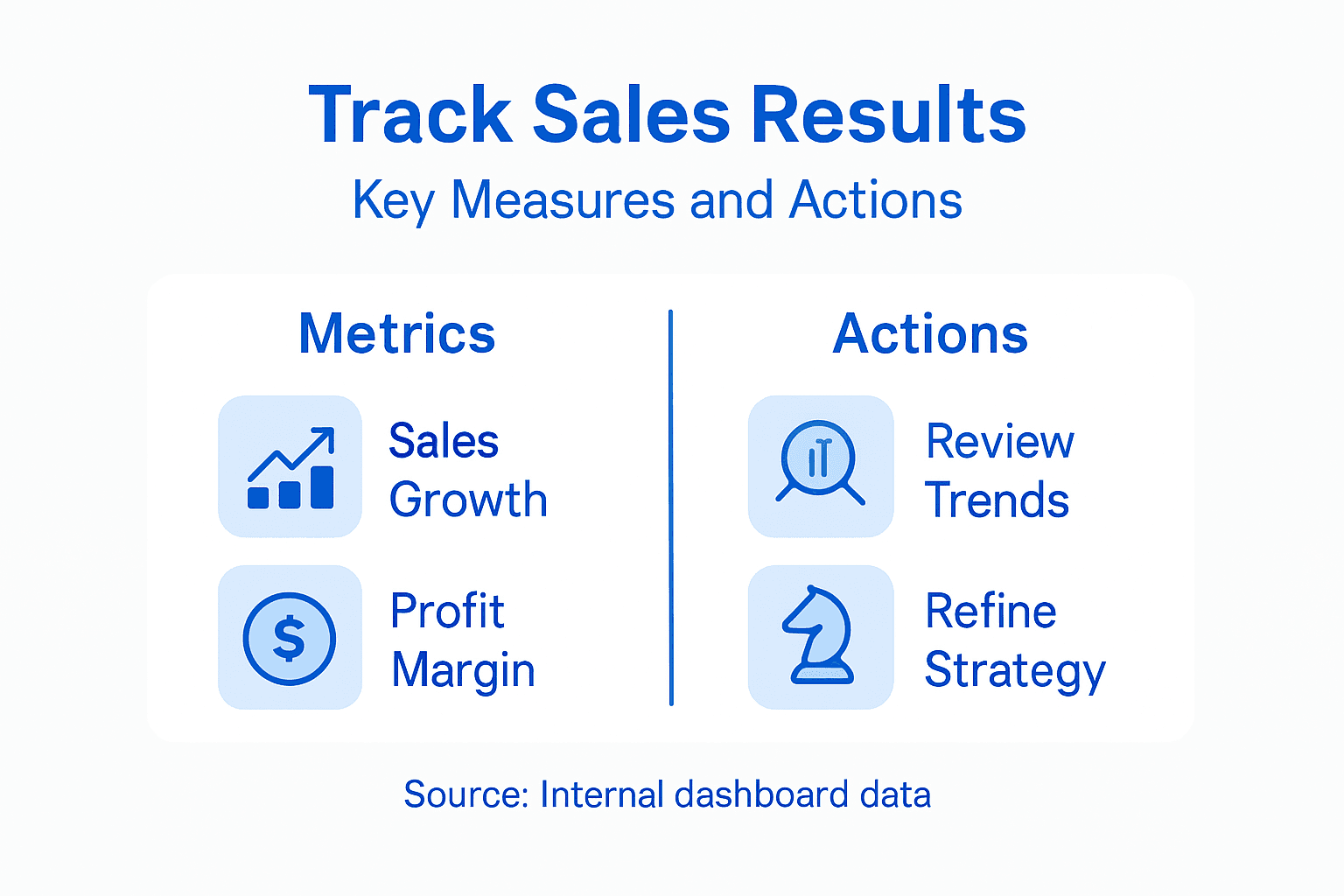
Develop a systematic review process where you analyse performance data at regular intervals monthly or quarterly. Look for emerging patterns, unexpected trends, and potential opportunities for innovation. Be prepared to make swift adjustments to your strategies based on empirical evidence. This might involve reallocating resources, modifying marketing approaches, or retraining your sales team to address specific performance gaps.
Top tip: Establish a quarterly performance review ritual where your entire team collaboratively interprets data and brainstorms improvement strategies.
Unlock Your Retail Business Growth Potential with Expert Coaching
If you are striving to grow sales revenue but feel challenged by complex customer segmentation, pricing optimisation, or targeted sales campaigns, you are not alone. The article outlined critical steps like assessing sales performance, identifying high-value customer segments, and refining pricing strategies — areas where many retail business owners struggle to find clarity and implement effective actions. Without professional guidance, it can be overwhelming to translate these strategic concepts into tangible business growth, risking missed opportunities and stalled revenue.
Summit SCALE specialises in empowering retail entrepreneurs through personalised business coaching tailored to overcome exactly these pain points. Our proven methods help you build a strategic sales framework, optimise your product and pricing models, and harness data-driven marketing campaigns that convert. By partnering with Summit SCALE, you gain more than advice — you gain accountability, actionable plans, and ongoing support to transform insights into profit and freedom.
Take the next step to elevate your retail business success today.
Ready to break through growth barriers and scale your retail sales?
Explore how our coaching services can guide you through each strategic step outlined in the article. Visit Summit SCALE to book your free 15-minute assessment call. Discover practical ways to improve your sales dashboard, sharpen customer targeting, and fine-tune pricing strategies that boost your bottom line. Don’t wait for another month of missed revenue. Start transforming your retail business now with professional coaching designed for ambitious entrepreneurs.
Learn more about our approach at Summit SCALE and take charge of your business growth journey today.
Frequently Asked Questions
How can I assess my retail business’s current sales performance?
To assess your retail business’s sales performance, gather data from multiple sources, including industry reports and your internal metrics. Start by tracking key performance indicators like total revenue, average transaction value, and conversion rates to identify strengths and areas for improvement.
What are effective strategies for identifying high-value customer segments?
Identifying high-value customer segments involves analysing your existing customer data to understand purchasing behaviours, lifetime value, and transaction frequency. Use this information to create distinct customer profiles and tailor your marketing strategies towards your most profitable groups.
How do I optimise my product and pricing strategy?
Optimising your product and pricing strategy includes implementing a tiered pricing approach that offers different product packages based on features and price. Continuously monitor market dynamics and customer responses to fine-tune your pricing structure and maximise profit margins.
What steps should I take to implement targeted sales campaigns?
To implement targeted sales campaigns, develop detailed customer personas based on demographic information and purchasing behaviours. Use a multi-channel approach to reach your audience effectively, and track campaign performance closely to refine your strategies for better results.
How can I effectively track and measure sales results?
To effectively track and measure sales results, establish a comprehensive system that goes beyond basic figures, including metrics like customer acquisition costs and conversion percentages. Regularly review this data to identify patterns and adjust your strategies accordingly for improved performance.
What should I include in my sales performance dashboard?
Your sales performance dashboard should include key metrics like total revenue, sales conversion rates, and average transaction values. By aggregating data from various sources, you can easily identify trends and areas for improvement, allowing for quick adjustments to your strategy.

