
Every small business leader in the United Kingdom and Australia faces misleading advice about what drives true, lasting growth. Questions around balancing profits with resource efficiency and social impact often spark confusion, yet these discussions have never been more relevant. Unpacking the myths of sustainable business growth reveals practical strategies that help you build lasting success while enhancing your freedom as an owner.
Table of Contents
- Defining Sustainable Business Growth and Common Myths
- Variations: Economic, Social, and Environmental Growth
- Core Characteristics and How It Works
- Essential Strategies for Achieving Sustainable Growth
- Risks, Pitfalls, and Mistakes to Avoid
Key Takeaways
| Point | Details |
|---|---|
| Sustainable Growth Combines Profit and Responsibility | Organisations can enhance both profitability and sustainability through innovative strategies that create economic and social value. |
| Tailored Approaches are Essential | Each industry requires customised strategies to effectively integrate sustainable practices into their core operations. |
| Long-Term Perspective Outweighs Short-Term Costs | Investing in sustainability leads to long-term benefits that surpass immediate costs, contributing to enduring competitive advantages. |
| Avoid Common Pitfalls | Businesses should be wary of superficial commitments to sustainability and focus on genuine, measurable initiatives to ensure real progress. |
Defining Sustainable Business Growth and Common Myths
Sustainable business growth represents a strategic approach that balances economic performance with long-term organisational resilience. Unlike traditional growth models focused purely on financial metrics, this approach integrates economic efficiency, social responsibility, and environmental stewardship.
At its core, sustainable business growth challenges several prevalent myths about organisational development. Many business owners mistakenly believe that profitability and sustainability are mutually exclusive. However, recent research on ESG frameworks demonstrates that corporations can successfully create both economic and social value.
Key misconceptions about sustainable business growth include:
Here is a summary of how common sustainable growth myths differ from reality:
| Myth | Reality | Strategic Implication |
|---|---|---|
| Sustainability reduces profits | Many firms boost profitability with sustainability | Invest in sustainable operations for long-term gains |
| Sustainability is too complex | Scalable, phased strategies exist | Start small and scale sustainability initiatives |
| Only short-term costs matter | Long-term value far outweighs costs | Focus on enduring competitive advantage |
| One approach fits all | Each industry needs tailored solutions | Adapt strategies to market and sector needs |
- Financial Performance Myth: The belief that sustainable practices reduce profitability
- Complexity Barrier: Assuming sustainable strategies are too complicated to implement
- Short-term Cost Perspective: Viewing sustainability investments as expenses rather than strategic opportunities
- One-size-fits-all Approach: Thinking identical strategies work across different industries
Successful sustainable growth requires a nuanced understanding that goes beyond traditional shareholder value maximisation. Business owners must develop holistic strategies that consider economic resilience, workforce development, environmental impact, and social equity.
The most effective sustainable growth models integrate multiple dimensions:
- Economic Performance
- Social Responsibility
- Environmental Stewardship
- Innovation and Adaptability
- Long-term Strategic Planning
Pro tip: Begin by conducting a comprehensive audit of your current business practices to identify sustainable growth opportunities and potential inefficiencies.
Variations: Economic, Social, and Environmental Growth
Sustainable business growth transcends traditional financial metrics by integrating three critical dimensions: economic performance, social responsibility, and environmental stewardship. Sustainable development integrates complex interconnected goals that balance present needs with future generational requirements.
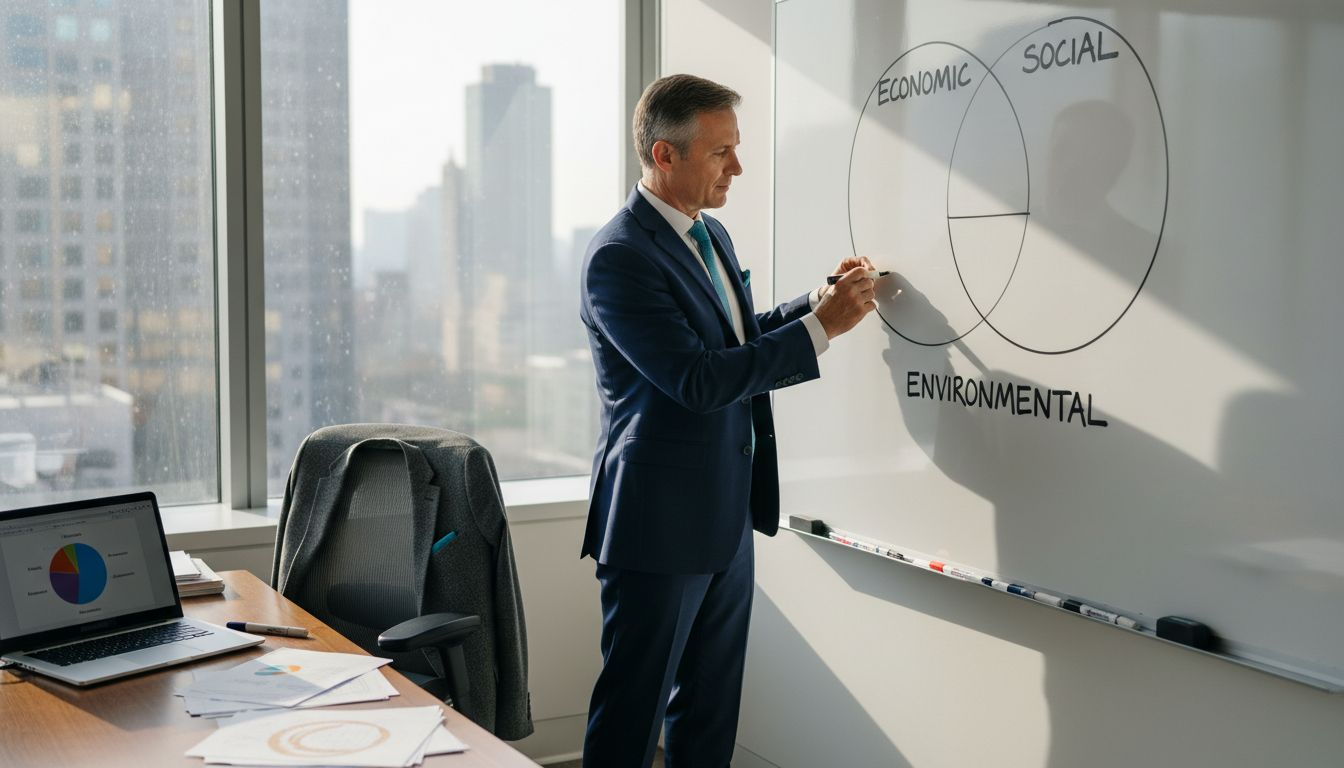
Each dimension of sustainable growth plays a unique yet interconnected role in organisational strategy:
This table clarifies the distinct focus and beneficial outcomes of economic, social, and environmental growth in business:
| Growth Type | Main Focus | Key Organisational Benefit |
|---|---|---|
| Economic | Profitability and expansion | Financial resilience and market share |
| Social | Workforce and community impact | Positive reputation, talent retention |
| Environmental | Resource and footprint reduction | Regulatory compliance, risk management |
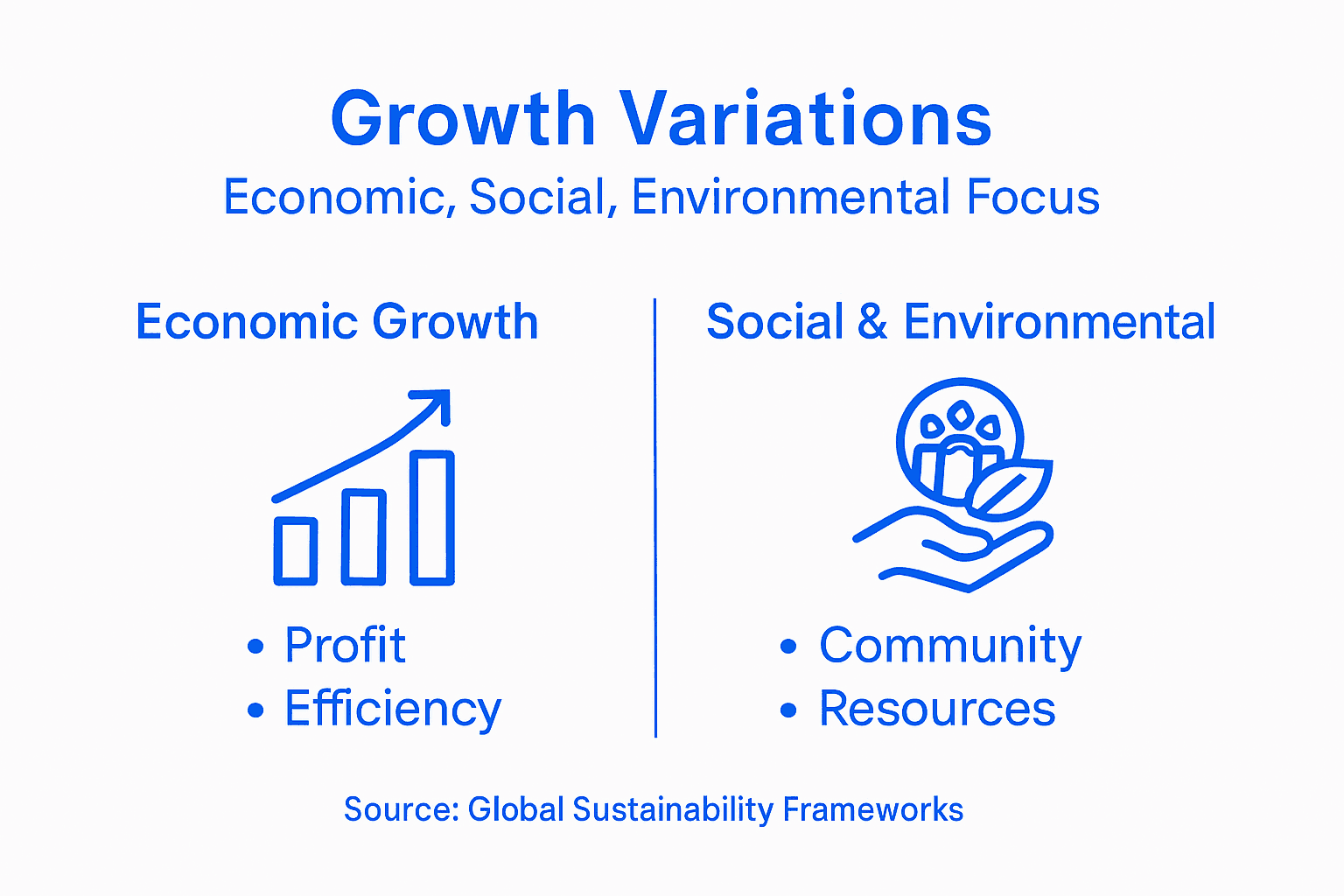
- Economic Growth: Focuses on financial performance, profitability, and market expansion
- Social Growth: Emphasises workforce development, community engagement, and ethical practices
- Environmental Growth: Prioritises ecological sustainability, resource efficiency, and carbon footprint reduction
Government policies and global frameworks significantly influence these growth variations. Government support for sustainable innovation remains crucial in driving technological advancements and creating supportive ecosystems for sustainable business models.
Business leaders must recognise that these dimensions are not competing priorities but interdependent strategies. Successful organisations develop holistic approaches that simultaneously address economic performance, social equity, and environmental preservation.
Key strategies for integrating these growth variations include:
- Developing comprehensive sustainability metrics
- Investing in renewable technologies
- Creating inclusive workforce development programmes
- Implementing circular economy principles
- Establishing transparent reporting mechanisms
Pro tip: Conduct a thorough sustainability audit to identify opportunities for balanced growth across economic, social, and environmental dimensions.
Core Characteristics and How It Works
Sustainable business growth is a dynamic framework that integrates strategic planning, operational efficiency, and long-term value creation. Sustainable business practices leverage ESG criteria to enhance organisational resilience and drive meaningful transformation across multiple business dimensions.
The core characteristics of sustainable business growth are built on several fundamental principles:
- Systemic Thinking: Viewing the organisation as an interconnected ecosystem
- Stakeholder Alignment: Balancing interests of employees, customers, investors, and communities
- Continuous Innovation: Adapting and evolving business models to meet changing market demands
- Transparent Reporting: Maintaining clear communication about organisational performance and impact
This approach differs fundamentally from traditional growth models by emphasising holistic value creation. Instead of focusing solely on financial metrics, sustainable business growth considers the broader implications of organisational decisions on economic, social, and environmental systems.
The operational mechanics of sustainable growth involve several key strategic components:
- Comprehensive data collection and analysis
- Regular performance benchmarking
- Proactive risk management
- Strategic resource allocation
- Continuous learning and adaptation
Businesses implementing this approach typically develop robust frameworks that integrate:
- Advanced monitoring systems
- Flexible strategic planning
- Agile response mechanisms
- Long-term sustainability metrics
Pro tip: Develop a cross-functional sustainability team that can effectively bridge strategic planning with operational execution.
Essential Strategies for Achieving Sustainable Growth
Achieving sustainable business growth requires a multifaceted approach that integrates strategic planning, innovative thinking, and holistic performance management. Policy frameworks supporting sustainable innovation play a critical role in creating an ecosystem that encourages long-term organisational resilience and adaptability.
The core strategies for sustainable growth encompass several key dimensions:
- Stakeholder Value Creation: Developing solutions that benefit multiple organisational stakeholders
- Regenerative Business Models: Moving beyond minimising harm to actively creating positive impact
- Continuous Innovation: Consistently adapting and evolving business approaches
- Transparent Performance Measurement: Establishing clear, comprehensive reporting mechanisms
Sustainable business strategies emphasise embedding environmental and social criteria directly into business planning, transforming traditional operational paradigms.
Practical implementation of these strategies involves:
- Conducting comprehensive sustainability assessments
- Developing cross-functional collaboration frameworks
- Investing in employee training and development
- Creating adaptable technological infrastructures
- Establishing robust risk management protocols
Businesses can further enhance their sustainable growth by:
- Embracing digital transformation
- Prioritising circular economy principles
- Developing long-term strategic partnerships
- Maintaining flexibility in organisational design
Pro tip: Create a dedicated sustainability dashboard that tracks progress across economic, social, and environmental performance metrics.
Risks, Pitfalls, and Mistakes to Avoid
Sustainable business growth requires sophisticated navigation of complex challenges that can potentially derail organisational progress. Sustainable business practices reveal critical implementation risks that demand strategic awareness and proactive management.
The most significant risks and pitfalls in sustainable business growth include:
- Greenwashing: Creating superficial sustainability claims without genuine commitment
- Resource Misallocation: Investing in unsustainable or ineffective initiatives
- Inadequate Measurement: Failing to establish robust performance tracking mechanisms
- Stakeholder Misalignment: Neglecting diverse stakeholder perspectives and needs
Businesses frequently encounter complex challenges that can compromise their sustainability efforts. These challenges often emerge from:
- Insufficient strategic planning
- Limited understanding of comprehensive sustainability frameworks
- Resistance to fundamental organisational transformation
- Lack of long-term investment perspective
- Inadequate skills and capabilities within existing teams
Critical mistakes to avoid during sustainable growth implementation include:
- Treating sustainability as a compliance exercise
- Overlooking supply chain complexity
- Underestimating cultural change requirements
- Focusing solely on short-term financial metrics
- Neglecting continuous learning and adaptation
Pro tip: Develop a comprehensive sustainability maturity model that objectively assesses and tracks your organisation’s progression across multiple dimensions.
Drive Sustainable Business Growth with Expert Guidance
Unlocking lasting value through sustainable business growth requires strategic clarity and practical action. If you are navigating challenges like balancing profitability with social responsibility or avoiding common pitfalls such as greenwashing and ineffective resource allocation, know that expert help is available. By integrating economic performance, social impact, and environmental stewardship into your growth plans you position your business for resilience and long-term success.
Summit SCALE understands these complexities and offers tailored business coaching that empowers you to implement proven sustainable strategies. With a focus on holistic development, from sales growth to team building and cost control, our coaching helps you create real, measurable value. Begin transforming your business by exploring insights in our Business Growth Archives – Summit Scale and learn how to link sustainable principles with profitability.
Start your journey towards enduring sustainable growth today. Schedule a free 15-minute assessment to uncover personalised strategies that balance economic, social, and environmental goals. Take the next step in scaling your business with confidence at Summit SCALE. Discover fresh perspectives through our Business Coach Archives – Summit Scale and make your sustainable growth vision a reality.
Frequently Asked Questions
What is sustainable business growth?
Sustainable business growth refers to a strategic approach that balances economic performance with long-term organisational resilience, integrating economic efficiency, social responsibility, and environmental stewardship.
How can sustainability enhance profitability?
Sustainability can enhance profitability by improving operational efficiency, attracting customers who value ethical practices, and fostering innovation, ultimately leading to greater financial resilience and market share.
What are the key dimensions of sustainable growth?
The key dimensions of sustainable growth include economic performance, social responsibility, and environmental stewardship, each playing a unique and interconnected role in organisational strategy.
What common pitfalls should businesses avoid when pursuing sustainable growth?
Common pitfalls include greenwashing, resource misallocation, inadequate performance measurement, and neglecting diverse stakeholder perspectives, all of which can undermine genuine sustainability efforts.

