
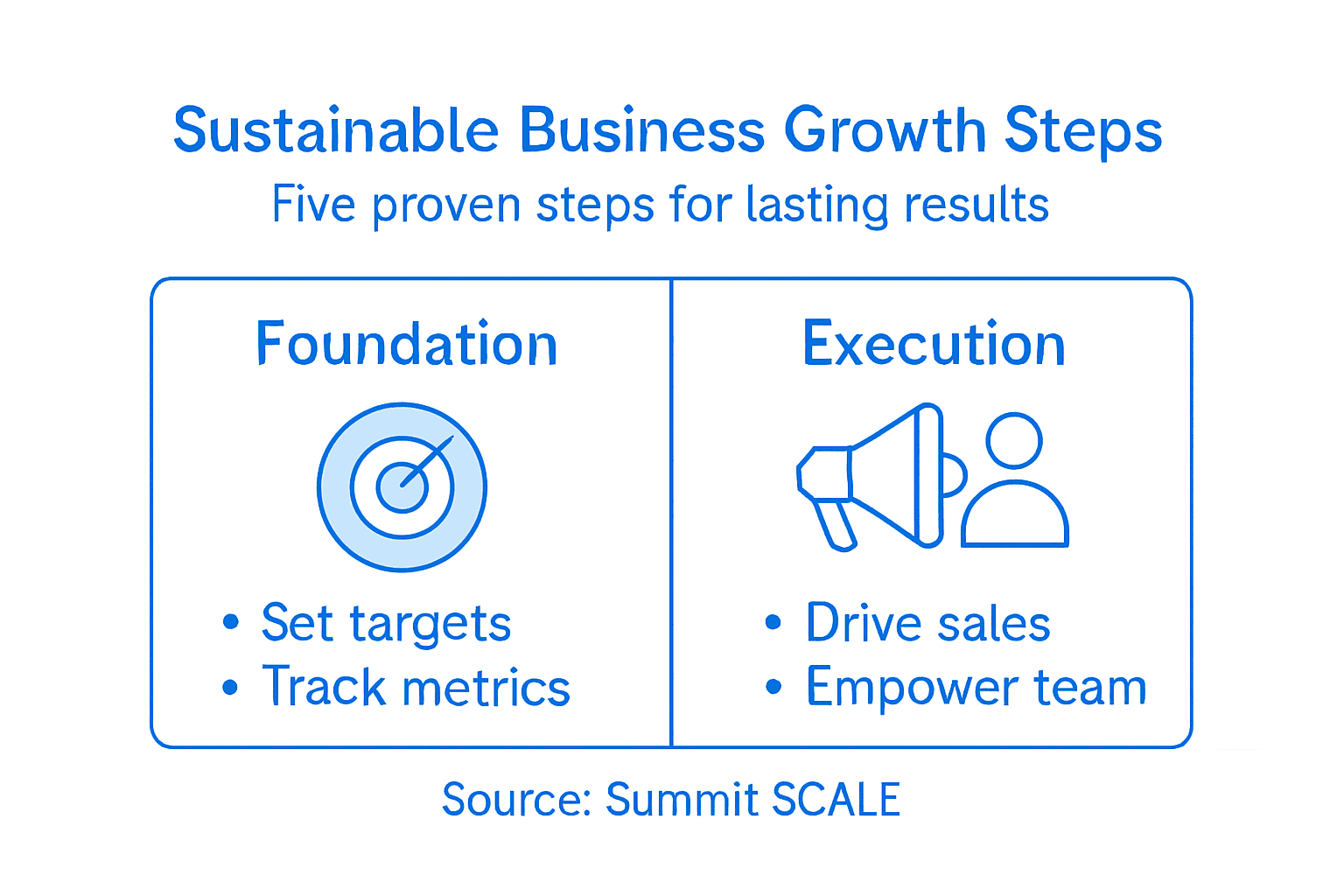
Finding clarity in your business goals can feel elusive, especially when growth seems stalled and ambitions remain just out of reach. For entrepreneurs and small business owners across the United States and United Kingdom, establishing specific and measurable objectives is the foundation for meaningful progress and genuine business freedom. This guide reveals how to transform your vision into practical steps, measure impact, and build sustainable growth using proven strategies designed for your unique challenges.
Table of Contents
- Step 1: Define Growth Targets And Performance Metrics
- Step 2: Assess Current Operations And Identify Barriers
- Step 3: Implement Strategic Sales And Marketing Initiatives
- Step 4: Build And Empower An Effective Team Structure
- Step 5: Monitor Progress And Refine Growth Strategies
Quick Summary
| Key Point | Explanation |
|---|---|
| 1. Define clear growth targets | Establish specific, measurable goals aligned with your overall business strategy to guide decision-making and track progress. |
| 2. Assess current operations thoroughly | Identify bottlenecks and inefficiencies within your business to uncover constraints that may limit growth potential. |
| 3. Implement strategic marketing initiatives | Develop targeted marketing strategies that leverage data to reach your ideal customers and maximise revenue opportunities. |
| 4. Build an effective team structure | Design a collaborative environment that empowers team members and defines clear roles to enhance performance and motivation. |
| 5. Monitor progress regularly | Establish frameworks for ongoing monitoring and refinements to ensure strategies remain effective and adjusted to market changes. |
Step 1: Define growth targets and performance metrics
Establishing clear growth targets and performance metrics is fundamental to driving sustainable business success. This critical step transforms vague aspirations into actionable, measurable objectives that will guide your strategic decision-making and track meaningful progress.
To define robust growth targets, begin by conducting a comprehensive assessment of your current business performance. Analyse key indicators such as revenue, profit margins, customer acquisition rates, and market share. When developing these metrics, consider using holistic performance evaluation frameworks that move beyond traditional quantitative measurements.
Key steps for defining effective growth targets include:
- Establish specific and measurable goals
- Align targets with your overall business strategy
- Create benchmarks for comparison
- Develop both short-term and long-term objectives
- Ensure targets are realistic and achievable
Your performance metrics should reflect not just financial outcomes, but also innovation, impact, and sustainable growth potential.
Regular monitoring and periodic reassessment of these metrics will help you stay adaptable and responsive to changing business landscapes.
Here’s how common performance metrics impact business growth:
| Metric Type | What It Measures | Impact on Growth |
|---|---|---|
| Financial Metrics | Revenue, profits | Reveals business viability |
| Customer Metrics | Acquisition, retention | Drives market expansion |
| Innovation Metrics | New products, R&D | Enables long-term success |
| Sustainability Metrics | Environmental impact | Ensures future resilience |
Top tip: Consider using digital dashboards or specialised tracking software to maintain real-time visibility into your performance metrics.
Step 2: Assess current operations and identify barriers
Assessing your current business operations is a critical step in understanding potential growth limitations and strategic opportunities. This comprehensive review will help you identify operational bottlenecks, inefficiencies, and barriers that might be hindering your business’s potential for sustainable expansion.
Begin by conducting a thorough systematic review of organisational challenges that could impede your business growth. This process involves a multi-dimensional analysis of your current operational landscape, examining several key areas:
- Financial performance and resource allocation
- Operational workflows and efficiency
- Team capabilities and skill gaps
- Technology and infrastructure limitations
- Communication and collaboration processes
Successful operational assessment requires an honest, comprehensive examination of both strengths and potential barriers to growth.
To effectively identify barriers, break down your assessment into structured stages. Look beyond surface-level metrics and dig deep into the root causes of potential operational constraints. Pay special attention to resource availability and structural limitations that might be restricting your business’s ability to scale and innovate.

Practical insight: Create a detailed map of your current operational processes, highlighting potential bottlenecks and areas requiring immediate attention or strategic intervention.
Step 3: Implement strategic sales and marketing initiatives
Implementing strategic sales and marketing initiatives is crucial for driving business growth and expanding your market presence. This step transforms your business strategy from theoretical planning into practical, results-oriented action that generates tangible revenue and market opportunities.
Begin by developing innovative marketing strategies that are data-driven and precisely targeted to your ideal customer base. Your approach should focus on creating a comprehensive marketing framework that integrates multiple channels and communication methods:
- Digital marketing platforms
- Social media engagement
- Content marketing strategies
- Targeted advertising campaigns
- Personalised communication approaches
Strategic marketing is not about reaching everyone, but about reaching the right people with the right message at the right time.
Critical to this implementation is leveraging technological tools and analytics to refine your marketing approach. Analyse customer data systematically, tracking key performance indicators that reveal insights about customer behaviour, preferences, and potential growth opportunities.
Practical insight: Continuously test and adapt your marketing strategies, treating each campaign as a learning opportunity to improve future initiatives and targeting precision.
Step 4: Build and empower an effective team structure
Building and empowering an effective team structure is fundamental to transforming your business’s potential into sustainable growth. This critical step moves beyond simple hiring, focusing on creating a dynamic, collaborative environment that maximises individual and collective performance.
Start by understanding high-performance team dynamics that foster trust, psychological safety, and shared strategic objectives. Your team structure should be intentionally designed to leverage complementary skills and create clear role definitions:
- Establish transparent communication channels
- Define clear team roles and responsibilities
- Create collaborative performance frameworks
- Implement regular skill development programmes
- Develop mechanisms for continuous feedback
Effective team structures are living systems that adapt, grow, and evolve with your organisation’s changing needs.
Critical to this process is recognising that team empowerment goes beyond delegating tasks. It requires creating an environment where team members feel valued, understand their contributions, and are motivated to develop their skills and pursue collective goals.
Practical insight: Conduct periodic team alignment workshops that blend professional development with strategic planning, ensuring every team member understands how their individual role connects to the broader business vision.
Step 5: Monitor progress and refine growth strategies
Monitoring progress and refining growth strategies is the critical mechanism that transforms your business plan from a static document into a dynamic, responsive roadmap. This step ensures your business remains agile, adaptable, and consistently aligned with your strategic objectives.
Begin by developing robust progress monitoring frameworks that provide comprehensive insights into your business performance. Your monitoring approach should encompass multiple dimensions of organisational growth:
- Quantitative performance metrics
- Financial health indicators
- Customer satisfaction measurements
- Team productivity benchmarks
- Strategic goal alignment tracking
Effective monitoring is not about criticism, but about creating opportunities for continuous improvement and strategic recalibration.
Critical to this process is establishing a systematic approach to data collection and analysis. Implement regular review cycles that allow you to identify trends, recognise emerging opportunities, and quickly address potential challenges before they become significant obstacles.
Practical insight: Schedule quarterly strategic review sessions where you critically examine your progress, celebrate achievements, and make data-driven adjustments to your growth strategies.
Here’s a comparison of monitoring methods for tracking business progress:
| Method | Frequency | Key Benefit |
|---|---|---|
| Digital Dashboards | Real-time | Quick data insights |
| Quarterly Reviews | Every 3 months | Strategic adjustment |
| Annual Audits | Yearly | In-depth evaluation |
| Team Progress Reports | Weekly/Monthly | Track team performance |
Empower Your Business Growth Journey with Expert Coaching
Growing a business sustainably is no simple task. This article highlights challenges like defining clear growth targets, overcoming operational barriers, and building empowered teams—key hurdles many entrepreneurs face when striving for lasting success. If you are seeking to break through these obstacles and achieve measurable, strategic growth that leads to more time and financial freedom, Summit SCALE offers proven support tailored precisely to these needs.
At Summit SCALE, our professional business coaching services focus on guiding you through actionable steps including sales growth, team development, and performance optimisation. Our personalised approach ensures your business systems and strategies align perfectly with your growth objectives. Ready to transform your business and personal life with expert guidance?
Start your journey today by exploring insights from our business growth archive and scheduling a free 15-minute assessment call at https://summitscale.biz. Don’t wait to take control of your business future and unlock your full potential.
Frequently Asked Questions
How can I define effective growth targets for my business?
To define effective growth targets, start by conducting a comprehensive assessment of your current business performance. Identify specific and measurable goals that align with your overall business strategy and create benchmarks for comparison within the next 30 days.
What operational barriers should I look for that might impede business growth?
Look for operational barriers such as inefficiencies in workflows, skill gaps in your team, and limitations in technology. Conduct a thorough review of your organisational challenges and create a detailed map of your processes to identify bottlenecks within the next quarter.
How do I implement successful marketing initiatives to drive business growth?
To implement successful marketing initiatives, develop innovative, data-driven marketing strategies that target your ideal customer base across multiple channels. Start by analysing customer data to refine your approach and launch your first campaign within 60 days.
What steps can I take to empower my team for better performance?
Empower your team by establishing clear roles and responsibilities, along with transparent communication channels. Implement regular skill development programmes and set up periodic team alignment workshops to reinforce collaboration and individual contributions over the next few months.
How should I monitor progress to ensure my growth strategies are effective?
Monitor progress by developing robust frameworks that track quantitative performance metrics and customer satisfaction measurements. Schedule quarterly strategic review sessions to critically evaluate your progress and adjust your strategies based on data-driven insights.
Recommended
- Step by Step Business Growth: Achieve Profitable Scaling
- Levers for Profit Growth | Summit SCALE® Coaching
- 7 Examples of Business Growth Strategies for Owners
- Planning for Massive Growth in Your Small Business – Summit Scale
- Role of Branding in Sales – Driving Loyalty and Growth
- 7 Event Branding Ideas to Boost Trade Show Engagement

