
Finding the right path for growth often starts with confronting uncertainty about your business’s current strengths and market position. For many British and American owners, knowing exactly where your organisation stands can clarify priorities and drive profitability. By combining market research and competitive analysis with structured assessment techniques, you’ll gain the insight needed to craft effective strategies and guide your team through sustainable operational improvements.
Table of Contents
- Step 1: Assess Your Current Business Position
- Step 2: Define Measurable Growth Objectives
- Step 3: Develop Targeted Strategies For Key Areas
- Step 4: Implement Action Plans With Your Team
- Step 5: Review Progress And Optimise Continuously
Quick Summary
| Essential Insight | Clarification |
|---|---|
| 1. Evaluate Your Current Position | Conduct a thorough SWOT analysis to identify strengths, weaknesses, opportunities, and threats to your business. |
| 2. Set SMART Growth Objectives | Define Specific, Measurable, Achievable, Relevant, and Time-bound objectives to guide your strategy. |
| 3. Develop Targeted Strategies | Focus on financial performance, market positioning, and operational efficiency to create actionable strategies. |
| 4. Implement Clear Action Plans | Establish specific tasks, responsibilities, and performance metrics to ensure successful execution of strategies. |
| 5. Review and Optimise Regularly | Monitor performance continuously and adjust strategies based on feedback and market changes for sustained growth. |
Step 1: Assess your current business position
Understanding where your business stands today is the critical first step towards sustainable growth. By conducting a comprehensive market research and competitive analysis, you’ll gain essential insights into your organisation’s strengths, weaknesses, and potential market opportunities.
To effectively evaluate your business position, implement a structured approach that combines multiple assessment techniques. Start with a detailed SWOT analysis – examining your internal Strengths and Weaknesses, and external Opportunities and Threats. This strategic framework will help you:
- Identify your unique competitive advantages
- Recognise potential market gaps
- Understand your current performance benchmarks
- Highlight areas requiring immediate strategic intervention
The goal is not just to collect data, but to transform these insights into actionable strategies. Your assessment should cover key business dimensions:
Here’s a comparison of key business dimensions often assessed in a SWOT analysis:
| Dimension | Typical Assessment Focus | Example Action |
|---|---|---|
| Financial Performance | Revenue trends, profitability | Adjust pricing, review cost structures |
| Operational Efficiency | Process speed, cost control | Streamline workflows, automate tasks |
| Customer Satisfaction | Feedback scores, loyalty | Enhance support, refine services |
| Market Positioning | Brand recognition, share | Invest in marketing, differentiate offers |
| Team Capabilities | Skills, collaboration | Upskill staff, strengthen team alignment |
- Financial performance metrics
- Operational efficiency
- Customer satisfaction levels
- Market positioning
- Team capabilities
Your business’s growth trajectory depends on how honestly and comprehensively you evaluate its current state.
Pro tip: Schedule quarterly review sessions to continuously track and update your business assessment, ensuring your strategies remain dynamic and responsive to changing market conditions.
Step 2: Define measurable growth objectives
Establishing clear and achievable business growth objectives is fundamental to your organisation’s strategic success. By implementing SMART criteria for defining objectives, you’ll create a robust framework that transforms vague aspirations into concrete, actionable targets.
To develop meaningful growth objectives, focus on creating goals that are Specific, Measurable, Achievable, Relevant, and Time-bound. This approach ensures your strategic planning moves beyond wishful thinking into practical implementation. Consider the following key dimensions when crafting your objectives:
- Financial performance targets
- Customer acquisition and retention goals
- Operational efficiency improvements
- Market expansion strategies
- Product or service innovation milestones
Your objectives should answer critical questions:
The table below summarises how the SMART framework ensures growth objectives are practical and effective:
| SMART Element | Key Question Addressed | Business Benefit |
|---|---|---|
| Specific | What exactly is the goal? | Focused, clear direction |
| Measurable | How will we track progress? | Enables progress tracking |
| Achievable | Is it realistically attainable? | Prevents setting unattainable targets |
| Relevant | Does it support strategy? | Aligns goals to business priorities |
| Time-bound | What is the deadline? | Creates urgency and accountability |
- What specific outcomes do you want to achieve?
- How will you measure progress?
- Who is responsible for each objective?
- What resources are required?
- When will these objectives be accomplished?
Effective growth objectives are not just statements – they are precise roadmaps that guide your business towards sustainable success.
Pro tip: Review and recalibrate your objectives quarterly, ensuring they remain aligned with your evolving business landscape and market conditions.
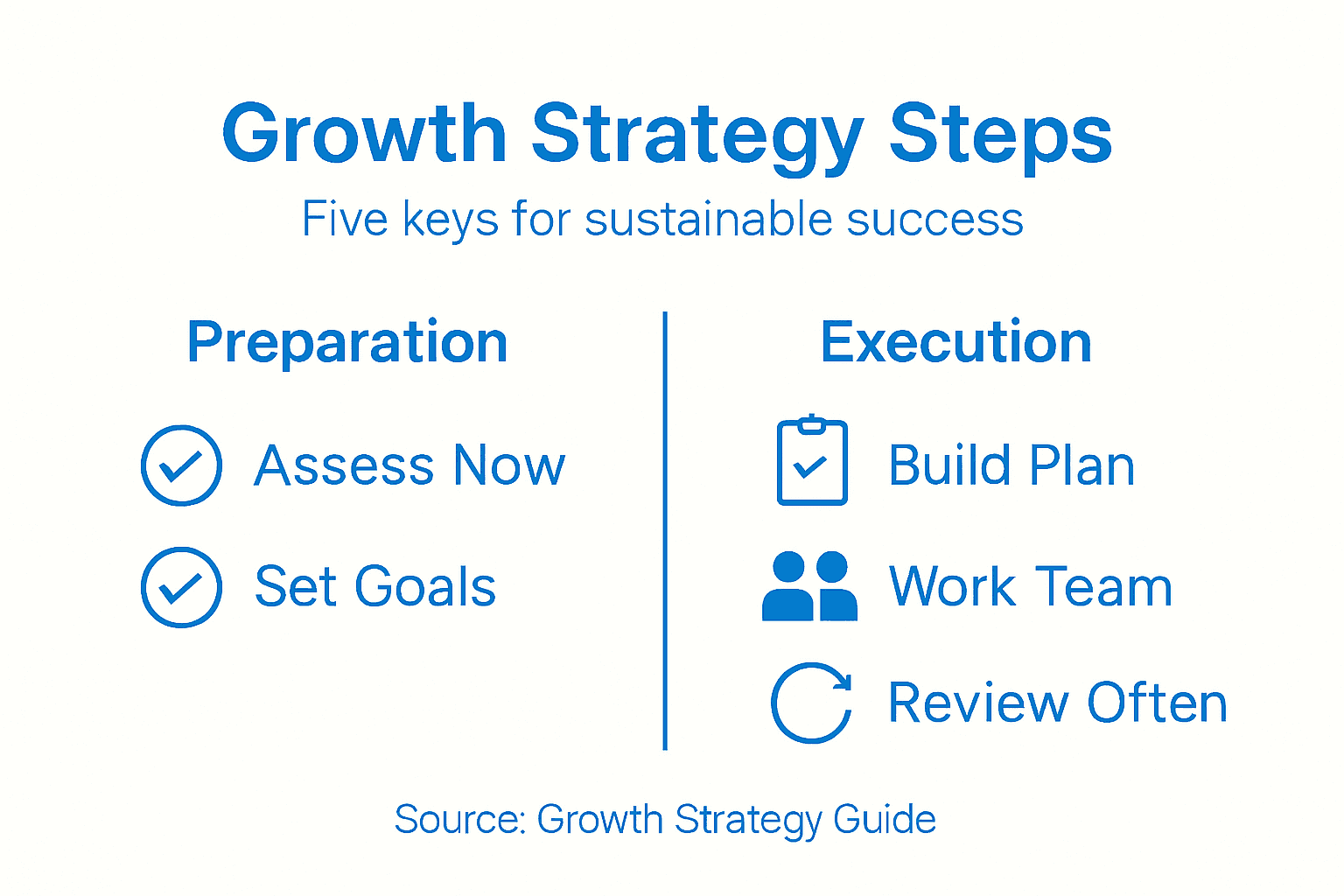
Step 3: Develop targeted strategies for key areas
Crafting precise strategies demands a nuanced understanding of your business’s unique landscape. By applying strategic growth principles, you’ll transform broad aspirations into focused, actionable plans that drive sustainable business expansion.
To develop targeted strategies, you’ll need to analyse your business across multiple critical dimensions. This approach requires a comprehensive assessment of your organisation’s strengths, market positioning, and potential growth opportunities. Your strategic development should concentrate on these key areas:
- Financial Performance: Revenue growth, profitability metrics, cost management
- Market Positioning: Customer segmentation, competitive differentiation
- Operational Efficiency: Process optimisation, resource allocation
- Innovation Capacity: Product development, service enhancement
- Human Capital: Talent acquisition, skill development, team performance
Structure your strategic approach by addressing fundamental questions:
- What are your most significant competitive advantages?
- Where do your greatest growth opportunities exist?
- What internal capabilities need immediate enhancement?
- How can you differentiate from competitors?
- What resources are required to execute these strategies?
Strategic success emerges from deliberately designed approaches, not accidental outcomes.
Pro tip: Maintain flexibility in your strategies, allowing periodic reassessment and nimble adjustments to respond effectively to changing market dynamics.

Step 4: Implement action plans with your team
Transforming strategic vision into tangible results requires a systematic approach to implementing comprehensive action plans. Your team’s collective effort will determine how effectively your business transforms strategic objectives into measurable outcomes.
Creating robust action plans demands clear communication, precise role definition, and collaborative commitment. Develop your implementation strategy by establishing transparent expectations and accountability mechanisms. Your action plan should encompass these critical elements:
- Specific Tasks: Clearly defined, granular activities
- Responsibility Allocation: Precise team member assignments
- Performance Metrics: Quantifiable success indicators
- Realistic Timelines: Achievable milestones and deadlines
- Resource Requirements: Necessary tools, budget, and support
Break down your implementation process through these strategic steps:
- Communicate the overarching strategic vision
- Define individual and collective responsibilities
- Establish measurable performance benchmarks
- Create transparent tracking and reporting mechanisms
- Schedule regular progress review sessions
Successful implementation is less about perfect planning and more about adaptive, collaborative execution.
Pro tip: Schedule brief, focused weekly team meetings to maintain momentum, address emerging challenges, and celebrate incremental progress towards your strategic objectives.
Step 5: Review progress and optimise continuously
Sustaining business growth requires a dynamic approach to continuous process improvement. Your organisation’s ability to adapt, learn, and refine strategies will determine its long-term success and competitive resilience.
Effective continuous optimisation involves systematic monitoring, honest evaluation, and strategic refinement across multiple business dimensions. This iterative process transforms performance challenges into opportunities for growth and innovation. Your review approach should encompass these critical elements:
- Performance Metrics: Quantitative and qualitative assessment
- Feedback Mechanisms: Insights from team members and stakeholders
- Market Trends: External environmental scanning
- Competitive Landscape: Comparative analysis
- Resource Allocation: Efficiency and effectiveness evaluation
Implement your continuous optimisation strategy through these structured steps:
- Establish clear, measurable performance indicators
- Create regular review cycles (monthly or quarterly)
- Collect comprehensive performance data
- Analyse results against original objectives
- Develop targeted improvement interventions
Continuous improvement is not about achieving perfection, but about making consistent, incremental progress.
Pro tip: Cultivate a learning culture where feedback is viewed as an opportunity for growth, not criticism, encouraging open and constructive dialogue across all organisational levels.
Unlock Sustainable Growth with Expert Guidance
Struggling to translate strategic objectives into real business success can be overwhelming. This article highlights key challenges like setting measurable growth goals, developing targeted strategies, and ensuring continuous optimisation — all vital for business owners aiming to achieve lasting expansion and increased profitability. If you are seeking clear steps to refine your financial performance and sharpen your market positioning, Summit SCALE offers tailored coaching designed specifically for small to medium-sized enterprises navigating these complexities.
Gain confidence in your path forward by partnering with experts who specialise in transforming potential into measurable results. Discover proven strategies that enhance team capabilities, improve operational efficiency, and accelerate growth within Business Growth Archives – Summit Scale and optimise your financial insights through Business Finance Archives – Summit Scale.
Take control of your business journey today with personalised coaching from Summit SCALE. Visit https://summitscale.biz to schedule your free 15-minute assessment call and unlock the strategic support your business deserves. Don’t wait for opportunities to pass — act now and build the sustainable success your enterprise deserves.
Frequently Asked Questions
How can I assess my current business position?
To assess your current business position, conduct a comprehensive SWOT analysis to identify your strengths, weaknesses, opportunities, and threats. Gather data on financial performance, customer satisfaction, and operational efficiency to formulate a clear picture of where your business stands.
What are SMART objectives in business growth planning?
SMART objectives are Specific, Measurable, Achievable, Relevant, and Time-bound goals that guide your business growth strategy. Create objectives that not only outline clear targets but also include measurable indicators to track progress over a defined timeframe.
How do I develop targeted strategies for business growth?
To develop targeted strategies, analyse your business’s strengths and weaknesses, and identify key areas for improvement or market opportunities. Formulate strategies that focus on financial performance, operational efficiency, and innovation capacity to drive sustainable growth.
What elements should be included in an action plan for implementing growth strategies?
Your action plan should include specific tasks, clearly defined roles, performance metrics, realistic timelines, and resource requirements. Breaking down your strategies into actionable steps will ensure a focused approach to achieving your business objectives.
How can I continuously review and optimise my business growth strategy?
To optimise your business growth strategy, establish regular review cycles to monitor performance metrics and market trends. Collect feedback and engage your team to identify areas for improvement, allowing you to make adjustments and stay aligned with your growth objectives.
What role does team collaboration play in implementing growth strategies?
Team collaboration is crucial for successfully implementing growth strategies as it ensures clear communication and shared objectives. Create a culture of accountability by assigning specific responsibilities and regularly checking in on progress to maintain momentum.

