
Success for a british or American business rarely happens by chance. Clear growth objectives set the leading companies apart, yet nearly half of businesses in the United States and United Kingdom face stalled progress from vague or shifting goals. For small and medium-sized business owners, understanding what makes growth objectives effective holds the key to improved profitability and the kind of personal freedom most entrepreneurs seek. This guide highlights the strategies that drive lasting results for british and American businesses alike.
Table of Contents
- What Are Business Growth Objectives?
- Main Types of Growth Objectives for SMEs
- Strategic Steps to Setting Effective Goals
- Implementing and Measuring Growth Initiatives
- Common Pitfalls and Success Factors
Key Takeaways
| Point | Details |
|---|---|
| Business Growth Objectives | Clear and measurable objectives guide organisations towards sustainable development, aligning daily operations with long-term goals. |
| Types of Growth Objectives for SMEs | SMEs focus on financial growth, market expansion, operational efficiency, and innovation to tailor their strategies for unique contexts. |
| Effective Goal Setting | The SMART framework ensures that objectives are specific, measurable, achievable, relevant, and time-bound, promoting focused efforts and adaptability. |
| Measuring Growth Initiatives | Continuous evaluation of growth initiatives through KPIs allows businesses to adapt strategies based on real-time performance and market changes. |
What Are Business Growth Objectives?
Business growth objectives are strategic targets that translate a company’s broad vision into specific, measurable outcomes. These objectives serve as a roadmap, guiding organisations towards sustainable development by breaking down overarching goals into actionable steps. Strategic planning experts define these objectives as precise milestones that help businesses systematically track progress and align daily operations with long-term aspirations.
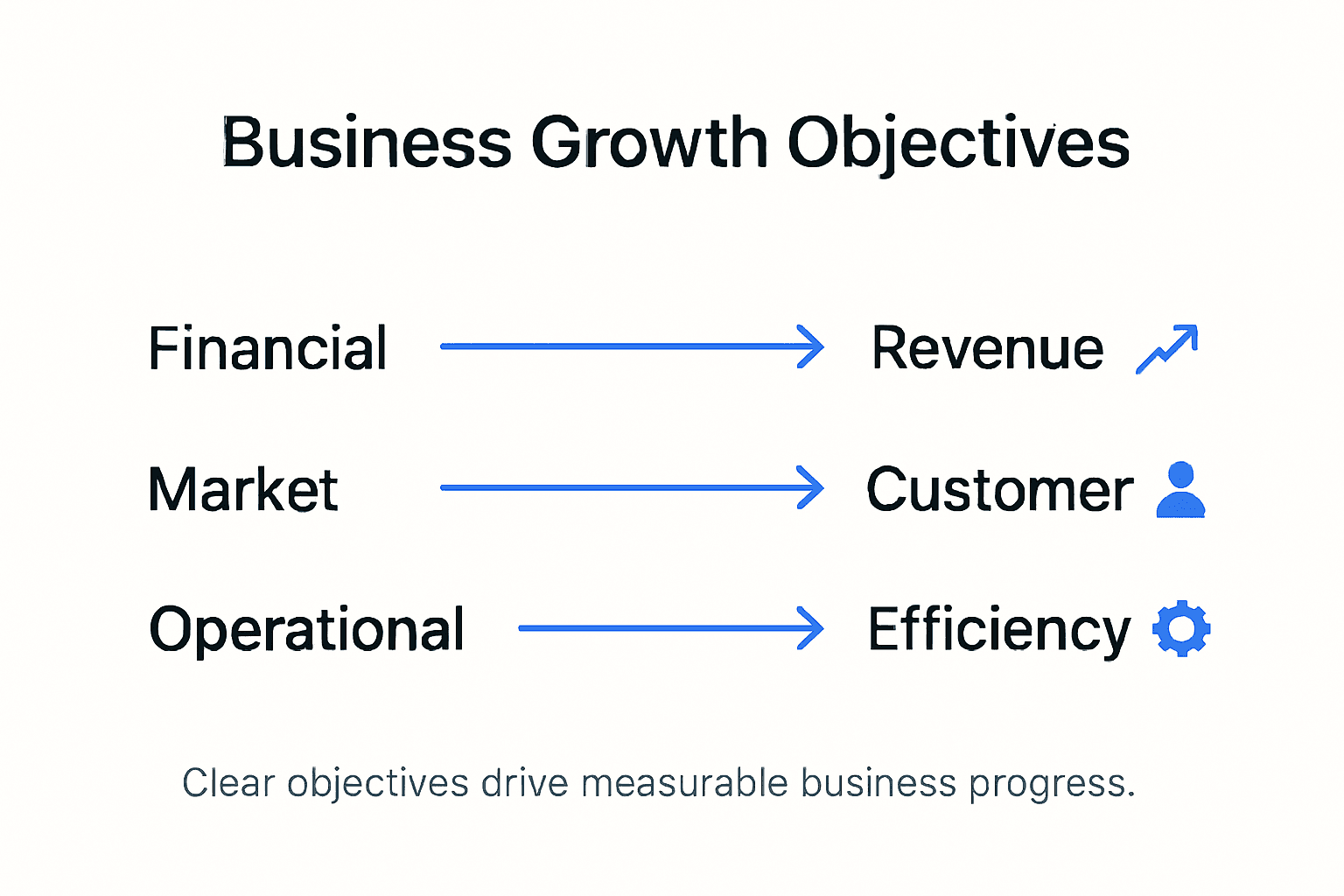
Unlike vague ambitions, business growth objectives are concrete and quantifiable. They typically focus on key performance areas such as revenue generation, market expansion, customer acquisition, and operational efficiency. By establishing clear targets with specific metrics, businesses create a framework that enables teams to understand exactly what needs to be achieved and by when. These objectives might include increasing annual revenue by 25%, expanding into two new regional markets, or improving customer retention rates by 15% within a specified timeframe.
The primary purpose of business growth objectives is to provide direction and motivation while creating accountability across the organisation. By translating broad organisational goals into specific, measurable outcomes, companies can ensure that every department and team member understands their role in driving the business forward. This alignment helps prevent scattered efforts and promotes a unified approach to achieving strategic milestones.
Pro tip: Conduct quarterly objective reviews to assess progress, recalibrate targets, and maintain organisational agility in a dynamic business environment.
Main Types of Growth Objectives for SMEs
Small and medium-sized enterprises (SMEs) typically pursue growth objectives across multiple strategic dimensions. Research indicates that SMEs focus on key performance areas including financial resources, market expansion, and innovation adoption. These objectives are not one-size-fits-all but are tailored to each organisation’s unique context, considering factors such as company size, industry sector, and current market positioning.

The primary types of growth objectives for SMEs can be categorised into several critical domains. Financial growth objectives often centre on increasing revenue, improving profit margins, and securing additional capital investment. Market expansion objectives involve strategies like entering new geographic regions, targeting different customer segments, or developing new product lines. Operational efficiency objectives focus on streamlining processes, reducing costs, and enhancing overall business productivity. Innovation objectives encourage developing new technologies, improving existing products, or creating novel service offerings that differentiate the business from competitors.
Critical success factors influencing these growth objectives include entrepreneurial traits, technology adoption, and strategic networking. SMEs must develop comprehensive strategies that address multiple growth dimensions simultaneously. This might involve investing in staff training, implementing advanced technologies, building strong industry connections, and maintaining a flexible approach to business development. Successful SMEs recognise that growth is a holistic process requiring coordinated efforts across financial, operational, and strategic domains.
Pro tip: Conduct a comprehensive quarterly review of your growth objectives, assessing progress across financial, market, operational, and innovation dimensions to ensure balanced and sustainable business development.
Here’s a comparison of common SME growth objectives and their typical business impact:
| Objective Type | Example Action | Expected Business Impact |
|---|---|---|
| Financial Growth | Increase annual revenue by 25% | Greater financial stability and resources |
| Market Expansion | Enter two new regional markets | Increased market reach and visibility |
| Operational Efficiency | Streamline supply chain processes | Lower costs and higher productivity |
| Innovation | Develop a new technology platform | Stronger competitive advantage |
Strategic Steps to Setting Effective Goals
Setting effective business growth objectives requires a systematic and thoughtful approach that goes beyond simple wishful thinking. Strategic planning begins with understanding the current market landscape and developing goals that align with real-world business conditions. The process demands rigorous analysis, clear intention, and a commitment to adaptability.
The cornerstone of effective goal setting is adopting the SMART framework. This approach ensures goals are Specific, Measurable, Achievable, Relevant, and Time-bound. Specific goals provide clear direction, avoiding vague statements by defining exact outcomes. Measurable goals allow precise tracking of progress, enabling businesses to understand their advancement. Achievable goals balance ambition with realistic expectations, preventing demotivation through unattainable targets. Relevant goals connect directly to broader business strategies, ensuring each objective contributes meaningfully to overall growth. Time-bound goals create urgency and provide a clear timeline for achievement.
Successful goal implementation requires a comprehensive approach that includes regular monitoring and adaptive strategies. Businesses should conduct periodic SWOT analyses to assess internal strengths and weaknesses alongside external opportunities and threats. This process helps refine goals continuously, ensuring they remain aligned with changing market dynamics. Regular review meetings, detailed progress tracking, and a willingness to adjust strategies are critical. Effective goal setting is not a static process but a dynamic journey of strategic refinement, requiring ongoing commitment and flexibility from leadership.
Pro tip: Schedule quarterly goal review sessions where you critically evaluate progress, reassess market conditions, and adjust objectives to maintain strategic alignment and momentum.
This table summarises strategic planning tools for effective business growth goal-setting:
| Tool or Method | Main Purpose | Typical Business Use |
|---|---|---|
| SMART Framework | Ensure goals are actionable | Achieve focused, realistic results |
| SWOT Analysis | Assess strengths/weaknesses | Refine strategy based on business context |
| KPI Tracking | Measure goal progress | Maintain accountability and alignment |
Implementing and Measuring Growth Initiatives
Developing strategic growth initiatives requires a comprehensive approach that bridges strategic planning with practical execution. Successful businesses understand that growth is not merely about creating ambitious plans, but about designing targeted strategies that can be systematically implemented and rigorously measured. This process demands cross-functional collaboration, clear communication, and a commitment to continuous improvement.
The foundation of effective implementation lies in breaking down broad growth objectives into specific, actionable initiatives. These might include product innovation strategies, market expansion plans, operational efficiency improvements, or customer engagement programmes. Key Performance Indicators (KPIs) play a critical role in this process, providing quantifiable metrics that track progress and reveal the actual impact of implemented strategies. Aligning KPIs with strategic objectives enables real-time decision making and resource optimisation, transforming abstract goals into concrete business outcomes.
Measurement is not a one-time event but a continuous process of evaluation and adaptation. Businesses should establish a robust monitoring framework that includes regular performance reviews, comprehensive data analysis, and flexible adjustment mechanisms. This approach allows organisations to respond quickly to changing market conditions, identify emerging opportunities, and mitigate potential risks. Effective growth initiative implementation requires a balance between strategic vision and tactical execution, ensuring that every implemented strategy contributes meaningfully to the organisation’s broader growth trajectory.
Pro tip: Create a dynamic dashboard that consolidates key growth metrics, enabling real-time tracking and enabling swift strategic adjustments based on actual performance data.
Common Pitfalls and Success Factors
SMEs frequently encounter complex challenges that can significantly impede their growth potential. These obstacles range from financial constraints to strategic limitations, often creating intricate barriers that require nuanced navigation. Understanding these potential pitfalls is crucial for entrepreneurs seeking sustainable business development, as recognising challenges early can transform potential roadblocks into opportunities for strategic adaptation.
Key pitfalls that consistently undermine business growth include resource mismanagement, resistance to technological adoption, and strategic inflexibility. Businesses often struggle with misaligned sales incentives and confuse operational activity with meaningful progress. Leaders must critically evaluate their approach, focusing on qualified opportunities and building long-term value rather than pursuing short-term gains. Successful organisations distinguish themselves by maintaining adaptability, continuously updating their strategic frameworks, and remaining responsive to market dynamics.
Success factors that counteract these challenges include developing robust entrepreneurial characteristics, implementing effective resource management strategies, and cultivating a culture of continuous learning and strategic planning. Strong leadership that embraces technological innovation, maintains flexible strategic frameworks, and prioritises systematic performance tracking can significantly enhance an organisation’s growth potential. Businesses must invest in building comprehensive capabilities that extend beyond traditional operational boundaries, creating adaptive ecosystems capable of responding swiftly to emerging market opportunities.
Pro tip: Conduct monthly strategic reviews that critically assess your current performance against established objectives, identifying potential growth barriers before they become insurmountable challenges.
Unlock Your Business Potential with Expert Coaching
The journey to achieving clear business growth objectives, as outlined in the article, often presents challenges like setting measurable targets, aligning teams, and adapting to changing markets. Recognising these common pain points such as the need for strategic planning, operational efficiency, and innovation can feel overwhelming without experienced guidance. Summit SCALE specialises in helping small and medium-sized business owners conquer these hurdles by providing tailored coaching that focuses on real-world results like sales growth, team building and long-term business valuation.
If you are ready to turn broad ambitions into specific, actionable plans that deliver more time, profit, and freedom, access professional support designed around your unique business needs. Discover how expert coaching can guide you through the SMART framework and KPI tracking to keep your goals on track. Gain confidence in overcoming resource constraints and strategic inflexibility through proven methods and personalised mentoring.
Take your next step towards sustainable growth now
Experience the difference focused coaching makes in aligning your objectives with business success
Start your transformation by visiting Summit SCALE and schedule your free 15-minute assessment call today. Learn more about how our business coaching services empower entrepreneurs to build adaptive, profitable and scalable enterprises. Don’t wait let Summit SCALE help you unlock your business growth potential with clarity and confidence.
Frequently Asked Questions
What are business growth objectives?
Business growth objectives are strategic targets that help organisations set specific, measurable outcomes, guiding them towards sustainable development by breaking down broaden goals into actionable steps.
Why are clear business growth objectives important?
Clear business growth objectives provide direction and motivation, ensuring that all departments and team members understand their roles in achieving the organisation’s strategic milestones, promoting accountability and alignment.
What types of growth objectives do SMEs typically pursue?
SMEs typically pursue financial growth objectives, market expansion objectives, operational efficiency goals, and innovation objectives, focusing on areas such as revenue generation, market entry, process improvements, and product development.
How can businesses effectively set and achieve their growth objectives?
Businesses can effectively set and achieve their growth objectives by adopting the SMART framework, conducting SWOT analyses, regularly monitoring progress, and being adaptable to changing market conditions.
Recommended
- The Business Owner’s Personal Growth Blueprint
- Levers for Profit Growth | Summit SCALE® Coaching
- The 4 Areas to Target to Grow Sales – Summit SCALE® Coaching
- Why Has Your Business Growth Stalled? – Summit Scale
- Strategic IT Planning: Aligning Technology with Business Goals – Cloudology
- 7 Key Benefits of Swiss GmbH for Global Entrepreneurs

