
You’ve built something real. You’ve put in the hours, made the hard calls, and kept the business moving forward. Yet somehow, growth still feels like it’s just out of reach. Sound familiar? For many small to medium-sized business owners in 2026, the bottleneck isn’t the market or the product. It’s leadership. The good news? Leadership coaching generates 3-7x return on investment and boosts leadership effectiveness by over 90%. The right leadership coaching process doesn’t just sharpen your skills. It transforms how you think, decide, and lead, and that changes everything.
Table of Contents
- Why leadership coaching matters for SMBs in 2026
- The complete leadership coaching process: 6 essential phases
- Key methodologies: GROW, 360-degree feedback and beyond
- Common pitfalls and how to avoid them
- Measuring results: KPIs, ROI, and lasting impact
- Unlock your SMB’s growth with expert leadership coaching
- Frequently asked questions
Key Takeaways
| Point | Details |
|---|---|
| Structured process delivers results | Following all six phases of leadership coaching maximises growth and measurable improvement. |
| Choose the right methodology | Use frameworks like GROW and 360-degree feedback to match your business needs and goals. |
| Measure and iterate | Track KPIs before, during, and after coaching to document ROI and guide future actions. |
| Avoid common pitfalls | Set clear goals, use metrics, and ensure the right mix of coaching and direct management. |
| Tailor coaching to your business | Blend individual and team coaching with proven accountability for lasting change in your SMB. |
Why leadership coaching matters for SMBs in 2026
Let’s be honest. Running a small or medium-sized business in 2026 is not for the faint-hearted. You’re managing people, chasing revenue, navigating technology shifts, and trying to carve out time for strategy. Leadership capability has become the key differentiator between businesses that plateau and those that scale with purpose.
The numbers back this up. SMBs see an average ROI of 5-7x from leadership coaching, with performance improvements ranging from 70 to 92%. That’s not a marginal gain. That’s a business transformation. And the industry is growing to match the demand. The global coaching industry hit $5.34B in revenue in 2025, with leadership coaching accounting for 54% of that figure.
What makes coaching especially powerful for SMBs is agility. Unlike large corporations, you can implement insights quickly, test new leadership behaviours in real time, and see results within weeks. The latest business coaching trends 2026 also point to AI-enhanced feedback tools, hybrid virtual formats, and more holistic approaches that address both professional performance and personal wellbeing.
For SMB owners, this means leadership coaching for owners is no longer a luxury reserved for corporate executives. It’s a practical, high-return investment in your most valuable asset: you.
- Faster implementation: SMBs can act on coaching insights immediately, without layers of bureaucracy.
- Personalised focus: Coaching is tailored to your specific business stage and leadership gaps.
- Team ripple effect: When you grow as a leader, your team follows. Culture shifts from the top.
- Resilience building: Coaching equips you to handle uncertainty with clarity and confidence.
Now that you’ve seen the stakes and potential upside, let’s clarify what the leadership coaching process actually involves for SMB owners.
The complete leadership coaching process: 6 essential phases
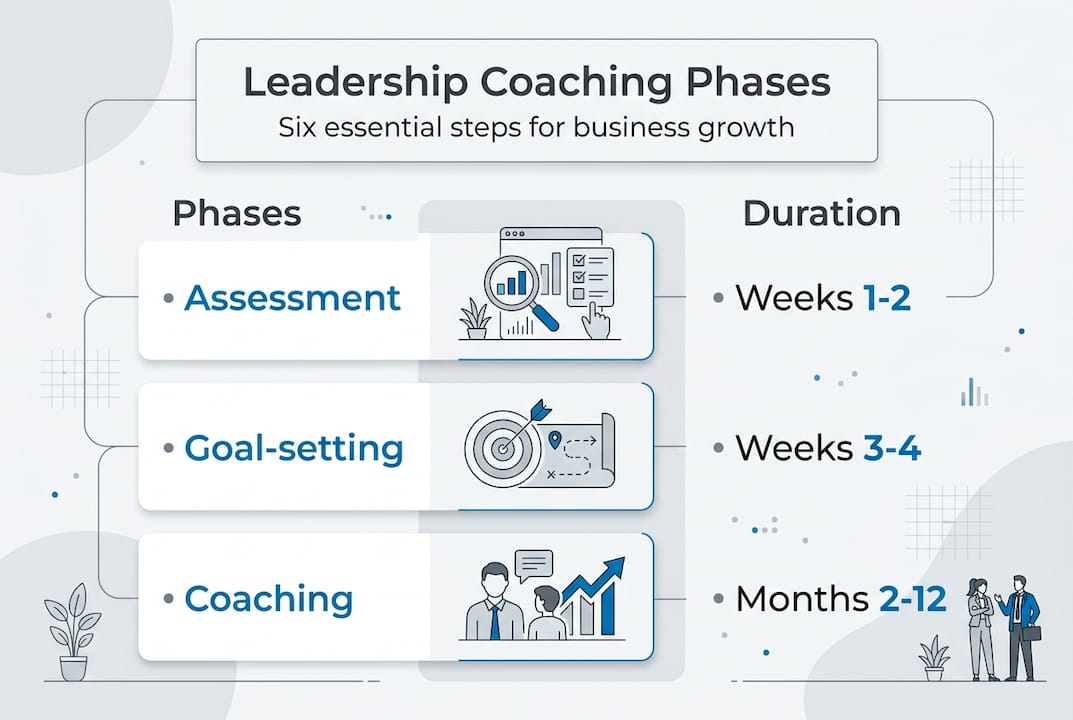
A structured coaching process is what separates a transformative experience from an expensive conversation. The leadership coaching process for SMBs follows a 4-6 stage sequence, moving from assessment through to measurement and scaling. Here’s how each phase works in practice.
- Assessment and diagnosis: Your coach helps you identify your current leadership strengths, blind spots, and the specific challenges holding your business back. This is where you turn the mirror around.
- Goal-setting: Clear, measurable goals are defined. Not vague aspirations, but specific outcomes tied to your business performance and personal growth.
- Action planning: You and your coach build a practical roadmap. Each step is designed to close the gap between where you are and where you need to be.
- Leadership development: This is the core work. Sessions focus on communication, decision-making, team management, and the mindset shifts that drive lasting change.
- Accountability: Regular check-ins keep you on track. Your coach holds you to your commitments, turning frustration into fuel when progress stalls.
- Measurement and scaling: Results are reviewed against your baseline KPIs. What’s working gets amplified. What isn’t gets adjusted.
Most engagements run over 6 to 12 months, with bi-weekly sessions of around 60 minutes. This cadence gives you enough time to implement changes between sessions without losing momentum. Explore the full leadership coaching workflow to see how each phase connects.
| Phase | Focus area | Typical duration |
|---|---|---|
| Assessment | Strengths and gaps | Weeks 1-2 |
| Goal-setting | Outcomes and priorities | Weeks 2-3 |
| Action planning | Roadmap creation | Week 3-4 |
| Leadership development | Skills and mindset | Months 2-9 |
| Accountability | Progress and course correction | Ongoing |
| Measurement | ROI and scaling | Months 6-12 |
Pro Tip: Blend one-to-one coaching with occasional team coaching sessions. When your leadership team grows together, scaling becomes a shared effort rather than a solo climb. Learn more about the leadership coaching process and how it applies to your growth stage.
With the big picture defined, let’s review the specific tools and models coaches use during these phases.
Key methodologies: GROW, 360-degree feedback and beyond
Not all coaching frameworks are created equal. The right methodology depends on your goals, your team’s maturity, and the specific challenges you’re facing. GROW, solution-focused coaching, 360-degree feedback, and enquiry-led approaches dominate effective leadership coaching in 2026, and each serves a distinct purpose.
GROW model (Goal, Reality, Options, Will) is the most widely used framework. It’s structured, goal-oriented, and ideal when you need clarity on a specific challenge or decision. Think of it as a GPS for your leadership journey.
360-degree feedback gathers input from peers, direct reports, and managers to give you a full picture of how your leadership lands in practice. It’s context-rich and particularly powerful when you suspect a gap between your intentions and your impact.
Solution-focused coaching shifts attention away from problems and towards what’s already working. It’s energising and effective when confidence or motivation is low.
Enquiry-led coaching uses powerful questions to help you surface your own answers. It builds self-awareness and long-term resilience, which is exactly what SMB owners need for sustained growth.
The ICF coaching study also highlights the growing influence of AI-enhanced feedback tools and virtual hybrid sessions, which are making high-quality coaching more accessible and data-driven than ever before.
- Use GROW when you need structured goal-setting and clear action steps.
- Use 360-degree feedback when you want honest, multi-source insight into your leadership style.
- Use solution-focused coaching when energy and motivation need a boost.
- Use enquiry-led coaching for deep self-awareness and long-term leadership development.
Explore how these leadership coaching process frameworks can be combined for maximum impact in your business.
Knowing the major tools lets you prepare for success and avoid common coaching mistakes.
Common pitfalls and how to avoid them
Even the best coaching process can fall flat if you walk into it unprepared. Many SMB owners invest in coaching with high hopes, only to see limited results because of avoidable mistakes. Skipping metrics, resisting change, or confusing coaching with directing are among the most common reasons coaching fails to deliver.
Here are the pitfalls to watch for:
- Undefined goals: Starting coaching without clear outcomes is like setting off on a road trip without a destination. You’ll move, but not necessarily forward.
- No baseline metrics: If you don’t measure where you start, you can’t prove where you’ve arrived. Always establish your KPIs before session one.
- Coaching in a crisis: When the business is on fire, you need a fire extinguisher, not a coach. Coaching works best in a stable environment where reflection is possible.
- Confusing coaching with managing: Coaching is about developing capability and ownership. It’s not about being told what to do. If you want directives, that’s a different conversation.
- Overloading on new systems: Introducing too many changes at once overwhelms your team and dilutes focus. Prioritise one or two shifts at a time.
Research shows that roughly 7% of coaching engagements produce negative outcomes, and the common thread is a lack of accountability in coaching or a mismatch between the coaching style and the business context.
Pro Tip: Before your first session, document your top three business challenges and the KPIs you want to move. Share these with your coach. This single step dramatically increases the focus and effectiveness of every session that follows.
If you avoid the traps above, here’s what you should expect from an effective leadership coaching journey.
Measuring results: KPIs, ROI, and lasting impact
How do you know if coaching is actually working? You measure it. Deliberately, consistently, and from the very beginning. Improved KPIs from leadership coaching include retention rates, productivity gains, work performance scores, and leadership behaviour improvements. These are the numbers that tell the real story.
Here’s a practical framework for tracking your coaching ROI:
- Retention rate: Are your best people staying? Leadership quality is one of the top drivers of employee retention. Track this quarterly.
- Productivity gains: Measure output per team member before and after coaching. Even a 10% improvement compounds significantly over 12 months.
- Leadership effectiveness scores: Use a simple 360-degree survey at the start and end of your engagement to quantify how your leadership has evolved.
- Revenue growth: Connect coaching milestones to revenue outcomes. If your sales process improves because your leadership clarity improves, that’s a direct line.
- Personal freedom metrics: How many hours are you working? Are you able to step away from the business without it falling apart? This is the ultimate measure of leadership maturity.
The ICF 2025 coaching data confirms that 86% of organisations report a positive coaching ROI. That’s not a coincidence. It’s the result of structured processes, clear goals, and consistent measurement. Explore how coaching and profitability metrics connect in practice, and see the leadership coaching results that SMB owners are achieving right now.
For SMBs looking to unlock these results, the next step is finding a coaching process tailored to your business and goals.
Unlock your SMB’s growth with expert leadership coaching
You now have a clear picture of what an effective leadership coaching process looks like, from the phases and frameworks to the KPIs that prove it’s working. The question is: what’s your next move?
At Summit SCALE, we work with small and medium-sized business owners across the United States who are ready to stop spinning their wheels and start scaling with intention. Our tailored coaching process is built around your specific goals, whether that’s growing revenue, building a stronger team, or reclaiming your time. If you’re serious about why invest in coaching and want to see what a structured leadership coaching process for growth looks like in practice, we’d love to show you. Book your free 15-minute assessment call today and take the first step towards more clarity, more profit, and more freedom.
Frequently asked questions
How long does the leadership coaching process take for SMBs?
Most SMB coaching engagements last 6 to 12 months, with bi-weekly sessions of around 60 minutes each. This timeframe allows enough space for real behavioural change to take root.
What’s the typical ROI of leadership coaching for entrepreneurs?
Research shows SMBs experience a 3-7 fold ROI alongside significant performance improvements. The return is both financial and operational, with gains in team productivity and leadership effectiveness.
Can leadership coaching be done virtually as effectively as in-person?
Studies confirm that virtual and in-person coaching are equally effective for SMB owners. The key factor is the quality of the coaching relationship, not the format.
Are there any situations where leadership coaching is not recommended?
Coaching is less effective during high-pressure crises or when the need is for tactical instruction rather than leadership development. In those moments, directive management tends to produce better short-term results.
How can I measure the impact of leadership coaching?
Track KPIs such as retention, productivity, and leadership effectiveness before and after coaching. Combining quantitative data with qualitative feedback gives you the clearest picture of progress.

