
Running a business in Australia can often feel like juggling profit goals, team morale, and personal priorities all at once. Knowing exactly where your company stands is the foundation for any successful next step. A thorough assessment opens the door for personalised coaching, giving you the clarity to build a path towards scalable growth and increased personal freedom. This guide breaks down the core stages needed to unlock your potential through objective analysis, goal-setting, and practical coaching strategies.
Table of Contents
- Stage 1: Assess Your Current Business Position
- Stage 2: Define Clear Growth Objectives
- Stage 3: Build a Tailored Coaching Plan
- Stage 4: Implement Coaching Strategies Effectively
- Stage 5: Monitor Progress and Refine Approach
Quick Summary
| Key Point | Explanation |
|---|---|
| 1. Assess Your Current Position | Conduct a thorough evaluation of financial and operational metrics to establish a baseline for growth. |
| 2. Set Clear Growth Objectives | Define specific, measurable goals to transform aspirations into actionable steps for progress. |
| 3. Develop a Tailored Coaching Plan | Create a customised framework that aligns coaching with organisational needs and leadership objectives. |
| 4. Implement with Nuance | Adapt coaching styles to individual needs for effective execution and meaningful change. |
| 5. Monitor and Adjust | Regularly track progress and refine strategies based on feedback to ensure continuous improvement. |
Stage 1: Assess Your Current Business Position
Navigating your business’s growth journey requires a clear understanding of where you are right now. This initial stage involves conducting a comprehensive evaluation of your current operational landscape to establish a solid foundation for strategic coaching and development.
To effectively assess your business position, you’ll want to analyse multiple critical dimensions simultaneously. Begin by gathering quantitative data such as financial statements, revenue trends, profit margins, and cash flow reports. These metrics provide an objective snapshot of your business’s current financial health. Simultaneously, conduct a qualitative assessment that explores your team’s performance, organisational culture, and individual capabilities. Business coaching interventions have demonstrated significant potential in enhancing organisational productivity when approached systematically.
Your assessment should cover key areas including financial performance, operational efficiency, market positioning, team dynamics, and personal leadership capacity. Create a structured scorecard or matrix that allows you to rate each dimension objectively, identifying both strengths to leverage and areas requiring focused improvement. This holistic approach ensures you’re not just looking at numbers, but understanding the interconnected systems driving your business performance.
Expert Advice: Create a frank and honest self assessment by involving trusted team members or an external perspective to ensure you’re not overlooking critical blind spots in your evaluation process.
Below is a summary of key dimensions to assess in your business diagnostic phase:
| Assessment Area | What to Analyse | Business Impact |
|---|---|---|
| Financial Performance | Profit margins, revenue trends | Reveals financial strengths/risks |
| Operational Efficiency | Process bottlenecks, resources | Identifies waste and savings |
| Market Positioning | Competitor analysis, brand reach | Shows competitive advantage |
| Team Dynamics | Collaboration, skill diversity | Drives productivity and morale |
| Leadership Capacity | Decision-making, adaptability | Influences growth potential |
Stage 2: Define Clear Growth Objectives
Defining precise growth objectives transforms your business strategy from abstract aspiration to actionable blueprint. This crucial stage establishes a clear roadmap that aligns your organisational potential with strategic direction.
Start by crafting measurable coaching objectives that reflect both your immediate operational needs and long-term vision. These objectives should encompass multiple dimensions including financial performance, market expansion, team development, and personal leadership growth. Consider categorising your goals into short term milestones and long term strategic targets. Typical business objectives might include increasing annual revenue by a specific percentage, expanding into new market segments, improving operational efficiency, or developing advanced leadership capabilities within your team.

To ensure robust goal setting, adopt a systematic approach that moves beyond generic statements. Break down each objective into specific measurable outcomes with clear timelines and accountability mechanisms. For instance, instead of stating ‘increase sales’, define a precise target like ‘increase quarterly revenue by 22% through targeted marketing and sales training programmes’. This granular approach transforms conceptual aspirations into quantifiable performance indicators that can be systematically tracked and evaluated.
Expert Advice: Always align your growth objectives with your core business values and personal leadership vision to maintain authenticity and sustainable motivation.
Stage 3: Build a Tailored Coaching Plan
Building a tailored coaching plan transforms generic guidance into a precision instrument for your business growth. This critical stage involves creating a customised roadmap that addresses your specific organisational needs and personal leadership objectives.
Begin by developing a strategic coaching framework that aligns closely with your unique business context. This involves conducting a comprehensive diagnostic assessment to identify specific performance gaps, leadership challenges, and growth opportunities. Your coaching plan should incorporate multiple layers of intervention including individual leadership coaching, team development strategies, and organisational performance enhancement techniques. Consider mapping out specific milestones, measuring tools, and accountability mechanisms that will track progress and ensure meaningful transformation.
The most effective coaching plans integrate both qualitative and quantitative elements. This means combining structured performance metrics with more nuanced personal development goals. For instance, alongside financial targets, include objectives around communication skills, strategic thinking, emotional intelligence, and team dynamics. Each element of the plan should be explicitly linked to your broader business strategy, ensuring that personal growth translates directly into organisational capability and competitive advantage.
Expert Advice: Design your coaching plan as a living document that can be flexibly adjusted as your business evolves, maintaining a balance between structured goals and adaptive potential.
Stage 4: Implement Coaching Strategies Effectively
Successful coaching implementation requires a strategic and nuanced approach that goes beyond generic instruction. This stage transforms your carefully crafted plan into meaningful organisational transformation, ensuring your coaching strategies deliver tangible results.
Start by understanding coaching styles and their applications, recognising that different team members and scenarios demand unique coaching approaches. Some individuals might require directive guidance, while others flourish with a more collaborative and supportive method. Your implementation strategy should be flexible enough to adapt to individual learning styles, personality types, and specific performance challenges. This means developing a repertoire of coaching techniques that can be dynamically applied based on the specific context and developmental needs of each team member.
Here is a comparison of coaching styles and their organisational applications:
| Coaching Style | Typical Use Case | Suitable For |
|---|---|---|
| Directive | Rapid results, skill correction | New employees |
| Collaborative | Problem solving, innovation | Experienced team members |
| Supportive | Motivation, confidence building | Underperforming individuals |
| Developmental | Long-term growth, leadership | High potential talent |
Effective implementation also demands consistent communication and structured feedback mechanisms. Establish regular check-in sessions that allow for open dialogue, progress tracking, and real-time strategy adjustments. Create measurable milestones that enable both quantitative and qualitative assessment of coaching outcomes. This might involve combining performance metrics, skills assessments, and more subjective evaluations of leadership growth, team dynamics, and individual potential. Remember that coaching is not a linear process but a continuous journey of development and refinement.
Expert Advice: Maintain a growth mindset during implementation, viewing each coaching interaction as an opportunity for mutual learning and organisational evolution.
Stage 5: Monitor Progress and Refine Approach
Monitoring and refining your coaching strategy is a dynamic process that transforms initial plans into meaningful organisational growth. This critical stage ensures your coaching intervention remains responsive and adaptive to emerging challenges and opportunities.
Implement systematic progress tracking methods that provide comprehensive insights into your coaching effectiveness. This involves establishing clear performance indicators, collecting both quantitative data and qualitative feedback from multiple stakeholders. Create a robust monitoring framework that captures individual and team developments, including metrics like skill acquisition, behavioural changes, productivity improvements, and leadership competence. Your tracking system should be flexible enough to capture nuanced progress that goes beyond simple numerical measurements.
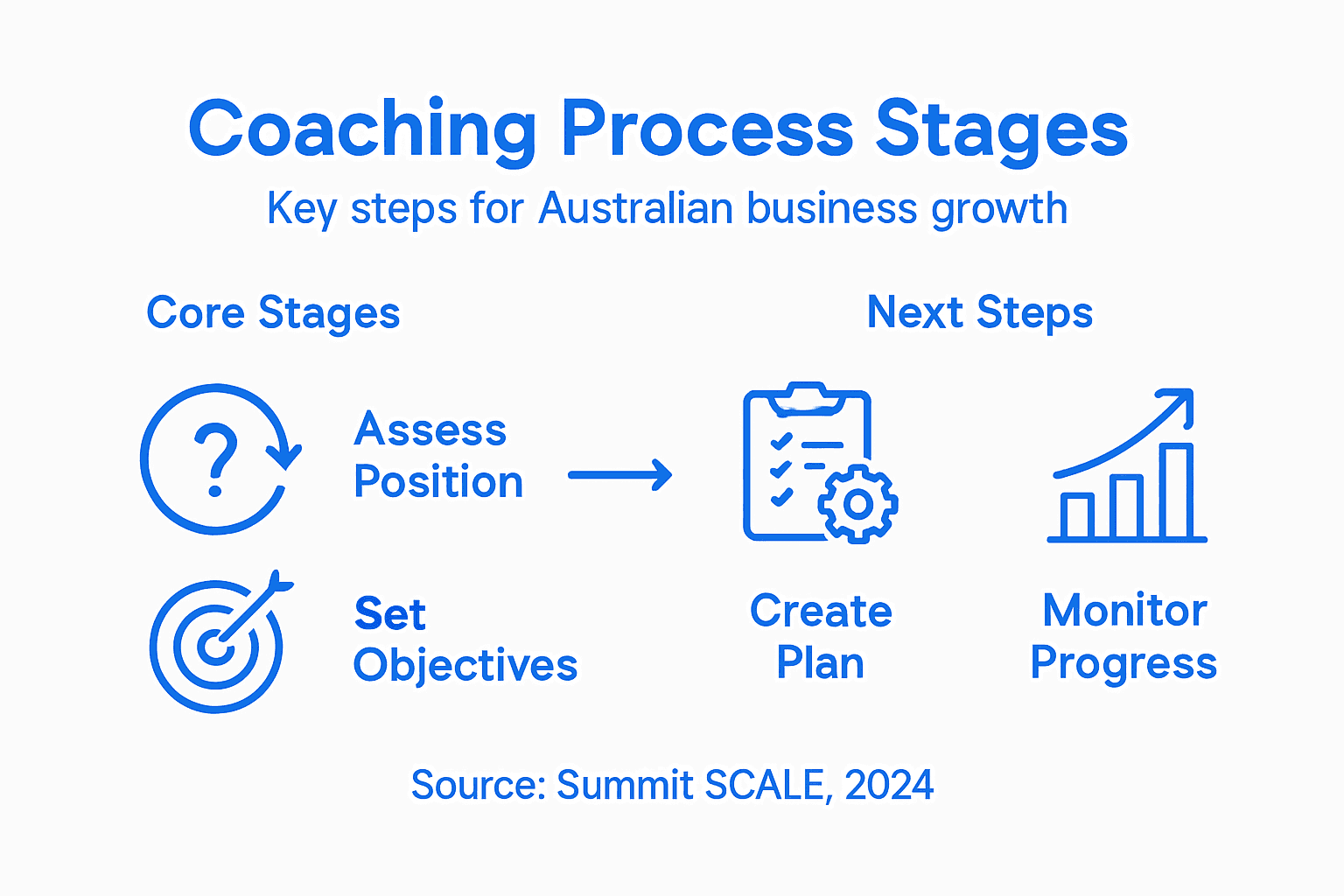
Regular review sessions are essential for meaningful refinement. Schedule quarterly comprehensive assessments where you critically evaluate the coaching strategies implementation, identifying what is working exceptionally well and where adjustments are needed. This might involve reassessing individual coaching plans, adjusting intervention techniques, or realigning objectives based on emerging organisational needs. The key is to maintain a continuous improvement mindset, viewing each coaching interaction as an opportunity for learning and strategic recalibration.
Expert Advice: Develop a culture of transparent feedback where team members feel empowered to share authentic insights about their coaching experience.
Unlock Your Business Growth with Expert Coaching Support
Navigating each stage of business coaching from assessing your current position to refining your approach can feel overwhelming. Common challenges like setting clear growth objectives and implementing effective coaching strategies require personalised solutions that adapt as your business evolves. This article highlights the importance of tailored coaching plans and consistent progress monitoring to turn ambitions into measurable success.
At Summit SCALE, we specialise in empowering Australian small to medium-sized business owners to conquer these very challenges. Our business coaching services focus on strategic steps such as sales growth, team building, and leadership development, perfectly complementing the article’s insights on building tailored coaching frameworks and effective implementation.
Discover how our approach integrates comprehensive diagnostics, goal alignment, and adaptive coaching styles to transform your business and leadership capacity. Ready to move beyond planning into impactful action?
Explore what professional guidance can do for you with a free 15-minute assessment call.
Take the first step today and visit Summit SCALE’s homepage to unlock your path to growth and greater business freedom.
Frequently Asked Questions
How do I assess my current business position for coaching?
To assess your current business position, gather quantitative data like financial statements and profit margins, alongside qualitative assessments of team dynamics and leadership capabilities. Create a scorecard to rate each area objectively, focusing on both strengths and weaknesses.
What are some clear growth objectives I can set for my business?
Start by defining measurable growth objectives that include financial targets, market expansion goals, and team development milestones. For example, aim to increase your quarterly revenue by 15% through enhanced marketing efforts within the next six months.
How can I build a tailored coaching plan for my business?
To build a tailored coaching plan, first identify your specific performance gaps and leadership challenges through a diagnostic assessment. Include milestones and measurable outcomes in your plan to track progress effectively and adjust as needed.
What strategies should I implement for effective coaching?
Implement coaching strategies by recognising the different styles of coaching required for various team members and situations. For instance, use directive coaching for new employees while applying a collaborative approach for more experienced team members to maximise effectiveness.
How do I monitor progress and refine my coaching approach?
To monitor progress, establish performance indicators and gather feedback from team members regularly. Conduct quarterly reviews to assess what is working well and where changes are needed, ensuring that your coaching strategy remains dynamic and relevant.

