
Many small business owners believe their natural leadership abilities will drive growth, yet 70% struggle to scale beyond initial success without structured coaching support. The reality is that leadership alone rarely translates to sustained profitability and expansion. Whilst vision and determination matter, the difference between stagnant businesses and thriving enterprises often lies in how leaders develop their capabilities through targeted coaching. This guide explores how leadership shapes business growth, which styles work best in different contexts, and why coaching accelerates results whilst preventing costly mistakes that derail scaling efforts.
Table of Contents
- Key takeaways
- Understanding the role of leadership in driving business growth
- Exploring leadership styles and their effects on business growth
- How leadership coaching accelerates growth and avoids common pitfalls
- Unlock your leadership potential with Summit SCALE® coaching
- Frequently asked questions about leadership’s role in growth
Key Takeaways
| Point | Details |
|---|---|
| Coaching drives growth | Coaching provides external perspective and structured frameworks that transform good leaders into growth drivers. |
| Tailored styles fit contexts | Different growth contexts demand different leadership styles rather than a universal approach. |
| Regular reviews and KPIs | Regular reviews and measurable KPIs help steer growth and keep leaders aligned with priorities. |
| Avoid common leadership pitfalls | Common pitfalls such as scale blindness, system ignorance, communication gaps and micromanagement derail scaling unless coaching helps map interdependencies and strengthen processes. |
Understanding the role of leadership in driving business growth
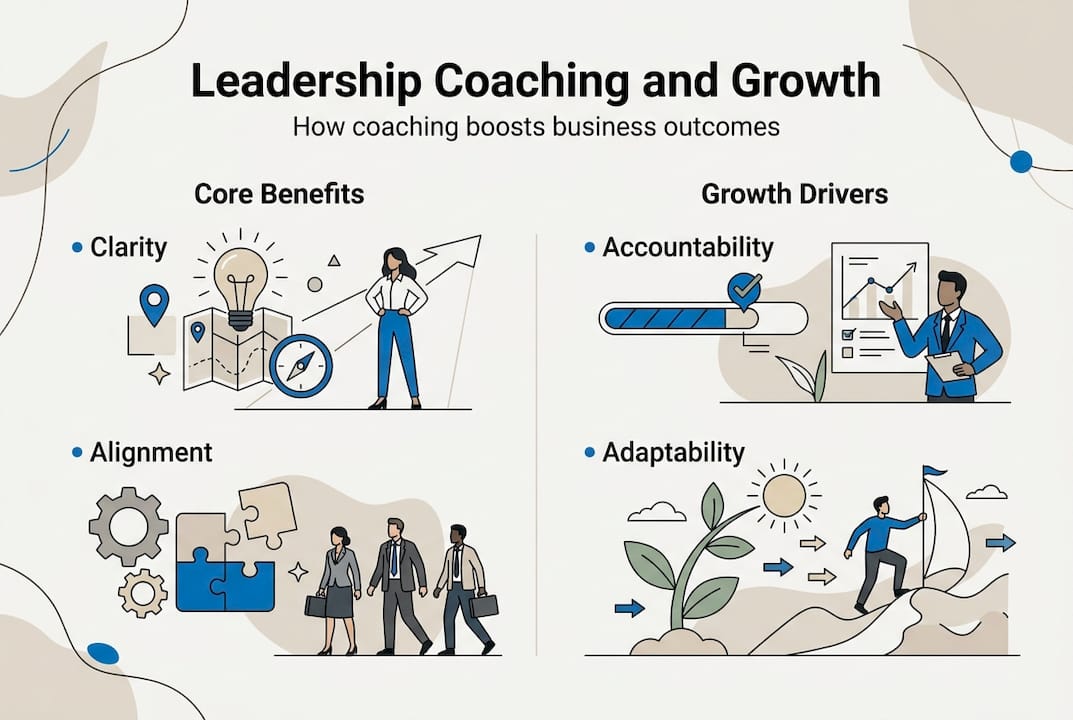
Leadership shapes every aspect of business growth through three core functions: inspiring teams toward shared goals, aligning resources with strategic priorities, and managing operations for consistent delivery. Leadership drives growth through strategic vision, team motivation, and operational oversight. Without clear vision, teams drift. Without alignment, resources scatter across competing priorities. Without effective management, execution falters regardless of strategy quality.
The challenge for SME owners lies in balancing these functions whilst maintaining day-to-day operations. Vision clarity requires stepping back from urgent tasks to identify long-term opportunities. Communication demands consistent messaging across all levels, ensuring everyone understands not just what to do but why it matters. Resource allocation means making tough choices about where to invest time, money, and attention for maximum growth impact.
Leadership coaching for owners helps shift mindset from individual achievement to collective success. This transition proves difficult for founders who built businesses through personal effort and expertise. Coaching facilitates the mental shift from “I must do this” to “we can achieve this together,” unlocking team potential that multiplies growth capacity beyond any single person’s capabilities.
Common pitfalls derail even experienced leaders:
- Scale blindness: assuming methods that worked at £500K revenue will work at £2M without adaptation
- System ignorance: failing to recognise how changes in one area ripple through the entire organisation
- Communication gaps: underestimating how much clarity teams need to execute effectively
- Micromanagement: holding onto tasks that should be delegated, creating bottlenecks
Pro Tip: Schedule monthly “system checks” where you map how decisions in sales, operations, and finance interconnect. This practice builds awareness of interdependencies that coaching emphasises for sustainable growth.
Leaders who understand these dynamics position themselves to drive growth intentionally rather than accidentally. They recognise that their role evolves as the business scales, requiring new skills and perspectives at each stage. This awareness creates the foundation for effective coaching that accelerates growth whilst avoiding predictable mistakes.
Exploring leadership styles and their effects on business growth
Leadership style profoundly influences team engagement, innovation capacity, and ultimately growth outcomes. Research shows no one leadership style fits all; transformational approaches often excel but autocratic methods may suit structure-focused needs. Understanding these distinctions helps owners choose approaches that match their business context, team composition, and growth objectives.
| Leadership style | Primary focus | Growth impact | Best contexts |
|---|---|---|---|
| Transformational | Inspiration and innovation | High engagement, creative solutions | Fast-changing markets, innovation-driven growth |
| Transactional | Clear tasks and rewards | Predictable execution, efficiency gains | Stable operations, process optimisation |
| Autocratic | Centralised control | Quick decisions, consistent standards | Crisis management, quality-critical work |
| Servant | Team development | Long-term capability building | Culture transformation, retention focus |
Transformational leadership drives growth by connecting team members to a compelling vision that transcends daily tasks. Leaders who adopt this style invest heavily in communication, celebrating wins whilst framing challenges as opportunities for collective problem-solving. This approach generates high engagement and encourages innovation, making it particularly effective for businesses navigating market disruption or pursuing differentiation strategies. The downside emerges when teams need clear direction rather than inspiration, or when operational consistency matters more than creative solutions.
Transactional leadership establishes clear expectations, metrics, and reward systems that drive predictable performance. This style works brilliantly for scaling operations where consistency and efficiency determine profitability. Teams know exactly what success looks like and receive recognition for meeting targets. However, transactional approaches can stifle innovation and reduce engagement when overused, particularly among team members who crave autonomy and creative challenges.
Autocratic leadership centralises decision-making, enabling rapid responses and maintaining tight quality control. Whilst often criticised, this style proves valuable during crises, when entering highly regulated industries, or when brand consistency demands strict standards. The risk lies in creating dependency on the leader, suppressing team initiative, and burning out the owner who becomes the bottleneck for every decision.
Successful leaders rarely use one style exclusively. They adapt based on:
- Business maturity: startups often need more directive leadership whilst established firms benefit from distributed decision-making
- Team capability: experienced teams thrive with autonomy whilst new teams require more structure and guidance
- Market conditions: stable environments allow participative styles whilst volatile markets may demand faster, centralised decisions
- Growth objectives: scaling operations benefits from transactional clarity whilst innovation pursuits need transformational inspiration
Pro Tip: Assess your natural leadership style through 360-degree feedback, then identify situations where a different approach might accelerate growth. High performance leadership requires style flexibility rather than rigid adherence to one method.
The leadership coaching process helps owners develop this flexibility by building awareness of their default patterns and practising alternative approaches in low-risk environments. Coaches provide feedback on style effectiveness, helping leaders recognise when their natural tendencies serve growth and when they create obstacles. This awareness transforms leadership from instinctive reaction to strategic choice.
How leadership coaching accelerates growth and avoids common pitfalls
Leadership coaching uses scenario planning, KPIs, quarterly reviews, and shifting mindsets to team focus. These methods create structured frameworks for developing leadership capabilities whilst maintaining accountability for growth outcomes. Coaching transforms abstract leadership concepts into concrete practices that drive measurable business results.
Effective coaching follows a systematic approach:
- Assessment: Identify current leadership strengths, blind spots, and growth obstacles through self-reflection, team feedback, and business metrics analysis
- Goal setting: Define specific leadership capabilities to develop and business outcomes to achieve, creating clear targets for coaching focus
- Action planning: Design experiments and practices that build new leadership behaviours whilst addressing immediate business challenges
- Implementation support: Provide guidance and accountability as leaders apply new approaches in real business situations
- Review and adjustment: Evaluate results, celebrate progress, and refine strategies based on what works in the specific business context
Quarterly reviews keep teams aligned and prevent strategic drift that undermines growth momentum. These sessions create space to assess whether daily activities still serve long-term objectives or whether the business has unconsciously shifted priorities. Leaders often discover that urgent demands have gradually consumed resources intended for strategic initiatives, explaining why growth has stalled despite hard work.

| Coaching element | Purpose | Growth impact |
|---|---|---|
| Scenario planning | Prepare for multiple futures | Reduces reactive decisions, builds strategic confidence |
| KPI frameworks | Track leading indicators | Enables course correction before problems compound |
| Quarterly reviews | Maintain strategic alignment | Prevents drift, ensures resources serve growth priorities |
| Mindset shifts | Move from individual to team focus | Unlocks capacity beyond leader’s personal limits |
Coaching fosters a system-curious mindset that prevents scale blindness. Leaders learn to ask how changes in one area affect others, anticipating ripple effects before they create problems. This systems thinking proves essential for sustainable growth, as businesses become increasingly complex with each expansion phase. What worked perfectly at ten employees creates chaos at fifty without conscious adaptation.
Experienced leaders risk pattern-blindness; coaching keeps them system-curious and adaptable. Success creates mental models that worked brilliantly in past contexts but may fail in new situations. External coaches challenge these assumptions, asking questions that reveal where yesterday’s solutions have become today’s obstacles. This outside perspective proves invaluable for breaking through growth plateaus that internal thinking cannot solve.
“The greatest danger in times of turbulence is not the turbulence itself, but acting with yesterday’s logic.” This wisdom applies perfectly to scaling businesses, where past success often blinds leaders to necessary adaptations.
Pro Tip: Create a “challenge board” of trusted advisers who question your assumptions quarterly. Coaching in scaling business works best when leaders actively seek disconfirming evidence rather than validation.
The benefits of leadership coaching extend beyond individual capability development to organisational transformation. As leaders grow, they model learning behaviours that cascade through teams, creating cultures where continuous improvement becomes normal rather than exceptional. This cultural shift multiplies coaching impact far beyond the hours spent in formal sessions.
Coaching and development programmes that integrate leadership growth with business strategy deliver the strongest results. Rather than treating coaching as separate from operations, effective programmes embed leadership development into strategic planning, team meetings, and performance reviews. This integration ensures new capabilities immediately apply to real challenges, accelerating both learning and business outcomes.
Unlock your leadership potential with Summit SCALE® coaching
You’ve built a successful business through determination and hard work. Now growth demands different capabilities, ones that coaching develops systematically rather than through trial and error. Summit SCALE® offers tailored leadership coaching for SME owners who recognise that their next level of success requires new thinking, skills, and support.
Our coaching approach addresses the specific challenges you face: breaking through revenue plateaus, building teams that execute without constant oversight, and creating systems that support sustainable expansion. We focus on practical application rather than theory, ensuring every session translates to immediate business improvements. The role of coaching for SMEs centres on unlocking growth by building leadership capacity and team alignment that transforms good businesses into exceptional ones.
Clients achieve improved profitability and sustainable expansion by developing the leadership capabilities that matter most at their current growth stage. Whether you’re scaling from £500K to £2M or from £5M to £20M, our coaching adapts to your specific context, challenges, and opportunities. Discover why invest in coaching business owners consistently outperform peers who rely solely on experience.
Frequently asked questions about leadership’s role in growth
What are the main leadership qualities needed to drive business growth?
Effective growth leaders combine strategic vision with operational discipline, seeing both the destination and the path forward. They communicate clearly and consistently, ensuring teams understand priorities and how daily work connects to bigger goals. Emotional intelligence matters enormously, as growth creates stress that leaders must manage in themselves and others whilst maintaining team morale and focus.
How does leadership coaching specifically help small business owners?
Coaching provides external perspective that reveals blind spots invisible from inside the business. It creates accountability for strategic priorities that otherwise get displaced by urgent demands. Most importantly, coaching for SMEs accelerates learning by condensing years of trial and error into focused development that applies immediately to current challenges.
Can different industries require different leadership approaches for growth?
Absolutely. Professional services firms often need collaborative, relationship-focused leadership whilst manufacturing businesses may require more directive, process-oriented approaches. Market volatility, regulatory environment, and talent availability all influence which leadership styles drive growth most effectively. Smart leaders adapt their approach to industry context rather than applying universal formulas.
What are common mistakes leaders make when scaling their business?
The biggest mistake is assuming that methods that worked at smaller scale will continue working as the business grows. Leaders also commonly hold onto tasks they should delegate, creating bottlenecks that limit growth. Many underestimate how much communication clarity teams need, assuming others share their understanding of priorities and strategies when significant gaps actually exist.
How often should leaders evaluate their growth strategies?
Quarterly reviews provide the right balance between consistency and adaptability. Monthly reviews risk overreacting to normal fluctuations whilst annual reviews allow problems to compound too long before correction. Quarterly rhythms enable pattern recognition across sufficient data points whilst maintaining agility to adjust strategies when market conditions or internal capabilities shift meaningfully.

