
Many business leaders invest in coaching hoping for transformation, yet struggle to see tangible results. The missing ingredient isn’t better advice or more sessions. It’s accountability. Without structured mechanisms to track progress and enforce commitments, even the most insightful coaching conversations fade into forgotten intentions. Accountability transforms coaching from theoretical discussions into measurable business outcomes. It creates the bridge between what you learn in coaching sessions and what actually changes in your organisation. When implemented correctly, accountability frameworks drive sustained growth by ensuring every coaching insight translates into concrete action and measurable progress.
Table of Contents
- Key takeaways
- Understanding accountability in coaching: the bridge from intention to action
- Proven accountability frameworks and their measurable impact
- Navigating common challenges and expert insights on accountability coaching
- Applying accountability in SMB coaching for sustained business growth
- Boost your leadership effectiveness with Summit SCALE® coaching
- What is the role of accountability in coaching?
Key Takeaways
| Point | Details |
|---|---|
| Linking coaching to outcomes | Accountability creates a direct bridge between coaching insights and measurable business actions. |
| SMART goals and check ins | Structured goals and regular reviews translate insights into concrete progress. |
| Progress dashboards visualise progress | Dashboards provide real time metrics to prevent drift and keep momentum. |
| SMB context matters | Adapting accountability strategies to small and medium sized enterprises ensures practicality and better uptake. |
Understanding accountability in coaching: the bridge from intention to action
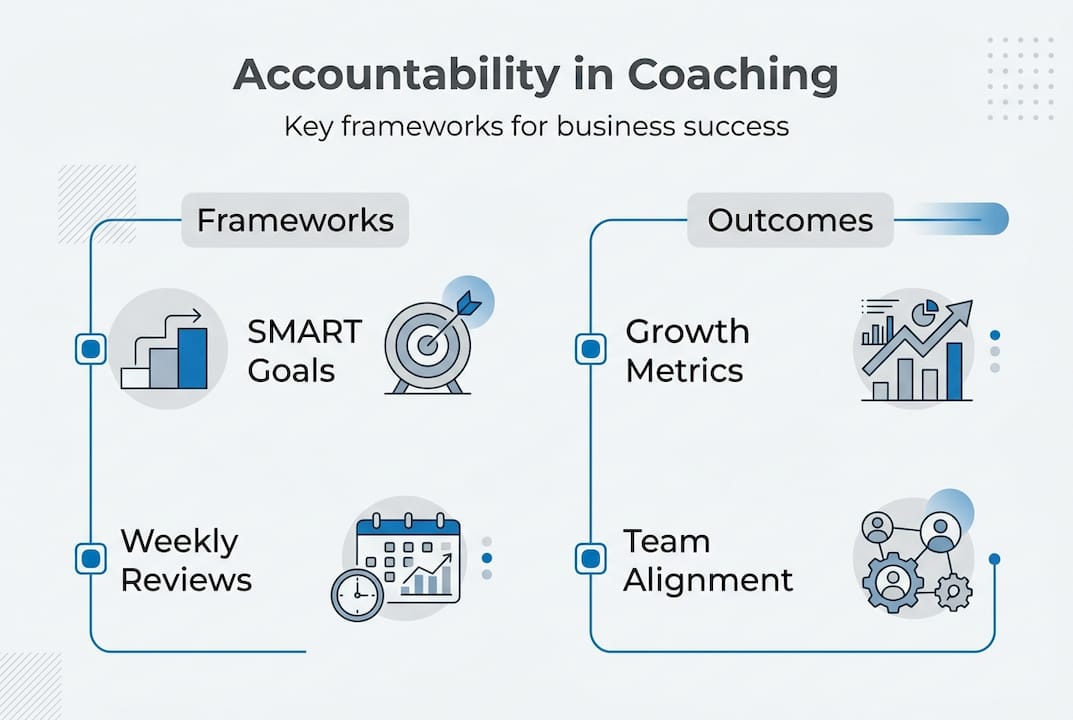
Accountability in coaching means establishing clear mechanisms that link your coaching plans to actual progress in your business. It’s not about punishment or micromanagement. Instead, it creates a structured system where commitments made during coaching sessions become tracked actions with measurable outcomes. Accountability bridges intention and action through regular check-ins, measurable goals, progress tracking, and feedback loops.
The mechanics involve several interconnected tools working together. SMART goals provide specificity, turning vague aspirations like “improve team performance” into concrete targets such as “reduce project delivery time by 15% within 90 days.” Regular check-ins, typically weekly or fortnightly, create consistent touchpoints where you review progress, identify obstacles, and adjust strategies. Progress dashboards visualise key metrics, making it impossible to ignore whether you’re moving forward or standing still.
Common frameworks structure these elements into repeatable processes. Some coaches use weekly accountability calls paired with digital tracking tools. Others implement monthly deep-dive reviews supplemented by brief daily or weekly self-reporting. The specific framework matters less than consistency and clarity about who’s responsible for what. When everyone knows what success looks like and when progress will be reviewed, follow-through increases dramatically.
These tools enable ongoing measurement and adjustment, which separates accountability from rigid adherence to outdated plans. Markets shift, team dynamics change, and unexpected challenges emerge. Effective accountability systems build in flexibility whilst maintaining momentum towards core objectives. You’re not locked into plans that no longer serve you, but you are committed to making conscious decisions about any changes rather than drifting away from goals through inattention.
Pro Tip: Schedule accountability reviews at the same time each week to build habit and rhythm. Consistency in timing creates psychological momentum that makes follow-through feel natural rather than forced.
The role of coaching for SMEs becomes exponentially more powerful when these accountability mechanisms are embedded from the start. Without them, coaching risks becoming an expensive series of conversations that feel good in the moment but produce little lasting change in how your business operates.
Proven accountability frameworks and their measurable impact
Several structured approaches have emerged as particularly effective for business coaching, each with documented results. The five-step formula provides a straightforward framework: establish a North Star goal that defines ultimate success, clarify roles so everyone knows their responsibilities, identify key performance indicators that signal progress, conduct weekly reviews to maintain momentum, and model the behaviour you expect from your team. This approach creates alignment between coaching insights and daily operations.
The twelve-week framework takes a different approach, breaking longer-term objectives into quarterly sprints. It typically begins with comprehensive assessments to establish baseline performance, followed by goal-setting sessions, weekly accountability check-ins, mid-point reviews to adjust course, and final assessments to measure progress. These methodologies yield 15-30% business growth when implemented consistently, with the structured timeframe creating urgency whilst remaining achievable.

The financial returns justify the investment required. Executive coaching returns 3-7x investment, with a median return of 700%. The same research shows significantly improved goal attainment, demonstrating that accountability mechanisms don’t just feel productive, they deliver measurable business outcomes. These returns stem from faster decision-making, improved team performance, and reduced costly mistakes that occur when leaders operate without structured guidance and accountability.
| Framework | Duration | Key tools | Primary outcomes |
|---|---|---|---|
| Five-step formula | Ongoing | North Star goals, KPI dashboards, weekly reviews | Alignment, role clarity, sustained momentum |
| Twelve-week sprint | Quarterly | Assessments, check-ins, mid-point reviews | 15-30% growth, focused intensity, measurable progress |
| Monthly deep-dive | Monthly | Progress reports, obstacle analysis, strategy adjustment | Strategic flexibility, problem-solving, course correction |
Practical tools support these frameworks by making accountability visible and manageable. Common platforms include:
- Asana for task management and progress tracking
- Trello for visual workflow management
- CoachAccountable for specialised coaching relationship management
- Custom dashboards in Excel or Google Sheets for metrics tracking
- Weekly email reports for simple, consistent communication
The choice of tools matters less than consistent use. Many successful coaching relationships rely on simple spreadsheets and scheduled calls rather than sophisticated software. The technology serves the accountability process, not the other way round. What matters is creating visibility into commitments and progress, ensuring nothing falls through the cracks between coaching sessions.
Understanding performance coaching business growth connections helps you select frameworks and tools that match your specific situation. A fast-growing startup needs different accountability structures than an established business optimising operations. The principles remain constant whilst application adapts to context.
Navigating common challenges and expert insights on accountability coaching
Implementing accountability in coaching encounters predictable obstacles that undermine effectiveness when not addressed proactively. Lack of leadership buy-in tops the list. When business owners or senior leaders don’t fully commit to the accountability process, it signals to everyone else that commitments are optional. This creates a culture where coaching becomes another initiative that fades away rather than a transformation tool that drives lasting change.
Vague targets represent another frequent pitfall. Goals like “improve customer satisfaction” or “be a better leader” sound worthwhile but provide no basis for accountability. Without specific, measurable criteria, you can’t determine whether you’ve succeeded or failed. This ambiguity allows drift and rationalisation, where any minor effort feels like progress even when business results remain unchanged.
Balancing psychological safety with structure proves essential to avoid two opposite dangers. Too much softness transforms coaching into comfortable conversations that never challenge you to change. Too much rigidity creates fear-based compliance where you hit targets whilst hiding problems and avoiding necessary risks. The sweet spot maintains high standards whilst creating space for honest discussion about obstacles and setbacks.
A related challenge emerges from excessive coaching that creates dependency rather than capability. Some leaders coach when they should direct, turning every situation into a learning opportunity when team members need clear answers. This slows decision-making and signals lack of confidence. Effective accountability includes knowing when to coach for development and when to provide direct guidance for urgent situations.
The coaching paradox requires maintaining a person-centred approach whilst remaining problem-focused. Accountability coaching prioritises action over mindset, recognising that business results require both personal development and practical problem-solving. Pure person-centred coaching can become therapy that feels supportive but doesn’t drive business outcomes. Pure problem-focused coaching can achieve short-term results whilst burning out people and damaging culture.
Common obstacles include:
- Inconsistent follow-through on commitments between sessions
- Lack of clear metrics to measure progress objectively
- Resistance to feedback when accountability reveals gaps
- Competing priorities that push coaching commitments aside
- Insufficient time allocated for accountability activities
Pro Tip: Use discernment to recognise when situations require coaching versus directing. Coach for development when time permits and capability-building matters. Direct when urgency demands quick decisions or when team members lack foundational knowledge needed for effective problem-solving.
“Leadership accountability in coaching succeeds when leaders model commitment to the process, demonstrate vulnerability in acknowledging their own gaps, and maintain consistency between stated values and actual behaviour. Without visible leadership engagement, accountability frameworks become bureaucratic exercises rather than transformation tools.”
Understanding the coaching role in profitability helps frame these challenges as obstacles worth overcoming rather than reasons to avoid accountability altogether. The businesses that navigate these challenges successfully see dramatically better results than those that either avoid accountability or implement it poorly. External perspectives on coaching overcoming fear and stagnation provide additional context for addressing psychological barriers that undermine accountability.
Applying accountability in SMB coaching for sustained business growth
Small and medium-sized businesses face unique constraints that require adapting accountability frameworks developed for larger organisations. Resource limitations mean you can’t dedicate full-time staff to tracking metrics or conducting elaborate reviews. Flat organisational structures mean accountability mechanisms must work without multiple management layers. Rapid change means frameworks need flexibility built in from the start.
Customising accountability to your SMB context starts with honest assessment of current capacity. What tracking already happens? What meetings already occur? Build accountability into existing structures rather than creating entirely new systems that add burden. If you already hold weekly team meetings, add a brief accountability check-in. If you already track financial metrics, add operational metrics that connect to coaching goals.
Adapting expert accountability methods to SMB context avoids pitfalls like outsourcing judgement to frameworks that don’t match your reality. Large enterprise frameworks often assume resources and stability that SMBs lack. Blindly following them wastes time and creates frustration. Instead, extract core principles and implement them in ways that match your actual situation.
Practical steps for embedding accountability:
- Align coaching goals directly with business priorities, ensuring every commitment connects to revenue, profitability, or strategic objectives
- Establish review frequency that balances momentum with practicality, typically weekly for high-priority goals and monthly for longer-term objectives
- Select simple tracking tools you’ll actually use consistently rather than sophisticated platforms that become abandoned
- Define clear ownership for each goal, naming specific individuals responsible for progress
- Create consequences for both success and failure, celebrating wins and addressing gaps promptly
- Build in quarterly reviews to assess whether accountability mechanisms themselves need adjustment
The table below summarises key metrics SMBs should monitor to assess whether coaching accountability drives actual business growth:
| Metric category | Specific measures | Review frequency | Target improvement |
|---|---|---|---|
| Revenue growth | Monthly sales, average transaction value, customer acquisition | Monthly | 10-20% annual increase |
| Operational efficiency | Project completion time, error rates, resource utilisation | Weekly | 15-25% improvement |
| Team performance | Employee retention, productivity per person, goal achievement | Quarterly | 20-30% enhancement |
| Leadership effectiveness | Decision speed, delegation success, strategic time allocation | Monthly | 25-35% improvement |
| Profitability | Gross margin, net profit, cash flow | Monthly | 15-25% increase |
Leadership involvement makes or breaks accountability in SMBs. In smaller organisations, owner and senior leader behaviour sets culture more directly than in large companies with multiple layers. When you consistently participate in accountability reviews, treat commitments seriously, and acknowledge your own gaps, everyone else follows. When you skip reviews, make excuses, or blame circumstances, accountability collapses regardless of frameworks and tools.
Balancing rigour and psychological safety in SMB context requires recognising that relationships are closer and more personal in smaller organisations. You can’t hide behind corporate formality. This intimacy can strengthen accountability when trust is high, as people don’t want to let down colleagues they know well. It can also make accountability conversations more difficult when addressing performance gaps feels like personal criticism.
Exploring coaching for SME growth and staying current with business coaching trends 2026 ensures your accountability approach evolves with changing business conditions and coaching methodologies. What worked brilliantly last year may need adjustment as your business scales or market conditions shift.
Boost your leadership effectiveness with Summit SCALE® coaching
Transforming coaching insights into measurable business growth requires expertise in both business strategy and accountability frameworks. Summit SCALE® specialises in helping SMB leaders implement structured accountability that drives real results. Our approach combines proven methodologies with practical adaptation to your specific business context, ensuring coaching delivers tangible returns rather than comfortable conversations.
We work with business owners and managers who recognise that growth requires both strategic insight and disciplined execution. Our coaching programmes embed accountability from day one, with clear metrics, regular reviews, and structured frameworks that match your resources and objectives. Whether you’re focused on revenue growth, team development, or operational efficiency, we help you bridge the gap between intention and achievement. Discover how investing in coaching business success works when accountability drives every session. Explore the specific role of coaching for SMEs and learn how performance coaching business growth connections create measurable returns. Schedule your free 15-minute assessment to discuss your specific accountability challenges and growth objectives.
What is the role of accountability in coaching?
What exactly does accountability mean in a coaching context?
Accountability in coaching means establishing clear mechanisms that track commitments made during sessions and ensure they translate into actual business actions. It includes setting measurable goals, scheduling regular progress reviews, identifying obstacles, and adjusting strategies based on results. Accountability transforms coaching from theoretical discussions into practical business improvements.
How does accountability improve coaching outcomes for business growth?
Accountability creates consistent follow-through on coaching insights, preventing the common pattern where sessions feel valuable but produce no lasting change. By tracking specific metrics and reviewing progress regularly, accountability ensures coaching addresses real business challenges rather than staying theoretical. Research shows properly implemented accountability frameworks deliver 15-30% business growth and 3-7x return on coaching investment.
How do you balance accountability with psychological safety in coaching?
Effective accountability maintains high standards whilst creating space for honest discussion about obstacles and setbacks. This means celebrating progress, addressing gaps promptly without blame, and distinguishing between circumstances beyond control and lack of effort. The balance requires clear expectations set collaboratively, consistent follow-through on commitments, and coaching conversations that explore challenges rather than judge failures.
What timeframe should SMBs expect before seeing results from accountability coaching?
Most businesses notice improved decision-making and team alignment within the first month of implementing accountability structures. Measurable business metrics like revenue growth or operational efficiency typically show improvement within 90 days. Sustained transformation requiring culture change or significant capability development takes six to twelve months. Quick wins build momentum whilst longer-term objectives develop.
What tools are most helpful for maintaining accountability in coaching relationships?
Simple, consistently used tools outperform sophisticated platforms that get abandoned. Weekly email updates, shared spreadsheets tracking key metrics, scheduled video calls for reviews, and basic project management tools like Trello or Asana all work effectively. Choose tools that match your current technology comfort and commit to using them every week rather than searching for perfect solutions that never get implemented.

