
Many American business owners find themselves juggling rapid growth, team setbacks, and dwindling personal time. The path from manager to genuine leader is rarely straightforward, and generic advice often misses what actually challenges you day to day. By understanding what leadership coaching truly is—and what it is not—you gain the clarity to develop strategic, confident leadership that powers your team and your business forward, while reclaiming the breathing room you deserve.
Table of Contents
- Leadership Coaching Defined and Debunked Myths
- Personalised Coaching Approaches for Leaders
- Driving Growth Through Enhanced Team Performance
- Accountability, Decision-Making, and Confidence Gains
- Comparing Leadership Coaching to Traditional Training
Key Takeaways
| Point | Details |
|---|---|
| Coaching Promotes Genuine Growth | Leadership coaching fosters authentic behaviour change, ensuring leaders develop alongside their businesses. |
| Misconceptions About Coaching | Common myths, such as coaching being exclusively for struggling leaders, deter many from pursuing its benefits. |
| Personalised Approaches Yield Results | Tailored coaching focuses on individual challenges, leading to measurable improvements in leadership effectiveness. |
| Accountability Enhances Outcomes | Engaging in coaching builds accountability, improving decision-making and boosting overall confidence in leadership. |
Leadership Coaching Defined and Debunked Myths
Leadership coaching is far more than just another training programme or quick fix. It’s a targeted partnership between a business owner and a coach designed to unlock your leadership potential and drive meaningful, lasting change in how you lead.
What Leadership Coaching Actually Is
At its core, leadership coaching focuses on fostering authentic, change-oriented behaviours that transform how you lead your team. Unlike generic training programmes, coaching addresses your specific challenges, strengths, and blind spots through personalised guidance.
Coaching works by building your self-awareness and confidence. A skilled coach asks powerful questions, challenges your assumptions, and holds you accountable to the goals you set. The result? You develop the strategic thinking and emotional intelligence needed to lead your growing team effectively.
Leadership coaching targets lasting behaviour change that sustains leadership performance, not temporary fixes that fade after the programme ends.
For small to medium-sized business owners, this matters enormously. Your team will never outgrow your leadership capabilities. Coaching ensures you grow alongside your business.
Common Myths About Leadership Coaching
Misunderstandings about coaching often prevent business owners from pursuing it. Let’s address the ones holding you back:
Myth 1: Coaching is only for struggling leaders
This couldn’t be further from the truth. Research shows coaching benefits high-performing leaders by increasing self-awareness, confidence, and strategic leadership capabilities. Your existing strengths become even stronger with the right guidance.
Myth 2: Coaching is a quick fix
Some expect coaching to solve problems overnight. Real coaching requires commitment, typically spanning months. You’re rewiring how you think and lead—that takes time. The payoff? Sustainable change you can rely on for years.
Myth 3: Good leaders don’t need coaching
The best leaders actively invest in their development. You wouldn’t expect your team to improve without support; the same applies to you. Coaching accelerates your growth trajectory dramatically.
Myth 4: Coaching is just advice or consulting
Coaches don’t tell you what to do. Instead, they guide you towards discovering your own solutions. This approach builds confidence and ownership of your results.
Why This Distinction Matters for Your Business
When you understand what genuine leadership coaching is—and isn’t—you can make an informed decision about whether it’s right for your situation.
Many common misconceptions about business coaching stem from mixing coaching with other development methods. Real coaching transforms you from the inside out, creating leaders who inspire their teams and drive measurable business results.
Your business growth depends directly on your leadership quality. Investing in becoming a stronger, more self-aware leader isn’t a luxury—it’s essential infrastructure for scaling successfully.
Pro tip: When evaluating a coach, ask about their approach to accountability and how they measure progress. A legitimate coach will focus on your behaviour change and business outcomes, not just pleasant conversations.
Personalised Coaching Approaches for Leaders
One-size-fits-all coaching doesn’t work. Your business is unique, your challenges are specific, and your leadership style is distinctly yours. Personalised coaching recognises this reality and builds a development plan around what actually matters to you.
Why Generic Coaching Falls Short
Standard leadership programmes treat every leader the same. They cover broad topics, offer generic advice, and rarely address your specific situation. By the time the course ends, you’re back to your daily challenges with little that applies directly.
Personalised coaching is fundamentally different. It starts with understanding your world—your team dynamics, your market pressures, your personal leadership goals. From there, your coach builds a tailored approach designed specifically for your circumstances.
Tailored coaching focuses on your specific challenges, strengths, and goals, facilitating meaningful professional growth aligned with what actually drives your business forward.
What Personalised Coaching Includes
Effective personalised coaching integrates multiple dimensions of your leadership context:
- Individual factors: Your strengths, blind spots, decision-making style, and core values as a leader
- Relational elements: How you interact with your team, communication patterns, and trust-building approaches
- Contextual awareness: Your industry landscape, growth stage, competitive pressures, and organisational structure
This approach means your coach isn’t following a preset curriculum. Instead, they’re adapting continuously based on what you’re learning about yourself and what’s working in your business.
How Personalised Coaching Drives Real Results
When coaching is tailored to your situation, transformation becomes measurable. You’re not developing generic leadership skills—you’re building capabilities directly tied to your business goals.

Personalised coaching in leadership development supports enhanced self-awareness and adaptive leadership capabilities essential for dynamic organisational settings. This means you understand yourself better as a leader, which naturally improves how you show up with your team.
The investment pays dividends because the coaching addresses what actually matters: your current challenges, not hypothetical scenarios. When you’re struggling with delegation, that becomes the focus. If strategic thinking is your gap, coaching targets that specifically.
The Role of Assessment in Personalised Coaching
Your coach starts by thoroughly understanding where you are now. This typically includes:
- In-depth conversations about your leadership journey and current situation
- Assessment of your strengths and development areas
- Exploration of your aspirations for yourself and your business
- Understanding of your team’s perspective and organisational culture
This assessment period isn’t wasted time—it’s the foundation for everything that follows. A coach who skips this step is likely not personalising anything.
Measuring Progress That Matters
Personalised coaching tracks outcomes aligned with your goals, not generic metrics. You might measure progress through team feedback, business results, your own confidence level, or specific leadership behaviours you’ve committed to developing.
Your coach holds you accountable to these measures, ensuring the coaching translates into real change you can see in your business and your leadership.
Pro tip: Ask your potential coach how they personalise their approach and what specific assessment methods they use. The more detailed their answer about understanding YOUR situation, the more likely they’ll deliver results.
Driving Growth Through Enhanced Team Performance
Your team’s performance directly determines your business growth. A struggling team creates a ceiling on what you can achieve. An engaged, capable team becomes your competitive advantage and accelerates everything you’re trying to build.
Leadership coaching transforms how you lead your team, which fundamentally shifts their performance. This isn’t about hiring different people—it’s about unlocking the potential already sitting in your organisation.
The Link Between Leadership and Team Performance
Your leadership quality sets the tone for everything your team does. When you’re unclear about priorities, your team wastes energy. When you avoid difficult conversations, performance issues fester. When you inspire confidence, your team steps up.
Coaching improves your ability to lead in ways that matter. You develop clarity, communication skills, and emotional intelligence. Your team responds by becoming more engaged, productive, and aligned.
Enhanced leadership directly produces enhanced team performance, creating a multiplier effect on your business growth.
How Better Leadership Shows Up in Team Results
When you improve as a leader, your team sees concrete changes:
- Clearer direction: Your team understands priorities and knows what success looks like
- Better communication: Misunderstandings decrease, collaboration increases
- Stronger accountability: People know expectations and deliver consistently
- Increased engagement: Team members feel valued and invested in outcomes
- Faster problem-solving: Issues get addressed before they become crises
These shifts accumulate quickly. Within months, you notice improved retention, higher quality work, and better team morale.
Building the Team Your Growth Demands
As your business scales, your team’s capabilities must scale with it. Coaching helps you develop leaders within your organisation rather than always hiring from outside. This builds continuity, culture, and institutional knowledge.
Understanding the characteristics of healthy teams helps you recognise what you’re working towards. Strong teams share common traits: psychological safety, clear goals, accountability, and mutual respect. Your coaching helps you cultivate these.
Measuring Team Improvement
Better leadership produces measurable outcomes. Track what matters to your business:
- Employee retention rates and reduced turnover costs
- Quality of work and fewer errors or rework
- Time to fill open positions through internal promotions
- Revenue per employee and productivity metrics
- Employee feedback and engagement scores
These metrics reveal whether your improved leadership is translating into genuine team performance gains.
The Compounding Effect on Growth
When your team performs better, growth accelerates. You’re not bottlenecked by your own capacity anymore. Your team takes on bigger projects, handles more complex challenges, and frees you to focus on strategy rather than execution.
This is when business ownership feels less like a job you can’t escape and more like the opportunity you envisioned.
Pro tip: Involve your team in setting their own performance goals during your coaching journey. When they help define success, they’re far more likely to achieve it, and you’ll see faster, more sustainable improvements.
Accountability, Decision-Making, and Confidence Gains
Three fundamental shifts happen when you engage in leadership coaching: you become more accountable to your goals, you make better decisions, and your confidence strengthens. These aren’t soft improvements—they directly impact your bottom line.
Many business owners struggle because they lack genuine accountability. Without it, progress stalls. Coaching creates the structure and support that transforms good intentions into consistent action.
Building Real Accountability
Accountability isn’t punishment. It’s clarity. It’s knowing exactly what you committed to and having someone invested in your success.
When you work with a coach, you set specific, measurable goals. Then your coach regularly checks in on progress. This simple structure changes everything. You stop procrastinating on important initiatives because you know you’ll report back.
Many business owners discover that building accountability into your business requires starting with themselves first. You can’t expect your team to be accountable if you aren’t modelling it. Coaching ensures you’re walking the talk.
Real accountability means keeping your word to yourself, which paradoxically becomes easier with external support from a coach.
Making Decisions with Confidence
Leadership is constant decision-making. Every choice ripples through your business. Yet many owners struggle with decision paralysis or second-guess themselves afterwards.
Coaching builds your decision-making framework. Your coach helps you think through options systematically, understand your decision-making blind spots, and develop confidence in your choices. You learn to trust your instincts whilst remaining open to new information.
Within weeks, you notice you’re deciding faster and sleeping better at night. Fewer decisions haunt you because you’ve thought them through properly.
The Confidence That Changes Everything
Confidence isn’t arrogance. It’s the quiet certainty that you can handle what comes next. It’s the foundation for taking calculated risks and pursuing ambitious growth.
Many business owners started their company with confidence, then lost it through setbacks and overwhelm. Coaching restores it by helping you see your actual capabilities clearly—not minimising challenges, but not catastrophising either.
Confidence shows up concretely:
- You speak with authority in client meetings
- You make tough decisions without second-guessing
- You delegate more freely because you trust your team
- You pursue growth opportunities you’d previously avoided
- You enjoy the business more because you’re not constantly anxious
The Compound Effect of These Three Shifts
Accountability keeps you moving forward. Better decisions reduce wasted effort and costly mistakes. Growing confidence makes you bolder and more resilient.
Together, these three create exponential change. Six months into coaching, you’re unrecognisable—not in personality, but in capability and clarity. Your business feels more stable. Your personal stress decreases. Growth accelerates.
This is why coaching delivers such consistent results across different industries and business types. These three foundations matter everywhere.
Below is a summary of key outcomes business owners can expect from effective leadership coaching:
| Outcome | Description | Potential Business Impact |
|---|---|---|
| Enhanced Self-Awareness | Deeper understanding of leadership style | More effective team interactions |
| Improved Decision-Making | Faster, more confident strategic choices | Reduced costly errors |
| Stronger Accountability | Consistent progress on key objectives | Continuous business improvement |
| Higher Team Performance | Engagement, retention, and productivity gains | Sustainable business growth |
| Increased Confidence | Greater assurance in challenging situations | Bolder pursuit of opportunities |
Pro tip: Track your confidence level monthly on a simple 1-10 scale, and notice how specific decisions felt before and after coaching. You’ll see the progress in real time, which itself builds even more confidence.
Comparing Leadership Coaching to Traditional Training
You’ve probably attended leadership training courses. A room full of people, a facilitator presenting material, perhaps some group discussions. It felt valuable in the moment. Then you returned to work and little changed.
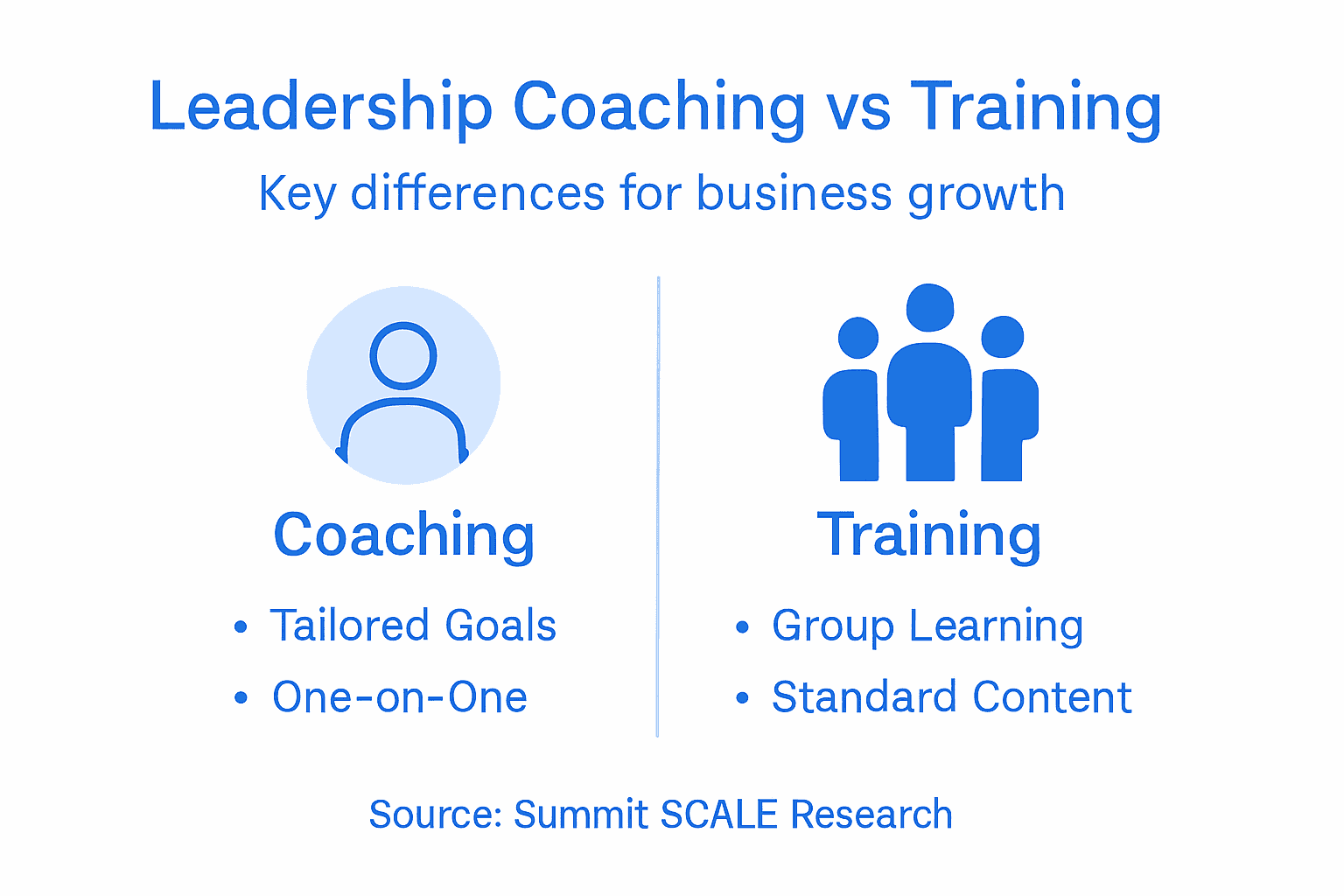
This is the fundamental difference between traditional training and leadership coaching. One delivers knowledge. The other transforms behaviour. For small to medium-sized business owners, that distinction matters enormously.
How Traditional Training Works
Traditional training programmes are designed for scale. One instructor teaches the same content to dozens or hundreds of people simultaneously. The approach works well for imparting foundational knowledge efficiently.
Think of it as a broadcast model. The content goes out to everyone, and attendees absorb what’s relevant to them. Cost per person is low, which is why organisations favour this approach for broad skill development.
But here’s the problem: your specific challenges aren’t addressed. The training covers generic leadership topics that apply nowhere and everywhere. You recognise concepts intellectually without knowing how to apply them to your actual situation.
Why Coaching Produces Different Results
Individual coaching offers higher satisfaction and goal attainment through personalised support that adapts to your unique circumstances. Your coach isn’t delivering preset content—they’re asking powerful questions about your specific challenges and guiding you towards solutions that work for your business.
Coaching fosters intrinsic motivation because you’re discovering answers yourself, not being told what to do. This autonomy matters. When you find your own solution, you own it. When someone tells you what to do, you follow it until the coach disappears.
Coaching facilitates sustained behaviour change because it targets your actual challenges, not generic topics disconnected from your reality.
Key Differences at a Glance
Here’s what separates coaching from training:
Here’s a side-by-side comparison of leadership coaching and traditional leadership training:
| Aspect | Leadership Coaching | Traditional Training |
|---|---|---|
| Approach | Individualised and adaptive | Standardised and fixed |
| Focus | Sustained behavioural transformation | Knowledge delivery |
| Accountability | Ongoing, coach-driven | Largely self-directed post-course |
| Measurability | Progress linked to business outcomes | Attendance or test-based |
| Impact on Team | Drives team engagement and growth | Limited impact on team performance |
- Personalisation: Training covers standard topics; coaching addresses your specific situation
- Accountability: Training ends; coaching includes ongoing accountability to your goals
- Behaviour change: Training transfers knowledge; coaching drives lasting transformation
- Timeline: Training is event-based; coaching is sustained over months
- Cost structure: Training is inexpensive per person; coaching is higher investment with higher return
When Training Makes Sense
Training isn’t worthless. If you need your entire team to understand a new software system or compliance framework, training is efficient. If you’re building foundational knowledge across many people, training works.
But for leadership development—for solving the complex, contextual challenges you face as a business owner—training falls short. You need the personalised, adaptive approach only coaching provides.
The Investment Question
Coaching costs more upfront than training. You’re paying for individual attention and customisation. But the return is incomparable. Training might cost £500 per person and produce minimal behaviour change. Coaching might cost £5,000 but directly generates £50,000 in additional business results through better decisions and improved team performance.
The question isn’t whether coaching is expensive. It’s whether you can afford not to invest in it.
Pro tip: If you’ve done training before, notice whether you actually implemented what you learned. That honest assessment reveals why coaching—with its accountability structure and personalisation—will deliver dramatically different results.
Unlock Your Business Growth Potential with Expert Leadership Coaching
If you have recognised that sustainable business growth requires more than just knowledge but a personalised, accountable leadership transformation then you are ready to explore solutions tailored for your unique challenges. This article highlighted key pain points such as the need for lasting behaviour change, enhanced decision-making confidence, and stronger team performance that only genuine leadership coaching can address.
At Summit SCALE, we specialise in empowering small to medium-sized business owners just like you to develop these very capabilities through customised, outcomes-driven coaching. Our proven approach focuses on building your accountability, sharpening your strategic thinking, and boosting your leadership confidence so your team grows with your business—not beyond it. Learn more about how we guide entrepreneurs through strategic steps like team building and business scaling on our Business Coaching Archives – Summit Scale and gain insights from experts featured on our Business Coach Archives – Summit Scale.
Ready to transform how you lead and accelerate your business growth?
Take the first step today by scheduling a free 15-minute assessment call at Summit SCALE. Discover how personalised leadership coaching can unlock your full potential and drive the meaningful, measurable change your business deserves.
Frequently Asked Questions
What is leadership coaching?
Leadership coaching is a targeted partnership between a business owner and a coach aimed at unlocking leadership potential and driving meaningful, lasting change in how one leads their team. It focuses on fostering authentic, change-oriented behaviours tailored to individual challenges and strengths.
How does leadership coaching benefit high-performing leaders?
Coaching benefits high-performing leaders by increasing their self-awareness, confidence, and strategic leadership capabilities. It helps strengthen existing strengths and aids in the development of skills essential for effective leadership, ensuring continued growth alongside business development.
Why is personalised coaching more effective than generic training programmes?
Personalised coaching is more effective because it is tailored to the unique challenges and goals of each leader. Unlike standard training, which provides generic information, personalised coaching adapts continuously based on the client’s circumstances, ensuring relevant and applicable strategies for real-life challenges.
How can leadership coaching improve team performance?
Leadership coaching enhances team performance by transforming how leaders communicate, set priorities, and engage their teams. Improved leadership qualities lead to clearer direction, better accountability, and increased employee engagement, which collectively result in a more productive and capable team.

