
TL;DR:
- Effective SME leadership involves evolving mindset, clear vision, and strategic use of coaching tools.
- Avoid common pitfalls like micromanagement, unclear vision, and under-communication to foster team growth.
- Measuring engagement, innovation, and profitability helps verify leadership development progress.
Leading a business is one of the most rewarding things you can do. It is also one of the most relentless. You are making dozens of decisions daily, trying to motivate a team, managing costs, and somehow finding time to think strategically. Many SME owners find themselves trapped in the business rather than leading it. The good news? That pattern is entirely reversible. This guide walks you through the core leadership challenges holding you back, the mindsets and tools that set great leaders apart, a step-by-step improvement strategy, common pitfalls to avoid, and how to measure real progress. Let’s turn your leadership into your greatest growth engine.
Table of Contents
- Understand core leadership challenges in SMEs
- Prepare: Essential leadership coaching tools and mindsets
- Lead for growth: Step-by-step leadership improvement strategy
- Troubleshoot: Avoid common leadership pitfalls
- Verify and sustain: Measuring the impact of your leadership
- The reality: What most SME leaders miss about leadership coaching
- Professional coaching: Your next step to sustained business leadership
- Frequently asked questions
Key Takeaways
| Point | Details |
|---|---|
| Self-awareness is foundational | Effective business leadership for SMEs starts with honest recognition of strengths, gaps, and priorities. |
| Coaching drives growth | Evidence shows coaching directly boosts leadership effectiveness and business performance. |
| Empowerment beats control | Empowering your team creates more innovation and sustainable results than micromanagement. |
| Measure and adapt | Track relevant KPIs and use regular feedback to refine your leadership strategies. |
| Get expert support | Working with a professional coach ensures you avoid common pitfalls and sustain progress. |
Understand core leadership challenges in SMEs
Every business owner hits a wall at some point. The team stops performing, communication breaks down, or you find yourself second-guessing every decision. These are not signs of failure. They are signs that your leadership needs to evolve alongside your business.
The most common SME leadership challenges include:
- Motivation gaps: Team members lose direction when the vision is unclear or inconsistently communicated.
- Communication rifts: Misaligned expectations between leaders and teams create friction and slow execution.
- Ethical grey zones: Decisions involving fairness, loyalty, or values can create lasting cultural damage if handled poorly.
- Decision fatigue: Making too many decisions without a clear framework drains your mental energy and reduces decision quality over time.
These challenges are not just operational. They are deeply psychological. Self-doubt creeps in when results stall. You start questioning your instincts, your team, and your strategy all at once. That spiral is costly.
Here is what the research confirms: business coaching enhances entrepreneurial locus of control and self-efficacy, leading to organisational growth and improved financial performance in SMEs. In plain terms, coaching helps you believe in your ability to influence outcomes, and that belief changes how you lead.
Understanding coaching’s impact for SMEs starts with recognising that leadership is a learnable skill, not a fixed trait. You do not need to be born with charisma or natural authority. You need self-awareness, a willingness to grow, and the right support.
When facing a difficult decision, especially one with ethical dimensions, the most effective leaders pause and reflect in tough decisions rather than reacting immediately. They consult their team, gather perspectives, and then decide with clarity.
“Your business will never outgrow you. The ceiling of your business is the ceiling of your leadership.”
Understanding the business coach’s role in helping you break through that ceiling is the first practical step. A coach does not solve your problems. They help you see them differently.
Pro Tip: Block 15 minutes each week for a leadership reflection session. Ask yourself: where did I react instead of respond this week? That single habit builds the self-awareness that great leadership depends on.
Now that we have recognised why effective leadership is non-negotiable, let us outline what you need to lead with impact.
Prepare: Essential leadership coaching tools and mindsets
Before you can change how you lead, you need to examine how you currently think about leadership. Most SME owners default to a command-and-control style simply because it feels efficient. It rarely is.
Two leadership models worth understanding are servant leadership and transformational leadership. They are not opposites. They are partners. Servant leadership remains relevant, aligning with transformational values through empowerment and ethics. Together, they create an environment where people feel valued, trusted, and motivated to contribute their best.
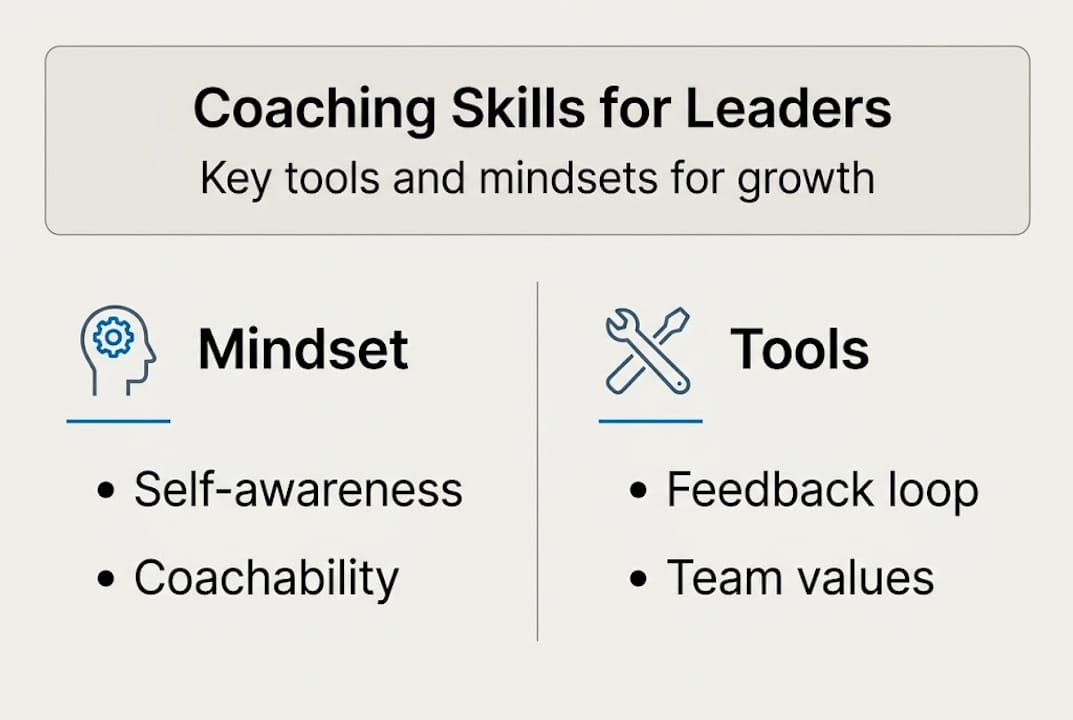
The mindsets that underpin effective leadership coaching include:
- Self-awareness: Knowing your triggers, blind spots, and default reactions.
- Curiosity: Asking questions before drawing conclusions.
- Empowerment: Believing your team is capable and giving them the space to prove it.
- Accountability: Owning your outcomes without deflecting blame.
Beyond mindset, you also need practical tools in place. Think of these as the infrastructure of great leadership.
| Tool | Purpose | Example |
|---|---|---|
| Documented values | Anchors decisions and behaviour | Written team charter |
| Feedback mechanisms | Surfaces problems early | Monthly anonymous surveys |
| Open discussion forums | Builds psychological safety | Weekly team check-ins |
| Leadership skills checklist | Tracks development areas | Structured self-assessment |
Using these tools consistently is what separates leaders who grow from those who stay stuck. They create a rhythm of reflection and improvement that compounds over time.
The leadership coaching process typically begins with exactly this kind of audit. You assess where you are, clarify where you want to go, and build the habits to bridge the gap.
Pro Tip: Start with one feedback mechanism this week. Even a simple three-question anonymous survey sent to your team will surface insights you cannot see from the top.
With clear challenges and the right mindset, you are ready to implement practical leadership steps proven by professional coaches.
Lead for growth: Step-by-step leadership improvement strategy
Great leadership is not accidental. It follows a sequence. Here is a practical five-step framework you can apply immediately.
- Establish your vision: Define where the business is going in clear, specific terms. A vague vision creates a vague team.
- Empower your people: Delegate real responsibility, not just tasks. Trust your team with outcomes, not just activities.
- Develop trust: Be consistent, follow through on commitments, and admit when you are wrong. Trust is built in small moments.
- Enable innovation: Create space for ideas, tolerate intelligent failure, and reward creative thinking. Coaching leadership boosts incremental innovation and performance through positive affect within the team.
- Review and adapt: Build in regular leadership reviews. What is working? What needs to change? Treat your leadership like a strategy, not a personality.
To understand how far this approach differs from traditional styles, consider this comparison:
| Old leadership style | New coaching leadership style |
|---|---|
| Command and control | Guide and empower |
| Information hoarding | Transparent communication |
| Fear-based motivation | Purpose-driven engagement |
| Reactive decisions | Proactive, values-led choices |
| Individual performance focus | Team-wide growth mindset |
The shift from old to new is not about being soft. It is about being effective. When your team feels genuinely empowered, they bring energy and ideas you would never generate alone.

It is also worth clarifying what leadership coaching is not. Unlike therapy, which focuses on healing past experiences, coaching vs therapy shows that coaching is forward-focused, action-oriented, and performance-driven. It is about building the future, not processing the past.
Exploring leadership coaching steps in detail will help you understand how each phase connects to real business results. And if you want to understand how leadership directly connects to your bottom line, look at coaching for profitability.
Pro Tip: After each team meeting, ask one person to share what they found most valuable and one thing they would improve. Over time, this single habit transforms your meeting culture.
Reviewing these actionable steps, it is equally important to identify and avoid frequent leadership missteps.
Troubleshoot: Avoid common leadership pitfalls
Even well-intentioned leaders make costly mistakes. Knowing what to watch for is half the battle.
The most damaging SME leadership pitfalls include:
- Micromanagement: Hovering over every task signals distrust and kills initiative. Your team stops thinking for themselves when you are always thinking for them.
- Unclear vision: Without a compelling direction, your team fills the gap with their own assumptions. Alignment breaks down fast.
- Under-communication: Leaders often assume their team knows more than they do. Silence creates anxiety and rumour.
- Ignoring team insights: Your frontline team sees things you cannot. Dismissing their input is one of the most expensive mistakes you can make.
Here is a quick diagnostic checklist to spot these errors in your own leadership:
- Do team members ask for permission on decisions they should own?
- Are the same problems recurring without resolution?
- Is there low energy or disengagement in meetings?
- Do people hesitate to share bad news?
If you answered yes to any of these, you have a leadership signal worth acting on.
“In ethical grey areas, pausing and gathering team input mitigates biases and leads to better decisions.”
This is not just good advice. It is research-backed guidance from Harvard Business School. The instinct to decide quickly under pressure is understandable, but it is often wrong.
Building a feedback-friendly culture means making it safe to raise concerns, share failures, and challenge ideas. Leaders who model vulnerability by admitting their own mistakes first create teams that do the same.
Staying ahead of these pitfalls also means staying current. Exploring 2026 coaching trends will show you where progressive SME leaders are focusing their development energy right now.
Once you are actively troubleshooting, measuring your progress ensures your leadership efforts yield tangible, lasting results.
Verify and sustain: Measuring the impact of your leadership
You cannot improve what you do not measure. Leadership development without clear metrics is just good intention. Here is how to verify that your efforts are actually working.
Key outcomes to track include:
- Team engagement: Are people energised, contributing ideas, and staying?
- Innovation rate: How often are new ideas being tested and implemented?
- Financial growth: Is revenue, margin, or profitability improving over time?
- Owner freedom: Are you spending less time firefighting and more time leading strategically?
Use a simple KPI table to track progress quarterly:
| Metric | Baseline | 3-month target | 6-month target |
|---|---|---|---|
| Team engagement score | Current survey result | +10% | +20% |
| New ideas implemented | Monthly count | +2 per month | +5 per month |
| Revenue growth | Current monthly average | +5% | +15% |
| Owner hours in operations | Weekly hours | Reduce by 20% | Reduce by 40% |
The evidence is clear: business coaching directly improves organisational and financial outcomes. Tracking these metrics gives you the proof that your leadership investment is paying off.
For continued growth, your next steps should include:
- Enrol in a structured leadership development programme.
- Engage a business coach or mentor for regular accountability.
- Implement quarterly 360-degree feedback reviews.
- Build a personal reading and learning habit around leadership.
Investing in your own development is the highest-leverage activity you can take as a business owner. Understanding the entrepreneur development impact of ongoing coaching will reinforce why this is never a cost. It is always an investment.
With measurable progress in hand, consider what the world’s best SME leaders do differently and what that means for your leadership journey.
The reality: What most SME leaders miss about leadership coaching
Here is a truth most leadership articles will not tell you. The biggest barrier to better leadership is not skill. It is identity. Most SME owners secretly believe that needing help is a sign of weakness. So they push through alone, mistaking control for leadership and busyness for progress.
The leaders who grow fastest are not the most talented. They are the most coachable. They embrace discomfort, welcome honest feedback, and treat ambiguity as a signal to get curious rather than defensive. That shift in identity, from the person with all the answers to the person asking the best questions, is where real transformation begins.
We have seen founders completely change their business trajectory simply by turning the mirror around and asking, “What am I doing that is slowing my team down?” Exploring entrepreneurial leadership principles reveals that the most effective leaders treat their own growth as seriously as their business growth. That is the real edge.
Professional coaching: Your next step to sustained business leadership
Self-driven improvement gets you so far. But sustained leadership growth requires structure, accountability, and expert perspective that is difficult to create alone. That is where professional coaching makes the difference.
At Summit SCALE, we work with SME owners who are ready to lead with clarity, build stronger teams, and reclaim their time. Our coaching frameworks are built around unlocking time and profit through coaching so that your business works for you, not the other way around. Whether you want to explore coaching for business potential or follow a proven leadership coaching for growth pathway, we are here to guide every step. Book your free 15-minute assessment call today and take the first real step towards the business and life you have been building towards.
Frequently asked questions
How does business coaching boost leadership in SMEs?
Business coaching enhances entrepreneurial locus of control and self-efficacy, directly improving company growth and financial performance by helping leaders believe in and act on their ability to influence outcomes.
Is servant leadership still relevant in fast-changing businesses?
Yes. Servant leadership remains relevant because it aligns with transformational values, fostering empowerment and ethical decision-making even in high-pressure, fast-changing environments.
What is the first step for SMEs to improve leadership?
The best first step is to clarify your core values and open up honest team dialogue, because alignment between what you say and what you do is the foundation of credible leadership.
How can SME owners measure leadership improvement?
Track metrics such as team engagement scores, innovation output, revenue growth, and the number of hours you spend working in the business rather than on it.
What should leaders do when faced with ethical dilemmas?
Pause, seek diverse perspectives from your team, and avoid rushing to a decision. Gathering team input reduces personal bias and leads to better, more trusted outcomes.

