
Many business owners believe leadership is either an innate gift or simply a matter of managing tasks effectively. This misconception limits growth potential. In reality, entrepreneurial leadership requires specific principles that drive innovation, agility, and team performance. This article explores the core principles of entrepreneurial leadership and shows you how to apply them to accelerate your business growth, enhance team effectiveness, and achieve sustainable success in competitive markets.
Table of Contents
- What Is Entrepreneurial Leadership And Why It Matters
- Core Principles Of Effective Entrepreneurial Leadership
- Applying Entrepreneurial Leadership Principles To Grow Your Business
- Measuring The Impact Of Entrepreneurial Leadership On Business Success
- Discover Coaching To Enhance Your Entrepreneurial Leadership
- Frequently Asked Questions About Entrepreneurial Leadership Principles
Key takeaways
| Point | Details |
|---|---|
| Entrepreneurial leadership drives growth | It combines vision, agility, and innovation to create competitive advantage and business expansion. |
| Core principles guide decision making | Visionary thinking, adaptability, team building, innovation, and financial acumen form the foundation. |
| Tailored leadership analysis accelerates development | Structured assessment helps identify strengths, gaps, and growth opportunities for informed decisions. |
| Measurable impact validates effectiveness | Tracking KPIs linked to leadership reveals tangible business and team performance improvements. |
What is entrepreneurial leadership and why it matters
Entrepreneurial leadership represents a distinct approach where business owners actively drive innovation, embrace calculated risks, and maintain agility in pursuit of growth. Unlike traditional management focused on maintaining operations, entrepreneurial leaders constantly seek opportunities, challenge assumptions, and inspire teams toward ambitious goals. They blend strategic vision with hands-on execution, adapting quickly to market changes whilst maintaining focus on long-term objectives.
The distinction matters because conventional leadership models often emphasise stability and process optimisation. Entrepreneurial contexts demand different capabilities. You need higher tolerance for uncertainty, willingness to experiment, and ability to pivot strategies based on real-time feedback. When you understand that tailored leadership analysis is crucial for growth and informed decisions, you can develop capabilities specific to your business challenges.
Many entrepreneurs unknowingly limit growth by applying generic leadership approaches unsuited to dynamic business environments. Common mistakes include:
- Prioritising control over empowerment, stifling team initiative and innovation
- Avoiding necessary risks due to fear of failure, missing growth opportunities
- Focusing solely on short-term results without building sustainable competitive advantages
- Neglecting personal leadership development whilst demanding team growth
Recognising the unique demands of entrepreneurial leadership allows you to develop skills aligned with growth objectives. Understanding how coaching in entrepreneurship role supports this development creates pathways to accelerate your leadership evolution. The foundation lies in mastering specific principles that transform how you think, decide, and inspire others.
Core principles of effective entrepreneurial leadership
Five fundamental principles distinguish effective entrepreneurial leaders from conventional managers. Mastering these creates competitive advantage and sustainable growth.
-
Visionary thinking and opportunity recognition: You must develop ability to identify market gaps, anticipate trends, and articulate compelling future states that motivate stakeholders. This involves constant environmental scanning, customer insight gathering, and creative problem solving. Visionary leaders connect daily decisions to long-term objectives, ensuring alignment across all activities.
-
Agile decision making and adaptability: Entrepreneurial environments demand quick, informed choices with incomplete information. You need frameworks for rapid evaluation, willingness to adjust course based on evidence, and resilience when facing setbacks. Agility means balancing speed with quality, knowing when to persist and when to pivot.
-
Building and inspiring a committed team: Growth requires talented people aligned with your vision. Effective leaders recruit for potential, develop capabilities, delegate meaningfully, and create cultures where innovation thrives. You inspire through authentic communication, recognition, and demonstrating values through actions. High performance leadership coaching helps you refine these critical people skills.
-
Embracing innovation and continuous learning: Successful entrepreneurs maintain curiosity, experiment systematically, and learn from failures. This principle involves creating safe spaces for testing ideas, investing in personal development, and encouraging team learning. Innovation becomes embedded in operations rather than occasional initiatives.
-
Financial acumen and growth focus: Understanding financial levers enables smart resource allocation and sustainable scaling. You must balance investment in growth with profitability, manage cash flow proactively, and make data-driven decisions about expansion. Financial literacy transforms from compliance exercise to strategic advantage.
Pro tip: Schedule quarterly self-assessments against these principles to identify development priorities. Honest evaluation reveals gaps before they limit growth, allowing targeted improvement through reading, mentoring, or coaching and development programmes designed for entrepreneurs.
When tailored leadership analysis is crucial for growth and informed decisions, these principles provide the framework for meaningful assessment. Each principle builds on others, creating compound effects that accelerate business performance beyond what isolated improvements achieve.
Applying entrepreneurial leadership principles to grow your business
Transforming principles into practice requires deliberate action and structured approaches. Start with honest self-assessment using the five core principles as evaluation criteria. Rate your current capability in each area, identify specific behaviours you want to develop, and create action plans with measurable milestones. This foundation enables targeted improvement efforts.

Implementing visionary thinking in daily operations means consistently asking how decisions align with long-term goals. During meetings, explicitly connect proposed actions to strategic objectives. When evaluating opportunities, assess fit with your vision before analysing financial returns. Share your vision regularly with teams, customers, and partners to maintain alignment and gather feedback that refines your thinking.
Developing agile decision-making skills involves:
- Establishing clear decision criteria before evaluating options to reduce bias
- Setting time limits for decisions to prevent analysis paralysis
- Documenting assumptions to enable quick reassessment when circumstances change
- Creating feedback loops that surface problems early, allowing rapid course correction
- Building decision-making capability in your team to distribute authority appropriately
Inspiring and developing your team requires intentional effort beyond occasional recognition. Regular one-to-one conversations uncover individual motivations and career aspirations. Transparent communication about business challenges builds trust and invites collaborative problem solving. Investing in building a growth-oriented team creates the foundation for sustainable scaling.
The table below illustrates tangible differences when entrepreneurial leadership principles are systematically applied versus conventional management approaches:
| Outcome Area | Without Principles | With Principles Applied |
|---|---|---|
| Revenue growth | 5-10% annually | 20-35% annually |
| Team engagement | 60% satisfaction | 85% satisfaction |
| Innovation rate | 2-3 initiatives yearly | 8-12 initiatives yearly |
| Decision speed | 3-4 weeks average | 3-5 days average |
| Market responsiveness | Reactive, lagging competitors | Proactive, leading market |
Pro tip: Partner with experienced coaches who understand entrepreneurial contexts to accelerate application of these principles. Leadership coaching for owners provides accountability, outside perspective, and proven frameworks that compress your learning timeline whilst avoiding costly mistakes.
When you recognise that tailored leadership analysis is crucial for growth and informed decisions, you can systematically apply these practical strategies to transform your leadership effectiveness and business results.
Measuring the impact of entrepreneurial leadership on business success
Effective measurement validates your leadership development efforts and guides ongoing refinement. Key performance indicators linked to leadership effectiveness span both quantitative metrics and qualitative assessments. Financial indicators include revenue growth rate, profit margin expansion, and return on invested capital. Operational metrics cover customer acquisition cost, customer lifetime value, and innovation success rate. People measures track team retention, engagement scores, and leadership pipeline strength.
Using tailored leadership analysis is crucial for growth and informed decisions because structured frameworks reveal patterns invisible through casual observation. Assessment tools evaluate decision-making quality, communication effectiveness, strategic thinking capability, and team development skills. Combining self-assessment with 360-degree feedback from team members, peers, and mentors provides comprehensive perspective on your leadership impact.
The following data illustrates typical improvements businesses experience when owners systematically develop entrepreneurial leadership capabilities over twelve months:
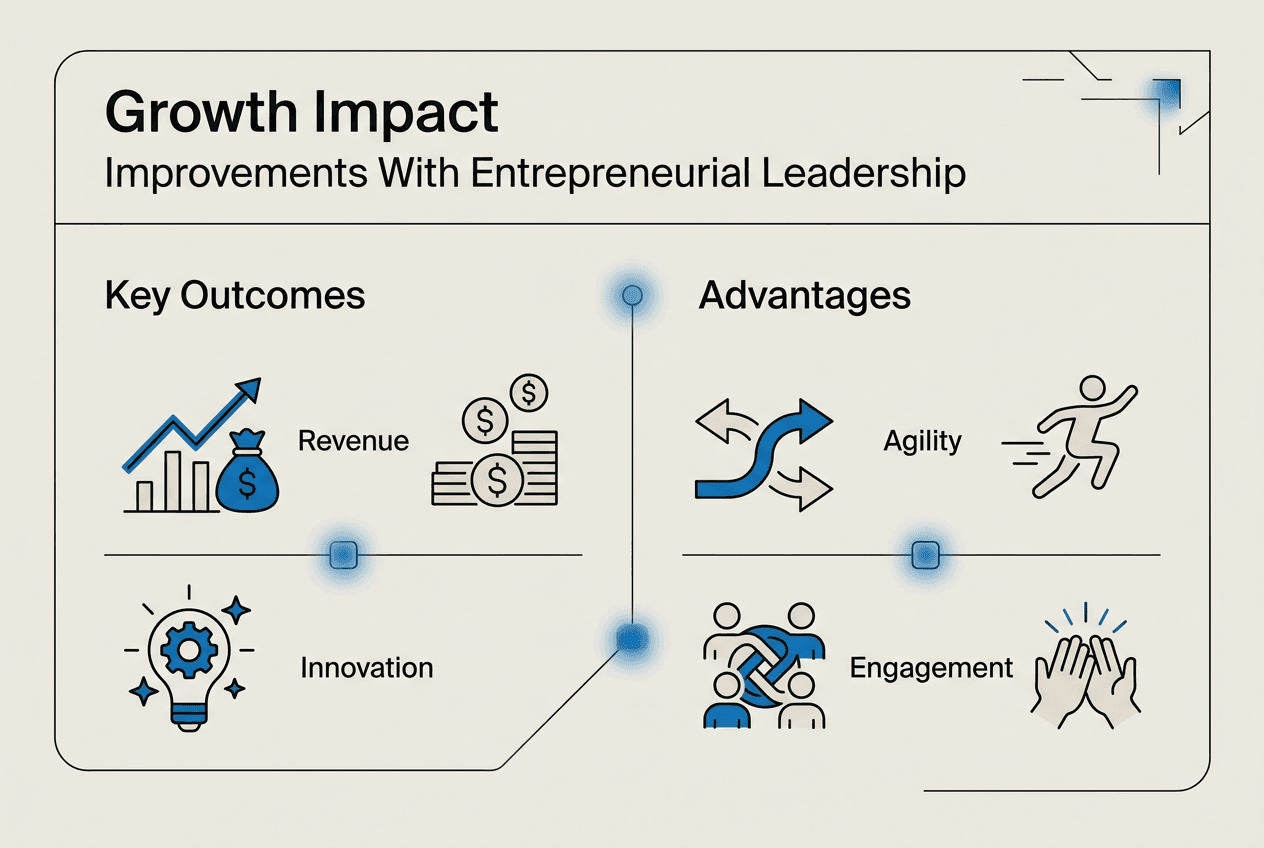
| Metric | Baseline | After 12 Months | Change |
|---|---|---|---|
| Revenue | £500,000 | £650,000 | +30% |
| Profit margin | 12% | 18% | +6 points |
| Team retention | 75% | 92% | +17 points |
| Customer satisfaction | 7.2/10 | 8.8/10 | +1.6 points |
| New product launches | 1 | 4 | +300% |
Beyond numbers, qualitative indicators reveal leadership impact:
- Increased frequency of team-initiated improvements and innovations
- Faster problem resolution through improved delegation and empowerment
- Enhanced reputation attracting higher-quality talent and customers
- Greater personal satisfaction and reduced stress from clearer priorities
- Stronger strategic partnerships resulting from credible vision communication
Continuous tracking enables iterative refinement of leadership approaches. Monthly reviews of core metrics highlight what’s working and what needs adjustment. Quarterly deep dives using comprehensive frameworks identify emerging patterns and strategic opportunities. Annual assessments measure progress against long-term development goals, informing next year’s priorities.
Integrating measurement into your business growth strategy guide ensures leadership development aligns with commercial objectives. Following a step by step business growth guide that incorporates leadership KPIs creates accountability and maintains focus on capabilities that drive sustainable success.
Discover coaching to enhance your entrepreneurial leadership
Developing entrepreneurial leadership capabilities accelerates dramatically with expert guidance. Professional coaching provides personalised frameworks, accountability, and outside perspective that compress learning timelines whilst avoiding common pitfalls. Coaches experienced in entrepreneurial contexts understand the unique challenges you face, from managing growth pressures to balancing multiple priorities.

The benefits of coaching business extend beyond skill development to include strategic clarity, decision-making confidence, and sustainable work-life integration. Structured programmes help you apply proven principles whilst adapting them to your specific context, industry, and personal strengths. Understanding the role of coaching for SMEs reveals how tailored support addresses growth barriers that generic training cannot solve. Whether you’re navigating rapid expansion or optimising operations, coaching in scaling business provides tools and insights that transform leadership effectiveness and business performance.
Frequently asked questions about entrepreneurial leadership principles
What are the most important entrepreneurial leadership qualities?
The most critical qualities include visionary thinking, agility in decision making, ability to inspire teams, commitment to continuous learning, and financial acumen. These qualities enable you to identify opportunities, adapt quickly to market changes, build committed teams, innovate systematically, and allocate resources effectively for sustainable growth.
How can I develop my entrepreneurial leadership skills?
Start with honest self-assessment against core principles to identify development priorities. Combine targeted reading with practical application, seeking feedback from team members and mentors. Consider structured programmes that provide frameworks, accountability, and expert guidance tailored to entrepreneurial contexts for accelerated development.
Why is entrepreneurial leadership vital for startup success?
Startups operate in highly uncertain environments requiring rapid adaptation, resource optimisation, and constant innovation. Entrepreneurial leadership provides the vision, agility, and team-building capabilities essential for navigating challenges, seizing opportunities, and achieving sustainable growth despite limited resources and intense competition.
How does entrepreneurial leadership differ from traditional leadership?
Entrepreneurial leadership emphasises opportunity recognition, calculated risk-taking, and rapid adaptation, whereas traditional leadership often focuses on stability, process optimisation, and incremental improvement. Entrepreneurs must balance strategic vision with hands-on execution, tolerate higher uncertainty, and inspire teams through ambiguous situations that conventional managers rarely face.
What role does coaching play in improving entrepreneurial leadership?
Coaching accelerates leadership development by providing personalised frameworks, outside perspective, and accountability that compress learning timelines. Experienced coaches help you apply proven principles to your specific context, avoid costly mistakes, and develop capabilities systematically. Understanding how developing an entrepreneurial mindset growth transforms business outcomes reveals coaching’s strategic value beyond generic skill development.

