
Every American or Australian business owner knows that steering a team toward growth means facing tough decisions and constant change. The difference between reactive management and true strategic progress often lies in the quality of support and perspective leaders receive. Discover how professional business coaching can shape stronger leadership, drive team performance, and create a foundation for measurable, lasting profitability by providing a truly objective external perspective and empowering approach.
Table of Contents
- Defining The Business Coach’s Impact
- Business Coach Versus Mentor Or Consultant
- Core Areas Of Coaching Support Explained
- How Coaching Drives Measurable Business Growth
- Choosing The Right Business Coach For Your SME
Key Takeaways
| Point | Details |
|---|---|
| Business Coaching as Transformation | Business coaching unlocks strategic potential by enhancing leadership development, performance, and organisational adaptability. |
| Difference Between Coaching, Mentoring, and Consulting | Coaches facilitate self-discovery and responsibility; mentors advise based on experience, while consultants provide direct solutions. |
| Core Areas of Coaching Support | Effective coaching focuses on leadership development, performance improvement, skill enhancement, behavioural change, and communication optimisation. |
| Selecting the Right Coach | Choose a coach with verified credentials, industry knowledge, a compatible communication style, and proven methods for tracking results. |
Defining the Business Coach’s Impact
Business coaching represents a transformative professional partnership designed to unlock an organisation’s strategic potential and drive sustainable growth. At its core, coaching goes far beyond traditional consulting by focusing on holistic leadership development and systemic performance enhancement. Global coaching research highlights the profound impact coaches have in cultivating organisational adaptability and leadership effectiveness.
The strategic role of a business coach encompasses multiple critical dimensions:
- Providing objective external perspective on business challenges
- Developing leadership capabilities and emotional intelligence
- Designing performance improvement strategies
- Facilitating psychological safety within teams
- Supporting entrepreneurs through complex decision-making processes
Business coaches operate as strategic partners who blend diagnostic expertise with personalised guidance. By combining psychological insights with business acumen, they help leaders transform potential obstacles into opportunities for growth. Coaching leadership research demonstrates that organisations leveraging professional coaching experience significantly higher engagement levels and more robust leadership development.

Ultimately, business coaches serve as catalysts for organisational transformation, bridging the gap between current performance and potential excellence. They provide structured accountability, strategic frameworks, and personalised interventions that empower business leaders to make more informed decisions and drive sustainable growth.
Pro Tip: Select a business coach who demonstrates proven expertise in your specific industry and has a track record of measurable client success.
Business Coach Versus Mentor or Consultant
Business professionals often confuse coaching, mentoring, and consulting as interchangeable services, yet each plays a distinctly different role in organisational development. Transitional roles of business coaches reveal critical distinctions that set these professional relationships apart, highlighting the unique value of each approach.
Key differences between these professional relationships include:
- Mentors: Provide advice based on personal experience and industry knowledge
- Consultants: Deliver specific solutions and implement strategic recommendations
- Business Coaches: Facilitate self-discovery and personal accountability through guided reflection
Unlike mentors who share personal insights or consultants who prescribe direct solutions, business coaches operate as transformative partners. Coaching profession’s evolution demonstrates their commitment to client-centred development, focusing on empowerment and strategic questioning rather than directive guidance.
The fundamental distinction lies in the approach: mentors advise from experience, consultants solve problems directly, and coaches unlock an individual’s inherent potential by promoting self-reflection and personal growth. This approach enables business leaders to develop sustainable skills and insights, rather than becoming dependent on external intervention.
Here is how business coaching compares to mentoring and consulting in terms of approach, outcome focus, and leader dependency:
| Aspect | Business Coaching | Mentoring | Consulting |
|---|---|---|---|
| Main Approach | Facilitative, reflective | Advisory, experience-led | Prescriptive, expert-driven |
| Lasting Outcome | Sustainable skill-building | Expanded industry insight | Implemented strategic solutions |
| Dependency Created | Fosters independence | Can create reliance | May result in ongoing reliance |
Pro Tip: Choose the right professional support by clearly understanding your specific business development needs and the unique strengths of each advisory relationship.
Core Areas of Coaching Support Explained
Workplace coaching strategies encompass a comprehensive approach to professional development, targeting multiple critical dimensions of organisational performance and individual growth. Business coaches employ sophisticated methodologies designed to address the multifaceted challenges faced by modern enterprises.
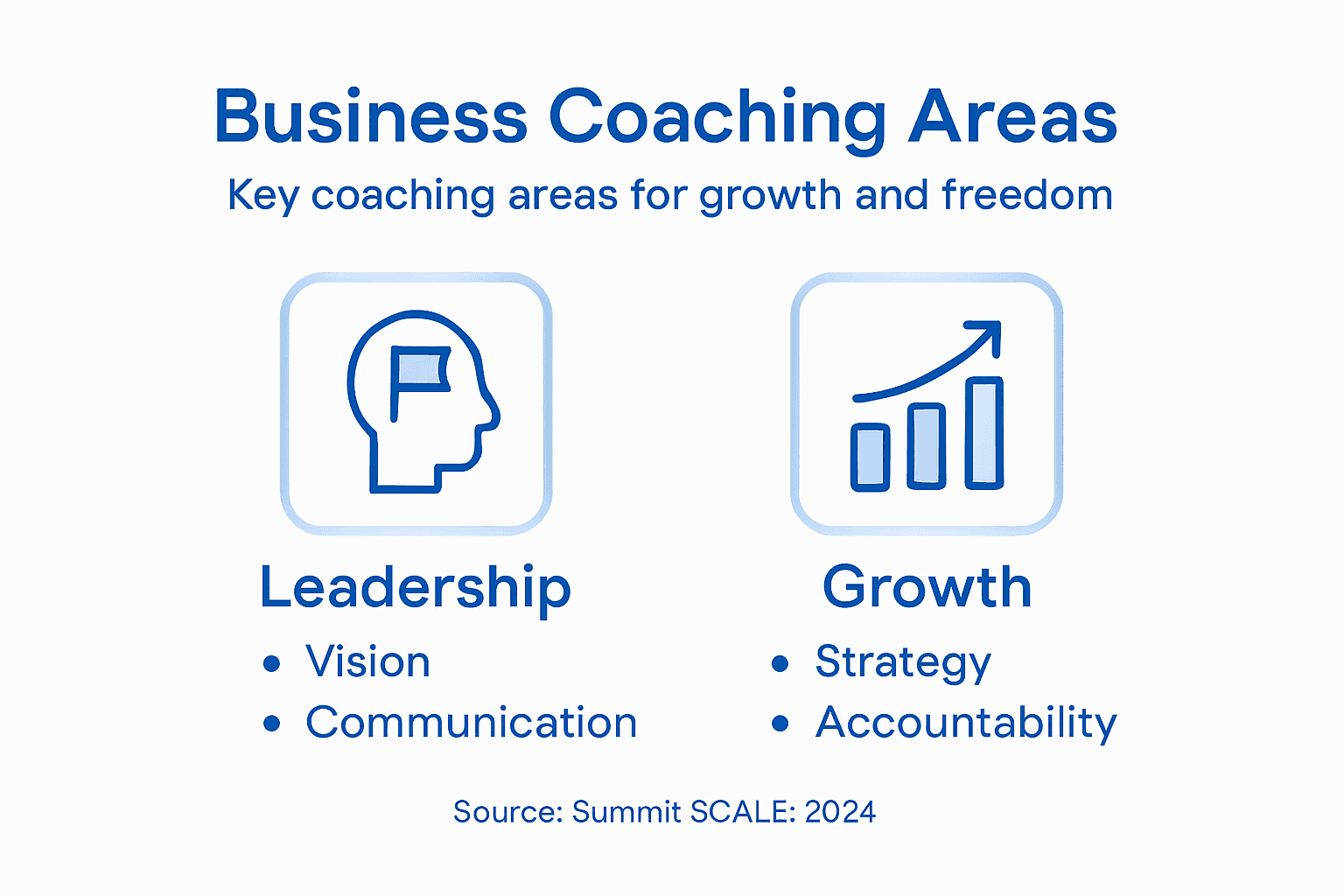
The core areas of coaching support typically include:
- Leadership Development: Enhancing strategic thinking and decision-making capabilities
- Performance Improvement: Identifying and eliminating performance barriers
- Skill Enhancement: Developing technical and interpersonal competencies
- Behavioural Change: Transforming counterproductive workplace patterns
- Communication Optimization: Improving team dynamics and interpersonal interactions
Executive coaching research reveals that effective coaching goes beyond traditional training, focusing on personalised interventions that align individual potential with organisational objectives. This approach allows businesses to create tailored development strategies that address specific performance gaps and unlock hidden potential.
The most successful coaching interventions blend structured assessment techniques with flexible, client-centred approaches. By utilising both virtual and face-to-face modalities, coaches can adapt their support to individual learning styles and organisational contexts, ensuring maximum impact and sustainable growth.
Pro Tip: Prioritise coaches who demonstrate a holistic understanding of your specific business challenges and can provide measurable, targeted support strategies.
How Coaching Drives Measurable Business Growth
Executive coaching strategies provide a systematic approach to driving tangible business performance, transforming organisational potential through targeted interventions. By aligning individual capabilities with strategic objectives, coaching creates a powerful mechanism for sustainable growth and competitive advantage.
Measurable business growth through coaching occurs across multiple dimensions:
- Leadership Effectiveness: Enhancing strategic decision-making skills
- Employee Engagement: Improving team motivation and productivity
- Performance Metrics: Establishing clear, trackable development goals
- Organisational Adaptability: Developing resilience and change management capabilities
- Financial Performance: Direct impact on revenue and profitability
Randomized controlled trials reveal that coaching interventions demonstrate statistically significant improvements in workplace performance, with moderate effect sizes validated across diverse organisational contexts.
The most successful coaching approaches integrate quantitative assessment techniques, allowing businesses to track progress, validate investment, and create data-driven development strategies. By establishing clear benchmarks and measuring incremental improvements, coaches transform abstract potential into concrete, measurable business outcomes.
Pro Tip: Request detailed performance metrics and ROI projections from potential coaches to ensure a data-driven approach to your business development.
Choosing the Right Business Coach for Your SME
Coach selection criteria represent a critical strategic decision for small and medium enterprises seeking transformative professional development. The right coaching partnership can significantly amplify an organisation’s growth potential by providing targeted, contextualised guidance tailored to specific business challenges.
Key considerations when selecting a business coach include:
- Professional Credentials: Verified qualifications and industry experience
- Strategic Alignment: Understanding of your specific business context
- Communication Style: Compatibility with your leadership approach
- Performance Metrics: Ability to establish and track measurable outcomes
- Digital Adaptability: Capacity to deliver coaching across multiple modalities
Practical coaching recommendations emphasise the importance of integrating coaching behaviours into daily management practices. Successful coaches demonstrate not just theoretical knowledge, but a pragmatic approach to fostering ongoing organisational development and individual performance enhancement.
The selection process requires thorough due diligence, including reviewing the coach’s track record, understanding their methodology, and assessing their ability to navigate complex organisational dynamics. Potential coaches should be able to articulate a clear strategy for addressing your specific business challenges and demonstrate a proven approach to driving sustainable growth.
The following table summarises the primary factors to consider when selecting a business coach for your SME:
| Selection Factor | Why It Matters | What to Look For |
|---|---|---|
| Credentials | Ensures validated expertise | Recognised qualifications |
| Strategic Fit | Aligns with business goals | Relevant industry experience |
| Communication Style | Supports effective engagement | Compatible interaction manner |
| Measurable Results | Tracks and proves improvement | Clear metrics and case studies |
Pro Tip: Request detailed case studies and references from potential coaches, focusing on their demonstrated impact in businesses similar to your own.
Unlock Your Business Growth and Freedom with Expert Coaching
The article highlights crucial challenges faced by small to medium-sized enterprises such as the need for strategic leadership development, sustainable performance improvement, and measurable growth outcomes. If you find yourself needing personalised guidance to enhance leadership effectiveness, improve team dynamics, and drive profitable business transformation, understanding the unique role of a business coach is the first step towards freedom and success. Concepts like holistic leadership, structured accountability, and measurable business growth are exactly what Summit SCALE specialises in delivering.
At Summit SCALE, we empower business owners through tailored coaching programs that address your specific challenges including sales growth, team building, and long-term business valuation. Our approach aligns perfectly with the article’s emphasis on data-driven strategies and sustainable skill-building to help you reclaim your time and financial independence.
Ready to take meaningful action towards sustainable business growth and personal freedom?
Take advantage of a free 15-minute assessment call to explore how professional coaching can transform your organisation. Visit Summit SCALE now and discover how expert coaching drives lasting results. Learn more about our business coaching services to start your journey today.
Frequently Asked Questions
What is the primary role of a business coach?
The primary role of a business coach is to facilitate self-discovery and personal accountability, helping leaders unlock their potential, enhance their strategic decision-making, and drive sustainable growth within their organisations.
How does business coaching differ from consulting and mentoring?
Business coaching focuses on facilitating personal growth and self-reflection, while consultants provide specific solutions and mentors share personal experiences and insights. Coaches empower individuals to develop skills independently rather than depending on external advice.
What core areas do business coaches typically support?
Business coaches usually support leadership development, performance improvement, skill enhancement, behavioural change, and communication optimisation to address multiple challenges faced by organisations.
How can I measure the effectiveness of a business coach?
The effectiveness of a business coach can be measured through established performance metrics, tracking incremental improvements in leadership effectiveness, employee engagement, and overall organisational adaptability. Requesting case studies and specific ROI projections can further validate their impact.

