
Invest in entrepreneur development: boost growth by 46%
Many entrepreneurs dismiss professional development as a nice-to-have luxury, yet the coaching industry’s explosive growth to $5.34 billion globally reveals a different story. Smart business owners recognise that structured entrepreneur development directly drives measurable revenue increases, improved productivity, and sustainable competitive advantage. This article unpacks the evidence behind coaching’s transformative impact, reveals common pitfalls that sabotage results, and guides you through selecting the development approach that aligns with your business goals and growth stage.
Table of Contents
- The Growing Impact Of Entrepreneur Development On Business Success
- How Entrepreneur Development Boosts Business Performance And Growth
- Maximising Entrepreneur Development: Avoiding Pitfalls And Ensuring Success
- Comparing Entrepreneur Development Approaches And Choosing What Fits Your Business
- Unlock Your Business Potential With Summit Scale Coaching
Key takeaways
| Point | Details |
|---|---|
| Revenue impact | Entrepreneur development delivers average revenue increases of 46% through strategic clarity and optimised operations. |
| Time savings | Structured coaching strategies help entrepreneurs save 15 hours weekly through improved delegation and productivity systems. |
| Success factors | Tailored programmes with measurable KPIs and accountability mechanisms maximise coaching ROI and prevent reverting to old behaviours. |
| Survival rates | SMEs using entrepreneurial development programmes show 10-20% higher survival rates than those without structured support. |
| Leadership gains | Development programmes boost employee engagement by 25-35% through enhanced leadership capabilities and team management skills. |
The growing impact of entrepreneur development on business success
The coaching industry’s remarkable expansion reflects a fundamental shift in how businesses approach growth. Global investment in business coaching trends 2026 demonstrates that entrepreneur development has moved from experimental to essential. The coaching industry has grown to $5.34 billion globally, signalling widespread recognition of its strategic value.
Small and medium enterprises increasingly allocate budget to coaching programmes as competitive pressures intensify. This isn’t philanthropic spending on personal growth. Businesses invest because data consistently shows coaching delivers quantifiable returns through improved decision-making, streamlined operations, and accelerated strategic execution. The market’s sustained expansion validates that entrepreneur development produces measurable business outcomes rather than vague personal satisfaction.
Companies that embed structured development programmes gain decisive advantages in market responsiveness and innovation capacity. They build leadership teams capable of navigating complexity whilst maintaining operational excellence. The industry’s growth trajectory suggests this advantage will become more pronounced as business environments grow increasingly volatile and competitive.
How entrepreneur development boosts business performance and growth
Quantifiable results separate effective entrepreneur development from motivational platitudes. Businesses with coaching programmes experience revenue increases of 46% on average, a figure that transforms the economics of small to medium enterprises. This growth stems from sharper strategic focus, better resource allocation, and elimination of costly operational inefficiencies that quietly drain profitability.

Time represents the entrepreneur’s scarcest resource. Entrepreneurs save 15 hours weekly through coaching strategies that improve delegation frameworks and decision processes. These recovered hours enable owners to focus on high-value activities like business development, strategic partnerships, and innovation rather than firefighting operational crises. The coaching role in profitability extends beyond immediate time savings to building systems that scale without constant owner intervention.
Leadership capability improvements ripple throughout organisations. Leadership development programmes report 25-35% higher employee engagement, translating to reduced turnover, improved productivity, and stronger customer service. Leadership coaching for owners addresses the reality that technical expertise rarely prepares entrepreneurs for the people management challenges of scaling businesses.
Key performance improvements include:
- Revenue growth averaging 46% through strategic clarity and execution improvements
- Weekly time savings of 15 hours enabling focus on strategic priorities
- Employee engagement increases of 25-35% reducing costly turnover
- Operational efficiency gains through systematic process optimisation
- Enhanced decision quality reducing expensive strategic mistakes
Pro Tip: Track specific metrics before starting any development programme. Baseline measurements of revenue, profit margin, time allocation, and team engagement allow you to quantify coaching ROI and adjust approaches based on actual results rather than subjective impressions.
Maximising entrepreneur development: avoiding pitfalls and ensuring success
Common failures in coaching programmes offer valuable lessons. Clients revert to old behaviours within weeks if programmes lack measurable KPIs or business context reinforcement. Generic coaching approaches ignore the specific constraints and opportunities within your industry, market position, and organisational culture. Expert coaches recommend aligning coaching with specific business needs rather than applying standardised frameworks that miss critical context.
Successful programmes build accountability structures that extend beyond coaching sessions. Weekly check-ins, peer accountability groups, and transparent KPI tracking prevent the drift back to reactive management patterns. Sustained growth requires active implementation and accountability post-coaching, not passive consumption of advice during sessions. The gap between knowing what to do and consistently doing it destroys more development investments than poor initial programme design.
Effective entrepreneur development demands customisation to your business stage, market dynamics, and personal leadership style. A startup founder needs different support than someone scaling a 50-person organisation or preparing for exit. Smart entrepreneurs invest in coaching business programmes that address their current challenges whilst building capabilities for next-stage growth.
Steps to maximise your development investment:
- Define specific business outcomes you need coaching to deliver, not vague aspirations
- Select coaches with demonstrated expertise in your industry and business stage
- Establish measurable KPIs that track progress weekly, not quarterly
- Build accountability mechanisms including peer support and regular progress reviews
- Schedule dedicated implementation time immediately following coaching sessions
- Review and adjust your programme quarterly based on results and changing priorities
Pro Tip: The best coaching programmes feel uncomfortable because they challenge ingrained habits and assumptions. If development feels entirely comfortable, you’re likely not addressing the behaviours that limit your growth. Seek programmes that create productive tension between current state and desired outcomes.
Comparing entrepreneur development approaches and choosing what fits your business
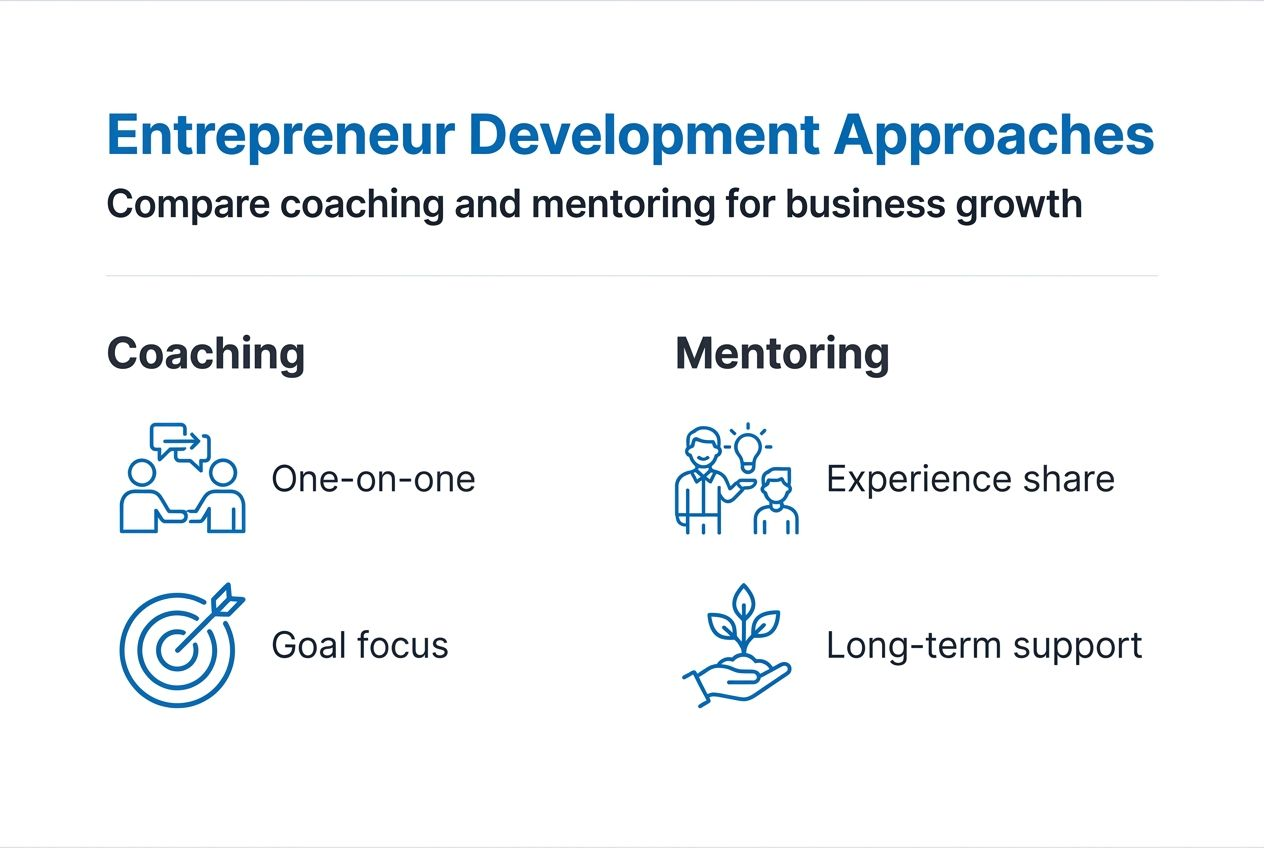
Entrepreneur development encompasses diverse methodologies, each serving different needs and business contexts. Executive coaching provides intensive one-on-one support focused on leadership effectiveness and strategic thinking. Leadership development programmes build management capabilities across your team. Mentoring relationships offer experience-based guidance from entrepreneurs who’ve navigated similar challenges. Peer groups create accountability and diverse perspective through facilitated owner forums.
Executive coaching returns 3 to 7 times the initial investment with 86% of organisations reporting positive ROI. This performance reflects coaching’s ability to accelerate decision quality and prevent expensive strategic mistakes. Entrepreneurial development programmes increase SME survival rates by 10-20%, a margin that separates thriving businesses from failed ventures in competitive markets.
| Approach | Key benefits | Best for | Typical duration |
|---|---|---|---|
| Executive coaching | Personalised strategic guidance, leadership development, decision quality improvement | Owners facing complex strategic decisions or scaling challenges | 6-12 months |
| Leadership programmes | Team capability building, management system development, delegation frameworks | Businesses building management layers or preparing successors | 3-6 months |
| Mentoring | Experience-based advice, industry insights, network access | New entrepreneurs or those entering unfamiliar markets | Ongoing relationship |
| Peer groups | Accountability, diverse perspectives, shared problem-solving | Owners seeking regular accountability and fresh viewpoints | Ongoing monthly |
Selection criteria for your development approach:
- Business stage: startups need different support than established enterprises
- Specific challenges: strategic, operational, financial, or leadership focused
- Learning style: some entrepreneurs thrive in groups, others need individual attention
- Time availability: intensive programmes require greater commitment than monthly peer sessions
- Budget constraints: peer groups offer lower cost entry than executive coaching
- Desired outcomes: clarity on specific results drives appropriate programme selection
Exploring types of coaching for owners reveals how different methodologies address distinct business challenges. The coaching in entrepreneurship role evolves as businesses grow, requiring periodic reassessment of whether your current development approach still serves your needs.
Business coaching workflow growth success depends on matching programme intensity to your commitment level and business priorities. The most sophisticated coaching programme delivers no value if you can’t dedicate time to implementation. Start with approaches that fit your current capacity, then expand as you build development habits and see initial results.
Unlock your business potential with Summit Scale coaching
Your business deserves development support tailored to your specific growth challenges and market context. Summit Scale provides coaching programmes designed for small to medium enterprise owners pursuing sustainable profitability and operational freedom. Our structured approach helps you implement proven strategies that increase revenue, save time, and build valuable businesses.
Discover why invest in coaching business programmes transforms theoretical knowledge into practical results. Explore the role of coaching for SMEs in navigating growth challenges whilst maintaining profitability. Learn how coaching in scaling business builds the systems and leadership capabilities required for sustainable expansion. Book your free 15-minute assessment to identify which development approach aligns with your current business priorities and growth objectives.
FAQ
How does entrepreneur development improve business revenue?
Entrepreneur development optimises sales processes, enhances team performance, and sharpens strategic clarity to drive revenue growth. Coaching programmes help identify and eliminate profit leaks whilst improving conversion rates and customer retention. The average revenue increase of 46% reflects systematic improvements across multiple business functions rather than single tactical changes.
What types of entrepreneur development programmes are best for SMEs?
Programmes range from executive coaching and leadership development to mentoring and peer accountability groups. The most effective choice depends on your specific business goals, current challenges, company size, and growth stage. Start-ups often benefit from mentoring and peer groups, whilst scaling businesses typically need executive coaching and leadership development to build management capability.
How long does it take to see results from coaching?
Some clients notice improvements within weeks as they implement new frameworks and decision processes. However, sustained results require ongoing implementation and accountability over months rather than days. Active follow-through post-coaching proves essential to maintaining new behaviours and preventing reversion to reactive management patterns that limit growth.
How can I maximise the return on my investment in entrepreneur development?
Align coaching programmes to specific business KPIs and measurable outcomes rather than vague aspirations. Ensure robust accountability mechanisms including regular check-ins, peer support, and transparent progress tracking. Schedule dedicated implementation time immediately following coaching sessions and review results quarterly to adjust approaches based on actual performance rather than subjective impressions.

