
Align profitability with growth for lasting SME success
Many SME owners chase revenue growth, believing bigger sales solve everything. Yet over 60% of rapidly growing SMEs experience declining profit margins in early growth phases, threatening cash flow and survival. Profitability, not just revenue, fuels sustainable expansion. This guide reveals how balancing growth ambitions with robust profit margins protects your business health and unlocks genuine freedom. You will learn practical metrics, strategies, and a clear framework to align profitability with growth for long term SME success.
Table of Contents
- Understanding Profitability And Its Role In Growth
- How Profitability Enables Sustainable Growth
- Common Misconceptions About Growth Without Profitability
- Quantitative Benchmarks And Profitability Metrics In Growth
- Profitability’s Role In Funding, Investment, And Valuation
- Balancing Profitability And Growth: Operational Strategies For SMEs
- Conceptual Framework: Integrating Profitability And Growth
- Implementing Profitability Focused Growth Strategies
- Unlock Your SME’s Growth Potential With Expert Coaching
- Frequently Asked Questions
Key takeaways
| Point | Details |
|---|---|
| Profitability differs fundamentally from revenue and drives sustainable growth | Revenue measures sales volume; profitability reflects actual retained earnings essential for reinvestment and resilience. |
| Strong profit margins enable internal funding and reduce external debt reliance | Profitability generates capital to scale operations, manage risks, and maintain flexibility during market shifts. |
| Ignoring profitability during growth increases liquidity crisis risks | Unprofitable expansion drains cash reserves, causing operational failures despite rising sales figures. |
| Key metrics like net profit margin and EBITDA guide profitable scaling decisions | Tracking these benchmarks helps SME owners assess business health and avoid overextension during growth phases. |
| Operational strategies balancing cost control with growth investments sustain margins | Efficient resource allocation and process optimisation preserve profitability whilst supporting scalable expansion. |
Understanding profitability and its role in growth
Profitability measures the money your business keeps after covering all expenses, unlike revenue which only counts incoming sales. Profitability is a stronger indicator of business health than revenue alone, affecting cash flow and sustainability. Without positive profits, growth becomes a treadmill where rising sales drain resources faster than they replenish.
Profitable operations generate the cash flow needed for daily expenses, supplier payments, and payroll. This financial stability separates thriving SMEs from those constantly chasing external funding. Sustained profitability signals that your business growth models work efficiently, creating value rather than merely increasing activity.
Many owners equate growth with revenue expansion, overlooking margin health. This misconception leads to overtrading where sales volume rises but profits shrink or vanish. Understanding why improve profitability matters transforms how you approach scaling decisions.
Consider these profitability fundamentals:
- Profitability provides flexibility to weather economic downturns or competitive pressures without immediate crisis.
- Strong margins allow strategic investments in technology, talent, and market opportunities that compound growth.
- Positive profits reduce dependence on loans or investors, preserving control and reducing financial stress.
- Tracking profit trends reveals operational inefficiencies early, enabling corrective action before problems escalate.
Recognising business profitability importance shifts your focus from vanity metrics to financial fundamentals. Profitability is not about limiting ambition but ensuring your growth trajectory is financially viable and sustainable over years, not just quarters.

How profitability enables sustainable growth
Profitability generates internal funds for reinvestment and buffers against unforeseen risks, key to sustainable SME growth. When your business retains earnings, you build reserves that finance expansion without diluting ownership or accruing debt. This self sufficiency accelerates growth whilst maintaining strategic control.
Profits create a financial cushion that absorbs shocks like supply chain disruptions, sudden cost increases, or market slowdowns. This risk management capacity keeps operations stable during turbulence, preventing growth initiatives from collapsing under pressure. SMEs with healthy margins adapt faster and recover quicker than cash strapped competitors.
Reinvesting profits into scalable systems, technology, and team capacity drives efficiency gains that fuel further growth. Improved operational efficiency lowers per unit costs, widening margins and creating a virtuous cycle. Understanding the role of profitability in growth reveals why margin focused businesses outpace revenue obsessed rivals.
Key mechanisms include:
- Internal funding reduces interest expenses and loan covenants, preserving cash for growth investments.
- Profit reserves enable opportunistic acquisitions, market entries, or product launches without frantic fundraising.
- Strong margins attract better supplier terms and customer confidence, reinforcing competitive positioning.
- Consistent profitability supports workforce development and retention, building organisational capability essential for scaling.
Pro tip: Focus on incremental margin improvements of even 2 to 3 percentage points annually. These gains compound into substantial reserves that power expansion without external capital, aligning perfectly with your growth objectives.
Sustainable growth balances ambition with financial reality. Profitability transforms growth from a gamble into a managed process where each expansion step strengthens rather than weakens your business foundation.
Common misconceptions about growth without profitability
Many SME owners believe growth automatically equals success, a dangerous myth. Rapid revenue growth often leads to increased costs and declining profit margins, destabilising businesses if profitability is neglected. Chasing sales without margin discipline creates financial vulnerabilities that can trigger failure despite impressive top line numbers.
Unprofitable growth depletes working capital, forcing businesses into liquidity shortfalls where they cannot meet obligations. This cash flow crisis often strikes when sales are rising, catching owners by surprise. The gap between invoicing and payment collection widens with volume, straining resources and operational capacity beyond sustainable limits.
Real world examples abound of SMEs that scaled rapidly only to collapse under the weight of unmanaged costs and negative cash flow. These cautionary tales highlight why aligning growth ambitions with profitable operations is non negotiable. Recognising growth pitfalls early protects your business from becoming another statistic.
Consider these critical misconceptions:
- Revenue growth compensates for low margins. False. Volume cannot overcome fundamentally unprofitable economics; losses multiply with scale.
- Profitability can wait until after achieving market dominance. Risky. Most SMEs lack the capital reserves to sustain prolonged losses; cash runs out first.
- Cutting prices to win customers accelerates growth. Counterproductive. Price erosion damages margins permanently and attracts unprofitable customer segments.
- External funding solves profitability problems. Short sighted. Debt or equity only delays reckoning; sustainable models require operational profit generation.
As one business advisor noted:
“Growth without profitability is like running faster towards a cliff. Speed impresses observers but does not change the destination. Sustainable success requires direction grounded in financial health, not just velocity.”
Understanding these misconceptions shifts perspective from growth at any cost to growth that builds enduring value. Profitability is not a brake on ambition but the foundation enabling genuine, lasting expansion.
Quantitative benchmarks and profitability metrics in growth
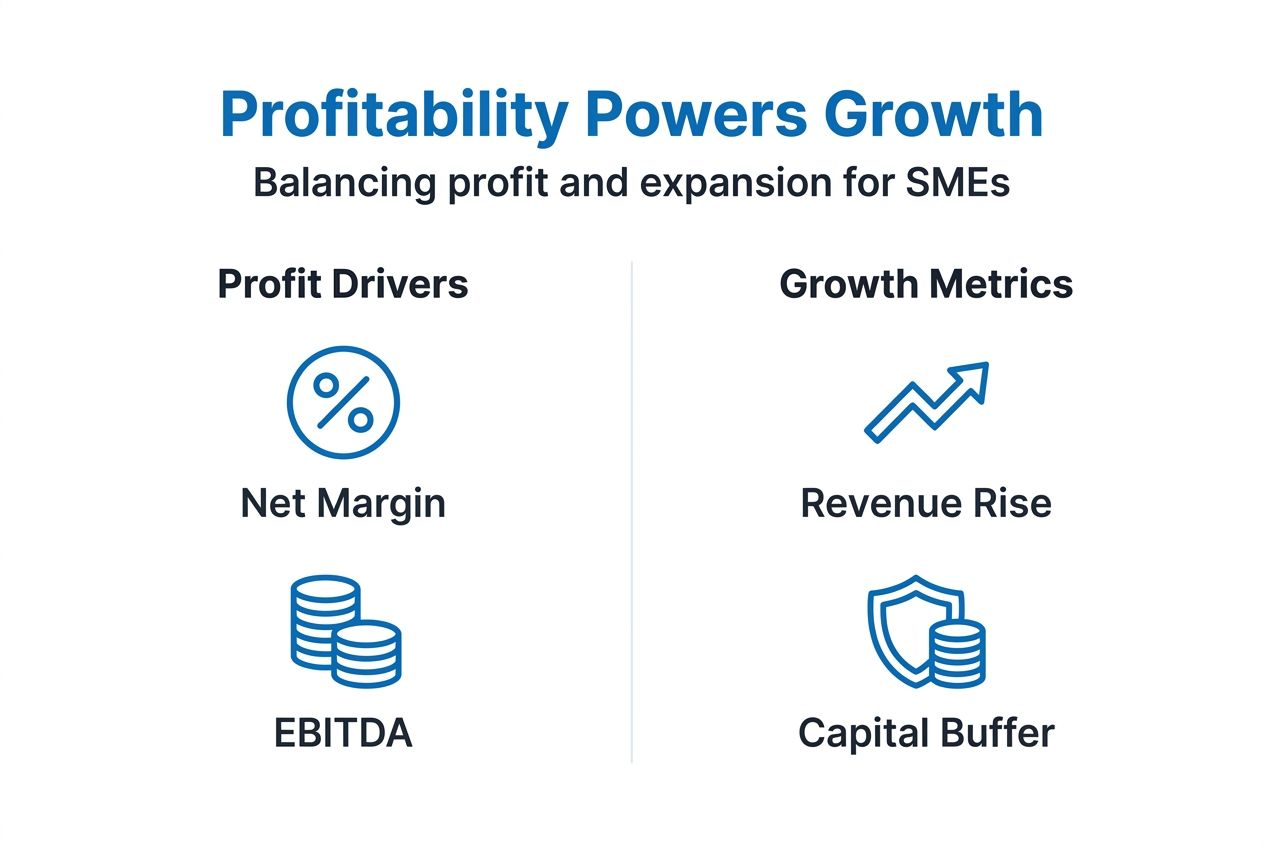
Net profit margin and EBITDA serve as essential tools for evaluating whether your growth trajectory remains financially sound. Net profit margin, calculated as net profit divided by revenue, reveals what percentage of sales you retain after all expenses. EBITDA, earnings before interest, taxes, depreciation, and amortisation, shows operational profitability before financing and accounting adjustments.
SMEs maintaining at least 15% net profit margin grow on average 27% faster over five years than peers with lower margins. This benchmark illustrates how strong profitability accelerates sustainable growth by funding reinvestment and buffering risks. Industry specific benchmarks vary, so comparing your metrics against sector averages provides realistic performance context.
| Industry Sector | Target Net Profit Margin | Typical EBITDA Margin |
|---|---|---|
| Professional Services | 15% to 25% | 20% to 35% |
| Retail | 3% to 8% | 8% to 15% |
| Manufacturing | 8% to 15% | 12% to 20% |
| Technology/SaaS | 10% to 20% | 15% to 30% |
| Construction | 5% to 12% | 10% to 18% |
Tracking these key profitability metrics informs strategic decisions about expansion timing, pricing adjustments, and cost management priorities. Metrics provide objective signals that prevent emotional or reactive choices during growth phases.
Practical applications include:
- Setting minimum margin thresholds before pursuing new markets or product lines.
- Identifying which revenue streams contribute most to profitability versus those dragging down overall margins.
- Assessing whether growth investments like marketing spend or team expansion deliver acceptable return on investment.
- Establishing early warning indicators when margins compress, triggering operational reviews before problems escalate.
Regular monitoring aligns growth ambitions with financial reality. Working with coaching in profitability can help interpret these metrics and translate them into actionable strategies tailored to your growth objectives.
Quantitative benchmarks demystify profitability, transforming abstract concepts into concrete targets. Measuring progress against these standards keeps your growth trajectory sustainable and financially healthy.
Profitability’s role in funding, investment, and valuation
Profitability is a key criterion investors and lenders use to assess SME creditworthiness and valuation potential. Strong profit margins signal financial stability, operational competence, and reduced risk, making your business attractive to external capital sources. Whether seeking loans, equity investment, or planning an exit, demonstrated profitability dramatically improves terms and multiples.
Higher profit margins translate directly into better valuation multiples when selling your business or attracting investors. Buyers pay premiums for profitable operations because they represent lower risk and immediate cash generation. Conversely, businesses with weak or inconsistent profits face scepticism, lower offers, or outright rejection from potential funders.
Real world outcomes illustrate this dynamic clearly. An SME with consistent 18% net margins secured acquisition interest at 6x EBITDA, whilst a similar sized competitor with 5% margins struggled to attract offers above 3x. Profitability track record directly influenced perceived value and negotiating leverage.
Key funding and valuation benefits include:
- Banks offer more favourable loan terms, lower interest rates, and higher credit limits to profitable businesses with stable cash flow.
- Equity investors accept lower ownership stakes when profitability demonstrates strong management and market fit.
- Demonstrated profit growth increases valuation multiples significantly, often adding hundreds of thousands to exit proceeds.
- Consistent profitability reduces due diligence concerns, accelerating transaction timelines and reducing deal fall through risk.
Pro tip: Build detailed profitability data into investor communications and funding applications from the outset. Highlight margin trends, efficiency improvements, and reinvestment returns to boost credibility and position your business as a low risk, high return opportunity.
Whether you aim to increase business valuation for an eventual exit or secure growth capital today, profitability is the foundation. Investing in coaching and valuation strategies ensures you optimise financial performance to maximise funding opportunities and business worth.
Balancing profitability and growth: operational strategies for SMEs
Effective cost control and resource allocation support margin maintenance during scalable growth phases. Implementing disciplined cost management prevents margin erosion as revenue expands. This does not mean slashing expenses indiscriminately but strategically managing spending to preserve profitability whilst investing in growth drivers.
Optimising team productivity and resource deployment ensures you extract maximum value from existing capacity before adding headcount or infrastructure. Process improvements, automation, and skill development boost output without proportional cost increases, widening margins and freeing cash for strategic investments.
Balancing short term profit sacrifices with long term growth objectives requires clear frameworks. Some growth investments, like entering new markets or developing products, may temporarily compress margins. The key is ensuring these tradeoffs are intentional, time bound, and demonstrably linked to future profitability improvements.
Practical strategies include:
- Conducting regular cost audits to identify and eliminate waste without impacting customer value or operational effectiveness.
- Negotiating supplier contracts and payment terms that align with your cash flow cycles, reducing working capital pressure during growth.
- Implementing performance metrics that tie team incentives to profitability outcomes, not just revenue targets, aligning organisational behaviour with margin health.
- Prioritising high margin products, services, or customer segments during expansion to ensure growth directly contributes to profitability.
Pro tip: Use technology and process improvement initiatives to scale efficiently. Cloud based tools, workflow automation, and standardised procedures reduce per unit costs as volume grows, protecting margins whilst expanding capacity. This operational leverage is fundamental to profitable scaling.
Ongoing financial monitoring and adjustment during growth phases prevent small margin compressions from becoming structural problems. Dashboards tracking gross margin, operating expenses as percentage of revenue, and cash conversion cycles provide early warnings when profitability drifts off target.
Strategies to maintain profit margins whilst pursuing growth strategies require discipline and systems. The most successful SMEs treat profitability as a non negotiable constraint within which growth occurs, not an optional goal sacrificed for expansion.
Conceptual framework: integrating profitability and growth
The Profitability Growth Cycle creates a self reinforcing loop essential for sustainable SME success. This framework visualises how profitability funds reinvestment, which drives growth opportunities, which in turn generate higher profits when managed effectively. Understanding this cycle helps SME owners make strategic decisions that strengthen rather than undermine business health.
Profitability generates surplus capital available for reinvestment in capacity, capability, or market expansion. These investments, when targeted strategically, create growth opportunities that increase revenue. Growth executed with operational discipline sustains or improves margins, feeding more profit back into the cycle. This virtuous loop accelerates sustainable expansion.
Operational management sustains margins within growth by maintaining cost discipline, pricing integrity, and productivity improvements. Without this management layer, growth dissipates profitability gains through inefficiency or margin erosion, breaking the cycle. The framework emphasises that all three elements must work in concert.
| Approach | Strategy Without Profitability Focus | Strategy With Profitability Integration |
|---|---|---|
| Growth funding | Relies heavily on external debt or equity, increasing financial risk | Uses retained earnings primarily, preserving control and reducing cost of capital |
| Risk management | Vulnerable to cash flow shocks and market volatility | Profit reserves buffer against uncertainties, maintaining operational stability |
| Decision making | Revenue targets drive choices, often ignoring margin impacts | Profitability metrics guide investments, ensuring sustainable value creation |
| Valuation trajectory | Inconsistent profits limit exit options and valuation multiples | Strong profit track record maximises business worth and attracts premium buyers |
| Operational focus | Emphasises sales volume and market share above efficiency | Balances growth with cost control, productivity, and margin preservation |
Visualising the profitability growth cycle provides clarity for strategic planning. It shows why profitability is not opposed to growth but essential for making growth sustainable, scalable, and valuable. This mental model guides balanced decision making that protects long term business health whilst pursuing ambitious expansion.
Implementing profitability focused growth strategies
Systematic assessment and target setting aligned with growth objectives increases likelihood of profitable scaling. Translating profitability principles into action requires a structured approach that evaluates current performance, establishes clear targets, and implements monitoring systems to maintain alignment.
Follow these steps to embed profitability into your growth strategy:
-
Assess current profitability metrics. Calculate your net profit margin, EBITDA, and gross margin across product lines or service offerings. Identify which areas contribute most to overall profitability and which drag down performance.
-
Set clear, achievable profitability targets alongside growth goals. Define minimum acceptable margins for existing operations and target margins for new initiatives. Ensure growth objectives specify both revenue and profit expectations, not just top line numbers.
-
Monitor cash flow rigorously to prevent liquidity risks during expansion. Implement weekly or bi weekly cash flow forecasts that project at least 90 days forward. Track accounts receivable ageing and payment cycles to anticipate and address shortfalls before they become critical.
-
Identify and implement operational improvements focused on margin sustainability. Analyse cost structures, renegotiate supplier contracts, streamline processes, and invest in productivity enhancing technology. Prioritise changes delivering quick wins alongside longer term efficiency gains.
-
Leverage coaching or expert guidance to accelerate profitability improvements. Working with performance coaching provides external perspective, proven frameworks, and accountability that accelerates implementation and results.
-
Demonstrate profitability when seeking funding to access better terms. Prepare detailed financial documentation showing profit trends, margin drivers, and how additional capital will enhance profitability further. Position your funding request around growth that strengthens financial performance.
Following this growth strategy guide ensures profitability remains central to expansion plans. Systematic implementation transforms abstract principles into concrete practices that deliver sustainable results. Regular review and adjustment maintain alignment as market conditions and business circumstances evolve.
Unlock your SME’s growth potential with expert coaching

Balancing profitability with ambitious growth requires strategic clarity, operational discipline, and often external expertise. Summit SCALE coaching helps SME owners integrate these critical elements, providing tailored guidance that aligns financial health with expansion objectives. Our approach supports decision making processes that preserve margins whilst pursuing scalable growth.
Working with experienced coaches accelerates your journey towards sustainable success by identifying blind spots, optimising resource allocation, and implementing proven frameworks. Whether you are refining cost structures, improving productivity, or preparing for funding, expert support enhances outcomes and reduces costly missteps.
Explore how role of coaching for SMEs transforms business performance, or discover why invest in coaching delivers measurable returns. Our comprehensive growth strategy guide provides additional insights to unlock time, profit, and freedom. Take action today to build a business that grows profitably and sustainably.
Frequently asked questions
What is the difference between profitability and growth?
Growth measures revenue or sales volume increases over time, whilst profitability reflects the actual earnings retained after covering all business expenses. Growth can occur without profitability, creating cash flow problems and financial instability. Sustainable success requires both revenue expansion and healthy profit margins working together.
How can SMEs track if growth is profitable?
Track net profit margin by dividing net profit by total revenue, and monitor EBITDA to assess operational profitability. Compare these metrics against industry benchmarks and your historical performance. Regular review of cash flow statements and gross margins by product or service line reveals whether growth initiatives contribute positively to overall profitability.
Why do some businesses grow revenue but still fail?
Rapid revenue growth without profitability drains working capital faster than sales replenish it, causing liquidity crises. Rising sales often bring increased costs for inventory, staffing, and operations that outpace revenue gains. Without positive cash flow from profitable operations, businesses run out of money to meet obligations despite impressive top line growth.
How important is profitability for getting business financing?
Profitability is critical for securing favourable financing terms from banks and attracting equity investors. Lenders assess profit margins and cash flow stability to evaluate repayment capacity and risk. Strong profitability demonstrates operational competence and financial health, leading to better interest rates, higher credit limits, and more attractive investment valuations.
What practical steps help balance growth and profits?
Implement disciplined cost control without sacrificing customer value, optimise team productivity through process improvements, and set minimum acceptable profit margin thresholds before pursuing growth initiatives. Monitor cash flow weekly, prioritise high margin offerings, and use technology to scale efficiently. Regular financial review and expert coaching guidance keep profitability central to growth strategy execution.

