
Frustrated when scaling efforts stall just as your business shows real promise? Many ambitious British small and medium-sized enterprises find that growth is more complex than adding new customers or increasing team size. Understanding business growth models gives leaders a clear pathway, helping them prioritise the right strategies at each stage. This overview will clarify how structured frameworks support informed decisions for expanding capacity, sharpening competitive focus, and strengthening profitability as your business evolves.
Table of Contents
- Defining Business Growth Models
- Types Of Growth Models For SMEs
- Core Drivers Behind Sustainable Scaling
- Implementing Growth Models Effectively
- Common Pitfalls When Pursuing Growth
Key Takeaways
| Point | Details |
|---|---|
| Understanding Growth Models | Organisations must recognise that business growth is complex, necessitating the use of tailored growth models that adapt to unique challenges and stages of development. |
| Core Drivers for Sustainable Scaling | Sustainable growth relies on strategic alignment, resource optimisation, and adaptive leadership to navigate market dynamics effectively. |
| Effective Implementation Strategies | Successful execution of growth models requires clear performance metrics, continuous learning, and stakeholder engagement to ensure alignment with business goals. |
| Avoiding Growth Pitfalls | Regular strategic reviews and flexible operational frameworks are essential to identifying and mitigating common challenges that hinder growth. |
Defining Business Growth Models
Business growth models represent strategic frameworks that organisations use to expand their operational capacity, market presence, and financial performance. Systematic research into growth configurations reveals these models are complex, dynamic systems that evolve with an organisation’s developmental stage.
At their core, business growth models describe how companies plan and execute strategies to increase revenue, market share, and organisational capabilities. These models typically encompass several critical dimensions:
- Expansion strategies focusing on market penetration
- Operational efficiency improvements
- Resource allocation techniques
- Performance measurement frameworks
Understanding these models requires recognising that growth is not linear but an intricate process involving interconnected organisational elements. Integrative theoretical frameworks suggest business growth models function as open systems, continuously adapting to changing economic ecosystems.
Small and medium enterprises often utilise growth models as roadmaps, helping leadership teams navigate complex scaling challenges. These models provide structured approaches to:
- Assess current organisational capabilities
- Identify potential growth opportunities
- Develop targeted expansion strategies
- Monitor progress and adjust tactics
Pro tip: Regularly review and recalibrate your business growth model to ensure it remains responsive to market dynamics and organisational capabilities.
Types Of Growth Models For SMEs
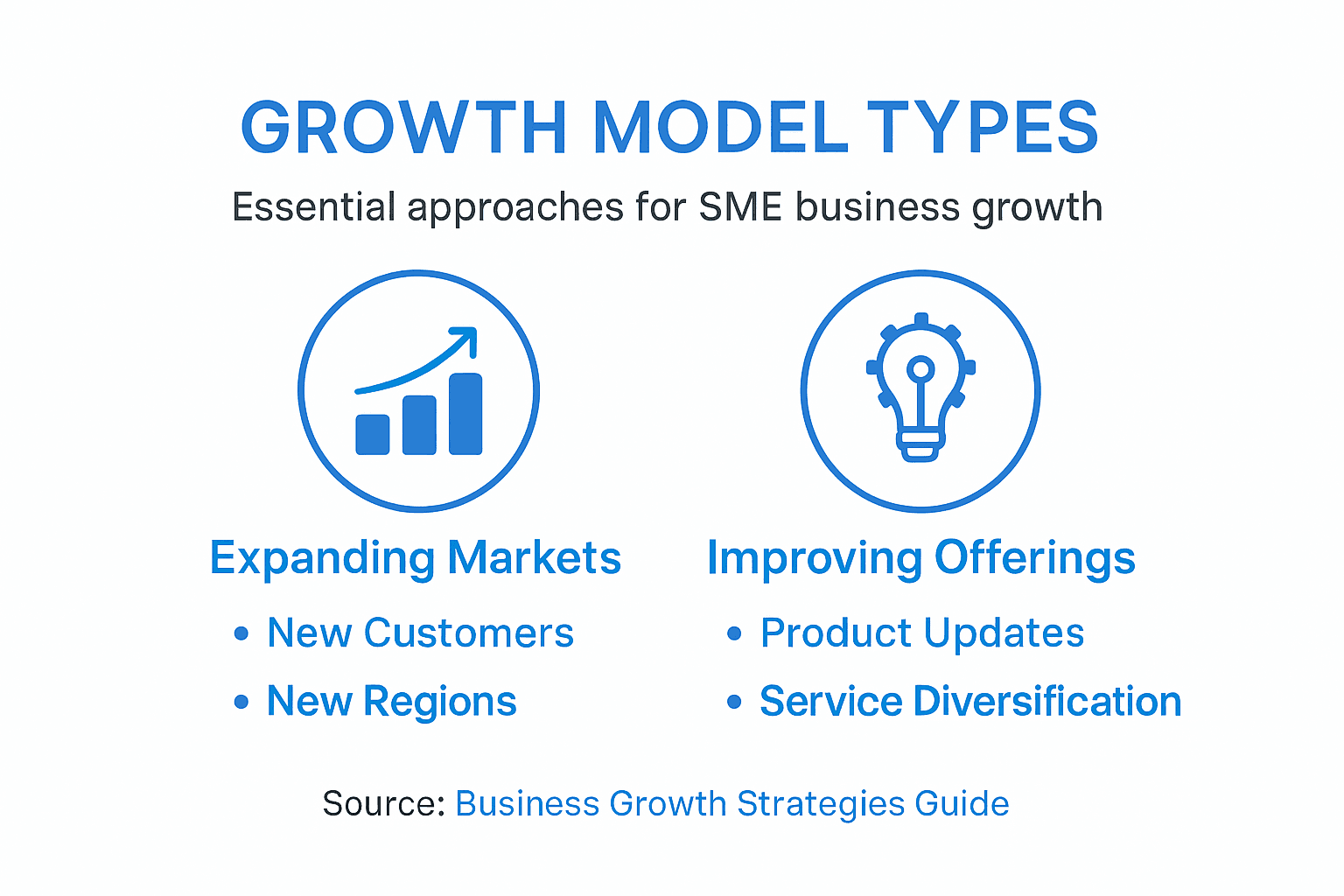
Small and medium enterprises require nuanced growth models that address their unique operational challenges. Eight distinct modelling approaches have emerged to help SMEs navigate complex scaling environments, each offering strategic insights into organisational development.

These growth models represent sophisticated frameworks designed to support entrepreneurial progression. The primary types of growth models for SMEs include:
The following table compares common SME growth model approaches, highlighting their unique focus and ideal business use case:
| Growth Model Type | Key Focus Area | Best For |
|---|---|---|
| Stochastic Approach | Managing uncertainty | Start-ups in volatile markets |
| Stages Model | Sequential milestones | Organisations seeking structured progress |
| Evolutionary Approach | Adapting to change | Firms in dynamic, shifting industries |
| Resource-Based View | Leveraging capabilities | Enterprises with unique internal strengths |
| Learning Approach | Knowledge improvement | Companies prioritising innovation |
| Managerial Approach | Leadership decision-making | Management-driven businesses |
- Stochastic approach: Emphasising probabilistic growth patterns
- Stages models: Defining sequential developmental phases
- Evolutionary approach: Focusing on adaptive capabilities
- Resource-based view: Analysing internal capability strengths
- Learning approach: Prioritising knowledge acquisition
- Managerial approach: Centring on leadership decision-making
Configuration models for SME growth specifically highlight the importance of understanding management priorities across different organisational stages. These models recognise that growth is not uniform but varies significantly based on individual enterprise characteristics, market conditions, and leadership strategies.
Successful implementation of these growth models requires careful consideration of multiple factors:
- Comprehensive organisational assessment
- Clear strategic objectives
- Flexible adaptation mechanisms
- Continuous performance monitoring
- Regular strategic recalibration
Pro tip: Select a growth model that aligns most closely with your specific business context, industry dynamics, and long-term strategic vision.
Core Drivers Behind Sustainable Scaling
Sustainable business scaling requires more than traditional growth strategies. Comprehensive scaling innovations demonstrate that successful expansion depends on understanding multiple interconnected drivers that support long-term organisational development.
The core drivers behind sustainable scaling can be categorised into several critical dimensions:
- Strategic alignment: Ensuring growth objectives match organisational capabilities
- Resource optimisation: Developing efficient systems and processes
- Ecosystem collaboration: Building supportive external networks
- Financial resilience: Maintaining robust economic foundations
- Adaptive leadership: Cultivating flexible management approaches
Scaling sustainability innovations emphasise the importance of developing comprehensive strategies that address both internal operational capabilities and external market dynamics. This holistic approach recognises that sustainable scaling is a multifaceted process requiring continuous learning and strategic recalibration.
This summary outlines how core scaling drivers impact long-term business sustainability:
| Scaling Driver | Organisational Benefit | Risk If Neglected |
|---|---|---|
| Strategic Alignment | Consistent business direction | Misaligned priorities |
| Resource Optimisation | Cost control and efficient operations | Financial inefficiency |
| Ecosystem Collaboration | Access to new markets and partners | Limited business outreach |
| Financial Resilience | Ability to withstand market shocks | Vulnerability to downturns |
| Adaptive Leadership | Faster response to external changes | Slow organisational adaption |
Successful organisations typically focus on these key implementation strategies:
- Develop clear mission-driven scaling objectives
- Create flexible organisational structures
- Invest in talent development
- Build robust performance measurement systems
- Maintain continuous stakeholder engagement
Pro tip: Regularly assess your scaling strategy against evolving market conditions and organisational capabilities to ensure sustainable growth trajectory.
Implementing Growth Models Effectively
Successful business growth requires a strategic and methodical approach to implementing growth models. Comprehensive growth model frameworks provide critical insights into operationalising organisational development strategies that drive meaningful progress.
Effective implementation of growth models demands attention to several key strategic elements:
- Clear performance metrics: Establishing precise measurement criteria
- Adaptive planning: Creating flexible strategic frameworks
- Stakeholder engagement: Ensuring comprehensive organisational alignment
- Continuous learning: Developing responsive improvement mechanisms
- Resource allocation: Optimising capability development
Multiple measurement approaches highlight the importance of selecting appropriate evaluation techniques that capture nuanced organisational progression. This requires businesses to develop sophisticated tracking systems that go beyond traditional performance indicators.
Practical steps for implementing growth models effectively include:
- Define specific, measurable growth objectives
- Conduct comprehensive organisational capability assessment
- Design tailored strategic intervention frameworks
- Establish robust monitoring and feedback mechanisms
- Create iterative improvement processes
Pro tip: Treat your growth model as a dynamic blueprint, regularly reviewing and adjusting strategies to maintain alignment with evolving business landscapes.
Common Pitfalls When Pursuing Growth
Business growth journeys are fraught with potential challenges that can derail even the most promising organisations. Common research-based pitfalls reveal systematic errors that consistently impede organisational development and strategic expansion.
The most critical pitfalls businesses encounter during growth include:
- Inadequate strategic planning: Lacking clear, measurable objectives
- Resource misallocation: Inefficient deployment of financial and human capital
- Premature scaling: Expanding before establishing stable operational foundations
- Ignoring market feedback: Failing to adapt to changing customer needs
- Weak leadership alignment: Mismatched organisational vision and execution
Methodological errors in organisational development demonstrate that growth challenges often stem from systemic biases and incomplete strategic assessments. Successful businesses must develop robust mechanisms to identify and mitigate these potential roadblocks.
Key strategies for avoiding common growth pitfalls include:
- Conduct regular strategic reviews
- Maintain flexible operational frameworks
- Invest in continuous team development
- Develop rigorous performance measurement systems
- Foster a culture of open communication and feedback
Pro tip: Implement quarterly strategic assessments to proactively identify and address potential growth barriers before they become significant organisational challenges.
Unlock Sustainable Growth with Tailored Business Coaching
Navigating the complexities of business growth models can be overwhelming. This article highlights key challenges like resource optimisation, strategic alignment, and adaptive leadership that often hold businesses back from achieving lasting success. If you are striving to develop a clear, flexible growth strategy that matches your unique organisational capabilities and market conditions, personalised coaching could be the transformative step you need.
Summit SCALE specialises in empowering small to medium-sized business owners to overcome common growth pitfalls through focused coaching on sales growth, team building, cost control, and long-term value creation. Our proven approach aligns perfectly with the article’s insights on sustainable scaling and adaptive planning, offering you the tools to turn complex growth models into actionable strategies.
Discover how you can benefit today by visiting our main website.
Ready to move from theory to practice? Take the first step by scheduling a free 15-minute assessment call and explore how expert guidance can accelerate your business growth journey. Start crafting your personalised growth model now at Summit SCALE.
Frequently Asked Questions
What are business growth models?
Business growth models are strategic frameworks that companies use to expand their operational capabilities, market presence, and financial performance. They describe how organisations plan and execute strategies to increase revenue and market share.
How can small and medium enterprises (SMEs) benefit from growth models?
SMEs can utilise growth models as roadmaps to navigate scaling challenges, helping them assess their capabilities, identify growth opportunities, develop targeted expansion strategies, and monitor their progress effectively.
What are the core drivers behind sustainable scaling for businesses?
The core drivers of sustainable scaling include strategic alignment, resource optimisation, ecosystem collaboration, financial resilience, and adaptive leadership. These drivers help organisations build a robust foundation for long-term growth and adaptability.
What common pitfalls should businesses avoid when pursuing growth?
Common pitfalls include inadequate strategic planning, resource misallocation, premature scaling, ignoring market feedback, and weak leadership alignment. Avoiding these issues requires regular strategic assessments and a flexible operational approach.

