
TL;DR:
- Many SME owners underestimate the profitability of implementing structured process improvement frameworks like Lean Six Sigma and Kaizen. These techniques can deliver significant cost reductions and operational efficiency when applied consistently, especially with professional coaching support. Success depends on treating continuous improvement as an ongoing discipline with strong leadership commitment and structured accountability.
Many SME owners assume that rigorous process improvement frameworks belong exclusively to large corporations with dedicated teams and limitless budgets. That assumption is quietly costing them money. Operational cost reductions of 20 to 30% are achievable within the first two years of applying Lean Six Sigma, and Six Sigma projects average $230,000 in savings per initiative. These are not figures reserved for multinationals. They are within reach for your business, right now. This article breaks down the most effective optimisation techniques for SMEs, shows you real results from real businesses, and explains how professional coaching transforms knowledge into lasting change.
Table of Contents
- Understanding business optimisation: Key techniques for SMEs
- From framework to results: How optimisation techniques deliver measurable gains
- The role of professional coaching: Turning technique into transformation
- Choosing the right approach: Matching techniques to your business needs
- Why most SME optimisation efforts stall—and what actually works
- Take your business optimisation further with expert support
- Frequently asked questions
Key Takeaways
| Point | Details |
|---|---|
| Proven techniques deliver | Methods like Lean Six Sigma and Kaizen have produced dramatic operational and financial gains for SMEs. |
| Coaching accelerates impact | Professional coaching transforms technique into sustained results through structured support and accountability. |
| Start small, scale smart | Piloting improvements and training employees allows SMEs to optimise without major risk or expense. |
| Metric tracking is key | Benchmarking and continuous measurement ensure optimisation efforts deliver results and sustain improvements. |
| Ongoing improvement matters | Viewing optimisation as a habit, not a one-off, is the true driver of lasting SME growth. |
Understanding business optimisation: Key techniques for SMEs
With the scene set for what optimisation can deliver, let’s clarify and compare the top frameworks available to SMEs. Business optimisation, at its core, means finding smarter ways to do what you already do, reducing waste, improving quality, and making better use of your resources. The good news is that the most powerful frameworks are also the most practical.
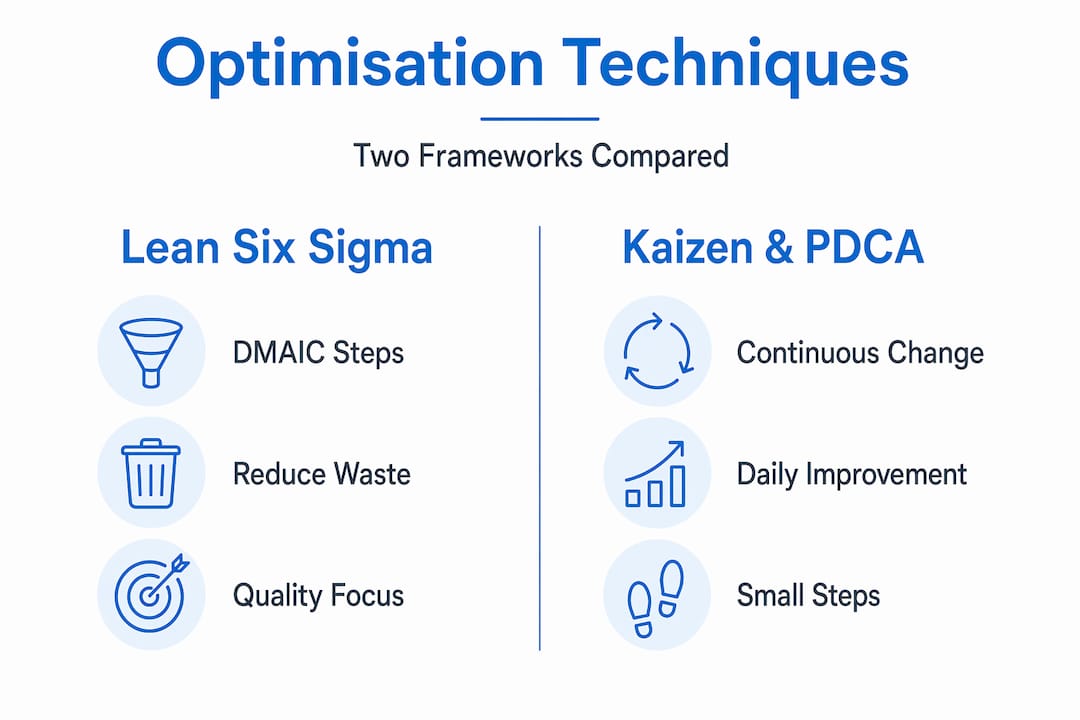
Lean Six Sigma (LSS) combines two philosophies. Lean focuses on eliminating waste from processes, while Six Sigma targets variation and defects. Together, they follow a structured path known as DMAIC, which stands for Define, Measure, Analyse, Improve, and Control. Lean Six Sigma uses DMAIC to systematically reduce waste, defects, and operational variation, making it one of the most evidence-based tools available to business owners today.
Kaizen and the PDCA cycle take a different angle. Kaizen, a Japanese term meaning “change for the better,” is built on the idea that small, consistent improvements compound into significant gains over time. It works hand in hand with the PDCA cycle, which stands for Plan, Do, Check, Act. Rather than waiting for a quarterly review, you implement changes, observe outcomes, and refine continuously. This makes it particularly well suited to daily operations in SMEs where flexibility matters.
Benchmarking is the practice of comparing your KPIs to industry leaders to identify performance gaps and adopt proven best practices. It gives you an honest external reference point rather than relying solely on internal perceptions of how well things are going.
Here is a quick comparison to help you see where each technique fits:
| Technique | Best for | Focus | Complexity |
|---|---|---|---|
| Lean Six Sigma (DMAIC) | Complex, recurring problems | Waste reduction and defect control | Moderate to high |
| Kaizen / PDCA | Daily continuous improvement | Small iterative gains | Low to moderate |
| Benchmarking | Strategic positioning | Gap analysis and best practice adoption | Low |
Only 22.7% of SMEs have actively implemented structured improvement frameworks, which means the vast majority of your competitors are still operating on gut feel and habit. That is an enormous opportunity for those willing to act.
For a deeper look at how these frameworks connect to profitability, our SME profit optimisation guide is an excellent starting point. If you are considering outside support for implementation, business process optimisation services can also help you map your existing workflows before you begin.
Pro Tip: Do not attempt to overhaul your entire operation at once. Choose one process, run a pilot project, train the team involved, and measure results before rolling out further. This approach keeps risk low and builds momentum.
From framework to results: How optimisation techniques deliver measurable gains
Now that the techniques are clear, what kind of business impact do they produce? The numbers tell a compelling story, and they come from businesses that look a lot like yours.
A mid-sized manufacturer applying LSS achieved high-teen EBITDA margins after a sustained optimisation programme. Their results included a 25% reduction in lead time, a 40% drop in defect rates, and a 30% cut in inventory costs. These are not abstract percentages. They represent real cash freed up, real time saved, and real confidence restored in the business.

In a separate case, another manufacturer improved on-time completion by 157%, moving from a 35% completion rate to 90%, while simultaneously reducing overtime by 28% through LSS Green Belt training. The team did not need to work harder. They needed to work smarter, and the framework gave them a map to do exactly that.
Here is a summary of the kind of results SMEs have documented:
| Metric | Before optimisation | After optimisation | Improvement |
|---|---|---|---|
| On-time completion rate | 35% | 90% | +157% |
| Defect rate | High | 40% lower | Significant |
| Lead time | Baseline | 25% reduction | Meaningful |
| Overtime costs | Elevated | 28% lower | Substantial |
| Inventory costs | Baseline | 30% reduction | Significant |
“The shift wasn’t just operational. It transformed how the entire team approached their work, moving from reactive firefighting to proactive problem solving.”
So how do you replicate this in your business? Follow these steps:
- Map your current process from start to finish, identifying every handover point, delay, and repeated error.
- Measure what matters by selecting three to five KPIs that directly reflect customer satisfaction and cost efficiency.
- Identify the biggest pain point using data rather than opinion, and prioritise that as your first improvement target.
- Run a controlled pilot with a small team or a single product line to test your proposed change safely.
- Review, refine, and roll out by checking results against your baseline and scaling what works across the business.
The path to results is achievable through consistent process improvement for growth, and it does not require a budget that only a large corporation can afford. For a practical look at what an efficiency review can reveal, efficiency audit examples provide useful context on where hidden costs tend to accumulate.
The role of professional coaching: Turning technique into transformation
With evidence of dramatic results, the question remains: how do real SMEs make these changes stick? Here coaching makes the vital difference.
Knowing a framework and executing it consistently are two very different things. Most business owners who read about Lean or Kaizen feel a burst of clarity and enthusiasm. But within weeks, the daily demands of running a business push those intentions to the back of the queue. This is not a willpower problem. It is a structure problem, and that is precisely what professional coaching addresses.
Business coaching for optimisation typically includes:
- Assessment: An honest audit of where your business stands today, not where you hope it does.
- Goal-setting: Translating vague ambitions like “improve efficiency” into specific, measurable targets with timelines.
- Strategic planning: Sequencing initiatives so that quick wins build confidence while longer-term changes embed themselves properly.
- Accountability: Regular check-ins that keep you honest about progress and flag early when something is drifting off course.
- Feedback loops: Structured reviews that help you learn from what the data is showing, not just what feels right.
- Culture building: Helping your team adopt new habits rather than resisting them, which is often the most underestimated challenge of all.
Coaching for SMEs is about alignment as much as it is about strategy. A coach helps you connect the methodology to your actual team, your actual constraints, and your actual goals. Without that connection, even the best framework becomes a binder on a shelf.
The role of a business coach in an optimisation journey is to act as the external perspective that holds up the mirror without judgement, and then helps you do something meaningful with what you see. Think of your coach as the engine that keeps the improvement vehicle moving even when momentum naturally wants to slow.
For SMEs with limited resources, coaching is particularly powerful because it concentrates effort. Rather than trying twelve things and hoping two work, a coach helps you identify the highest-leverage changes and pursue those with focus and discipline. You can explore more on coaching for SMEs and what a structured programme looks like in practice. If you need broader strategic support, business consulting services can complement coaching with technical expertise.
Pro Tip: When measuring the ROI of coaching, go beyond revenue. Track time saved, team retention, and customer satisfaction alongside financial metrics. These tell the real story of whether your optimisation efforts are working.
Choosing the right approach: Matching techniques to your business needs
Different techniques fit different business contexts. So how do you choose where to start?
The honest answer is that there is no single best methodology. The right choice depends on where your pain is, how much complexity you are dealing with, and what resources you can realistically commit. The most effective starting point for SMEs is usually a small pilot combined with employee involvement and targeted training, rather than a full-scale rollout from day one.
Here are the questions you should ask before committing to an approach:
- Is this problem recurring and complex, or is it a daily irritation that could be resolved with a simple tweak?
- Do I have the data to measure this process accurately, or do I need to start by building better measurement habits?
- How much time can my team realistically dedicate to an improvement initiative without disrupting core operations?
- Is the root cause of the problem known, or do I need a structured diagnostic process like DMAIC to uncover it?
- Am I looking for a cultural shift towards continuous improvement, or do I need a defined project with a clear endpoint?
As a general rule, Kaizen and PDCA are ideal for daily operational issues where incremental gains add up over time, while DMAIC is better suited to complex, multi-step problems where the cause is not immediately obvious. Coaching amplifies both by ensuring your team is aligned, your measurements are meaningful, and your gains are sustained rather than temporary.
Remember that only 22.7% of SMEs actively use these frameworks. If you start now, you are not following a trend. You are getting ahead of one. Explore how coaching for profitability and coaching for scaling can help you match the right techniques to your current stage of growth.
Why most SME optimisation efforts stall—and what actually works
Here is something that most articles on this topic will not tell you. The framework is rarely the problem. Most SME optimisation efforts stall because of something far more human: the business owner loses interest, or the team quietly reverts to familiar habits once the initial enthusiasm fades.
We have seen it repeatedly. A business owner attends a workshop, reads a book, or hires a consultant for a month. There is energy, there is a plan, there is genuine intention. Then the phone rings, a key client has an issue, two team members call in sick, and the improvement initiative gets quietly shelved. It is not a failure of knowledge. It is a failure of infrastructure.
The businesses that succeed with optimisation share one consistent trait: they treat it as an ongoing operating discipline, not a project. Kaizen literally means “continuous improvement,” and that word “continuous” is the one that most businesses underestimate. Progress does not come from a dramatic quarterly transformation. It comes from small, persistent daily decisions made by a team that understands why those decisions matter.
Leadership commitment is non-negotiable. If you as the owner are not visibly engaged with the improvement process, your team will not be either. Discipline and consistency from the top create the permission structure for the whole organisation to adopt new habits. This is where business coaching insights become genuinely transformative rather than just intellectually interesting.
The most valuable thing a coach provides is not a methodology. It is accountability. That regular, structured conversation where someone asks, “Did you do what you said you would do?” is more powerful than any framework document. Treat your optimisation effort as a living part of your business culture, not a one-off initiative, and the results will follow.
Take your business optimisation further with expert support
If you are ready to move from understanding these techniques to actually embedding them into your business, the right support changes everything. Reading about DMAIC and Kaizen is valuable. Applying them consistently, under pressure, with a real team and real constraints, is where most owners need a guide.
At Summit SCALE, we work with SME owners who are serious about building businesses that run better, grow faster, and give them back their time. Our coaching programmes are built around why investing in coaching pays dividends that go far beyond a single quarter’s results. Whether you are just beginning to explore optimisation or you have tried before and lost momentum, our structured approach helps you make genuine, lasting progress. Explore the range of types of business coaching available, and take the first step by booking a free 15-minute assessment call today through coaching for growth.
Frequently asked questions
What is the most effective business optimisation technique for SMEs?
Lean Six Sigma uses DMAIC for complex, recurring problems, while Kaizen and PDCA suit daily continuous improvement. The most effective technique depends on the nature of your specific challenge.
What results can I expect from applying Lean Six Sigma to my business?
SMEs consistently report 20 to 30% reductions in operational costs within the first two years, with individual projects averaging $230,000 in savings and a potential 300% ROI on a $50,000 investment.
How does business coaching accelerate optimisation in SMEs?
Business coaching provides structured support through assessment, goal-setting, strategic planning, and accountability, ensuring that changes are implemented consistently and sustained over time rather than abandoned under operational pressure.
Are these optimisation techniques expensive or resource-intensive for smaller businesses?
Not necessarily. SMEs are advised to start small with pilot projects and targeted employee training, making meaningful optimisation achievable without large-scale investment or a dedicated internal team.
Why do some optimisation projects in SMEs stall or fail?
The most common causes are a lack of visible leadership commitment, inconsistent accountability structures, and treating optimisation as a one-off project rather than a continuously practised business discipline.

