
TL;DR:
- Most SME owners focus on revenue growth, often neglect margins and internal systems.
- Sustainable, system-focused growth at 15-30% annually offers more long-term success than rapid scaling.
- Leveraging technology and strategic partnerships, aligned with internal readiness, enhances growth and owner freedom.
Most business owners assume that faster growth equals more freedom. But the data tells a different story. Scalers drive over half of all SME turnover growth, yet the majority of owners chasing rapid expansion find themselves more trapped, not less. This guide is for you if you run a small to medium-sized business and want genuine profitability alongside personal freedom. We’ll walk through what the evidence actually says about growth drivers, compare growth models, explore how technology and AI are reshaping the game, and show you how sequenced partnerships create lasting competitive advantage. Expect clarity, not complexity.
Table of Contents
- What drives SME growth? Current factors and barriers explained
- Comparing growth models: Aggressive scaling vs. sustainable success
- Leveraging technology and AI: Practical strategies for SMEs
- Sequencing partnerships and innovation: The SME advantage
- What most SME owners miss about growth strategies
- Ready to unlock SME growth? Next steps to personal freedom
- Frequently asked questions
Key Takeaways
| Point | Details |
|---|---|
| Barriers and drivers | Regulatory pressure and tax top growth barriers, but embracing tech and innovation delivers resilience. |
| Growth model choice | Sustainable, systems-first scaling often yields better long-term results than chasing rapid expansion. |
| Technology impact | SMEs using AI and automation are achieving double-digit revenue and productivity gains. |
| Innovation sequencing | The right order: strengthen internal capabilities, then partner externally for innovation. |
| Mindset and discipline | Growth without operational discipline can jeopardise both profit and owner freedom. |
What drives SME growth? Current factors and barriers explained
Understanding what truly moves the needle for SMEs requires looking beyond revenue figures. The picture across Europe and the UK is nuanced, and the patterns are worth paying close attention to.
In 2024, EU SMEs saw a -0.2% decline in value added, yet employment within the sector continued to grow. That contrast is telling. It means SMEs are holding on to people even when margins tighten, which speaks to resilience but also to the pressure owners face when revenue stalls. Meanwhile, in the UK, tax and business rates remain the leading obstacles cited by SME employers, ahead of access to finance and skills shortages.
So what is actually working? The most resilient SMEs share a few common traits:
- Technology adoption: Businesses integrating digital tools are outperforming those that rely solely on traditional methods.
- Operational focus: Owners who prioritise systems and processes over purely chasing new customers tend to sustain growth longer.
- Financial discipline: Maintaining healthy cash flow, even during expansion, separates survivors from casualties.
- Agility: Micro-SMEs, in particular, can pivot faster than larger competitors, which becomes a genuine advantage in uncertain markets.
Here is a snapshot of the current growth landscape:
| Factor | Growth driver | Growth inhibitor |
|---|---|---|
| Technology use | Boosts efficiency and revenue | Slow adoption limits competitiveness |
| Tax and business rates | N/A | Top barrier for UK SMEs |
| Cash flow management | Enables sustainable scaling | Poor discipline causes failure |
| Workforce investment | Builds capacity and loyalty | Skills gaps slow delivery |
| Market uncertainty | Forces creative pivots | Delays investment decisions |
“The owners who focus only on top-line revenue often miss the signals that their business model is quietly breaking underneath them.”
What most owners miss is that revenue growth without margin growth is a treadmill. Exploring the full range of types of business growth strategies helps you see which levers actually improve your position, rather than just your turnover figure. Growth is not one-dimensional, and treating it that way is where many SMEs come unstuck.
Comparing growth models: Aggressive scaling vs. sustainable success
With the broad context in mind, let’s unpack how different growth approaches can make or break your business. The choice between aggressive scaling and sustainable growth is not just philosophical. It has real consequences for your cash, your team, and your quality of life.
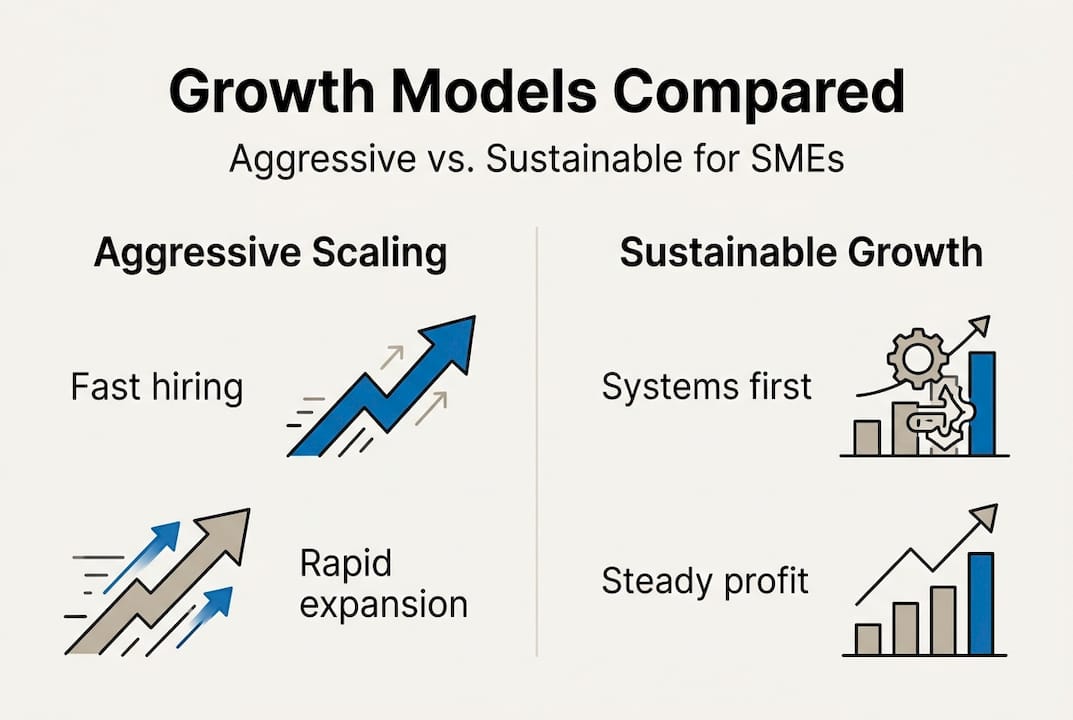
Aggressive scaling means pursuing rapid expansion, often through heavy investment, fast hiring, and ambitious market entry. It can produce impressive headline numbers. But it also compresses your margin for error. One bad quarter, one key hire who doesn’t work out, or one market shift can unravel months of progress.
Sustainable growth, by contrast, is systems-first. It means building the infrastructure of your business before pushing hard on volume. Aggressive scaling carries more risk than a measured, systems-led approach, particularly for businesses without deep financial reserves.

Here is how the two models compare:
| Aggressive scaling | Sustainable growth | |
|---|---|---|
| Growth rate | 50%+ year on year | 15 to 30% year on year |
| Cash risk | High | Moderate |
| Team stress | Significant | Manageable |
| Systems required | Often built reactively | Built proactively |
| Owner freedom | Often decreases | Tends to increase |
How do you decide which model fits your stage? Work through these steps:
- Assess your cash position. Can you sustain six months of accelerated costs without external funding?
- Audit your systems. Are your operations documented and repeatable without you being present?
- Evaluate your team. Do you have the right people in the right roles to absorb rapid growth?
- Define your freedom goals. What does success look like personally, not just financially?
- Choose your pace. Match your growth ambition to your actual capacity, not your aspirational one.
Pro Tip: Before you chase explosive growth, build the systems that would allow someone else to run your business for a week without calling you. If that feels impossible, you are not ready to scale. Explore what scaling a business really involves, and review the growth models explained to find your best fit.
Leveraging technology and AI: Practical strategies for SMEs
Choosing the right growth model is only part of the story. Technology increasingly shapes your competitive edge, and the gap between early adopters and laggards is widening fast.
The numbers are striking. 91% of SMEs using AI report revenue increases, and businesses using AI-driven email flows have seen revenue grow by 54% year on year. These are not figures from tech giants. They are from businesses much like yours.
So where do you start? Here are the most impactful areas for SME technology adoption:
- Customer communication: AI tools can personalise outreach at scale, improving conversion without adding headcount.
- Financial reporting: Automated dashboards give you real-time visibility into cash flow, margins, and performance.
- Lead generation: Smart CRM systems identify your best prospects and prompt follow-up at the right moment.
- Inventory and fulfilment: Automation reduces errors and frees your team for higher-value work.
- Content and marketing: AI-assisted tools accelerate content production while keeping messaging consistent.
The key is sequencing. Start with structured data, meaning areas where you already collect reliable information, and test the impact of automation before committing to major investment. Business automation for growth works best when it is layered in gradually, not bolted on all at once.
Pro Tip: Do not automate a broken process. Fix the workflow first, then automate it. Otherwise, you simply make mistakes faster.
What should you avoid automating too soon? Relationship-heavy touchpoints, complex client onboarding, and anything requiring genuine human judgement. Technology amplifies what you already do well. It does not fix what is fundamentally flawed. For practical ideas on accelerating revenue, explore these sales growth tips and consider how you can optimise processes for growth before layering in new tools.
Sequencing partnerships and innovation: The SME advantage
With digital tools in place, the next frontiers are innovation and external partnerships. Here is how to avoid the most common missteps.
Many SME owners assume that partnerships and open innovation are for larger businesses with dedicated R&D budgets. That assumption is costly. The real advantage SMEs hold is speed and flexibility. You can test, iterate, and implement faster than any corporate. But the sequence matters enormously.
Successful open innovation in SMEs requires sequencing early R&D partners before moving to external exploitation. In plain terms: build your internal capability first, then bring in outside partners to amplify it.
Here is a practical sequence to follow:
- Identify your internal strengths. What do you do better than anyone else? That is your foundation.
- Document your processes. Partners need to understand how you work before they can add value.
- Seek complementary partners. Look for businesses that fill genuine gaps, not just relationships that feel exciting.
- Pilot before committing. Run a small, time-bound collaboration before signing long-term agreements.
- Measure and iterate. Track what the partnership actually produces, not just what it promises.
“The SMEs that scale with confidence are those that treat partnerships as a strategic tool, not a shortcut.”
The most common mistake is going external too soon. Owners who feel stuck often reach for a partnership as a quick fix, only to find that it creates more complexity than it resolves. If your internal systems are not solid, an external partner simply inherits your confusion. Understanding what business scale-up genuinely involves will help you time these decisions correctly. For technology-specific partnerships, exploring IT outsourcing for growth can reveal practical options that complement your existing capability.
Pro Tip: The best partnerships feel almost boring at first. They are built on clear expectations, shared metrics, and mutual accountability, not excitement alone.
What most SME owners miss about growth strategies
Here is the uncomfortable truth we see repeatedly: most owners focus on tactics and ignore the mindset that makes tactics work. You can have the best growth model, the smartest AI tools, and the most promising partnerships, and still find yourself exhausted and no freer than when you started.
The owners who scaled too quickly often tell us the same thing in hindsight: they confused activity with progress. They hired fast, spent fast, and moved fast, but never paused to ask whether the business was actually serving their life or consuming it.
Discipline beats hustle. Systems beat speed. True business success aligns profit, people, and owner goals, not just size. The scaling business guide we recommend is not just about tactics. It is about building something that works without requiring everything from you.
Focus on systems first. Growth will follow. And when it does, it will feel like freedom rather than a new kind of trap.
Ready to unlock SME growth? Next steps to personal freedom
The strategies in this guide are proven. But knowing what to do and actually implementing it with confidence are two very different things. That gap is exactly where coaching makes the difference.
At Summit SCALE, we work with SME owners who are serious about building profitable businesses that give them back their time. Whether you want to explore why investing in coaching accelerates results, understand the role of coaching for SMEs, or access practical growth strategies for SMBs, we have the frameworks and accountability to help you move forward. Book your free 15-minute assessment call today and take the first real step towards the business and life you have been building towards.
Frequently asked questions
What is the most effective growth strategy for SMEs?
A blend of sustainable, systems-first growth and targeted innovation consistently outperforms aggressive expansion for long-term SME success. Sustainable growth at 15 to 30% year on year tends to preserve cash and owner wellbeing far better than rapid scaling.
How can technology boost SME revenue?
AI and automation deliver measurable revenue gains when introduced strategically. 91% of SMEs using AI report increased revenue, making structured, tested adoption one of the highest-return moves available to growing businesses.
What common mistake holds SMEs back from scaling?
Relying on external partnerships before establishing strong internal systems is a frequent and costly error. Premature external reliance undermines innovation and adds complexity before the business is ready to absorb it.
Are most growth obstacles financial or operational?
Financial pressures lead the way, with taxation and business rates topping the list for UK SME employers. However, operational discipline is what determines whether a business can overcome those pressures and grow despite them.
How important is coaching for SME growth?
Coaching provides the external perspective, proven frameworks, and accountability that most owners cannot generate alone. It accelerates both profitability and the personal freedom that makes building a business worthwhile.

