
Most British and American business owners face relentless pressure to perform, yet only about 25 percent regularly tap into professional coaching for real growth. Running a business can stretch your limits whether you are establishing new systems or trying to gain personal freedom. Understanding what business coaching truly involves reveals how targeted support can transform daily operations and raise your revenue potential.
Table of Contents
Key Takeaways
| Point | Details |
| Business Coaching Transforms Entrepreneurs | It provides targeted guidance and personal development strategies to enhance professional trajectories. |
| Assessment Tools are Essential | Key tools like psychometric evaluations and performance benchmarking help identify challenges and growth opportunities. |
| Selecting the Right Coach Matters | Choosing a coach with relevant expertise and suitable communication style is crucial for achieving successful outcomes. |
| Coaching Drives Growth and Profitability | Strategic coaching interventions can significantly improve organisational performance and financial results by addressing systemic challenges. |
What Business Coaching Really Involves
Business coaching is a strategic partnership designed to transform entrepreneurs’ professional trajectories by providing targeted guidance, performance insights, and personalised development strategies. Unlike generic consultancy, business coaching focuses intensely on unlocking an owner’s potential through systematic performance interventions.
At its core, business coaching involves comprehensive assessment, goal alignment, and structured support across multiple business dimensions. Coaches work closely with owners to diagnose organisational challenges, identify growth opportunities, and develop actionable strategies that enhance operational effectiveness. This process typically encompasses areas like leadership development, strategic planning, financial management, team dynamics, and personal productivity.
Successful business coaching creates transformative experiences by helping owners break through performance barriers. Modern coaching approaches leverage sophisticated assessment techniques, including psychometric evaluations, performance benchmarking, and tailored intervention strategies. These methods enable coaches to provide nuanced, data-driven recommendations that address both systemic business challenges and individual leadership capabilities.

Here’s a summary of core assessment tools used in modern business coaching:
| Assessment Tool | Purpose | Typical Business Impact |
| Psychometric Evaluation | Measures leadership traits and behaviours | Tailored staff development plans |
| Performance Benchmarking | Compares organisational metrics to industry | Identifies specific growth areas |
| Structured Interviews | Evaluates skill gaps and team dynamics | Informs targeted improvement |
| Goal Alignment Reviews | Ensures goals match strategic vision | Enhances long-term focus |
Pro tip: Schedule quarterly coaching reviews to ensure your strategic objectives remain aligned with your evolving business landscape.
Main Types of Business Coaching Services
Business coaching services have evolved to address diverse organisational needs, offering targeted interventions that support entrepreneurs and leaders across different strategic dimensions. Executive coaching specialities represent a critical subset of these services, focusing on developing leadership capabilities and driving performance transformation.
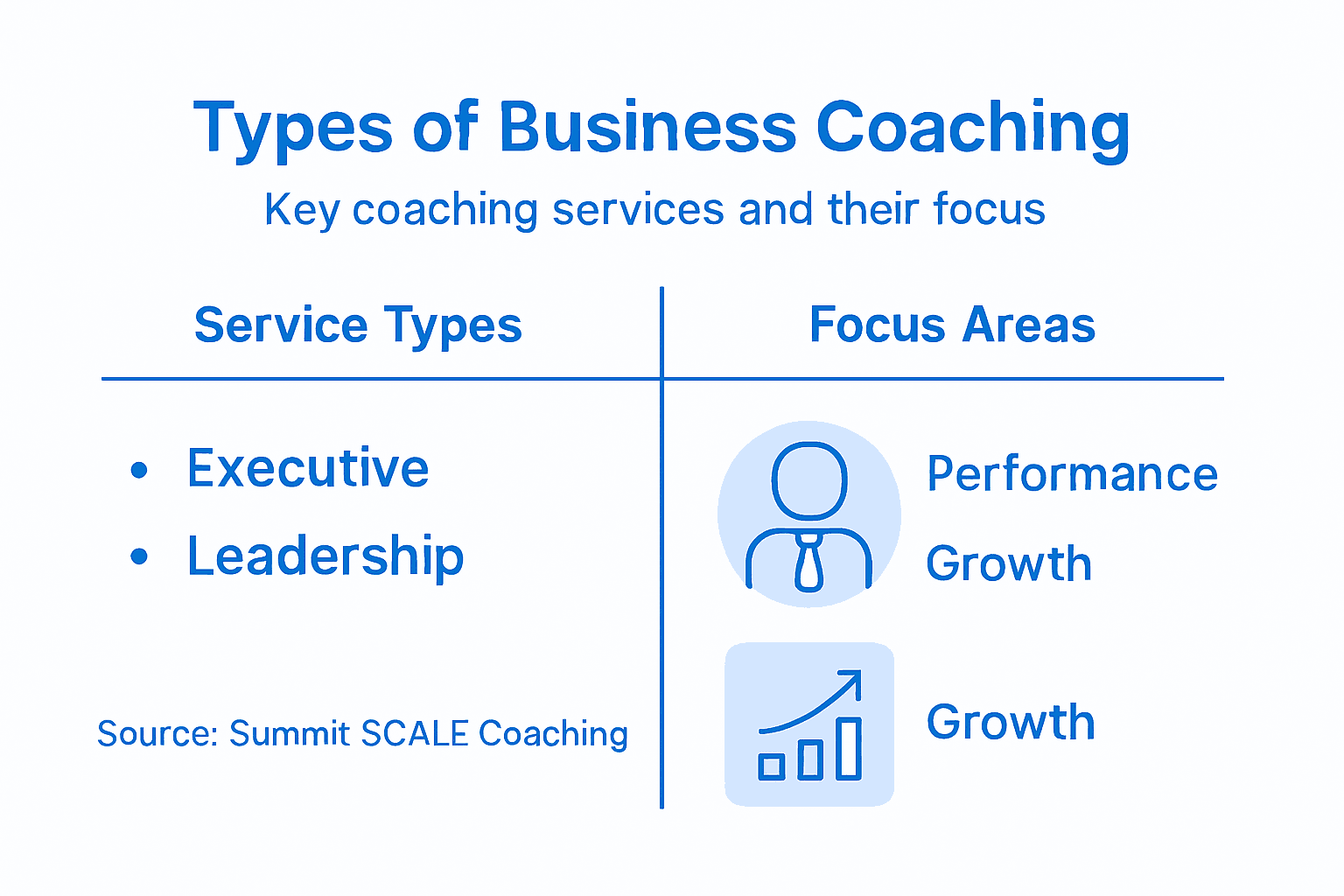
The primary categories of business coaching services include:
-
Executive Coaching: Concentrates on senior leadership development, helping executives enhance strategic thinking, decision-making skills, and organisational impact
-
Leadership Development Coaching: Designed to nurture emerging leaders by building core competencies like communication, emotional intelligence, and strategic planning
-
Performance Coaching: Targets individual and team productivity, addressing specific skill gaps and creating actionable improvement strategies
-
Organisational Transformation Coaching: Supports broader systemic changes, helping businesses navigate complex transitions and cultural shifts
These coaching approaches differ in methodology but share a common goal of unlocking human potential and driving sustainable business growth. Integrated coaching techniques enable organisations to create comprehensive development frameworks that address individual, team, and strategic challenges simultaneously.
This table compares the main types of business coaching services:
| Coaching Service | Primary Focus | Ideal For | Typical Outcome |
| Executive Coaching | Senior leader development | C-suite, directors | Enhanced strategic decision-making |
| Leadership Development Coaching | Emerging leader capabilities | Mid-level managers | Improved team management skills |
| Performance Coaching | Individual/team productivity | Employees and project teams | Increased output and efficiency |
| Organisational Transformation Coaching | Change management and culture | Enterprises undergoing transition | Greater agility and resilience |
Pro tip: Select a business coaching service that aligns precisely with your specific organisational challenges and growth objectives.
How Coaching Drives Growth and Profitability
Business coaching represents a strategic investment that directly translates into organisational performance and financial outcomes. Workplace coaching significantly contributes to enhanced productivity, employee engagement, and sustainable business growth by providing targeted interventions that address both individual and systemic challenges.
The mechanisms through which coaching drives profitability are multifaceted:
-
Performance Optimisation: Coaches help identify and eliminate operational bottlenecks
-
Leadership Development: Enhancing leadership capabilities creates more effective decision-making processes
-
Employee Engagement: Improved workplace relationships and skill development increase retention and motivation
-
Strategic Alignment: Coaches assist in creating clear, actionable strategies that directly impact bottom-line results
Empirical evidence demonstrates that organisations with robust coaching cultures experience measurable financial benefits. Coaching cultures drive organisational growth by developing employee skills, advancing career trajectories, and fostering authentic connections that translate into enhanced business resilience and profitability.
Pro tip: Treat coaching as a strategic investment by setting clear, measurable objectives and tracking both performance and financial outcomes.
Choosing the Right Business Coach for You
Selecting an exceptional business coach requires a strategic approach that goes beyond surface-level credentials. Effective coaching involves complex relationship dynamics that demand careful consideration of a coach’s professional background, expertise, and alignment with your specific business objectives.
Key criteria for selecting the ideal business coach include:
-
Professional Credentials: Look for coaches with recognised certifications and demonstrable industry experience
-
Specialisation Matching: Ensure the coach has expertise specific to your business sector or growth challenges
-
Communication Style: Assess compatibility with the coach’s approach and communication methodology
-
Track Record: Investigate previous client success stories and measurable outcomes
-
Personal Chemistry: Evaluate the potential for a trusting, constructive working relationship
Beyond technical qualifications, choosing the right coach involves understanding your personal coaching goals and finding a professional who can create a supportive, non-judgmental partnership. The most successful coaching relationships are built on mutual trust, transparent communication, and a shared commitment to breakthrough performance.
Pro tip: Request initial consultation sessions with multiple coaches to assess their approach and compatibility before making a final commitment.
Common Pitfalls and Success Factors
Navigating the complex landscape of business coaching requires understanding both potential challenges and critical success factors. Coaching interventions involve nuanced relationship dynamics that can significantly impact organisational performance and individual growth trajectories.
Common pitfalls in business coaching include:
-
Unclear Objectives: Failing to establish precise, measurable coaching goals
-
Misaligned Expectations: Inconsistent understanding between coach and client about desired outcomes
-
Insufficient Organisational Support: Lack of broader strategic commitment to coaching initiatives
-
Poor Coach Selection: Choosing coaches without appropriate credentials or sector-specific expertise
-
Resistance to Change: Psychological barriers that impede personal and professional development
Effective coaching strategies require careful candidate selection and a commitment to transformational processes. Successful coaching depends on building strong interpersonal connections, maintaining transparent communication, and creating an environment that supports genuine personal and professional growth.
Pro tip: Conduct thorough due diligence by requesting detailed performance metrics and client testimonials before engaging a business coach.
Unlock Your Business Potential with Expert Coaching from Summit SCALE
The article highlights the critical challenges business owners face such as unclear objectives, leadership development needs, and resistance to change. It also emphasises the power of tailored business coaching in driving growth, realigning strategic goals, and enhancing leadership capabilities. At Summit SCALE, we understand these pain points and offer practical solutions designed to help you overcome performance barriers and achieve true business freedom with focused strategies on sales growth, team building, and cost control.
Why settle for ordinary when you can transform your business and life? Our experienced coaches use proven, data-driven approaches aligned with your unique business challenges to unlock higher profitability and more personal time. Discover how business coaching services at Summit SCALE can turn your goals into results with clear steps and measurable outcomes. Don’t miss the opportunity to explore leadership coaching designed for entrepreneurs committed to breakthrough success.
Take control today by visiting Summit SCALE and schedule your free 15-minute assessment call. Let us guide you to more time, money, and freedom through expert business coaching.
Boost your growth journey now.
Experience the power of personalised coaching and start transforming your business. Book your free consultation now at Summit SCALE.
Frequently Asked Questions
What is business coaching?
Business coaching is a strategic partnership aimed at enhancing an entrepreneur’s professional journey through tailored guidance, performance insights, and development strategies.
How does business coaching drive growth and profitability?
Business coaching optimises performance, enhances leadership capabilities, improves employee engagement, and aligns strategic objectives, leading to measurable financial benefits for organisations.
What types of business coaching services are available?
Major types of business coaching services include executive coaching, leadership development coaching, performance coaching, and organisational transformation coaching, each addressing specific needs within an organisation.
What should I consider when choosing a business coach?
When selecting a business coach, consider their professional credentials, specialisation, communication style, track record, and personal compatibility to ensure a successful coaching relationship.

