
Small to medium-sized businesses often overlook a powerful lever for growth: optimising business processes can deliver up to 50% productivity gains and 40% more revenue per employee. Many owners assume process improvement is reserved for large corporations with dedicated teams and budgets. In reality, structured optimisation provides SMBs with the efficiency, cost savings, and competitive edge needed to scale sustainably. This article explores why process optimisation matters, proven methodologies you can apply, common pitfalls to avoid, and practical steps to start transforming your operations today.
Table of Contents
- Key takeaways
- Understanding the benefits of optimising business processes
- Core methodologies for optimising business processes in SMBs
- Common pitfalls and risks in process optimisation and automation
- Practical steps for SMBs to start optimising their business processes
- How coaching accelerates optimisation and business growth
- Frequently asked questions
Key Takeaways
| Point | Details |
|---|---|
| Productivity gains | Process optimisation can deliver up to fifty per cent productivity gains and higher revenue per employee for SMBs. |
| Cost savings | Streamlining workflows reduces waste in materials, time and labour and automating manual tasks lowers operating expenses. |
| Initial mapping | Begin by mapping key processes and establishing KPIs to provide a baseline for continuous improvement. |
| Implementation risks | Avoid automating broken processes and secure team buy in to prevent wasted effort and poor uptake. |
Understanding the benefits of optimising business processes
Process optimisation delivers measurable advantages that directly impact your bottom line and operational capacity. Optimising business processes boosts efficiency, reduces costs, and increases profitability for SMBs, including up to 50% productivity gains and 40% more revenue per employee. These improvements stem from eliminating redundant steps, automating repetitive tasks, and focusing team energy on high-value activities.

Cost savings represent one of the most immediate benefits. When you streamline workflows, you reduce waste in materials, time, and labour. Automating manual tasks like data entry or invoice processing cuts operational expenses whilst reducing human error. Many SMBs discover they can handle increased volume without proportional staffing increases, improving margins substantially.
Enhanced business profitability through optimisation includes:
- Reduced operational costs by eliminating waste and redundant steps
- Faster cycle times allowing you to serve more customers with existing resources
- Lower error rates decreasing rework costs and customer complaints
- Improved cash flow through streamlined invoicing and payment processes
- Better resource allocation focusing team efforts on strategic priorities
Customer experience improves dramatically when processes run smoothly. Faster response times, fewer mistakes, and consistent service quality build loyalty and referrals. Your competitive positioning strengthens as you deliver better value at lower cost than rivals operating with inefficient workflows.
Perhaps most valuable for SMB owners is the personal freedom gained. Optimised processes run predictably with less intervention, reducing the need for constant firefighting. You gain time to focus on strategy, innovation, and the aspects of your business you genuinely enjoy. This shift from working in your business to working on it represents the ultimate benefit of systematic process improvement.
Pro Tip: Start by calculating the true cost of your most time-consuming manual process, including labour hours, error correction, and opportunity cost. This baseline makes improvement ROI tangible and helps prioritise optimisation efforts.
Core methodologies for optimising business processes in SMBs
Several proven frameworks guide effective process optimisation. Understanding these methodologies helps you select the right approach for your specific challenges and organisational context. Key methodologies for SMBs include BPM, Lean, Six Sigma, PDCA cycle, and automation after fixing processes.
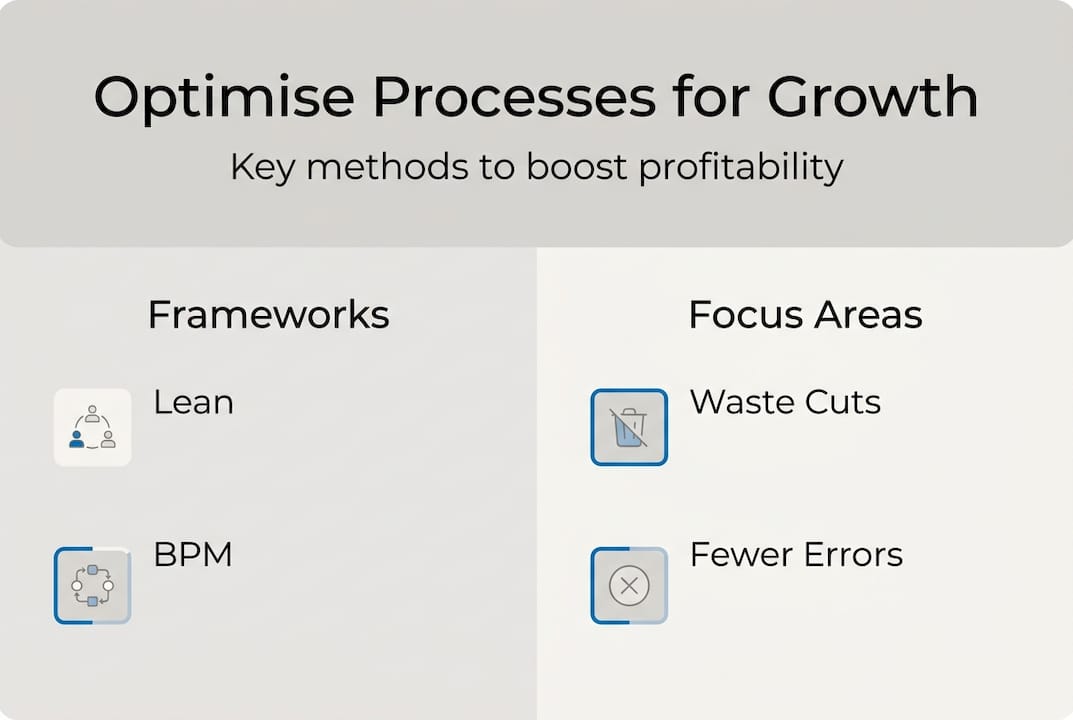
Business Process Management (BPM) provides a structured approach to understanding, analysing, and improving workflows. You begin by mapping current processes visually, identifying bottlenecks and inefficiencies. Analysis reveals where delays occur, costs accumulate, or quality suffers. Improvement initiatives then target these specific pain points with measurable objectives. BPM works particularly well for complex processes involving multiple departments or handoffs.
Lean methodology focuses relentlessly on eliminating waste. Originally developed in manufacturing, Lean principles apply equally to service businesses and administrative functions. The approach identifies seven types of waste: overproduction, waiting, transport, extra processing, inventory, motion, and defects. By systematically removing these wastes, you streamline operations and reduce costs without sacrificing quality.
Six Sigma targets variation and defects through statistical analysis. The methodology uses data to identify root causes of problems and implement solutions that reduce errors to near-zero levels. Whilst originally designed for large manufacturers, simplified Six Sigma tools help SMBs improve quality in critical processes like order fulfilment or customer onboarding.
| Methodology | Primary focus | Best for | Typical results |
|---|---|---|---|
| BPM | Mapping and systematic improvement | Complex multi-step processes | 20-30% cycle time reduction |
| Lean | Waste elimination | High-volume repetitive tasks | 25-50% cost savings |
| Six Sigma | Defect and variation reduction | Quality-critical processes | 50-90% error reduction |
| PDCA | Continuous incremental improvement | Ongoing optimisation culture | Sustained 10-15% annual gains |
The PDCA (Plan-Do-Check-Act) cycle supports continuous improvement through iterative experimentation. You plan a small change, implement it on a limited scale, check results against objectives, and act by standardising successful changes or adjusting unsuccessful ones. This approach reduces risk whilst building organisational capability for ongoing optimisation.
Implementing these methodologies effectively requires:
- Clear definition of the process scope and objectives
- Baseline measurement of current performance metrics
- Cross-functional team involvement for comprehensive perspective
- Pilot testing before full-scale rollout
- Documentation of improved processes for consistency
- Regular review cycles to sustain gains
Automation represents a powerful accelerator but should only follow process refinement. Automating a broken process simply makes you fail faster and more expensively. First optimise the workflow manually, then automate stable, well-understood steps. This sequence ensures you capture genuine efficiency gains rather than institutionalising dysfunction.
Many SMBs benefit from combining methodologies. You might use Lean to eliminate obvious waste, then apply PDCA for continuous refinement, and finally automate the optimised process. Performance coaching helps you select and adapt these frameworks to your specific business context, accelerating implementation whilst avoiding costly missteps. Professional guidance ensures you follow proven step by step growth strategies rather than reinventing the wheel.
Pro Tip: Choose one methodology to master rather than dabbling in several. Deep competence in a single framework delivers better results than superficial application of multiple approaches.
Common pitfalls and risks in process optimisation and automation
Process optimisation initiatives fail frequently, often due to predictable mistakes. Understanding these pitfalls helps you navigate implementation successfully and avoid wasting resources on ineffective efforts. Automating broken processes amplifies errors, ignoring team buy-in and maintenance risks project failure, with 70-85% of projects failing without proper planning.
The most costly mistake involves automating flawed processes. When you encode inefficiency into software, you scale dysfunction rather than eliminating it. Automated errors occur faster and affect more transactions than manual mistakes. The resulting mess requires expensive remediation and damages customer relationships. Always optimise processes manually first, proving improvements work before investing in automation technology.
Team resistance derails many optimisation efforts. When you impose changes without involving the people doing the work, you encounter passive resistance, workarounds, and eventual reversion to old methods. Employees possess invaluable process knowledge and spot problems leadership misses. Their buy-in transforms implementation from a struggle into a collaborative improvement effort.
Critical risks that undermine process optimisation include:
- Automating before fixing underlying process problems
- Failing to secure team engagement and input early
- Underestimating ongoing maintenance requirements
- Creating overly rigid processes that cannot adapt
- Optimising locally whilst creating bottlenecks elsewhere
- Neglecting to measure results and adjust approach
Maintenance demands significant ongoing resources. Automation systems require updates, troubleshooting, and adaptation as business needs evolve. Up to 30% of automation budgets must cover maintenance rather than initial deployment. Many SMBs implement solutions without planning for this sustained investment, leading to degraded performance over time.
Over-optimisation creates rigidity that hinders growth. Whilst standardisation improves efficiency, excessive process control eliminates the flexibility SMBs need to adapt quickly. You must balance consistency with responsiveness, maintaining enough slack to handle exceptions and opportunities. Processes should enable performance, not constrain it.
Local optimisation can worsen overall system performance. Improving one department’s efficiency might create bottlenecks elsewhere or increase total costs. Always consider end-to-end impact rather than isolated metrics. Business coaching provides the systems perspective needed to optimise holistically rather than creating new problems whilst solving old ones.
“The biggest risk in process improvement is not trying hard enough, but trying to do too much too fast without proper foundation. Start small, prove value, then scale systematically.”
Pilot testing mitigates many risks by revealing problems on a limited scale before full deployment. Run changes with a small team or subset of transactions first. Measure results carefully and gather feedback. Adjust based on what you learn, then expand gradually. This approach builds confidence whilst minimising disruption.
Pro Tip: Establish a simple change control process requiring documented baseline metrics, clear success criteria, and rollback plans before implementing any optimisation. This discipline prevents costly mistakes whilst maintaining momentum.
Practical steps for SMBs to start optimising their business processes
Starting process optimisation need not be complex or expensive. A systematic approach using simple tools delivers substantial results without requiring consultants or sophisticated software. For SMB owners, start with process mapping and high-impact areas such as invoicing, use tools like PDCA and Pareto, measure KPIs including cycle time and cost, gain team buy-in and pilot changes.
Follow these steps to begin optimising effectively:
-
Map your current processes visually using simple flowcharts showing each step, decision point, and handoff. Document what actually happens, not what should happen. Walk through the process with the people doing the work to ensure accuracy. This baseline reveals inefficiencies you might not notice otherwise.
-
Prioritise high-impact processes using the Pareto principle, focusing on the 20% of processes consuming 80% of costs or time. Invoicing, customer onboarding, order fulfilment, and inventory management typically offer substantial improvement opportunities. Calculate the current cost and cycle time for each priority process.
-
Identify improvement opportunities by analysing maps for delays, redundant steps, excessive handoffs, manual data entry, and error-prone activities. Ask the team where frustration occurs and what obstacles slow their work. Look for steps that add cost without adding value.
-
Design improved processes by eliminating unnecessary steps, combining related activities, automating repetitive tasks, and simplifying decision points. Sketch the proposed new workflow and estimate expected improvements in time, cost, and quality.
-
Pilot changes on a small scale with a subset of transactions or a single team. Run the new process alongside the old one initially to ensure reliability. Measure results carefully and gather feedback from participants.
-
Refine based on pilot results by addressing problems discovered during testing. Adjust the process design and documentation. Train the pilot team thoroughly on the refined approach.
-
Roll out systematically to remaining teams or transaction volumes. Provide clear training and support. Monitor performance closely during the transition period.
-
Establish continuous improvement using PDCA cycles to make ongoing incremental refinements. Schedule regular review sessions to identify new opportunities and address emerging issues.
| Process | Key metrics to track | Target improvement |
|---|---|---|
| Invoicing | Days to invoice, error rate, collection time | 30-50% cycle time reduction |
| Customer onboarding | Time to first value, completion rate, customer satisfaction | 40-60% faster onboarding |
| Order fulfilment | Order to shipment time, accuracy rate, cost per order | 25-40% cost reduction |
| Inventory management | Stock turnover, carrying costs, stockout frequency | 20-30% inventory reduction |
Measurement drives improvement. Establish clear KPIs before making changes so you can demonstrate results objectively. Track cycle time (how long the process takes), process cost (labour and materials consumed), error rates (defects or rework required), and customer satisfaction (feedback scores or complaints). Review these metrics weekly during implementation and monthly thereafter.
Essential KPIs for process optimisation include:
- Cycle time from process start to completion
- Cost per transaction or unit processed
- Error rate or defect percentage
- Resource utilisation and productivity
- Customer satisfaction scores
- Revenue per employee
Team engagement determines success. Involve employees early by explaining why optimisation matters and how it benefits them. Solicit their input on problems and solutions. Recognise and celebrate improvements achieved. Address concerns transparently. People support what they help create.
Simple tools work best for SMBs. You do not need expensive software to start optimising. Flowcharting tools, spreadsheets for tracking metrics, and basic project management suffice initially. Invest in technology only after proving manual improvements work and understanding exactly what you need.
Coaching support accelerates your optimisation journey by providing experienced guidance, accountability, and proven frameworks. Professional coaches help you avoid common mistakes, maintain momentum, and achieve results faster than trial and error alone. The benefits of professional coaching include objective perspective, structured methodology, and sustained focus on high-priority improvements.
Pro Tip: Create a simple one-page process improvement charter for each optimisation project documenting current state, target state, success metrics, team members, and timeline. This clarity prevents scope creep and maintains focus.
How coaching accelerates optimisation and business growth
Process optimisation delivers powerful results, but navigating implementation successfully requires expertise many SMB owners lack. Professional coaching provides the guidance, accountability, and strategic perspective needed to optimise effectively whilst avoiding costly mistakes. Coaches bring proven frameworks and experience from multiple businesses, helping you achieve in months what might otherwise take years of trial and error.
Investing in coaching transforms your approach to business improvement. Rather than reacting to problems, you develop systematic capability for identifying opportunities and implementing solutions. Coaches help you prioritise efforts on changes delivering maximum impact, ensuring your limited time and resources generate substantial returns. The accountability structure keeps optimisation initiatives on track despite daily operational pressures.
The role of coaching for SMEs extends beyond process improvement to encompass strategic growth, team development, and personal freedom. As you optimise operations, coaching helps you scale business growth and freedom by building systems that run without constant intervention. This transformation allows you to focus on strategy and innovation rather than firefighting, ultimately creating the business and lifestyle you envisioned when starting your company.
Frequently asked questions
What common mistakes should SMBs avoid when optimising processes?
The most critical mistake is automating broken processes before fixing underlying problems, which amplifies errors and waste. Neglecting team buy-in creates resistance that undermines implementation regardless of technical merit. Skipping pilot testing risks large-scale failure from undetected issues. Many SMBs also fail to plan adequately, contributing to the 70-85% failure rate in optimisation projects. Start small, involve your team early, and test changes thoroughly before full rollout.
How can SMBs measure the success of process optimisation?
Track specific KPIs including cycle time (process duration), cost per transaction, error rates, and revenue per employee before and after changes. Establish baseline measurements prior to implementation so improvements are objectively demonstrable. Customer satisfaction scores and employee feedback provide qualitative validation. Review metrics weekly during implementation and monthly thereafter to ensure gains are sustained. Consistent measurement guides continuous improvement and demonstrates ROI to stakeholders.
What is the best approach for SMBs new to business process improvement?
Begin with process mapping focused on high-impact areas such as invoicing, customer onboarding, or order fulfilment that consume significant time or cost. Use simple visual flowcharts to document current workflows, then identify obvious inefficiencies like redundant steps or excessive handoffs. Apply straightforward improvement frameworks like PDCA for iterative refinement rather than attempting complex methodologies initially. Pilot changes with a small team before broader rollout, gathering feedback and refining your approach. This practical, incremental method builds capability whilst delivering early wins that build momentum.
How long does it typically take to see results from process optimisation?
Simple improvements like eliminating redundant steps or automating manual data entry can deliver measurable results within weeks. More complex initiatives involving multiple departments or significant workflow redesign typically require two to four months before substantial benefits materialise. Continuous improvement approaches using PDCA cycles generate ongoing incremental gains that compound over time. The key is starting with quick wins that build confidence and capability, then progressing to larger optimisation efforts. Most SMBs achieve 20-30% efficiency improvements within six months when following systematic approaches with proper planning and team engagement.

