
Many business owners believe that squeezing every last penny from each sale equals success. This common misconception confuses profit maximisation with profit optimisation, often leading to decisions that boost short term gains but erode long term sustainability. Profit optimisation takes a different approach, balancing pricing, cost control, and operational efficiency to build resilient, growing businesses. This guide clarifies what profit optimisation truly means for small to medium sized enterprises and outlines strategic steps you can implement to achieve sustainable profitability without sacrificing customer loyalty or business health.
Table of Contents
- Key takeaways
- What is profit optimisation and why does it matter?
- Core strategies for effective profit optimisation
- Profit optimisation versus profit maximisation: risks and trade offs
- Practical steps to implement profit optimisation in your business
- How coaching can unlock your profit optimisation potential
- Frequently asked questions
Key Takeaways
| Point | Details |
|---|---|
| Sustainable profit growth | Profit optimisation shifts focus from short term gains to building durable, healthy profitability over time. |
| Dynamic pricing and costs | Adopting dynamic pricing and disciplined cost control helps optimise profitability while maintaining customer trust. |
| Operational efficiency gains | Automation and refined processes lift output without proportionate cost increases. |
| Data driven analytics | Data driven analytics provide real time profit insights to guide decisions. |
What is profit optimisation and why does it matter?
Profit optimisation is the strategic process of increasing net profit through improving pricing, reducing costs, and fine tuning operations for sustainable long term growth. This approach differs fundamentally from profit maximisation, which often pursues the highest possible profit in the shortest timeframe, sometimes at the expense of customer satisfaction, employee wellbeing, or operational stability. For SME owners, this distinction matters enormously because decisions made today shape your business trajectory for years ahead.
When you optimise rather than maximise, you balance competing priorities. You might accept slightly lower margins on certain products to build customer loyalty, or invest in automation that reduces costs over time rather than cutting staff immediately. These choices reflect a commitment to sustainable growth rather than extracting maximum value from every transaction. The profit maximisation guide explores these contrasts in detail, but the core insight remains simple: optimisation protects your business whilst growing it.
Several key areas benefit directly from profit optimisation:
- Pricing strategy becomes dynamic and responsive, adjusting to market conditions whilst maintaining customer trust
- Cost control focuses on efficiency gains and waste reduction rather than indiscriminate cuts
- Operational improvements through automation and process refinement increase output without proportional cost increases
- Product mix decisions prioritise high margin offerings whilst managing supply chain dependencies
Pro Tip: Start by identifying your three highest margin products or services, then analyse what makes them profitable. Can you replicate those characteristics elsewhere in your offering?
The benefits extend beyond immediate profit gains. Businesses that embrace optimisation develop stronger market positions, weather economic uncertainty more effectively, and create sustainable competitive advantages. Your customers notice the difference too. Rather than feeling squeezed by constant price increases or reduced service quality, they experience consistent value that justifies their loyalty. This foundation supports growth that compounds over years rather than spiking briefly before declining.
“Optimisation isn’t about doing less with less. It’s about achieving more with what you have by making smarter, more strategic choices at every level of your business.”
For SME owners juggling limited resources, profit optimisation offers a roadmap to growth that doesn’t require massive capital investment or unsustainable risk taking. It transforms profitability from a numbers game into a strategic discipline that strengthens every aspect of your business.
Core strategies for effective profit optimisation
Effective profit optimisation rests on several interconnected strategies, each contributing to sustainable profit growth. Understanding and implementing these approaches gives SME owners practical levers to pull when seeking profitability improvements.
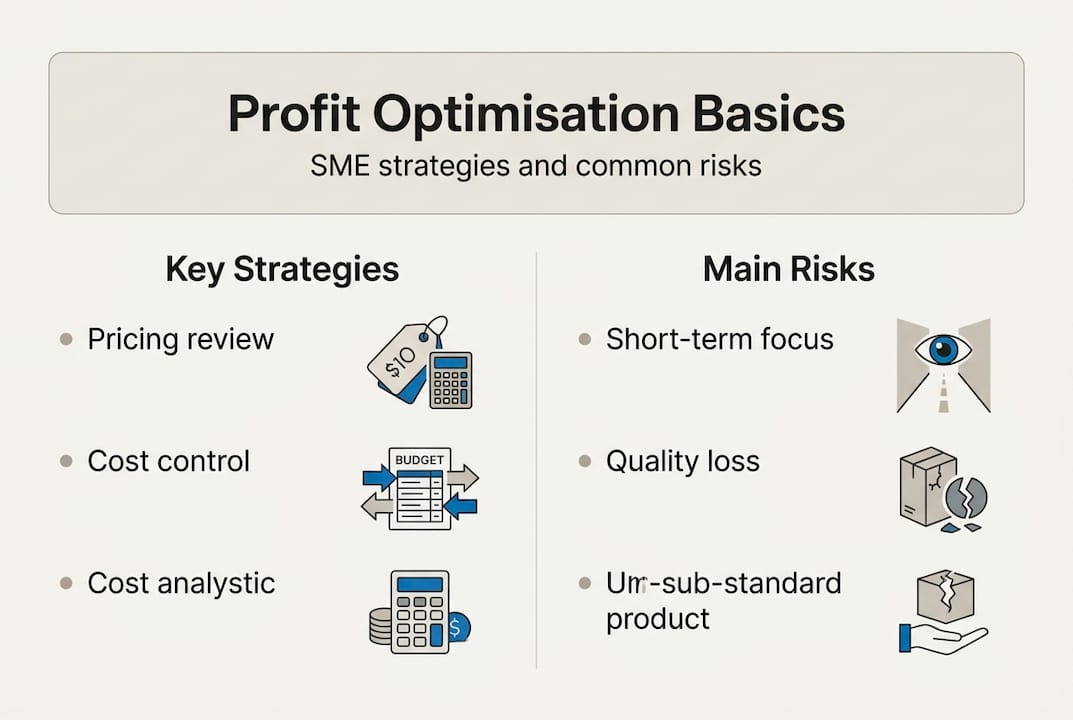
Data analytics and real time insights form the foundation. Without accurate, timely information about which products, customers, and channels drive profit, you’re making decisions blind. Data driven tools for real time insights enable you to identify profit drivers quickly, focusing resources where they generate the greatest return. Modern analytics platforms designed for SMEs make this accessible without requiring large IT departments or expensive enterprise software.
Dynamic pricing represents another powerful strategy. Rather than setting prices once and forgetting them, dynamic pricing adjusts based on demand, competition, inventory levels, and customer segments. This doesn’t mean constant price changes that confuse customers. Instead, it means strategic adjustments that capture value during peak demand whilst maintaining competitiveness during slower periods. The key lies in transparency and consistency, ensuring customers understand your value proposition even as specific prices evolve.
Cost control techniques tailored to SME realities deliver significant profit improvements without damaging operational capacity. These include:
- Negotiating better terms with suppliers based on volume commitments or early payment
- Identifying and eliminating process inefficiencies that waste time or materials
- Implementing energy efficiency measures that reduce overhead costs
- Reviewing subscriptions and services to eliminate unused or redundant expenses
Operational enhancements through automation and process optimisation create lasting profit improvements. When you automate repetitive tasks, you free staff for higher value activities whilst reducing error rates and processing times. Process optimisation identifies bottlenecks and inefficiencies, streamlining workflows to increase output without proportional cost increases. These improvements compound over time, creating ever widening gaps between your costs and competitors who haven’t optimised.

Pro Tip: Map your core business processes visually, identifying every step from customer enquiry to final delivery. You’ll spot inefficiencies and automation opportunities immediately.
Balancing high margin product focus with supply chain risks requires careful analysis. Whilst concentrating on your most profitable offerings makes sense, over dependence on single suppliers or narrow product ranges creates vulnerability. The practical profit strategies resource explores this balance in depth, but the principle remains straightforward: diversify enough to manage risk whilst maintaining focus on what drives profit.
Tools like the profit driver tool help you analyse which factors most influence your profitability, enabling targeted improvements. When combined with techniques from boosting business margins, these strategies create a comprehensive approach to profit optimisation that addresses pricing, costs, and operations simultaneously.
Profit optimisation versus profit maximisation: risks and trade offs
Understanding the distinction between profit optimisation and profit maximisation clarifies why balanced approaches deliver superior long term results. Profit maximisation pursues the highest possible profit in the immediate term, often through aggressive pricing, cost cutting, or market exploitation. Whilst this can boost short term financial results, it frequently erodes the foundations that sustain business success.
Common pitfalls of pure profit maximisation include:
- Customer alienation through excessive price increases or reduced service quality
- Employee burnout from unsustainable cost cutting that eliminates necessary support
- Operational brittleness as efficiency measures remove all slack from systems
- Market reputation damage when customers perceive exploitation rather than fair value
Profit optimisation avoids these traps by balancing multiple objectives. Rather than maximising profit this quarter at any cost, you seek sustainable profit improvement that preserves customer relationships, employee engagement, and operational resilience. This approach recognises that business profitability matters not just as a number but as an indicator of business health.
| Aspect | Profit maximisation | Profit optimisation |
|---|---|---|
| Time horizon | Short term focus | Long term sustainability |
| Customer approach | Extract maximum value per transaction | Build lasting relationships |
| Cost management | Aggressive cuts regardless of impact | Strategic efficiency improvements |
| Risk tolerance | High, accepts instability for gains | Balanced, protects business foundations |
| Growth pattern | Spiky, unsustainable | Steady, compounding |
Empirical evidence supports optimisation’s superiority. Research shows that SMBs using AI and automation for optimisation rather than maximisation achieve 40 to 200 percent gains whilst maintaining customer satisfaction and operational stability. These improvements stem from smarter resource allocation rather than simply squeezing harder.
Pro Tip: When evaluating any profit improvement opportunity, ask whether it strengthens or weakens your business foundations. If it weakens them, it’s maximisation, not optimisation.
The strategic benefits of an optimisation mindset extend beyond immediate profit gains. Businesses that optimise develop deeper customer loyalty, stronger employee engagement, and more resilient operations. These advantages compound over time, creating competitive moats that protect profitability even as markets evolve. Understanding why improve profitability through optimisation rather than maximisation transforms how you approach every business decision.
Consider pricing decisions. Maximisation suggests raising prices until volume drops unacceptably. Optimisation asks what price point delivers strong margins whilst building customer loyalty and market position. The optimisation approach might accept slightly lower margins to capture market share that generates greater lifetime value. This strategic thinking separates businesses that thrive long term from those that spike briefly before declining.
Practical steps to implement profit optimisation in your business
Implementing profit optimisation requires a systematic approach that builds on analysis, strategy, and continuous improvement. These practical steps guide SME owners through the process of transforming their profitability.
Begin by conducting thorough profit analysis to identify your key profit drivers. Examine which products, services, customers, and channels generate the greatest profit relative to the resources they consume. This analysis often reveals surprising insights, showing that your highest revenue products may not be your most profitable, or that certain customer segments cost more to serve than they return. The profit optimisation process emphasises this analytical foundation as essential for informed decision making.
Once you understand your profit drivers, follow this stepwise implementation approach:
- Prioritise opportunities based on impact and feasibility, focusing first on changes that deliver significant profit improvement without requiring major investment or disruption
- Adjust pricing strategically where analysis reveals underpricing relative to value delivered or market positioning
- Implement targeted cost reductions that improve efficiency without damaging operational capacity or customer experience
- Optimise operations through process improvements and selective automation that increase output or reduce waste
- Monitor results continuously, tracking key metrics to ensure changes deliver expected benefits and don’t create unintended consequences
- Iterate and refine based on results, treating optimisation as an ongoing discipline rather than a one time project
Tools and frameworks support this implementation. Profit driver tables help you visualise which factors most influence profitability:
| Profit driver | Current impact | Improvement potential | Priority |
|---|---|---|---|
| Product mix | Medium | High | 1 |
| Pricing strategy | Low | High | 1 |
| Operating costs | High | Medium | 2 |
| Process efficiency | Medium | Medium | 3 |
This structured approach ensures you focus resources where they generate the greatest return. The proven business growth steps resource expands on this methodology, showing how optimisation fits within broader growth strategies.
Embedding a culture of ongoing optimisation requires regular reviews and team engagement. Schedule quarterly profit reviews that examine results, identify new opportunities, and adjust strategies based on market changes. Involve team members in identifying efficiency improvements and cost savings, creating ownership and surfacing insights you might miss from a purely top down approach.
Plan for iterative adaptation rather than expecting perfect results immediately. Profit optimisation works through continuous small improvements that compound over time. Each pricing adjustment, process refinement, or cost reduction contributes to growing profitability that strengthens your business foundations. This approach aligns profitability with growth to create sustainable competitive advantage.
The implementation journey varies by business, but the principles remain constant: analyse thoroughly, prioritise strategically, implement systematically, and refine continuously. This disciplined approach transforms profitability from an outcome you hope for into a capability you build deliberately.
How coaching can unlock your profit optimisation potential
Whilst the strategies and steps outlined above provide a solid foundation, implementing profit optimisation successfully often benefits from expert guidance and accountability. Professional coaching accelerates your progress by helping you identify blind spots, prioritise opportunities, and maintain momentum through implementation challenges.
Coaching supports profit optimisation in several critical ways. First, experienced coaches bring proven frameworks and methodologies that help you avoid common pitfalls and focus on high impact opportunities. Second, they provide objective analysis of your business, identifying issues and opportunities you might miss due to familiarity or operational immersion. Third, coaching creates accountability structures that keep optimisation efforts on track even as daily operational demands compete for attention.
The role of coaching in profitability extends beyond strategy to execution and culture building. Coaches help you translate profit optimisation concepts into specific actions tailored to your business context, then support you through implementation challenges. This practical guidance bridges the gap between understanding what to do and actually doing it consistently.
For SME owners juggling multiple responsibilities, investing in coaching provides leverage that multiplies your effectiveness. Rather than learning through trial and error, you benefit from proven approaches refined across numerous businesses. The business growth workflow that coaching enables creates systematic progress towards your profitability goals, turning optimisation from an aspiration into a reality.
Frequently asked questions
What is the difference between profit optimisation and profit maximisation?
Profit optimisation focuses on sustainable long term profit increase by balancing multiple factors including customer satisfaction, operational health, and market position. Profit maximisation seeks the highest possible short term profit, often accepting risks to sustainability. Optimisation protects business foundations whilst growing profitability, whereas maximisation may erode customer loyalty or operational capacity for immediate gains.
How can small businesses implement profit optimisation without large budgets or teams?
Start by analysing existing data to identify quick wins in pricing and cost control that require minimal investment. Focus on high margin products and services, leveraging affordable analytics tools designed for SMEs. Consider engaging a coach or consultant to help prioritise efforts and avoid costly mistakes. Many optimisation strategies, such as process improvements and dynamic pricing adjustments, require more strategic thinking than capital investment.
What role do data and technology play in profit optimisation?
Data driven tools provide real time visibility into profit drivers, enabling informed decisions about pricing, costs, and operations. Technology, particularly automation and AI, substantially improves efficiency and pricing accuracy whilst reducing manual effort. Investing in appropriate technology creates foundations for continuous improvement and competitive advantage. Even modest technology investments deliver significant returns when applied strategically to high impact profit drivers.
How long does it take to see results from profit optimisation efforts?
Many profit optimisation initiatives deliver measurable results within weeks, particularly pricing adjustments and quick cost reductions. However, the full benefits of optimisation emerge over months and years as improvements compound and cultural changes take root. Expect early wins that validate your approach, followed by sustained improvement as systematic optimisation becomes embedded in how your business operates. The timeline varies by business size, complexity, and implementation commitment.

