
Every year, thousands of passionate entrepreneurs pour their energy into building businesses, yet 20% fail within the first year and 50% by the fifth. The difference between those who thrive and those who struggle isn’t always talent or effort. It’s clarity. Setting strategic business goals transforms scattered activity into focused momentum, turning your daily grind into measurable progress. This article unpacks why goal-setting radically shifts business outcomes, backed by evidence and practical frameworks you can implement immediately.
Table of Contents
- Why business goals matter for small and medium businesses
- How setting goals drives profitability and sustainable growth
- Choosing the right framework: SMART, OKRs, or Balanced Scorecard?
- Common pitfalls of goal-setting and how to avoid them
- Applying goal-setting in your business: practical steps to get started
- Take your business goals further with expert coaching
- Frequently asked questions
Key Takeaways
| Point | Details |
|---|---|
| Goal-setting boosts survival | SMBs with defined goals have a much higher chance of surviving and thriving. |
| Structure drives growth | Frameworks like SMART goals or OKRs make results measurable and repeatable. |
| Avoid goal overload | Too many or poorly defined goals can backfire, so focus and review regularly. |
| Apply step-by-step | Start small, involve your team, and review progress for continuous improvement. |
Why business goals matter for small and medium businesses
Running a business without clear goals is like navigating without a compass. You might move quickly, but are you heading in the right direction? Setting business goals aligns teams, focuses resources, enables decision-making, and builds long-term success frameworks that separate surviving businesses from thriving ones.
Goals provide the clarity you need when uncertainty strikes. They answer critical questions: Which opportunities deserve your attention? Where should you invest limited resources? What does success actually look like for your business this quarter?
When your team understands shared targets, everyone pulls in the same direction. Marketing knows which customer segments to prioritise. Sales understands revenue benchmarks. Operations can plan capacity accordingly. This alignment eliminates wasted effort and conflicting priorities that drain small business resources.
Key benefits of strategic goal-setting:
- Direction and focus during market uncertainty
- Resource alignment around highest-impact activities
- Smarter decision-making with clear success criteria
- Team motivation through visible progress markers
- Long-term frameworks that compound growth over time
The statistics tell a compelling story. Whilst half of small businesses fail by year five, those with structured goals dramatically improve their odds. This isn’t coincidence. Goals create accountability, measure progress, and force you to confront reality rather than operate on assumptions.
“Goals transform hope into strategy. They’re the bridge between where you are and where you need to be.”
Think about sales growth for lasting business success. Without specific revenue targets, how do you know if your sales efforts are working? Goals turn vague aspirations into concrete milestones. They help you identify what’s working, what isn’t, and where to adjust course before small problems become existential threats.
Understanding business growth objectives explained becomes essential when you realise that different goals serve different purposes. Revenue goals drive sales activity. Customer retention goals improve lifetime value. Operational efficiency goals protect margins. Each objective plays a role in your broader success framework.
Effective long-term business planning starts with goals that cascade from vision to quarterly actions. This creates coherence between your big-picture aspirations and daily priorities, ensuring every task contributes to meaningful progress.
How setting goals drives profitability and sustainable growth
The connection between goal-setting and financial performance isn’t theoretical. Businesses setting specific goals are 10% more likely to succeed, and the growth gap widens further when you examine top performers.
Consider the benchmark data: successful businesses grow approximately 11.8% annually according to Harvard Business Review research. Meanwhile, research from Bain shows that top B2B companies achieved twice the average revenue growth through structured approaches including rigorous goal-setting.
Growth comparison: goal-focused vs. reactive businesses
| Metric | Goal-Focused Business | Reactive Business |
|---|---|---|
| Annual growth rate | 11.8% average | 3-5% average |
| Survival rate (5 years) | 60-70% | 50% |
| Profitability trend | Consistent improvement | Unpredictable |
| Resource efficiency | High alignment | Scattered efforts |
| Team clarity | Clear priorities | Constant confusion |
Let’s examine two similar businesses to understand this difference. Company A sets quarterly revenue goals, tracks customer acquisition costs, and reviews progress monthly. Company B works hard but operates reactively, chasing whatever opportunity appears urgent.
After three years, Company A has grown revenue by 35%, improved profit margins by 8%, and built predictable systems. Company B remains roughly the same size, struggles with cash flow, and the owner works longer hours than ever. The difference? Strategic goals transformed effort into results.

Pro Tip: Start with one financial goal and one operational goal. Track them weekly. This builds the habit without overwhelming your team, and you’ll see measurable improvements within 90 days.
Goals also protect profitability by forcing difficult conversations early. When you set a margin target, you can’t ignore pricing problems or cost overruns. When you commit to customer retention rates, you must address service quality issues before they compound.
Exploring business growth models reveals how different goal structures support different growth strategies. Market penetration goals differ from diversification goals. Understanding which model fits your situation helps you set relevant, achievable targets.
The role of sales growth for profitability becomes clearer when you track both revenue and margin goals simultaneously. Growth without profitability burns cash. Profitability without growth limits opportunity. Balanced goals keep both in view.
Choosing the right framework: SMART, OKRs, or Balanced Scorecard?
Not all goal-setting methods work equally well for every business. The SMART framework (Specific, Measurable, Achievable, Relevant, Time-bound) remains the gold standard for small businesses because it’s straightforward and immediately actionable.
SMART goals force precision. “Increase revenue” becomes “Increase monthly recurring revenue from £15,000 to £20,000 by 30 June 2026 through adding 25 new customers.” This specificity eliminates ambiguity and creates clear accountability.
As your business grows, you might explore OKRs for team-oriented goals or Balanced Scorecard approaches that integrate strategic planning across multiple dimensions. Each framework serves different needs.
Framework comparison for SMBs
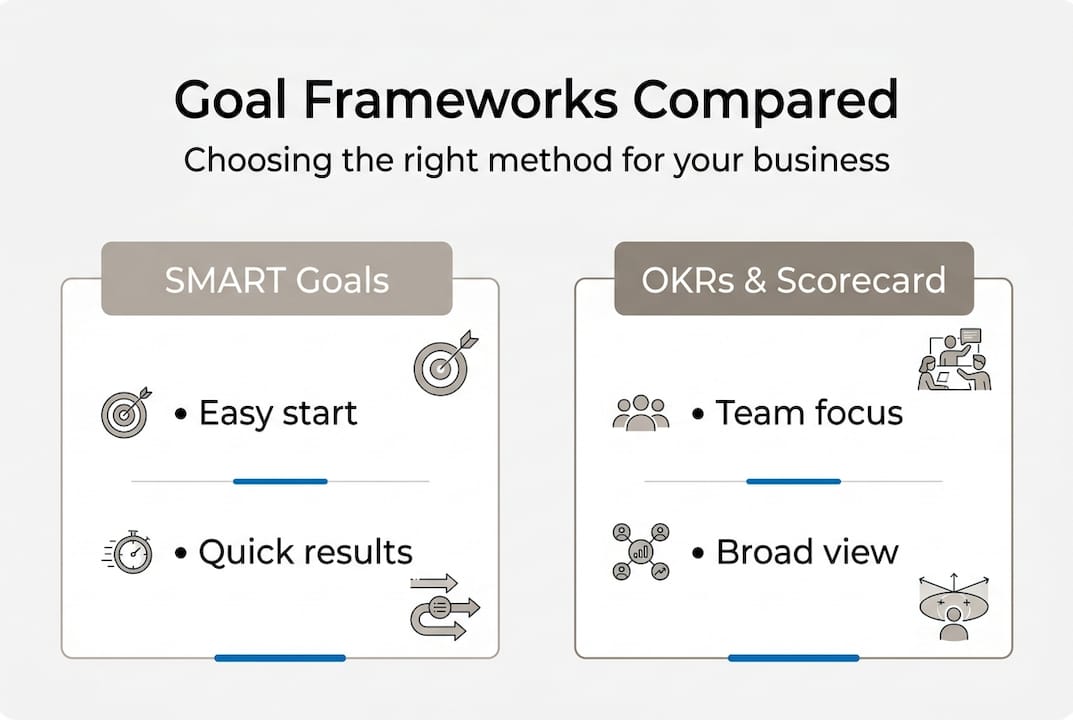
| Framework | Best For | Complexity | Review Frequency |
|---|---|---|---|
| SMART Goals | Individual targets, clear outcomes | Low | Monthly/Quarterly |
| OKRs | Team alignment, ambitious targets | Medium | Quarterly |
| Balanced Scorecard | Strategic planning, multiple perspectives | High | Quarterly/Annually |
When to use each framework:
- SMART Goals when you’re starting out, need quick wins, or want individual accountability
- OKRs when you have multiple team members and need alignment around ambitious objectives
- Balanced Scorecard when you’re planning strategically across financial, customer, internal process, and learning perspectives
Most small businesses should start with SMART goals. They’re simple to create, easy to track, and deliver immediate clarity. You can always graduate to more sophisticated frameworks as your team and complexity grow.
Pro Tip: Don’t switch frameworks mid-cycle. Commit to one approach for at least two quarters so you can properly evaluate its effectiveness for your specific situation.
The business development checklist often includes goal-setting as a foundational step because it influences every subsequent decision. Without clear targets, even the best development activities lack direction.
Applying business development best practices becomes far more effective when you’ve defined what success looks like. Goals turn best practices from generic advice into specific action plans tailored to your business.
Common pitfalls of goal-setting and how to avoid them
Goal-setting isn’t without risks. Research shows that over-prescribing goals causes side effects including narrow focus, unethical behaviour, inhibited learning, and reduced motivation. Understanding these pitfalls helps you create healthy, motivating goals.
The narrow focus problem occurs when aggressive targets blind you to important peripheral information. A sales team fixated solely on revenue might ignore customer satisfaction signals, creating short-term wins that damage long-term relationships.
Unethical behaviour emerges when goals create pressure without providing legitimate pathways to achievement. Employees might cut corners, manipulate data, or engage in questionable practices to hit targets. This destroys trust and culture.
Warning signs your goals have become toxic:
- Team members regularly work unsustainable hours to meet targets
- People celebrate hitting numbers whilst ignoring quality or ethics concerns
- Goals feel punitive rather than motivating
- Short-term metrics consistently trump long-term health
- Innovation stops because everyone fears missing their targets
“The best goals stretch your capabilities without breaking your values. They inspire effort, not desperation.”
To keep goal-setting healthy, balance quantitative targets with qualitative values. Set revenue goals alongside customer satisfaction goals. Track growth metrics whilst monitoring team wellbeing. This creates guardrails that prevent destructive pursuit of single metrics.
Regular review conversations matter enormously. When goals become obstacles rather than guides, adjust them. Business conditions change. New information emerges. Rigid adherence to outdated goals wastes resources and demoralises teams.
The benefits of professional coaching include external perspective on whether your goals serve your business or sabotage it. Coaches help you spot blind spots and reframe objectives that have become counterproductive.
Applying goal-setting in your business: practical steps to get started
Knowing why goals matter means nothing without implementation. Here’s your step-by-step process to define, implement, and track business goals that actually drive results.
Your goal-setting implementation process:
- Assess current state by reviewing last quarter’s financial performance, customer metrics, and operational efficiency
- Identify gaps between where you are and where you need to be across revenue, profitability, and capacity
- Choose 3-5 priorities that address your most critical gaps or opportunities
- Write SMART goals for each priority with specific numbers, deadlines, and ownership
- Create tracking systems using simple spreadsheets or tools you’ll actually use weekly
- Schedule reviews every two weeks initially, then monthly once the habit forms
- Adjust and iterate based on what you learn, celebrating progress and course-correcting quickly
Let’s walk through a real example. Imagine you run a consulting business currently generating £12,000 monthly revenue with inconsistent cash flow. You want stability and growth.
Your SMART goal might be: “Increase monthly recurring revenue to £18,000 by 31 August 2026 by converting six existing project clients to retainer agreements worth £1,000 each.”
This goal is specific (retainer conversions), measurable (£18,000 and six clients), achievable (you have existing relationships), relevant (addresses cash flow stability), and time-bound (31 August 2026).
Pro Tip: Share goals with your team before finalising them. Their input improves quality and builds buy-in. People support what they help create.
Getting team buy-in requires transparency about why these goals matter. Connect business targets to individual benefits. Show how hitting revenue goals enables bonuses, better tools, or additional support. Make success shared, not just imposed from above.
Review and adaptation separate effective goal-setters from those who set goals once and forget them. Successful businesses grow approximately 11.8% annually partly because they treat goals as living documents, not static declarations.
The business coaching workflow often centres on goal accountability. Regular coaching sessions create structured review points that keep goals visible and actionable rather than filed away and forgotten.
Take your business goals further with expert coaching
You now understand why goals matter, how they drive profitability, which frameworks work best, common pitfalls to avoid, and practical implementation steps. But knowing and doing remain different challenges.
This is where expert coaching amplifies everything you’ve learned. Professional guidance helps you set goals that stretch without breaking, identify blind spots before they become problems, and maintain accountability when daily pressures threaten focus.
Summit SCALE partners with ambitious business owners who refuse to settle for survival mode. Our coaching approach transforms goal-setting from an annual exercise into a growth engine that compounds results quarter after quarter. We help you clarify what matters most, build systems that track progress effortlessly, and adjust course based on real data rather than gut feelings.
Whether you’re exploring coaching for entrepreneurs for the first time or recognising the role of coaching for SMEs in your growth journey, the right partnership accelerates everything. Goals become clearer. Progress becomes visible. Growth becomes predictable.
Ready to transform your business goals from hopeful intentions into measurable results? Let’s talk about where you are, where you want to be, and the specific goals that will bridge that gap.
Frequently asked questions
What is the main purpose of setting business goals?
Business goals provide clarity, align teams around shared priorities, and guide daily decisions whilst creating long-term success frameworks that compound over time.
How do business goals affect company survival?
Firms with clear goals statistically outperform those without them, with failure rates dropping significantly when businesses implement structured goal-setting practices.
Which goal-setting method is best for small businesses?
The SMART framework is widely recommended for most small businesses due to its simplicity and immediate actionability, though OKRs and Balanced Scorecard approaches work well as teams grow.
Can setting too many goals be harmful?
Yes, excessive goal-setting causes narrow focus, reduced motivation, and potentially unethical behaviour when targets create pressure without legitimate achievement pathways.
How often should you review business goals?
Review goals quarterly as a minimum, with monthly check-ins recommended during implementation phases, adjusting targets as business conditions or strategic priorities shift.

