
TL;DR:
- Profit improvement involves strategic system optimization, not just cost-cutting or revenue increase.
- Key profit drivers include pricing, process efficiency, customer mix, and strategic investments.
- Business coaching accelerates profit growth through clarity, accountability, and tailored action plans.
Most business owners, when they hear “profit improvement,” immediately think about cutting costs. Slash the budget, reduce headcount, renegotiate supplier contracts. Job done. But this view is dangerously narrow. Real profit improvement is a strategic, holistic process that touches every corner of your business, from how you price your services to how efficiently your team operates. This guide will walk you through what profit improvement truly means, the key drivers that move the needle, how coaching can accelerate your results, and a practical roadmap you can apply right now. If you are ready to build a more profitable business with clarity and confidence, read on.
Table of Contents
- Understanding profit improvement: More than just higher revenue
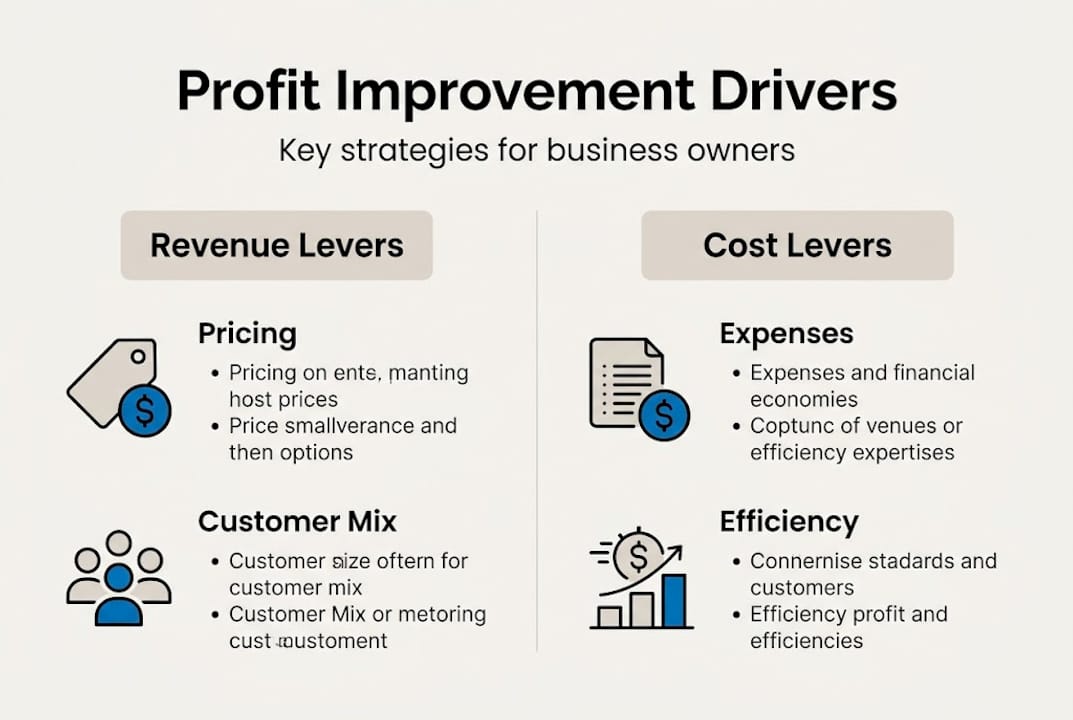
- Essential drivers and levers for profit improvement
- The role of coaching in accelerating profit improvement
- Roadmap: Applying profit improvement strategies in your business
- A fresh perspective on profit improvement
- Take your profit improvement to the next level
- Frequently asked questions
Key Takeaways
| Point | Details |
|---|---|
| Profit improvement defined | Profit improvement is about raising your business’s bottom line, not just sales. |
| Key profit drivers | Pricing strategy, operational efficiency, and value creation give the biggest margin boosts. |
| Coaching acceleration | Professional coaching helps you identify, implement, and sustain the profit levers that matter most. |
| Step-by-step actions | Review, plan, act, measure, and adjust for steady, sustainable profit growth. |
Understanding profit improvement: More than just higher revenue
Here is a question worth sitting with. Could your revenue increase while your profit actually shrinks? Yes, it absolutely can. That is the fundamental reason why profit improvement is its own discipline, distinct from chasing higher sales figures.
Profit improvement refers to the deliberate actions a business takes to increase its bottom-line profit. Not just the top line. This means optimising how money flows through your business, not merely how much comes in the front door. Boosting business margins requires understanding that profit improvement goes beyond increasing revenue, focusing also on operational efficiency and cost management.
To understand this more clearly, consider the difference between three approaches:
| Approach | Focus | Risk if used alone |
|---|---|---|
| Revenue growth | Increasing sales volume | Higher costs can cancel gains |
| Cost-cutting | Reducing expenses | Can damage quality and morale |
| Profit improvement | Optimising the whole system | Requires sustained effort |
As you can see, profit improvement is the only approach that treats your business as an interconnected system. It uses operational levers, which are specific mechanisms you can adjust to affect profitability. These include pricing strategy, process efficiency, cost control, customer mix, and strategic investment decisions.
“Profit improvement is not a one-time event. It is an ongoing discipline of examining how value is created and captured across every part of your business.”
Exploring practical profit strategies can give you a richer sense of how these levers work in combination. Many SME owners also find value in considering business process outsourcing as one tool for reducing operational drag.
Pro Tip: Before trying to improve profit, map out where your gross and net margins sit today. You cannot adjust a lever you cannot see.
Essential drivers and levers for profit improvement
With a clear definition in place, it is time to unpack what truly influences how profits rise. Think of profit drivers as the engine components in your business. Each one matters, and some matter far more than others depending on where you are in your growth journey.
Key profitability drivers for SMEs include pricing strategies, operational efficiency, and resource allocation. But there are several more worth knowing:
- Pricing optimisation: Are you leaving money on the table by undercharging? Many SMEs set prices based on gut instinct rather than value delivered.
- Process improvement: Streamlining workflows reduces waste and frees your team to focus on higher-value activity.
- Cost management: This is not about slashing budgets indiscriminately. It is about ensuring every pound spent is contributing to growth or quality.
- Customer mix: Not all clients are equally profitable. Shifting focus toward higher-margin customers can transform your bottom line.
- Value delivery: Improving the customer experience often increases retention and referrals, lowering your cost of acquisition over time.
- Strategic investment: Spending on the right tools, training, or people accelerates returns that compound over time.
Here is a snapshot of how some of these levers play out in practice:
| Profit lever | Example action | Potential impact |
|---|---|---|
| Pricing optimisation | 5% price increase with no churn | Significant margin uplift |
| Process efficiency | Automating invoicing | Reduced admin hours and errors |
| Customer mix | Focus on top 20% by margin | Higher revenue per client |
| Cost management | Renegotiate supplier terms | Direct reduction in overheads |
Understanding the importance of prioritising profit is what separates reactive owners from strategic ones. The most powerful levers are rarely the most obvious ones.

Pro Tip: If you are at an early growth stage, focus on pricing and customer mix first. These two drivers typically yield the fastest uplift with the least operational disruption.
The role of coaching in accelerating profit improvement
Having explored the drivers and levers, let us address something that most guides overlook. Knowing what to do and actually doing it consistently are two very different things. This is where professional business coaching becomes a genuine game-changer.
Business coaching, in this context, is a structured and ongoing partnership where an experienced coach helps you identify where your business is underperforming, builds a clear improvement plan, and holds you accountable to executing it. It is not therapy. It is not generic advice. It is applied strategy with follow-through.
Here is how a coaching engagement typically accelerates profit improvement:
- Clarity audit: Your coach helps you identify your current profit position and uncover blind spots you have grown too close to see.
- Priority setting: Together, you identify the two or three levers with the greatest potential impact for your specific business.
- Action planning: A structured 90-day plan is built around measurable targets, not vague aspirations.
- Skill building: Coaching strengthens your ability to make better pricing, hiring, and investment decisions over time.
- Accountability: Regular check-ins ensure momentum is maintained even when day-to-day pressures push strategy off the agenda.
Coaching has been shown to help business owners identify blind spots and unlock more sustainable profit growth. The impact is not limited to struggling businesses either. In fact, many of the most profitable gains come when already-performing businesses use coaching for profitability to move from good to exceptional.
Think of it this way. A high-performance athlete does not hire a coach because they are failing. They hire one because they know that outside perspective and structured accountability will take them further than they can go alone.
Pro Tip: When choosing a coach, look for someone with direct experience in your business type or growth stage. Generalist advice rarely produces the same precision results as sector-relevant coaching.
Roadmap: Applying profit improvement strategies in your business
Armed with strategic insight and coaching support, it is time to map action onto your business reality. A great plan without execution is just a wish list. Here is a practical, sequential approach to get started.
- Review your numbers: Start with a clear picture of your current revenue, gross profit, net profit, and where the biggest cost concentrations sit.
- Diagnose your position: Identify which profit levers are currently underperforming. Use the table from the previous section as a starting framework.
- Plan your priorities: Choose no more than three improvement actions for your first 90-day cycle. Focus beats breadth every time.
- Act with intention: Implement changes deliberately, not all at once. Staggered rollouts allow you to isolate which actions are creating results.
- Measure consistently: Sustainable profit improvement requires reviewing data, prioritising impactful actions, and committing to ongoing measurement.
- Adapt and repeat: Profit improvement is cyclical. What works in one quarter may need refining in the next as your business evolves.
Common mistakes to avoid during this process:
- Treating profit improvement as a one-off project rather than an ongoing discipline
- Making decisions based on revenue alone without checking margin impact
- Ignoring the customer mix and serving all clients at the same priority level
- Failing to document changes, making it impossible to learn from results
- Skipping the diagnosis stage and jumping straight to action
Understanding the importance of improving profitability means accepting that this is not a sprint. The businesses that win long-term treat profit improvement as a core operating discipline, just like sales or customer service. Optimising your approach to optimising profitability for growth gives you a structured framework to make this continuous.
A fresh perspective on profit improvement
Most profit improvement advice you will read focuses heavily on cost reduction. Cut this, trim that, renegotiate everything. And while cost discipline matters, this narrow view misses something far more important. Sustainable profit growth is rarely won at the cost line. It is won through better decisions, better positioning, and better systems.
From what we observe working with SME owners across industries, the businesses that achieve lasting improvement share one trait. They treat profit not as a by-product of activity but as a designed outcome. They ask better questions: Who are our most profitable customers? Where are we creating real value versus just staying busy? What would we stop doing if we tracked the true cost of every activity?
Understanding why business profitability matters at a deeper level changes how you lead. It shifts you from reactive to strategic. Cost-cutting alone tends to produce short-term bumps followed by stagnation. Strategic, coached, data-driven improvement produces compounding results. That is the difference between a fleeting uptick and a fundamentally stronger business.
Think long-term. Quarter-to-quarter thinking limits your ambition and your potential.
Take your profit improvement to the next level
If this guide has sparked clarity, the natural next step is turning that clarity into action. Understanding profit improvement intellectually is only the beginning. The real transformation happens when you apply structured strategies within your specific business context, with the right support alongside you.
At Summit SCALE, we specialise in helping SME owners build more profitable, resilient businesses through tailored coaching and proven growth frameworks. Whether you want to explore coaching for profitable growth, understand why invest in coaching, or follow a clear business growth roadmap, we are here to help. Book your free 15-minute assessment call today and take the first focused step towards a stronger, more profitable business.
Frequently asked questions
What are common mistakes in profit improvement efforts?
Typical errors include focusing solely on cost-cutting, ignoring pricing strategy, and failing to track results over time. Owners often miss the opportunity for profit growth by treating it as a one-off initiative rather than an ongoing discipline.
How quickly can small businesses see results from profit improvement?
Some changes, like a pricing adjustment, can impact profit within weeks, but most robust improvements require regular action and measurement over several months. Sustainable improvements take commitment and ongoing adjustment rather than a single intervention.
Is profit improvement only for struggling businesses?
Not at all. Businesses at any performance level can benefit by improving margins, unlocking growth capacity, or future-proofing their model. Even healthy businesses can leverage profit drivers effectively with the right strategic support.
Do I need external help to improve profit?
Many owners find that coaching or outside expertise significantly accelerates results by providing accountability, fresh perspective, and tested frameworks. Coaching provides tools and insight that measurably boost the effectiveness of profit strategies.

