
Running a small or medium-sized business in the United States or United Kingdom often means juggling growth targets with operational pressures, all while seeking more personal freedom. The demand for practical solutions that build stronger leadership and improve daily performance has never been greater. Performance coaching offers personalised guidance proven to enhance both employee skills and overall business outcomes, giving business owners the support needed to thrive in a competitive market.
Table of Contents
- Defining Performance Coaching and Its Purpose
- Types of Performance Coaching in Business
- Key Elements and How Coaching Works
- Common Misconceptions and Pitfalls to Avoid
- Measurable Benefits for SMEs and Entrepreneurs
- Comparing Alternatives to Performance Coaching
Key Takeaways
| Point | Details |
|---|---|
| Importance of Performance Coaching | Performance coaching enhances individual and organisational effectiveness by providing tailored guidance to unlock potential. |
| Diverse Coaching Types | Different coaching methods, such as Instructional, Leadership, and Team Coaching, address specific organisational needs and performance objectives. |
| Key Coaching Elements | Effective coaching involves goal setting, feedback, skill development, and personal accountability for sustainable growth. |
| Misconceptions to Avoid | Common pitfalls include the belief that coaching is a quick fix or suitable only for underperformers, which can undermine its efficacy. |
Defining Performance Coaching and Its Purpose
Performance coaching represents a strategic intervention designed to enhance individual and organisational effectiveness by providing targeted professional guidance. Workplace coaching interventions have rapidly gained popularity as a powerful mechanism for improving employee performance and leadership capabilities.
At its core, performance coaching is about unlocking human potential through personalised support and skill development. The primary objectives include:
- Identifying individual strengths and areas for improvement
- Developing targeted strategies for professional growth
- Enhancing leadership and communication competencies
- Supporting organisational performance objectives
Coaching differs fundamentally from traditional training by offering individualised guidance tailored to specific professional contexts. Coaching programs enable adaptive management that helps professionals navigate complex workplace challenges more effectively.
Modern performance coaching integrates psychological insights, leadership theory, and practical skill development to create transformative professional experiences. By focusing on personal accountability and strategic thinking, coaches help business owners and executives breakthrough performance limitations.
Pro tip: Schedule an initial assessment to understand your specific coaching needs and potential growth opportunities.
Types of Performance Coaching in Business
Performance coaching encompasses a diverse range of specialised approaches tailored to address specific organisational and individual development needs. Multiple coaching types exist within business settings, each designed to target unique performance objectives and challenges.
The primary types of performance coaching include:
- Instructional Coaching: Focuses on developing specific skills and knowledge
- Leadership Coaching: Targets executive development and strategic thinking
- Career Coaching: Supports professional progression and career trajectory planning
- Team Coaching: Enhances collective performance and interpersonal dynamics
- Executive Coaching: Concentrates on high-level leadership behavioural transformation
Executive coaching approaches play a crucial role in organisational development by directly addressing leaders’ behavioural patterns and strategic capabilities. These targeted interventions help business professionals develop nuanced skills beyond traditional training methodologies.

Each coaching type requires a sophisticated understanding of individual psychological dynamics, organisational context, and specific performance goals. Successful coaching integrates psychological insights, practical skill development, and strategic thinking to create meaningful professional transformation.
Here’s an at-a-glance comparison of key business coaching approaches and their strategic focus:
| Coaching Method | Main Focus | Best For |
|---|---|---|
| Instructional | Skill mastery and knowledge | Employees seeking expertise |
| Leadership | Strategic vision and influence | Senior managers and executives |
| Executive | Behavioural transformation | C-level leaders |
| Team | Collaboration and dynamics | Project and cross-functional teams |
| Career | Long-term progression | Professionals planning advancement |
Pro tip: Select a performance coaching approach that precisely matches your specific professional development objectives and organisational requirements.
Key Elements and How Coaching Works
Performance coaching operates through a sophisticated framework designed to unlock individual and organisational potential. Coaching effectiveness depends on core competencies that create meaningful professional transformation.
The key elements of an effective coaching process include:
- Goal Setting: Establishing clear, measurable objectives
- Feedback Mechanisms: Providing structured, constructive insights
- Skill Development: Targeting specific performance improvements
- Continuous Assessment: Tracking progress and adjusting strategies
- Personal Accountability: Empowering individuals to drive their own growth
Coaching processes in the Industry 4.0 era integrate technology and focus on enhancing employee engagement. This approach goes beyond traditional training by creating personalised interventions that address individual psychological dynamics and organisational context.
Successful coaching creates a collaborative partnership between coach and client, focusing on bridging the gap between current performance and desired outcomes. The process typically involves deep listening, powerful questioning, and strategic guidance that helps professionals unlock their inherent potential and overcome performance barriers.
Pro tip: Prioritise finding a coach who understands your specific business context and can provide tailored, actionable strategies for growth.
Common Misconceptions and Pitfalls to Avoid
Performance coaching is frequently misunderstood, leading to unrealistic expectations and ineffective implementation. Common misconceptions about coaching can significantly undermine its potential transformative impact on business growth.
Key misconceptions and pitfalls to be aware of include:
- Quick Fix Fallacy: Believing coaching delivers instant results
- Underperformance Myth: Assuming coaching is only for struggling employees
- One-Size-Fits-All Approach: Treating coaching as a generic solution
- Lack of Clear Objectives: Entering coaching without specific, measurable goals
- Credential Overlooking: Hiring coaches without proper professional qualifications
Coaching practices often suffer from vague definitions and inconsistent implementation. Businesses frequently make the mistake of treating coaching as an informal process without establishing robust measurement frameworks to track genuine performance improvements.
Successful coaching requires a strategic approach that goes beyond superficial interventions. It demands careful selection of coaches with proven expertise, clear goal alignment, and a commitment to measurable outcomes that demonstrate tangible business value.
Pro tip: Always verify a coach’s professional credentials and request specific performance measurement methodologies before engaging their services.
Measurable Benefits for SMEs and Entrepreneurs
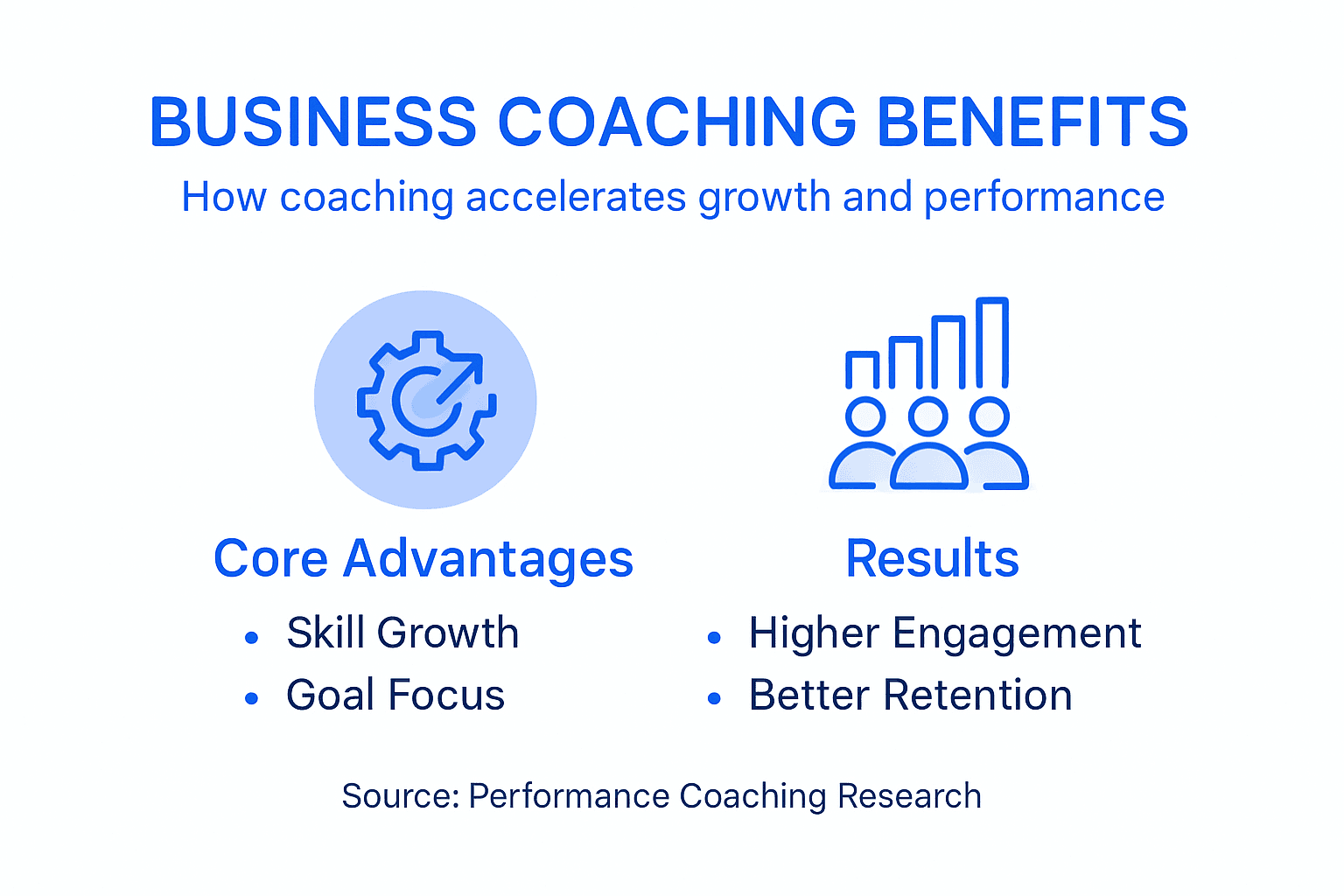
Performance coaching provides transformative advantages for small and medium enterprises seeking sustainable growth strategies. Performance coaching significantly improves employee creativity, motivation, and organisational performance in ways traditional training cannot match.
Key measurable benefits for SMEs and entrepreneurs include:
- Enhanced Problem-Solving: Developing advanced strategic thinking capabilities
- Increased Employee Motivation: Driving intrinsic performance improvements
- Leadership Skill Development: Cultivating adaptive management techniques
- Competitive Market Positioning: Creating strategic differentiation
- Organisational Resilience: Building sustainable growth frameworks
Coaching supports critical performance management by directly addressing job satisfaction, learning agility, and organisational competencies. These interventions provide entrepreneurs with targeted strategies that transform potential limitations into significant competitive advantages.
Unlike generic training programmes, performance coaching offers personalised guidance that adapts to each business’s unique challenges. By focusing on individual and collective potential, coaching enables SMEs to develop robust capabilities that drive long-term growth and operational excellence.
Pro tip: Request detailed performance metrics and case studies from potential coaches to validate their potential impact on your specific business context.
Comparing Alternatives to Performance Coaching
Performance coaching represents a distinctive approach to professional development, uniquely positioned among various interventional strategies. Mentoring and training programs offer alternative methods for organisational growth, each with distinct characteristics and limitations.
Key alternatives to performance coaching include:
- Mentoring: Focuses on long-term competency development and knowledge transfer
- Training Programmes: Provides structured skill acquisition in specific areas
- Consulting: Offers expert advice and strategic recommendations
- Counselling: Addresses personal psychological and emotional challenges
- Traditional Performance Reviews: Provides periodic assessment of organisational performance
Coaching distinguishes itself through its goal-oriented, client-driven approach that integrates motivational strategies with performance outcomes. Unlike other interventions that provide generic solutions, coaching offers personalised, dynamic support tailored to individual and organisational needs.
While alternative approaches have their merits, performance coaching stands out by creating a transformative, collaborative environment that actively empowers professionals to unlock their full potential and drive sustainable business growth.
This table summarises how performance coaching differs from major alternatives in professional development:
| Approach | Duration & Scope | Client Engagement | Outcomes Focus |
|---|---|---|---|
| Coaching | Medium-term, personalised | High involvement | Specific, measurable change |
| Mentoring | Long-term, informal | Moderate | Knowledge growth |
| Training | Short-term, structured | Low | Skill acquisition |
| Consulting | Project-based, expert-led | Low | Solutions and recommendations |
| Counselling | Variable, therapeutic | High | Emotional wellbeing |
Pro tip: Evaluate each intervention’s specific methodology and alignment with your unique business objectives before making a selection.
Unlock Your Business Potential with Expert Performance Coaching
The article highlights common challenges such as lack of clear goals, ineffective one-size-fits-all coaching, and the urgent need for personalised strategies that deliver measurable business growth. If you are an entrepreneur or business owner striving to overcome these obstacles, Summit SCALE offers tailored performance coaching that focuses on real solutions like sales growth, team building, cost control and long-term valuation. By targeting your unique strengths and development areas, our approach transforms leadership skills and drives sustainable results.
Experience coaching that goes beyond generic advice to empower your strategic thinking and personal accountability. Let Summit SCALE help you unlock your professional potential and build business resilience with proven, actionable guidance crafted for small to medium-sized enterprises.
Ready to break through your growth barriers now
Take the first step today by scheduling your free 15-minute assessment call with us at Summit SCALE. Discover how our focused performance coaching services can deliver the business freedom and success you deserve. Learn more about our tailored business coaching solutions and start your transformation journey.
Frequently Asked Questions
What is performance coaching?
Performance coaching is a strategic intervention aimed at enhancing individual and organisational effectiveness through personalised professional guidance, focusing on skill development, leadership enhancement, and achieving performance objectives.
How does performance coaching differ from traditional training?
Unlike traditional training, which often provides generic information, performance coaching offers individualised guidance tailored to specific professional contexts, helping individuals navigate challenges and unlock their full potential.
What are the key benefits of performance coaching for businesses?
Performance coaching can lead to enhanced problem-solving, increased employee motivation, leadership skill development, improved competitive positioning, and greater organisational resilience, driving sustainable growth.
What types of performance coaching are available in business settings?
Common types include instructional coaching, leadership coaching, career coaching, team coaching, and executive coaching, each focusing on different aspects of professional development and organisational needs.
Recommended
- Why Invest in Performance Coaching for Business Growth
- Role of Coaching in Profitability: Unlocking Business Potential
- 7 Key Benefits of Coaching for Entrepreneurs
- Leadership Coaching for Owners: Unlocking Business Growth
- Pursuitz – How Apex built a $1M+ pipeline and 59 qualified opportunities with Pursuitz

