
TL;DR:
- Profitability in SMBs depends on managing costs, pricing, and margins, not just increasing sales.
- Analyzing key metrics like gross profit margin and net profit margin reveals true financial health.
- Focusing on segment-level profitability and regular margin reviews prevents hidden profit leaks.
Many business owners chase revenue like it’s the finish line, only to find their bank account tells a different story. You can grow sales by 30% and still watch your margins shrink. The truth is, why profitability matters is a question too few SMB owners ask until it’s urgent. Profitability isn’t a by-product of growth. It’s the result of managing specific, measurable drivers with focus and discipline. This guide breaks down exactly what those drivers are, how to measure them, and how to apply practical frameworks that turn your business from a busy operation into a genuinely profitable one.
Table of Contents
- What are profitability drivers for SMBs?
- Understanding key profitability metrics and frameworks
- Tools and methodologies for profitability analysis
- Nuances: Growth vs. profitability and segment margin management
- Why most SMBs get profitability wrong: A contrarian take
- Unlock greater profitability with expert coaching and tools
- Frequently asked questions
Key Takeaways
| Point | Details |
|---|---|
| Understand profitability drivers | Profitability depends on cost control, pricing, diversification, efficiency, and margin management—not just sales growth. |
| Track key metrics | Use gross and net profit margins to measure and monitor your business’s financial health. |
| Leverage analytics tools | Business analytics and benchmarking help spot profit leaks and refine strategic decisions. |
| Segment for high-margin focus | Focus on your most profitable customers and products to maximise impact and avoid margin leakage. |
What are profitability drivers for SMBs?
Having set the scene for why profitability deserves focused attention, let’s clarify what actually drives profit in smaller businesses. Most owners assume that more sales automatically mean more money in their pocket. That assumption is one of the most expensive misconceptions in business.
Profitability depends on a web of interconnected factors, and revenue is just one thread. According to an SME profitability guide for lasting success, the businesses that sustain profit over time are those that manage costs, pricing, and margins with the same energy they put into winning new customers.
Consider this: UK SME profits rose 6.2% YoY to a four-year high in 2026, with around 70% of SMEs reporting profitability and a median profit of approximately £11,000. That median figure is a wake-up call. Plenty of businesses are technically profitable, but the margin between surviving and thriving is razor-thin.
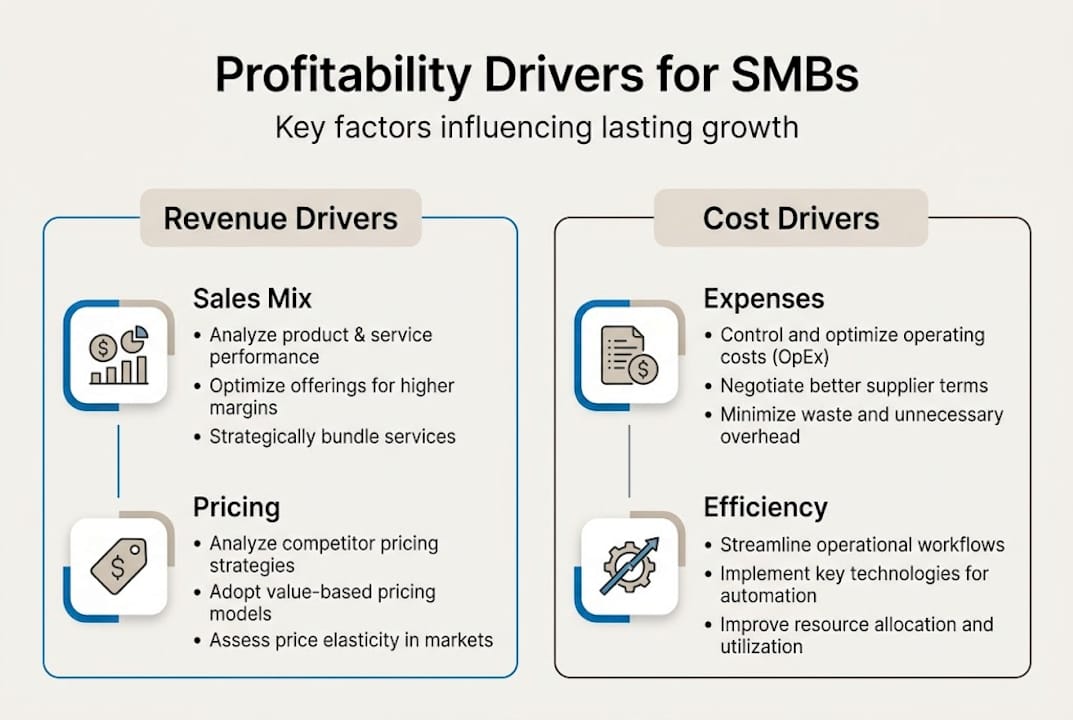
As research into profit levers highlights, core profitability drivers for SMBs include cost control, pricing optimisation, revenue diversification, operational efficiency, and margin management at product and customer levels. Each of these is something you can actively manage. None of them happen by accident.
Here’s a quick summary of the main drivers to keep on your radar:
- Cost control: Reducing unnecessary expenditure without compromising quality or team performance
- Pricing optimisation: Charging what your product or service is genuinely worth, not just what feels comfortable
- Revenue diversification: Spreading income across multiple streams to reduce vulnerability
- Operational efficiency: Doing more with less by streamlining processes and reducing waste
- Margin management: Understanding profit at the product, service, and customer level, not just the business level
These five drivers work together. Neglect one, and the others can only compensate so much.
Understanding key profitability metrics and frameworks
Now that we know what drives profitability, let’s turn those drivers into measurable indicators and actionable frameworks. Numbers don’t lie, but they do require context. Knowing your revenue means little if you don’t know your margins.
The two most essential metrics are Gross Profit Margin (GPM) and Net Profit Margin (NPM). GPM equals revenue minus COGS divided by revenue, while NPM equals net income divided by revenue. These give you a high-level view of financial health. But to truly boost margins strategies, you need to go deeper.

| Metric | Formula | What it tells you | Business impact |
|---|---|---|---|
| Gross Profit Margin | (Revenue – COGS) / Revenue | How efficiently you produce or deliver | Pricing and cost benchmarking |
| Net Profit Margin | Net Income / Revenue | Overall business profitability | Investment and growth decisions |
| Unit Margin | Selling price – Unit cost | Profit per individual product or service | Product mix decisions |
| Pocket Margin | Invoice value – All deductions | True cash received after discounts and rebates | Reveals hidden margin leakage |
| Cost-to-Serve | Total cost to deliver to one customer | Profitability by customer | Customer retention and pricing strategy |
Here’s a practical way to calculate your key margins step by step:
- Pull your most recent profit and loss statement
- Subtract your cost of goods sold (COGS) from total revenue to find gross profit
- Divide gross profit by total revenue and multiply by 100 for your GPM percentage
- Subtract all operating expenses from gross profit to find net profit
- Divide net profit by total revenue and multiply by 100 for your NPM percentage
- Repeat steps 2 to 5 by customer segment or product line for deeper insight
To optimise profitability for sustainable growth, segment-level analysis is where the real clarity lives. Knowing your overall margin is useful. Knowing which customers or products are dragging it down is transformative.
Pro Tip: Calculate your cost-to-serve for your top five customers. You may find that your most demanding clients are also your least profitable ones. That insight alone can reshape your entire growth strategy.
Tools and methodologies for profitability analysis
With metrics defined, selecting the right tools and methodologies is the next step toward clarity and action. You don’t need to be a financial analyst to run a solid profitability review. The right tools make this accessible for any business owner willing to look honestly at the numbers.
The core profitability analysis methodologies include income statement and balance sheet review, SWOT analysis, benchmarking against industry peers, business analytics platforms such as Power BI or Fathom, and scenario modelling. Each approach answers a different question, and together they give you a 360-degree view of where profit is being made and where it’s leaking.
| Tool | Key feature | Approximate cost | Best for |
|---|---|---|---|
| Fathom | Visual reporting and KPI tracking | Mid-range SaaS | SMBs wanting clear dashboards |
| Power BI | Advanced data modelling | Low to mid-range | Businesses with complex data |
| Xero + add-ons | Integrated accounting and reporting | Low-range SaaS | Early-stage SMBs |
| Excel/Sheets | Custom scenario modelling | Free | Lean teams with analytical skills |
Here’s a practical checklist for your next profitability review:
- Review your profit and loss statement line by line, not just the totals
- Run a SWOT analysis focused specifically on financial performance
- Benchmark your margins against industry averages using free sector reports
- Model two or three revenue and cost scenarios to stress-test your numbers
- Use data-driven decision examples to guide how you interpret and act on findings
The profit driver tool available through Summit SCALE is a practical starting point for identifying where your biggest opportunities lie. And the case for going data-driven is strong. Research shows that analytics drive scenario planning and inventory optimisation, helping businesses avoid the cash traps that quietly suffocate growth. Explore profit growth strategies to see how analytics can be applied practically in your business.
Nuances: Growth vs. profitability and segment margin management
Having explored the methods and tools, let’s address the critical differences between growth and profitability, and how segment analysis can supercharge profit. This is where many SMB owners make their most costly mistakes.
Chasing revenue without managing margins is like filling a leaking bucket. You can pour more in, but you’ll never get ahead. Not all growth is profitable, and the businesses that scale sustainably are those that apply the 80/20 rule to their customer and product portfolios, focusing energy on the segments that generate the most margin, not just the most revenue.
Margin leakage is one of the most underestimated threats to profitability. It happens gradually, through discounts that were never reviewed, rebates that eroded value, inefficient processes that inflated costs, and underpricing that was never corrected. By the time it’s visible, it’s already cost you significantly.
Watch out for these common pitfalls:
- Confusing revenue with profit: A busy business isn’t necessarily a profitable one
- Underpricing to win work: Winning at the wrong price is worse than not winning at all
- Ignoring segment margins: Treating all customers or products the same masks where value is really created
- Skipping regular reviews: Margin leakage compounds quietly over months and years
Pro Tip: Use your analytics tool to filter sales data by customer or product category. Look for the segments where revenue is high but margin is low. Those are your hidden profit drains, and addressing them is often faster than finding new customers.
Understanding how to manage business costs is closely tied to this. And if you’re thinking about the long game, segment-level profitability directly influences how to increase business valuation, making it a strategic priority, not just a financial one.
Why most SMBs get profitability wrong: A contrarian take
To wrap up, here’s an honest look at what actually moves the needle and why most SMBs miss it.
Most business owners we speak with are obsessed with sales. More leads, more clients, more revenue. And that energy is admirable. But here’s the uncomfortable truth: pursuing growth without disciplined margin management doesn’t build a better business. It builds a bigger, more expensive problem.
The businesses that genuinely unlock growth and stability are rarely the ones chasing the boldest strategies. They’re the ones running quarterly margin reviews, segmenting their customers ruthlessly, and fixing small leaks before they become floods. That’s not glamorous. But it works.
Profitability precedes growth. Use analytics for scenario planning and inventory optimisation to avoid the cash traps that stall momentum.
Data-driven segment margins consistently outperform moonshot sales strategies. The owners who understand this stop asking “how do I get more customers?” and start asking “which customers are actually making me money?” That shift in thinking changes everything.
Pro Tip: Schedule a quarterly margin review by customer and product segment. Block it in your calendar like a board meeting. It’s the single most underused habit among profitable SMB owners.
Unlock greater profitability with expert coaching and tools
If you’re ready to turn insight into action, it’s worth knowing where you can find support and tools to accelerate profitability.

Summit SCALE® Coaching provides practical frameworks and expert support designed specifically for SMB owners who want to move from busy to genuinely profitable. Whether you’re trying to identify hidden margin leaks, build a smarter pricing strategy, or create a roadmap for sustainable growth, the right coaching makes the difference between knowing and doing. Explore coaching for profitability to see how tailored guidance can reshape your numbers. Discover proven SMB growth strategies and learn more about the business coaching benefits that help owners like you build businesses that work harder for them.
Frequently asked questions
What is the most important profitability driver for SMBs?
Cost optimisation through automation and supplier negotiation is consistently ranked as the most critical driver, as it protects margins regardless of revenue fluctuations. Pairing this with revenue diversification creates a resilient profitability foundation.
How can I quickly measure my business’s profitability?
Start by calculating your gross and net profit margins using your latest profit and loss statement. These two figures give you an immediate, honest picture of financial health.
Are all types of business growth profitable?
No. Revenue does not equal profit, and growth only improves your bottom line when margin management and customer segment analysis are built into your strategy from the start.
How do analytics tools help increase profitability?
Analytics tools enable scenario planning, benchmarking, and rapid identification of where profit is leaking, turning raw financial data into decisions you can act on immediately.
Recommended
- Why prioritise profitability: unlock growth and stability
- Align profitability with growth for lasting SME success
- SME profitability guide: 11.3% average and how to beat it
- Why prioritise sales growth for lasting business success
- Employee Retention Solutions, Lower Turnover | OpenElevator
- Dubai business setup checklist: every step for success

