
TL;DR:
- Inefficient processes drain SME profitability and often go unaddressed due to busy routines.
- Mapping processes and setting measurable goals help identify and prioritize improvements.
- Continuous monitoring and small incremental changes lead to lasting business performance gains.
Every SME owner knows the feeling: a process that should take minutes somehow swallows hours, a simple task bounces between three people before it gets done, and somewhere in that chaos, money quietly walks out the door. Inefficient processes are one of the most common drains on SME profitability, yet they often go unaddressed because the day-to-day grind leaves little room for reflection. This guide gives you a practical, step-by-step approach to identifying, improving, and sustaining better processes in your business. No theory for theory’s sake. Just clear frameworks, honest measurement, and actionable steps that translate directly into stronger margins and faster growth.
Table of Contents
- Understand your current processes and set objectives
- Collect data and baseline performance
- Redesign and implement process improvements
- Monitor, measure and sustain improvements
- Why relentless small improvements beat one-off overhauls
- Drive deeper improvements with expert support
- Frequently asked questions
Key Takeaways
| Point | Details |
|---|---|
| Start with clear goals | Pinpoint bottlenecks and set measurable objectives for your business. |
| Baseline and track data | Accurate data is essential for understanding what’s working and what’s not. |
| Prioritise continuous improvement | Regular, small changes beat grand one-off overhauls for lasting gains. |
| Involve your team | Staff input and buy-in are critical for real adoption and sustainable results. |
Understand your current processes and set objectives
Before you can fix anything, you need to see it clearly. Most business owners have a rough sense of where things go wrong, but a rough sense is not enough to drive real change. Start by identifying your highest-friction processes: the ones that cost the most time, generate the most complaints, or require the most rework. These are your priority targets.
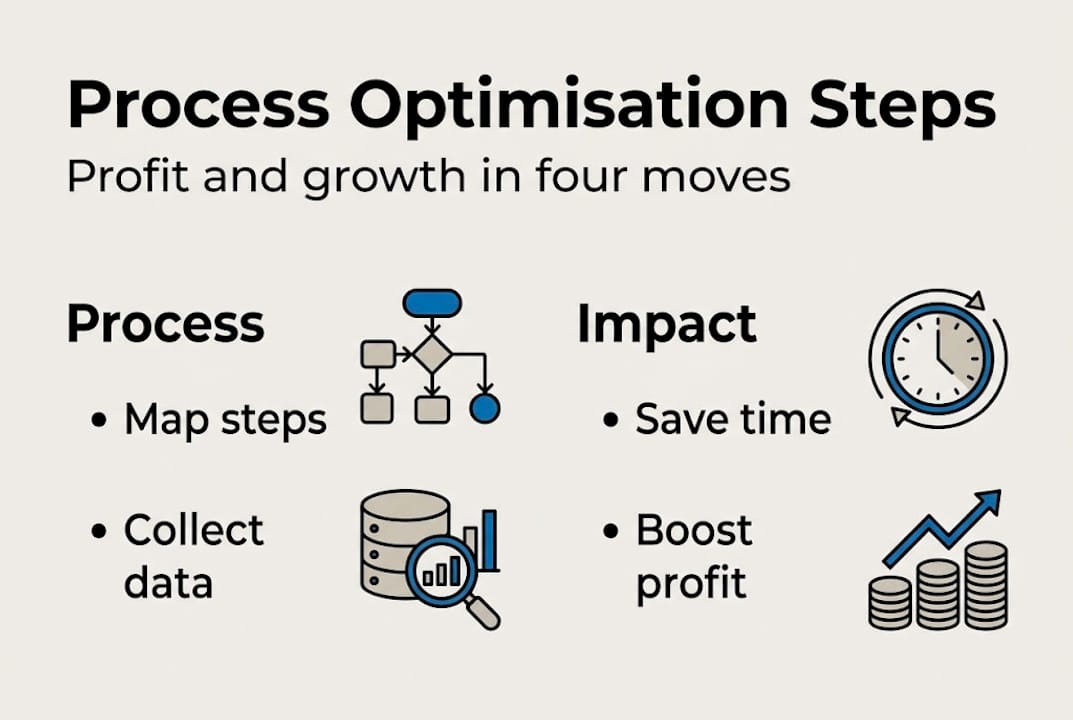
Process mapping is the tool most people reach for here, and it is genuinely useful. A simple map answers four questions: who does this, what exactly happens, when does each step occur, and why does it exist? You do not need specialist software. A whiteboard and a few sticky notes can get a small team aligned in under an hour.
There are reasons to optimise processes that go well beyond cutting costs. Clarity in your processes builds team confidence, reduces errors, and creates the kind of consistency that customers notice and trust.
However, be careful of a common trap. Process mapping alone does not guarantee improvement. Many SMEs invest time in beautifully documented processes that nobody follows. The map is a starting point, not the destination.
Once you have mapped a process, pair it with a measurable goal. Without one, you are just rearranging the furniture.
SMART objectives for process optimisation:
- Specific: Target one process at a time, such as customer onboarding or invoice processing
- Measurable: Define a clear metric, for example, reduce onboarding time from five days to two
- Achievable: Set targets based on your current capacity and resources
- Relevant: Prioritise processes that directly affect revenue, customer satisfaction, or team productivity
- Time-bound: Set a review date, typically four to eight weeks after implementation
| Process area | Common friction point | Suggested metric |
|---|---|---|
| Customer onboarding | Too many manual steps | Days to first delivery |
| Invoice processing | Approval delays | Hours from issue to payment |
| Stock management | Over-ordering or shortages | Stock accuracy percentage |
| Staff onboarding | Inconsistent training | Time to full productivity |
Pro Tip: Use a simple flowchart or whiteboard session with the people who actually do the work. They will spot inefficiencies in minutes that management might miss entirely.
Collect data and baseline performance
Once you know which processes to improve and what success looks like, the next step is to measure where you stand right now. This is your baseline, and without it, you will never know whether your changes actually worked.
The data you need does not have to be complex. Focus on four core areas: time (how long does each step take?), cost (what does it cost in labour, materials, or delays?), defect or error rates (how often does something go wrong?), and customer satisfaction (are people happy with the output?).
Many SMEs struggle here. Data quality constraints are one of the most common barriers to meaningful process improvement. Inconsistent definitions, missing records, and no clear ownership of measurement all get in the way.
Here is a practical three-step approach to baselining your processes:
- Define your metric clearly. Before you track anything, write down exactly what you are measuring and how. If two people measure the same thing differently, your data is useless.
- Collect data for two to four weeks. Use whatever tools you already have. A simple spreadsheet works well for most SMEs at this stage.
- Calculate your average and your worst case. The average tells you where you typically are; the worst case tells you where the real pain lives.
| Tracking method | Cost | Effort | Best for |
|---|---|---|---|
| Manual spreadsheet | Free | Medium | Small teams, simple processes |
| Google Sheets with forms | Free | Low | Consistent daily tracking |
| Low-cost apps (e.g. Trello, Asana) | Low | Low | Task and time tracking |
| Dedicated process tools | Medium | Medium | Growing teams, complex workflows |
For profit optimisation for SMEs, reliable baseline data is the foundation everything else is built on. Even a few weeks of consistent tracking gives you the confidence to make decisions rather than guesses.
Small, data-driven improvements compound quickly. A 10% reduction in processing time across three core workflows can free up significant staff capacity over a year, capacity that can be redirected into revenue-generating activity.
Redesign and implement process improvements
With solid baseline data in hand, you are ready to make real changes. This is where many SMEs either rush ahead without a plan or stall in endless deliberation. Neither serves you well. The goal is structured, confident action.

Start by generating improvement ideas for your target process. Three questions help here: Can any steps be eliminated entirely? Can any steps be automated or simplified? Are roles and responsibilities clearly defined for each step?
Bringing your team into this stage is not optional. Staff involvement in co-designing change significantly boosts the likelihood that improvements will stick. People support what they help build.
Follow this five-step redesign process:
- Select the specific improvement to test, based on your baseline data and team input
- Simplify the process by removing unnecessary steps and clarifying who owns each remaining one
- Test the new process with a small pilot group or a limited time window before rolling it out fully
- Train everyone involved, not just in what to do but in why the change matters
- Launch the updated process with a clear start date and a named person responsible for monitoring it
The workflow for process improvements does not need to be complicated. Simple, well-communicated changes almost always outperform elaborate redesigns that confuse the team.
“Optimising in silos, where one department improves its own process without considering the knock-on effect on others, is one of the most common and costly mistakes SMEs make.” This is why cross-functional input during the redesign stage is so valuable.
Pro Tip: Run a two-week pilot before committing to a full rollout. Pilots surface problems cheaply and quickly, and they give your team a chance to build confidence in the new approach before it becomes standard practice.
Monitor, measure and sustain improvements
Rolling out a new process is not the finish line. It is actually one of the most vulnerable moments in the whole improvement journey. Without active monitoring, teams naturally drift back to familiar habits, and the gains you worked hard to create quietly disappear.
Continuous monitoring and end-to-end governance are what separate businesses that sustain improvement from those that run in circles. Assign a named owner to each improved process. Set a regular review cadence, monthly at minimum, to check whether the process is performing as expected.
Track the same KPIs you measured at baseline, and compare them honestly. Ask your team for feedback too. They will often spot early signs of slippage before the numbers do.
Common errors that undermine sustained improvement:
- No named owner for the improved process
- Failing to update training materials when the process changes
- Reviewing results once and assuming the job is done
- Ignoring team feedback after launch
- Celebrating early wins before the change is truly embedded
For sustainable profitability steps, the discipline of ongoing measurement is what turns a one-off win into a permanent advantage.
| KPI | Baseline | Post-improvement | Change |
|---|---|---|---|
| Customer onboarding time | 5 days | 2.5 days | 50% reduction |
| Invoice processing errors | 12% error rate | 4% error rate | 67% reduction |
| Staff time on manual tasks | 8 hours/week | 3 hours/week | 63% reduction |
| Customer satisfaction score | 6.8/10 | 8.2/10 | 21% improvement |
The numbers in this table are illustrative, but they reflect the kind of gains that are genuinely achievable when SMEs apply a methodical, measurement-led approach. Small changes, tracked consistently, add up to meaningful results.
Why relentless small improvements beat one-off overhauls
Here is something most process improvement guides will not tell you: the businesses that gain the most are rarely the ones that attempt the biggest transformations. They are the ones that make small, deliberate improvements week after week and never stop.
Too many SME owners stall because they are waiting for the perfect redesign or the right moment to overhaul everything at once. That moment rarely comes, and when it does, the overhaul often collapses under its own weight.
Continuous improvement capability, not grand redesigns, is most strongly associated with higher innovation and sustained performance in SMEs. Consider a small logistics firm that spent two years making tiny adjustments to its booking, dispatch, and invoicing processes. No dramatic restructuring. Just consistent measurement, honest team conversations, and incremental tweaks. Over that period, they reduced operational costs by 18% and improved on-time delivery from 74% to 91%.
The lesson is not that big changes are bad. It is that the discipline behind proven SME growth steps matters far more than the size of the change itself. Build the habit of improvement into your business culture, and the results will compound in ways a single overhaul never could.
Drive deeper improvements with expert support
Applying these frameworks takes focus, and sustaining them takes discipline. If you are finding it difficult to move from insight to action, or if your improvements are not sticking, working with an experienced coach can make all the difference.
At Summit SCALE, we work with SME owners to embed a genuine culture of process improvement, not just a one-time fix. Whether you are looking to invest in coaching for process improvement, explore how coaching drives profitability gains, or follow a step-by-step growth guide, we have the tools and experience to support your next stage of growth. Book a free 15-minute assessment call and let us help you turn process clarity into real, lasting results.
Frequently asked questions
What is the first step to optimise business processes in an SME?
Start by identifying and mapping your most critical or high-pain processes, then set clear, measurable improvement goals. Process mapping helps identify bottlenecks but must be paired with a commitment to continuous improvement to deliver real value.
How can SMEs baseline their process performance with limited resources?
Use simple tools like spreadsheets and define each metric clearly before you start tracking. Clear definitions and low-cost measurement approaches are key for SMEs working with limited time and budget.
Why do business process improvements often fail to last?
They fail when new processes lack a named owner, are not monitored after launch, or when staff are not genuinely involved in the change. Sustaining process benefits requires ongoing measurement, staff buy-in, and clear accountability.
How soon can an SME expect results from process optimisation?
Simple improvements often show measurable results within a few weeks, while larger changes may take several months to deliver sustained gains. Cycle-time and defect improvements are typically visible within weeks when changes are methodical and data-driven.

