
TL;DR:
- Many SMEs struggle to scale without clear workflows, causing chaos instead of growth. Building documented SOPs, tracking unit economics, and establishing a structured operating rhythm are essential foundations. Professional coaching can help owners design, implement, and adapt scalable workflows confidently for sustainable expansion.
Growing a business feels exciting until the cracks appear. Orders increase, your team expands, and suddenly nothing runs as smoothly as it once did. For many SME owners across the UK, Australia, and New Zealand, the core problem is not a lack of ambition — it is the absence of a clear workflow for scaling businesses. Without structured, repeatable processes, growth creates chaos rather than momentum. This guide walks you through exactly what it takes to build a business scalability workflow that supports sustainable expansion, protects your cash flow, and gives you back the clarity to lead with confidence.
Table of Contents
- Understanding the problem: why SMEs struggle to scale without a workflow
- Preparing for scaling: systems, data, and cash flow foundations
- Executing the workflow: systemising, automating, and operating with cadence
- Verifying success: monitoring performance and adapting the workflow
- Rethinking scaling workflows: lessons and pitfalls to avoid
- How professional coaching helps you master scaling workflows
- Frequently asked questions
Key Takeaways
| Point | Details |
|---|---|
| Document your processes | Write down repeatable workflows with clear steps before delegation or automation to ensure consistency. |
| Use a 90-day rhythm | Plan and review growth priorities in 90-day cycles to make progress and pivot quickly as needed. |
| Manage cash weekly | Prepare a 13-week cash flow plan with conservative revenue estimates to maintain financial control. |
| Automate carefully | Only automate well-established processes with monitoring and human checkpoints to avoid disruptions. |
| Leverage coaching | Professional coaching helps build scalable workflows faster and bridges the gap between ambition and practical operations. |
Understanding the problem: why SMEs struggle to scale without a workflow
Most small businesses grow the same way. You land clients, deliver well, and hire as needed. For a while, it works. But here is the uncomfortable truth: scaling a company requires deliberate decisions about systems, processes, and resource planning. Winging it stops working the moment you are no longer the one doing everything yourself.
What does this look like in practice? Consider a trades business in Brisbane with 12 employees. The owner is still quoting every job, approving every purchase, and resolving every customer complaint. The business is technically growing, but the owner is exhausted and quality is slipping. That is not scaling. That is just more of the same, at volume.
Many SMEs share these common scaling pitfalls:
- Processes live in the founder’s head, making consistent execution impossible once you delegate.
- Cash flow mismanagement frequently causes businesses to run out of runway right when growth demands investment.
- Unclear decision rights create slow handoffs between sales and delivery, frustrating both staff and customers.
- No operating rhythm means the team lurches from crisis to crisis rather than building towards clear goals.
- Lack of documented processes makes it nearly impossible to train new team members or quality-check work reliably.
Understanding what scaling a business actually requires is the first step. It is not just about doing more. It is about building the systems that allow your business to do more without depending entirely on you.

Preparing for scaling: systems, data, and cash flow foundations
Before you execute any growth plan, you need the foundations in place. Think of it like building a house — no matter how grand the design, it collapses without solid footings. Your preparation phase is about getting those footings right.
Here is a practical sequence to follow:
-
Systemise repeatable work into SOPs. A Standard Operating Procedure (SOP) is simply a written, step-by-step description of how a task gets done. Start with your highest-volume, most error-prone processes. Sales handoffs, onboarding new clients, and invoicing are common starting points.
-
Set measurable unit economics. Know your Customer Acquisition Cost (CAC, what it costs to win one new client) and Lifetime Value (LTV, total revenue a client generates over the relationship). If your LTV is three times your CAC, you have a business worth scaling. If not, fix the economics first.
-
Build a 13-week cash flow plan. A 13-week cash survival workflow maps weekly inflows and outflows using conservative forecasts — typically reducing prior revenue expectations by 20 to 30 per cent. This is not pessimism. It is discipline.
-
Implement a rolling operating rhythm. Start with a 90-day plan to focus your team, then expand to a 12-month roadmap. Document critical processes, set unit economics targets, and build a monthly operating forecast alongside a 12 to 18 month cash runway model.
-
Clarify leadership roles and decision rights. Who approves what? Who owns which outcomes? Write it down. Ambiguity at the leadership level trickles down into operational confusion.
| Preparation element | Why it matters | Common mistake to avoid |
|---|---|---|
| SOPs for core processes | Ensures consistent delivery as team grows | Documenting too much at once; start small |
| Unit economics (CAC/LTV) | Validates whether growth is worth funding | Tracking revenue but ignoring acquisition cost |
| 13-week cash flow plan | Prevents running out of cash at critical moments | Using last year’s numbers without conservative adjustments |
| 90-day operational plan | Focuses team effort on the right priorities | Setting too many goals with no clear ownership |
| Leadership decision rights | Reduces bottlenecks and speeds up execution | Assuming everyone already knows who decides what |
Pro Tip: Do not try to systemise everything at once. Pick the three processes that, if they failed, would hurt your business most. Document those first, test them with your team, and iterate before moving on.
A step-by-step approach to business scaling is far more sustainable than a dramatic overhaul. Small, well-tested changes compound into significant operational strength over time, and they also build your team’s confidence in the new way of working.
Executing the workflow: systemising, automating, and operating with cadence
Preparation creates the foundations. Execution is where those foundations become a functioning business that can grow without breaking. Efficient workflows for growth are built through three interconnected disciplines: systemisation, automation, and operating cadence.
Here is how to execute effectively:
-
Stabilise before you automate. Every process you want to automate must first be documented and running reliably by hand. Automating a broken process just produces broken results faster.
-
Introduce automation with care. Workflow automation for scaling should always include audit trails (records of every action taken) and human-in-the-loop checkpoints, meaning a real person reviews outcomes at key decision points. Tools that handle invoicing, lead follow-up, or onboarding tasks are good starting points for most SMEs.
-
Adopt a 90-day operating rhythm. 90 days is the optimal cycle for making meaningful progress while enabling timely course correction through quarterly reviews. It is long enough to achieve something significant. It is short enough to catch a wrong turn before it costs you.
-
Use visual workflow management. Kanban boards (columns showing tasks to do, in progress, and done) or Scrum frameworks (short sprint cycles with defined team goals) help your team see the whole picture and spot bottlenecks quickly.
-
Define decision rights explicitly. Slow handoffs between sales and delivery are one of the most common growth killers. Map out who owns each stage of the process and what triggers a handoff.
Implementing a named, repeatable framework like SCALE — covering systems, capacity, automation, leadership, and execution — gives your team a common language for how the business operates and grows. It turns abstract goals into concrete actions.
| Process type | Manual approach | Automated approach |
|---|---|---|
| Lead follow-up | Relies on individual memory; inconsistent | Triggered emails/tasks; consistent and trackable |
| Invoicing | Time-consuming; prone to delays | Scheduled automatically; improves cash flow timing |
| Onboarding new clients | Ad-hoc; varies by team member | SOP-driven with automated reminders and checklists |
| Performance reporting | Compiled weekly by hand | Dashboard auto-updates; frees up leadership time |
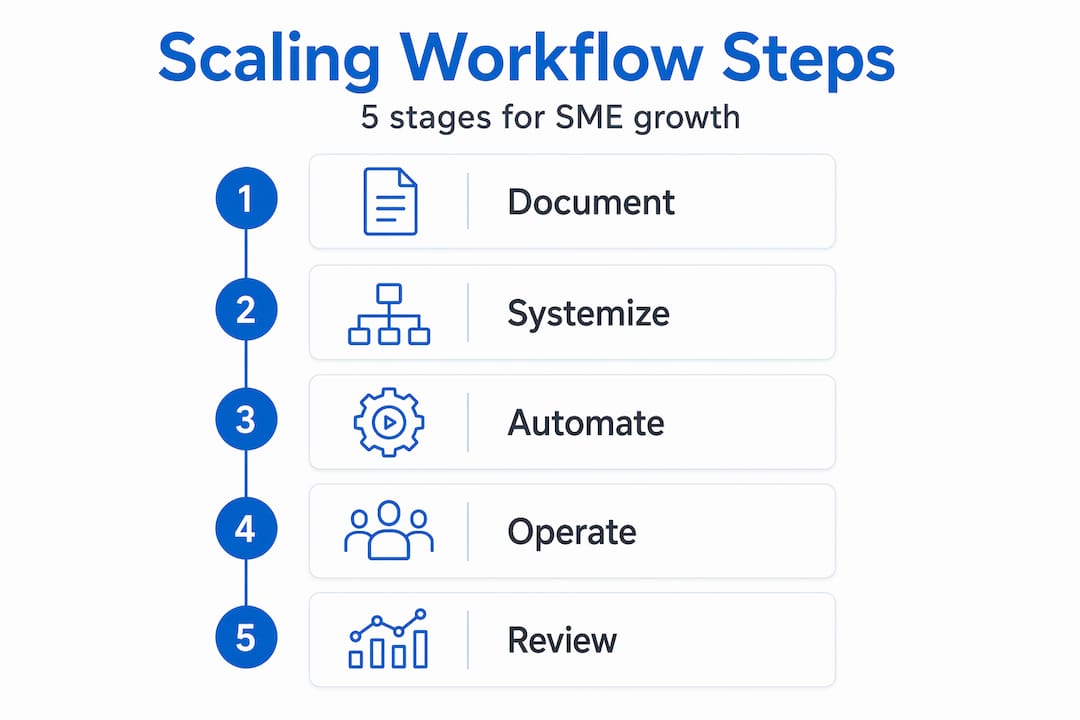
A business coaching workflow can help you decide which processes to automate first, based on your specific growth stage and team capacity. There is rarely a one-size-fits-all answer.
Pro Tip: Before rolling out any new workflow, pilot it with one team member or one client account for two weeks. You will identify gaps far faster than any planning session can reveal. A leadership coaching approach to workflow design helps founders step back from the detail and lead the process rather than become consumed by it.
Verifying success: monitoring performance and adapting the workflow
Building and executing a workflow is not a one-off event. It is an ongoing practice. Scaling operations effectively requires that you measure what matters, review regularly, and be willing to change course when the data tells you to.
Here is what a strong verification process looks like:
- Track leading indicators such as pipeline conversion rate, client activation rate (how quickly new clients become active), and churn rate (the percentage of clients who leave). These tell you where problems are developing before they hit your revenue.
- Monitor lagging indicators like revenue growth, gross margin, and net cash flow. These confirm whether your scaling process is working overall.
- Schedule weekly operational reviews with your team to catch drifting metrics early and resolve issues before they compound.
- Conduct quarterly strategic reviews to assess whether your 90-day priorities are still the right ones, or whether market conditions have shifted your focus.
- Gather customer feedback systematically. Build feedback loops into your workflow, not as an afterthought. What your clients experience at each stage of delivery is some of the most valuable data you have.
Track KPIs using dashboards that bring sales, finance, and operations data into one place. When your team can see the same numbers in real time, conversations shift from defending past decisions to making better future ones.
| KPI | What it measures | Review frequency |
|---|---|---|
| Pipeline conversion rate | Sales process effectiveness | Weekly |
| Client activation rate | Onboarding quality | Weekly |
| Customer churn rate | Retention and service quality | Monthly |
| Gross margin | Profitability of core delivery | Monthly |
| 13-week cash flow variance | Financial health and accuracy of forecasting | Weekly |
| Revenue per team member | Operational efficiency as team grows | Quarterly |
Setting three to five priorities each quarter and protecting time for honest end-of-quarter reviews is one of the most disciplined habits a scaling SME can develop. It sounds straightforward, but most businesses skip it.
Pro Tip: If a metric has been flashing amber for three weeks in a row, do not wait for the quarterly review. Stop the relevant initiative, diagnose the cause, and adjust. Speed of response is a competitive advantage.
Understanding sustainable business scaling means knowing when to push forward and when to pause and re-examine. The businesses that scale best are not the ones that move fastest. They are the ones that course-correct fastest.
Rethinking scaling workflows: lessons and pitfalls to avoid
Here is something most business articles will not tell you directly: the biggest obstacle to scaling is rarely the market, the competition, or even the funding. It is the founder.
Not because founders lack talent or drive. But because you cannot scale a process that only exists in your head, and documented SOPs are essential before you can delegate or automate anything with confidence. The businesses that stall at ten, fifteen, or twenty employees almost always have the same problem — the owner is still the operating system.
We also see founders delegate too early, without clear quality criteria or triggers. They hand off a task before defining what “done well” looks like. Then they are disappointed by the output, pull the task back, and conclude that delegation does not work. It is a self-fulfilling pattern that traps owners in the weeds for years.
On the automation side, the failures we see most often come down to incomplete design. Automation built with durability, observability, and human checkpoints reduces failure risk significantly compared to automation that only accounts for the ideal scenario. Real workflows encounter exceptions constantly. Design for those, not just for the clean path.
The most practical wisdom we can offer? Invest heavily in workflow documentation before you need it. Every hour spent writing a clear SOP today saves three hours of confusion, rework, and quality failure later. And clarity in your processes creates clarity in your team. They know what good looks like. They can hold each other accountable without waiting for you.
Understanding the role of coaching for SMEs in this context becomes clear: sometimes the best thing you can do is work with someone who has seen these patterns before and can help you avoid them entirely rather than learning from your own expensive mistakes.
“You cannot scale what only exists in your head. Documented processes are not bureaucracy — they are the architecture of a business that can grow without you.”
How professional coaching helps you master scaling workflows
Building a workflow for scaling your business is genuinely achievable. But knowing what to do and having the capacity to implement it under the daily pressure of running a business are two different things.
Professional coaching closes that gap. At Summit SCALE, we work with SME owners across the UK, Australia, and New Zealand to build the operational infrastructure, financial clarity, and leadership confidence that sustainable growth actually requires. We help you design workflows that fit your business, not generic templates borrowed from a corporate handbook. Coaching in a scaling business provides the external perspective and accountability that most founders desperately need but rarely ask for. Whether you want to understand why it pays to invest in business coaching or are ready to explore growth strategies for your SME, the first step is a free 15-minute assessment call. Let us help you turn your growth ambitions into a business that actually runs without you carrying it.
Frequently asked questions
What is a workflow for scaling businesses?
A practical scaling workflow for SMEs involves systemising work into SOPs, measuring unit economics, automating bottlenecks, and running rolling operating rhythms. It is a structured set of repeatable processes and disciplines designed to help a business grow sustainably without relying solely on the founder.
Why is a 90-day plan effective for SMEs scaling?
90 days is long enough to make meaningful progress on your priorities and short enough to catch a wrong turn before it becomes expensive. It balances focus with the flexibility to course-correct quickly.
How can automation support scaling without causing failures?
Automation supports scaling when it is built on well-documented, stable processes and includes audit trails and human checkpoints. Building workflow automation with durability and observability significantly reduces the risk of failures when real-world exceptions arise.
How does professional coaching help SMEs scale?
Coaching accelerates the building of operational infrastructure, financial planning disciplines, and leadership clarity. Scale Ready coaching closes the gap between commercial ambition and operational reality, typically within six to twelve months, helping owners implement scalable workflows with genuine confidence.

