
Many business owners chase rapid growth, adding staff and revenue without building the systems that make expansion sustainable. True scaling is different. It means growing your business efficiently through repeatable processes and strong foundations, not just throwing more resources at problems. This guide breaks down what scaling actually means, why it matters for your profitability, and how to implement proven frameworks that work in 2026’s evolving market.
Table of Contents
- What Is Scaling A Business And Why Does It Matter?
- Core Strategies And Frameworks For Scaling Your Business
- Organising Your Business For Scalable Success
- Applying Coaching And Expert Support To Accelerate Scaling In 2026
- Unlock Growth And Profitability With Expert Coaching
Key takeaways
| Point | Details |
|---|---|
| Scaling requires systems | True scaling builds sustainable processes, not just headcount or revenue spikes |
| The Scaling Wheel Framework | This model identifies critical strengths and weaknesses traditional approaches miss |
| Efficient growth wins | Sustainable expansion outperforms unsustainable hypergrowth in today’s market |
| Data drives decisions | Modern metrics adapted for AI and 2026 realities guide successful scaling |
| Coaching accelerates success | Expert support helps overcome challenges and build leadership for growth |
What is scaling a business and why does it matter?
Scaling means growing your business with sustainable, repeatable systems rather than simply increasing revenue or headcount. You achieve more output without proportionally increasing input. When you scale properly, your profit margins improve as you expand because your systems handle the growth efficiently.
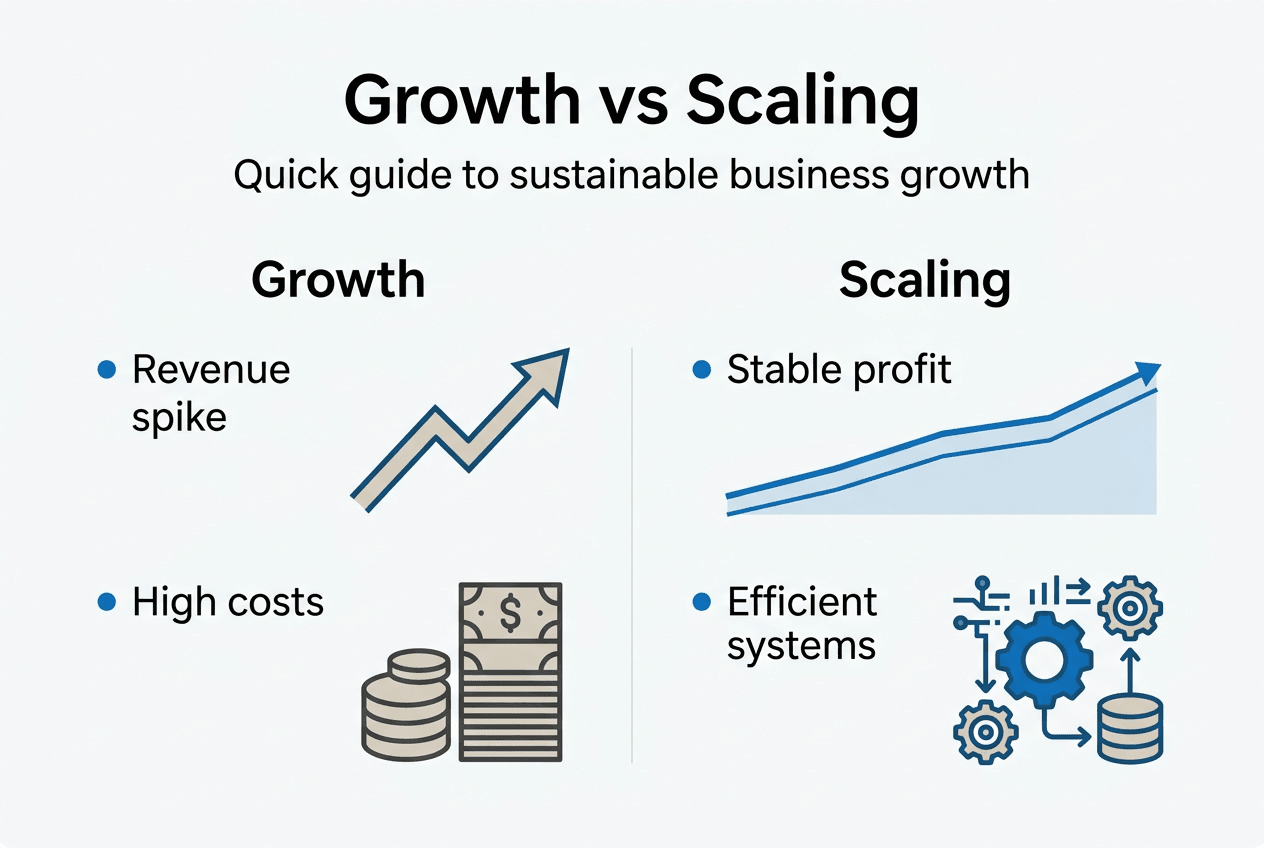
Growth and scaling are not the same thing. Growth can be one-off wins or unsustainable spikes that strain your resources. You might land a big contract and hire frantically to deliver, but without proper systems, you create chaos. Scaling builds the infrastructure first, then expands deliberately.
Why scaling matters becomes clear when you consider profitability and stability. Scaled businesses maintain or improve margins during expansion. They compete effectively because their systems create consistency. They weather market changes because their foundations are solid.
Recent research reveals that traditional models overlook critical factors in scaling success. The Scaling Wheel Framework identifies strengths and weaknesses that conventional approaches miss, giving you a more complete picture of your scaling readiness.
Key components needed for successful scaling include:
- Documented systems that anyone can follow
- Optimised processes that eliminate bottlenecks
- The right people in roles that support growth
- Metrics that track performance and guide decisions
- Technology that automates repetitive tasks
Pro Tip: Before adding more customers or staff, document your three most critical business processes. If you cannot hand these to someone else and have them execute successfully, you are not ready to scale.
Understanding scaling for lasting growth and freedom transforms how you approach expansion. You stop firefighting and start building. You create a business that runs without constant intervention, giving you the freedom to focus on strategy rather than daily operations.
Core strategies and frameworks for scaling your business
The Scaling Wheel Framework provides a comprehensive tool for identifying where your business stands. Unlike traditional models that focus narrowly on financials or operations, this framework examines multiple dimensions simultaneously. It reveals hidden weaknesses that could derail your scaling efforts and highlights strengths you can leverage.
Structure and systems form the foundation of scaling success. As experts emphasise, you need systems to scale effectively. Without structure, growth creates disorder. With proper systems, expansion becomes manageable and predictable.
The market has shifted dramatically. Efficient growth now beats hypergrowth, and AI-native companies are transforming competitive landscapes. Metrics that mattered in 2021 no longer apply in 2026. You must adapt your measurement approach to current realities.

Hypergrowth sounds exciting but often proves unsustainable. Companies pursuing rapid expansion at any cost frequently burn through resources, damage culture, and ultimately fail. Efficient growth prioritises profitability and sustainability over vanity metrics.
Core strategic steps for scaling include:
- Establish scalable operations through process documentation and automation
- Refine your product or service offerings based on data and customer feedback
- Optimise financial management with clear metrics and forecasting
- Build a team structure that supports growth without constant reorganisation
- Implement technology that enhances efficiency rather than adding complexity
- Create feedback loops that identify problems before they become crises
Pro Tip: Review your business growth models quarterly. What worked six months ago may not suit current conditions, especially with rapid AI advancement changing customer expectations.
| Characteristic | Growth | Scaling | Hypergrowth |
| — | — | — |
| Revenue increase | Variable | Consistent | Explosive |
| Cost structure | Proportional | Improving margins | Often unsustainable |
| Systems focus | Limited | Central priority | Often neglected |
| Sustainability | Uncertain | High | Low |
| Resource efficiency | Standard | Improving | Declining |
Following a step by step business growth guide keeps you focused on what matters. Scaling requires discipline and patience. You build foundations, test systems, refine processes, then expand deliberately.
Applying business development best practices throughout your scaling journey protects against common pitfalls. These practices include regular strategic reviews, customer-centric decision making, and continuous improvement mindsets.
Organising your business for scalable success
Team alignment determines whether your scaling efforts succeed or fail. Every role must connect clearly to your scaling goals. When people understand how their work contributes to growth, they make better decisions independently. This reduces bottlenecks and speeds execution.
Process optimisation and automation eliminate the friction that slows scaling. Identify repetitive tasks that consume time without adding strategic value. Automate these wherever possible. Document processes so anyone can execute them consistently. This creates the foundation for expansion.
Performance measurement systems provide the visibility you need to scale confidently. Without clear metrics, you fly blind. With proper measurement, you spot problems early and capitalise on opportunities quickly. Build feedback loops that surface issues before they escalate.
Top organisational priorities for scalable businesses include:
- Systems documentation that captures institutional knowledge
- Leadership development that builds decision-making capacity throughout the organisation
- Technology adoption that enhances rather than complicates operations
- Culture building that maintains values during rapid change
- Communication structures that keep everyone aligned
- Financial controls that prevent scaling from destroying profitability
Research shows that traditional approaches miss critical factors in scaling readiness. The Scaling Wheel Framework helps you assess whether your organisation can handle growth before you commit resources.
| Metric | Early Stage | Scaling Phase | Mature Scaled |
| — | — | — |
| Customer acquisition cost | High variability | Decreasing | Stable and optimised |
| Revenue per employee | £50,000-£80,000 | £80,000-£120,000 | £120,000+ |
| Gross margin | 40-50% | 50-65% | 65%+ |
| Customer lifetime value | 3x CAC | 5x CAC | 7x+ CAC |
| Employee satisfaction | Variable | Improving | Consistently high |
Pro Tip: Many businesses skip team development and neglect systems in their rush to scale. This creates chaos that costs more to fix later than preventing upfront. Invest in your people and processes before pursuing aggressive growth.
Building your business team for growth requires deliberate planning. You need people who can grow with the business, not just fill current gaps. Hire for potential and cultural fit, then develop skills through training and coaching.
A comprehensive business growth strategy integrates all these elements. Your strategy should address systems, people, processes, and metrics simultaneously. Focusing on one area while neglecting others creates imbalances that undermine scaling.
Implementing business development best practices throughout your organisation ensures consistency. These practices become habits that support scaling rather than special initiatives that fade when attention shifts.
Applying coaching and expert support to accelerate scaling in 2026
Small businesses face predictable challenges when scaling. You hit capacity limits, struggle with delegation, lose the culture that made you successful, or find that systems break under increased load. Coaching helps you anticipate and navigate these challenges before they become crises.
Benefits of coaching include strategic clarity that cuts through complexity. A coach helps you see patterns you miss when buried in daily operations. They provide accountability that keeps you focused on priorities rather than distractions. Leadership development accelerates as you work with someone who has guided others through similar journeys.
Coaching proves especially valuable in 2026 because market conditions evolve rapidly. AI transforms customer expectations and competitive dynamics. Economic uncertainty requires agile decision making. A coach with current market knowledge helps you adapt strategies quickly.
You need structure. You need a system. You need to SCALEUP.
This mantra captures the essence of successful scaling. Structure prevents chaos. Systems enable consistency. The ScaleUp mindset focuses on building foundations that support sustainable expansion.
Types of coaching relevant to scaling include:
- Executive coaching that develops your leadership capabilities
- Performance coaching that improves team effectiveness
- Business coaching that addresses strategy and operations
- Financial coaching that optimises profitability during growth
- Sales coaching that builds scalable revenue generation
Understanding the role of coaching in scaling helps you decide when and how to engage support. Coaching is not admitting weakness. It is recognising that outside perspective and expertise accelerate progress.
For SMEs specifically, coaching addresses unique challenges that larger companies do not face. You lack the resources for extensive management layers. You need to scale efficiently with limited budgets. Coaching helps you punch above your weight.
Investing in coaching delivers returns through faster decision making, fewer costly mistakes, and accelerated growth. The cost of coaching pales compared to the cost of scaling failures or missed opportunities.
Unlock growth and profitability with expert coaching
Professional coaching helps you develop the systems, leadership, and strategy needed to scale sustainably. You gain clarity on priorities, accountability for execution, and expertise that shortens your learning curve. The right coaching unlocks time, profit, and freedom while accelerating your business growth in 2026.
Explore specialised coaching designed for SMEs and entrepreneurs focused on scaling success. Discover how coaching supports your scaling journey through proven frameworks and personalised guidance. Learn why investing in coaching delivers measurable returns in profitability, efficiency, and business value.
Frequently asked questions
What is the difference between scaling and growing a business?
Growth often means increased revenue or staff without improved systems, whilst scaling means expanding efficiently with strong processes in place. Scaling focuses on sustainability and profitability, whereas growth can be temporary or costly. A growing business might double revenue but also double costs, whilst a scaling business improves margins as it expands.
How can small businesses start scaling effectively in 2026?
Begin by assessing and strengthening your systems and processes before pursuing aggressive expansion. Document your critical workflows, identify bottlenecks, and implement automation where it adds value. Use data-driven decisions and seek expert coaching to guide your scaling journey, especially given rapidly changing market conditions and AI advancement.
What common mistakes should entrepreneurs avoid when scaling?
Scaling too fast without systems causes chaos that damages culture and customer experience. Neglecting team development limits sustainable growth because your people cannot handle increased complexity. Ignoring changing market metrics and technology hurts competitiveness, particularly in 2026 when AI transforms business landscapes and customer expectations evolve rapidly.
How long does it typically take to scale a small business?
Scaling timelines vary based on your starting point, industry, and approach, but most businesses need 18 to 36 months to build proper foundations and see significant results. Rushing this process usually backfires, whilst patient system building creates sustainable expansion. Focus on building right rather than building fast, and your scaling efforts will prove more durable and profitable.

