
Every business owner hits a point where simple growth stops being enough and scaling becomes a necessity. The need to expand without escalating costs is what often separates thriving UK and Australian companies from those stuck in the cycle of basic expansion. By cutting through common misconceptions about business scale-up and clarifying the true difference between growth and strategic scaling, this guide helps you make informed decisions about your next steps, so you can build towards lasting personal and financial freedom.
Table of Contents
- Business Scale-Up Defined And Common Myths
- Scale-Up Versus Startup: Key Distinctions
- Essential Ingredients For Scaling Success
- Typical Challenges And Risks In Scaling Up
- Critical Steps And Success Factors For SMEs
Key Takeaways
| Point | Details |
|---|---|
| Understanding Scale-Up | Business scale-up involves strategic expansion beyond mere growth, requiring a comprehensive transformation of infrastructure and capabilities. |
| Myths versus Facts | Common misconceptions about scaling include the belief that it pertains only to tech startups, and that growth equals scaling; true scaling is industry-wide and involves sustainable strategies. |
| Leadership and Innovation | Successful scaling hinges on strong leadership and the capacity for innovation, ensuring that businesses can adapt and thrive in a competitive landscape. |
| Preparing for Challenges | Anticipating and addressing potential risks, such as financial constraints and organisational complexity, is crucial for effective scaling efforts. |
Business Scale-Up Defined And Common Myths
Business scale-up represents a strategic phase of accelerated growth where companies intentionally expand their operational capacity, revenue streams, and market presence. Unlike basic business growth, scaling involves systematically enhancing capabilities to support sustainable expansion without proportionally increasing operational costs.
At its core, business scaling involves complex organisational transformation. It’s not merely about increasing size, but strategically developing infrastructure, processes, and capabilities that enable consistent performance across larger operational parameters. This nuanced approach distinguishes genuine scale-ups from standard business expansion.
Common myths about business scale-ups frequently misrepresent their nature and potential. Here are several widespread misconceptions:
- Scale-ups are exclusively tech startups: Contrary to popular belief, scaling applies across industries, from manufacturing to professional services
- Scaling happens automatically: Successful scaling requires deliberate strategy and systematic implementation
- Growth equals scaling: Not all growth constitutes genuine scaling; true scaling involves sustainable, strategic expansion
- Only young companies can scale: Established businesses can and should pursue strategic scaling initiatives
Understanding these nuances helps business owners approach scaling with realistic expectations and targeted strategies. Business growth models offer diverse pathways for organisations seeking sustainable expansion.
The following table highlights the main myths versus facts about business scale-up:
| Myth | Reality | Business Impact |
|---|---|---|
| Only tech startups scale | Any industry can scale strategically | Broader industry participation |
| Scaling is automatic | Requires careful planning and execution | Reduces failure risk |
| Growth is the same as scaling | Scaling means sustainable, strategic expansion | Ensures long-term success |
| Only new companies can scale | Established firms can also scale | Revitalises mature businesses |
Pro tip: Develop a comprehensive scaling strategy that considers your unique organisational capabilities and market positioning.
Scale-Up Versus Startup: Key Distinctions
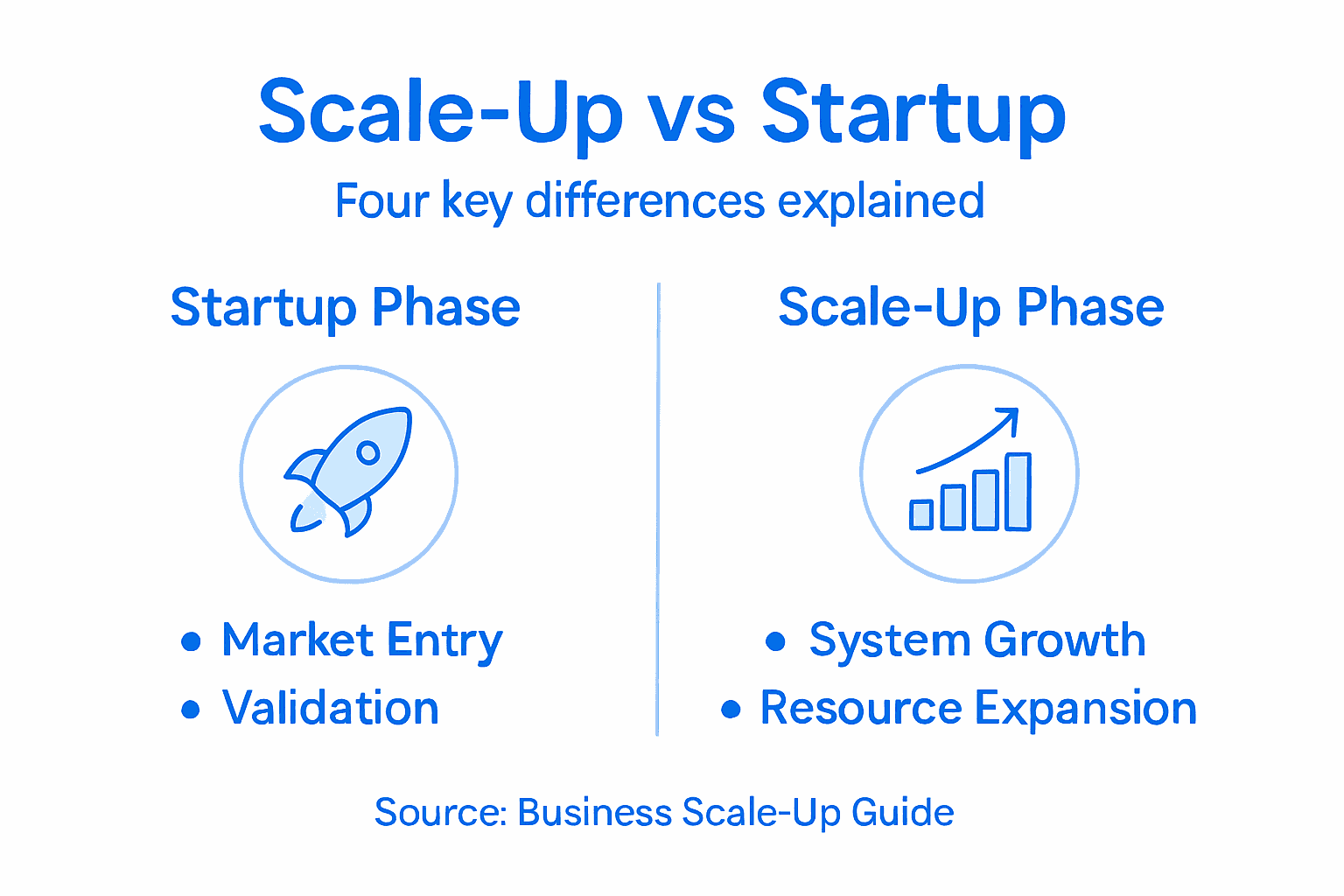
While startups and scale-ups are often conflated, they represent distinctly different stages of business development. A startup typically focuses on product validation, initial market entry, and proving a business concept, whereas a scale-up represents a more mature phase of strategic expansion and systematic growth.
International business scaling involves complex organisational transformations that extend far beyond the initial startup mentality. Scale-ups demonstrate more sophisticated operational capabilities, including:
- Established revenue streams
- Proven business models
- Robust infrastructure
- Advanced leadership structures
- Capacity for cross-border expansion
The primary differences between startups and scale-ups can be categorised across several critical dimensions:
- Financial Stability: Startups often operate with limited funding and uncertain revenue, while scale-ups have consistent financial performance
- Market Position: Startups seek market validation; scale-ups dominate specific market segments
- Operational Complexity: Scale-ups manage more intricate organisational ecosystems
- Growth Strategy: Startups experiment; scale-ups execute deliberate, systematic expansion plans
Pro tip: Recognise your business’s current developmental stage to implement appropriate growth strategies.
Here is a summary comparison of startups and scale-ups across key dimensions:
| Dimension | Startup | Scale-Up |
|---|---|---|
| Main Focus | Market entry and validation | Systematic, sustainable growth |
| Revenue Base | Unstable or limited | Established and consistent |
| Organisational Structure | Informal and flexible | Robust and systematic |
| Market Position | Seeking position | Leading segment player |
Essential Ingredients For Scaling Success
Successful business scaling requires a strategic blend of capabilities that transform potential into sustainable growth. Mastering the extrapolation stage involves shifting from pure growth to profitable expansion, which demands a comprehensive approach to organisational development.
The core ingredients for scaling success encompass multiple interconnected dimensions. Businesses must develop robust strategies that address both internal capabilities and external market opportunities:
- Leadership Quality: Strong, adaptive leadership that can navigate complex growth challenges
- Innovation Capacity: Continuous improvement and adaptive problem-solving
- Market Fit: Deep understanding of customer needs and value propositions
- Scalable Infrastructure: Flexible systems that can support rapid expansion
- Financial Discipline: Consistent monetisation and resource management
Strategic Scaling Framework:
- Develop a clear vision for sustainable growth
- Build adaptable organisational structures
- Invest in talent development
- Create robust performance measurement systems
- Maintain financial resilience
Scaling is not about growing bigger, but growing smarter and more strategically.
Organizational learning and resource acquisition play critical roles in enabling businesses to manage complexity while maintaining operational effectiveness. Successful scale-ups understand that growth is a multifaceted journey requiring continuous adaptation.

Pro tip: Regularly audit your business systems and capabilities to identify potential scaling constraints before they become critical limitations.
Typical Challenges And Risks In Scaling Up
Scaling a business is fraught with complex challenges that can derail even the most promising ventures. High-growth firms face significant barriers in accessing external finance, creating substantial obstacles to sustainable expansion.
The primary risks and challenges in scaling up can be categorised into several critical domains:
- Financial Constraints: Limited access to capital and funding gaps
- Organisational Complexity: Managing increasingly intricate business processes
- Talent Management: Recruiting and retaining skilled professionals
- Leadership Transition: Evolving from founder-led to systematic management
- Market Adaptation: Maintaining competitive relevance during growth
Specific challenges that can impede scaling include:
- Insufficient financial literacy
- Resistance to external investment
- Operational scalability limitations
- Strain on existing organisational systems
- Leadership capacity constraints
Scaling is fundamentally about managing complexity while maintaining strategic momentum.
The transition from founder-driven to industrialised growth models represents a critical inflection point where many businesses struggle. Companies must develop robust systems that can support accelerated growth without compromising core operational effectiveness.
Pro tip: Develop comprehensive scaling strategies that anticipate potential constraints and build adaptive organisational capabilities.
Critical Steps And Success Factors For SMEs
Small and medium enterprises (SMEs) require strategic approaches to navigate the complex landscape of business growth. Scalable business model innovation represents a critical pathway for sustainable expansion, demanding comprehensive strategic planning and adaptive capabilities.
Key success factors for SMEs seeking meaningful growth include:
- Strategic Positioning: Developing clear market differentiation
- Financial Resilience: Maintaining robust cash flow management
- Talent Development: Investing in skilled human capital
- Innovation Capacity: Creating flexible, adaptive business models
- External Networking: Building strategic partnerships and connections
Critical steps for successful scaling involve:
- Conduct comprehensive market research
- Develop robust strategic planning frameworks
- Invest in technological infrastructure
- Build agile organisational capabilities
- Create systematic performance measurement processes
Sustainable scaling requires more than growth—it demands strategic transformation.
SMEs must overcome financial constraints through strategic resource mobilization, leveraging external networks and developing sophisticated managerial skills to compete effectively in global markets.
Pro tip: Develop a holistic scaling strategy that integrates financial, operational, and human capital considerations.
Unlock Sustainable Growth With Expert Guidance
Scaling your business is more than just increasing size it involves careful planning to manage complexity, build leadership capacity, and ensure financial stability as highlighted in the article. If you are facing challenges such as organisational complexity, limited access to capital, or the need for a clear scaling strategy, you are not alone. Many businesses struggle to transition from startup to scale-up without losing momentum or operational effectiveness.
At Summit SCALE, we specialise in empowering business owners through tailored coaching that addresses these exact hurdles. By focusing on strategic growth, leadership development, and scalable infrastructure, our business coaches help you unlock greater profitability and freedom. Discover proven approaches and success stories in our Business Scaling Archives and deepen your understanding of deliberate business expansion through Business Growth Archives.
Ready to transform your scaling challenges into opportunities for sustainable success Schedule your free 15-minute assessment call today at Summit SCALE and take the first step towards growing smarter and faster. Start building a resilient business that thrives long term with expert support from seasoned professionals in the Business Coach Archives. Your future scale-up story begins now.
Frequently Asked Questions
What is the difference between business growth and business scaling?
Business growth refers to any increase in size or revenue, while business scaling specifically involves strategically expanding capabilities to support sustainable growth without a proportional increase in costs.
Can established companies scale effectively?
Yes, established businesses can pursue strategic scaling initiatives, allowing them to revitalise operations and enhance their market presence.
What are common myths about business scale-up?
Common myths include the belief that scale-ups are exclusively tech startups, that scaling happens automatically, and that growth is synonymous with scaling. True scaling involves deliberate strategies and sustainable expansion.
What are the essential ingredients for successful scaling?
Successful scaling requires strong leadership, continuous innovation, a deep understanding of market fit, scalable infrastructure, and financial discipline to manage resources effectively.
Recommended
- Business Growth Models Explained: Paths To Lasting Success
- Why Scale a Small Business: Unlocking Profit and Freedom
- Sustainable Business Growth – Unlocking Lasting Value
- Step by Step Business Growth: Achieve Profitable Scaling
- 7 Key Benefits of Corporate Videos for B2B Marketers
- Financial Clarity: Unlocking Small Business Success

