
TL;DR:
- Clear business objectives transform vision into actionable steps that motivate teams and drive measurable growth.
- Using frameworks like SMART goals or OKRs strategically helps small businesses stay focused, adaptable, and aligned.
- Regular reviews, visible tracking, and leadership engagement are essential for sustaining progress and overcoming common pitfalls.
Running a business without clear objectives is like navigating without a map. You might be working hard every single day, but without a defined destination, it is surprisingly easy to drift. Many business owners invest enormous energy into their work, yet still struggle to track real progress, motivate their teams, or make confident decisions about where to put their resources. Business objectives provide clarity, focus, alignment, and measurability, turning strategy into actionable execution for small and medium-sized businesses. This guide will show you exactly how to set objectives that create momentum, drive measurable results, and help your business grow with purpose.
Table of Contents
- What are business objectives and why do they matter?
- How clear objectives drive growth, productivity, and motivation
- SMART goals vs. OKRs: Which framework works for your business?
- Common pitfalls to avoid when setting business objectives
- Turning objectives into action: Practical strategies for SMBs
- A fresh take: Most business objective advice gets this wrong
- Maximise your business potential with expert support
- Frequently asked questions
Key Takeaways
| Point | Details |
|---|---|
| Objectives drive focus | Clear business objectives keep your team aligned and focused on what matters most. |
| Choose the right framework | SMART goals are best for achievable targets; OKRs for ambitious, innovation-driven growth. |
| Review and adjust regularly | Quarterly reviews and open communication help ensure objectives stay effective and relevant. |
| Limit objectives for success | Focusing on 2–3 objectives prevents overload and boosts chances of meaningful progress. |
What are business objectives and why do they matter?
Now that you see why ambiguity costs your business, let’s demystify what business objectives are and why they should be your top priority.
A business objective is a specific, measurable outcome that your business commits to achieving within a defined timeframe. Think of it as the bridge between your big-picture vision and the daily decisions your team makes. Without that bridge, your vision stays locked in your head rather than showing up in your results.
Many business owners assume that having a general sense of direction is enough. “I want to grow the business” or “I want to make more money” sound like objectives, but they are not. They lack the precision needed to guide action, prioritise resources, or measure success. This is one of the most common and costly myths in small business leadership.
Business objectives: definition, importance & examples highlights four key pillars that well-crafted objectives deliver:
- Clarity: Everyone in your business understands what success looks like.
- Focus: Time and energy go to activities that genuinely move the needle.
- Alignment: Your team pulls in the same direction, reducing friction and confusion.
- Measurability: You can track progress and make informed decisions based on real data.
Another common myth is that formal objectives are only for large corporations with strategic planning departments. In reality, the smaller your team, the more critical it is that every person understands exactly what you are working towards. A ten-person team rowing in different directions will never outpace a five-person team rowing in perfect sync.
“Objectives ensure resource allocation to priorities, prevent drift, and enable performance-based decisions.”
When you invest in understanding business growth objectives explained, you begin to see how objectives transform your vision into everyday action. Each team member knows what they are responsible for, why it matters, and how their contribution connects to the bigger picture. That connection is powerful, and it is what separates reactive businesses from genuinely scalable ones.
How clear objectives drive growth, productivity, and motivation
Understanding business objectives is a start, but how do they actually fuel daily progress and long-term achievement? Let’s look at the real-world impact.
Clear objectives do far more than keep your team busy. They create a culture of accountability and purpose that changes how people show up to work each day. When your team knows exactly what they are working towards, they make smarter decisions independently, reducing the need for constant management.

Research shows that team motivation and accountability improve significantly in small businesses when objectives are clear and visible. Stress levels drop because ambiguity is replaced with direction. People stop wondering whether they are doing the right things and start focusing on doing them better.
Consider the impact on cash flow, one of the most common pressure points for growing businesses. Without a specific objective, you might review your financials monthly without knowing what you are actually looking for. With a clear objective, such as reducing outstanding invoices by 20% in the next 90 days, you know exactly which actions to prioritise, who is responsible, and when to review progress.
The same principle applies to sales. A vague desire to “get more customers” produces inconsistent effort. A specific objective to increase monthly recurring revenue by 15% in one quarter gives your sales team a tangible target, making it far easier to plan campaigns, track performance, and celebrate wins along the way.
| Business area | Without clear objectives | With clear objectives |
|---|---|---|
| Cash flow | Reactive management | Targeted reduction in outstanding invoices |
| Sales | Inconsistent effort | Measurable revenue targets per quarter |
| Team performance | Unclear accountability | Defined roles tied to specific outcomes |
| Operations | Ad-hoc problem-solving | Streamlined processes with benchmarks |
Successful businesses grow at 11.8% annually on average, and setting financial and sales objectives is one of the clearest paths to hitting that benchmark. The businesses achieving that figure are not necessarily working harder. They are working with greater clarity and discipline.
Pro Tip: When you unlock growth and focus through well-defined objectives, your team’s energy compounds over time. Small, consistent wins build momentum that accelerates growth far beyond what sporadic bursts of activity ever could. If you want to explore a structured approach, the profitable scaling guide at Summit SCALE is a fantastic place to start.
SMART goals vs. OKRs: Which framework works for your business?
Clarity on growth benefits leads naturally to the next challenge: choosing the right framework to set and track your objectives effectively.
Two frameworks dominate the conversation when it comes to setting business objectives: SMART goals and OKRs (Objectives and Key Results). Both are genuinely useful. The question is knowing which one fits your situation.
SMART goals follow a well-established formula. Each goal must be:
- Specific: Clearly defined with no room for ambiguity.
- Measurable: Tracked with concrete data or milestones.
- Achievable: Realistic given your resources and constraints.
- Relevant: Directly connected to your broader business priorities.
- Time-bound: Attached to a clear deadline.
SMART goals work brilliantly for operational targets, steady improvement, and situations where you want your team to achieve something confidently within their current capabilities. They are particularly effective for smaller teams who are still building their planning muscles.
OKRs work differently. An OKR consists of an inspiring, qualitative Objective paired with two to five Key Results that define what achieving it looks like in measurable terms. The objective sets direction with ambition; the key results keep it grounded.
Companies using OKRs see 30% greater success in ambitious goals and a 25% improvement in overall goal achievement. OKRs are particularly powerful when you want to push boundaries, enter a new market, or inspire your team to innovate. OKRs address lack of inspiration by linking daily work to a larger, motivating purpose, which directly boosts engagement.
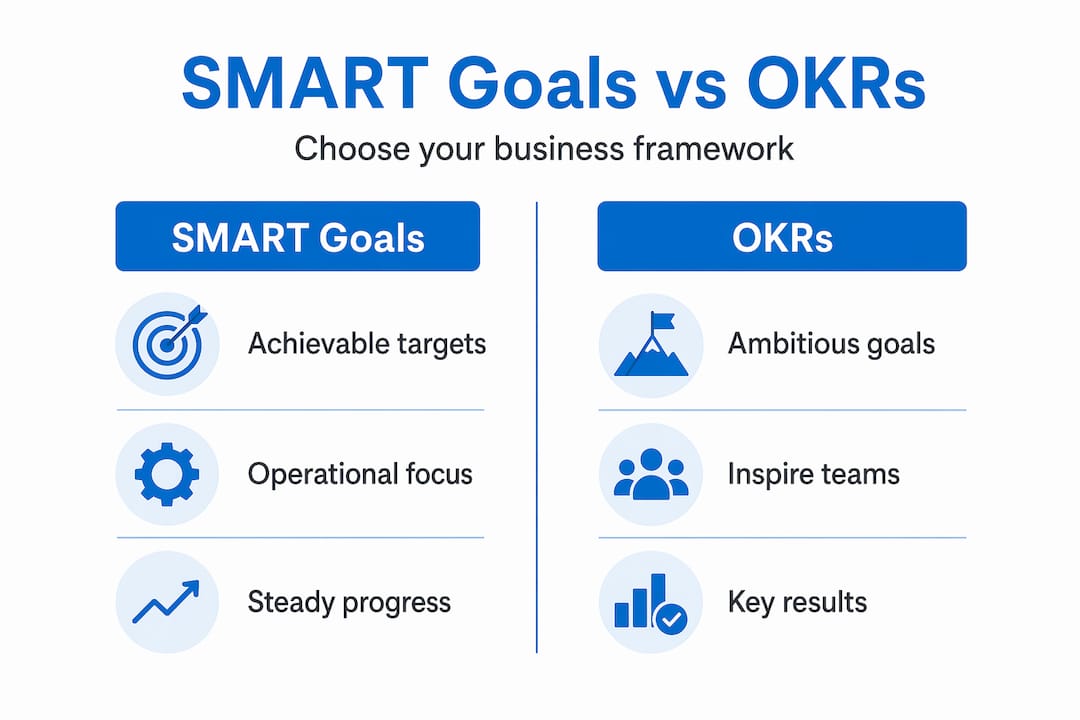
| Factor | SMART goals | OKRs |
|---|---|---|
| Best for | Achievable, operational targets | Ambitious, stretch goals |
| Team size | Any size | Works especially well for growing teams |
| Review cycle | Monthly or quarterly | Quarterly |
| Inspiration level | Moderate | High |
| Measurement | Outcome-based | Key results tracking |
Pro Tip: Do not feel pressured to choose just one framework. Many high-performing businesses use SMART goals for routine operational targets and OKRs for their growth and innovation priorities. Exploring the types of business goals that align with your stage of growth will help you decide which approach fits each area of your business best.
Common pitfalls to avoid when setting business objectives
Choosing a framework is just the start. The real test lies in setting your objectives the right way and avoiding the classic traps that hold businesses back.
The most common mistake is trying to do too much at once. When every priority becomes urgent, nothing truly is. Resource-limited SMBs suffer from over-prioritising, where too many objectives scatter attention and dilute results. The solution is simple but requires discipline: limit yourself to two or three key objectives at any one time. This is not settling for less. It is being strategic about where your focus creates the most value.
Here are the most damaging pitfalls to avoid:
- Setting too many objectives simultaneously: Scatter focus and you scatter results. Pick fewer, pursue them harder.
- Skipping regular reviews: Objectives without review become wallpaper. They fade into the background and lose their power to guide decisions.
- Annual-only planning cycles: Quarterly cycles outperform annual ones for market adaptability. A lot can change in twelve months, and rigid annual objectives often become irrelevant before they are achieved.
- Tying objectives to compensation in small teams: This might sound logical, but avoiding compensation links in small teams is a key expert recommendation. It can shift motivation from genuine achievement to gaming the metric, eroding trust and collaboration.
- No visible tracking: If your team cannot see progress, they cannot feel it. Progress visibility is a powerful motivator.
“Weekly check-ins and visible tracking are among the most effective practices for keeping objectives alive and relevant in small business environments.”
The fix for most of these pitfalls is consistent rhythm. Weekly check-ins do not need to be long or formal. Even a 15-minute team conversation about where things stand keeps objectives front of mind and surfaces small issues before they become big ones. Quarterly reviews give you the space to step back, assess whether your objectives still make sense, and adjust them if the market has shifted.
For practical guidance on building these rhythms, explore the workflow for sustainable results and long-term business planning resources available through Summit SCALE.
Turning objectives into action: Practical strategies for SMBs
With pitfalls to dodge, let’s finish by covering the practical steps to embed business objectives into your workflow for real, repeatable progress.
Knowing what an objective should look like is very different from actually living it week to week. Here is a straightforward process for making objectives stick:
- Set with intention: Define your two to three priority objectives for the quarter. Write them down clearly, share them with your team, and explain the why behind each one.
- Communicate openly: Make sure every team member understands how their daily work connects to these objectives. People work differently when they understand the purpose behind their tasks.
- Track consistently: Choose one or two key metrics for each objective and review them weekly. Keep it visible, whether that means a shared dashboard, a whiteboard in the office, or a brief team update.
- Adjust without guilt: If an objective is no longer relevant due to market shifts or new information, change it. Holding on to irrelevant targets simply to appear consistent is a form of stubbornness that costs real growth.
- Celebrate progress: Recognise milestones, not just final outcomes. Building a culture that values progress keeps energy high and sustains momentum through the inevitable challenges.
“Managerial competencies and goal setting are among the most significant positive influences on strategic goal achievement in small and medium-sized enterprises.”
This finding is important because it places leadership directly at the centre of objective-setting success. Your ability to communicate, coach, and maintain focus over time is just as critical as the quality of the objectives themselves. Developing your leadership skills alongside your planning process is not optional. It is the engine that keeps everything moving.
A simple quarterly calendar might look like this: set objectives in week one, run weekly check-ins throughout, hold a mid-quarter review at week six, and conduct a full review and reset in week twelve. This rhythm creates structure without bureaucracy, and it keeps your team engaged without overwhelming them.
For a full breakdown of how to move from intention to execution, the steps for sustainable success guide offers a detailed and practical roadmap.
A fresh take: Most business objective advice gets this wrong
Most guides on business objectives focus almost entirely on which framework to use. SMART or OKR? Annual or quarterly? The frameworks matter, but they are not what separate businesses that grow from those that stagnate.
What actually makes the difference is how you talk about your objectives with your team, and how willing you are to adapt them when reality changes.
Many business owners set strong objectives in January, file them away, and pull them out again in December wondering why they were not achieved. The problem is not the objective. It is the absence of ongoing conversation around it. Objectives need to breathe. They need to be talked about regularly, questioned honestly, and adjusted when circumstances shift.
Adaptability and cultural fit matter far more than system perfection. A beautifully crafted OKR that nobody believes in will always underperform a rough-and-ready SMART goal that your team owns completely. Culture beats process, every single time. If your team does not feel connected to an objective, no framework in the world will make them pursue it with genuine energy.
The businesses we see grow fastest are not those with the most sophisticated planning systems. They are the ones where the leader has a weekly, honest conversation with their team about what is working, what is not, and what might need to change. That kind of ongoing dialogue creates the agility that rigid systems simply cannot manufacture.
The lesson? Use frameworks as tools, not temples. Keep your objectives few, keep them visible, and keep talking about them. That simple habit will do more for your business than any planning retreat ever could.
Maximise your business potential with expert support
Knowing the theory behind business objectives is valuable. But putting it into consistent practice, especially while managing the daily demands of running a business, is where most owners find it hardest. That is exactly where coaching makes the biggest difference.
When you invest in coaching, you gain more than accountability. You gain a thinking partner who helps you identify the right objectives, build the systems to track them, and stay focused when distractions pull you off course. At Summit SCALE, our approach to coaching for SME growth is built around exactly these principles. We work with business owners to set meaningful objectives, create actionable plans, and build the leadership capacity to sustain results over time. If you are ready to move from intention to measurable progress, book your free 15-minute assessment call today and let’s build something great together.
Frequently asked questions
How often should I review my business objectives?
Review your objectives at least quarterly, as quarterly cycles beat annual ones for keeping your business adaptable and responsive to market changes.
What’s the key difference between business goals and objectives?
Goals set a broad direction for your business, while objectives break down the specific, measurable steps and timelines needed to actually get there.
Should I use SMART goals or OKRs for a small team?
Use SMART goals for realistic, achievable targets and OKRs for ambitious, stretch goals that require team innovation and a higher level of inspiration.
How many objectives should a small business set at once?
Limit yourself to 2 to 3 objectives at any one time to maintain genuine focus and avoid scattering your team’s energy across too many competing priorities.
How do clear business objectives affect team motivation?
They provide purpose and progress visibility, which improve team motivation and accountability while significantly reducing the stress that comes from unclear expectations and drifting direction.

