
Scaling a business often feels like a complex maze rather than a simple staircase. For many American and Australian entrepreneurs, the challenge lies in separating reality from myths about rapid, effortless growth. Understanding the strategic transformation behind true scaling is vital for sustainable progress and profitability. This overview dispels common misconceptions and highlights the deliberate, systematic actions needed to create lasting business impact and greater personal freedom.
Table of Contents
- Scaling Basics And Misconceptions
- Key Benefits Of Scaling For Owners
- Types Of Scalable Business Models
- Critical Factors For Sustainable Expansion
- Risks, Costs And Common Pitfalls
- Coaching’s Role In Scaling Success
Key Takeaways
| Point | Details |
|---|---|
| Misunderstanding Scaling | Entrepreneurs often equate scaling with rapid growth, but it requires strategic systems and organisational development for sustainability. |
| Transformational Leadership | Successful scaling necessitates a shift from being operational technicians to strategic leaders who design and implement systems. |
| Adaptable Business Models | Selecting a scalable business model that supports automation and recurring revenue is crucial for sustainable expansion. |
| Comprehensive Risk Management | Entrepreneurs must understand and manage financial and operational risks to avoid pitfalls associated with premature scaling. |
Scaling Basics and Misconceptions
Scaling a small business isn’t about magical overnight growth or simply expanding headcount. It’s a strategic transformation that demands careful planning, intentional systems development, and a nuanced understanding of organisational dynamics. Many entrepreneurs mistakenly view scaling as a straightforward linear progression, when in reality, it represents a complex, multidimensional journey.
The scaling process involves systematic coordination across multiple organisational dimensions. Most business owners misunderstand scaling by assuming it means rapid size expansion. However, true scaling encompasses more sophisticated elements:
- Financial infrastructure development
- Operational efficiency improvements
- Leadership capacity enhancement
- Strategic market positioning
- Sustainable growth methodology
Contrary to popular belief, scaling isn’t just about increasing revenue or hiring more staff. Comprehensive scaling requires understanding innovation diffusion and transformational system changes. This means creating adaptable frameworks that support consistent performance while maintaining organisational flexibility.
Sustainable scaling demands deliberate, systematic actions over extended time horizons, not quick tactical manoeuvres.
Successful scaling requires entrepreneurs to transition from being technicians who do the work to strategic leaders who design systems. This shift involves developing robust processes, building high-performance teams, and creating organisational architectures that can support consistent growth without compromising quality or culture.
Here is a comparison of commonly misunderstood concepts versus the reality of business scaling:
| Misconception | Actual Reality | Business Impact |
|---|---|---|
| Scaling is just hiring more staff | True scaling is system and process driven | Avoids unnecessary wage costs |
| Growth is always linear | Scaling is multi-dimensional and complex | Prevents unrealistic expectations |
| Only revenue increase matters | Infrastructure, leadership, and sustainability are equally critical | Preserves long-term viability |
| Fast growth guarantees success | Measured, strategic growth is more sustainable | Reduces risk of failure |
Pro tip: Invest time in mapping your current business systems before attempting to scale, identifying precise bottlenecks and opportunities for strategic improvement.
Key Benefits of Scaling for Owners
Scaling a business represents far more than numerical growth—it’s a transformative journey towards personal and professional liberation. Most entrepreneurs initially start their businesses seeking freedom, yet ironically find themselves trapped in daily operational constraints. Scaling offers a strategic pathway to break free from these limitations, creating sustainable systems that generate wealth and opportunity.
The core benefits of scaling extend well beyond financial metrics. Business owners who successfully scale can expect to experience:
- Increased personal income potential
- Reduced daily operational dependency
- Enhanced business valuation
- Greater organisational resilience
- Improved strategic control
- Expanded market opportunities
Strategic business scaling fundamentally reshapes an entrepreneur’s relationship with their enterprise. Instead of being consumed by day-to-day tasks, owners can transition into true leadership roles, making high-level strategic decisions that drive meaningful growth and innovation.
Scaling transforms business owners from technicians who work in their business to architects who design their business’s future.
Financial freedom emerges as a critical benefit of scaling. By developing robust systems, delegating effectively, and creating repeatable processes, entrepreneurs can generate passive revenue streams and build organisations that generate value independent of their constant personal input. This shift allows business owners to reclaim time, reduce personal stress, and create opportunities for personal and professional exploration.

Pro tip: Invest in creating documented, systematised processes that can function without your direct daily involvement, enabling true business scalability.
Types of Scalable Business Models
Scaling a business requires selecting an appropriate business model that aligns with your strategic growth objectives. Not all business models are created equal—some inherently support rapid expansion while others create significant implementation challenges. Understanding the landscape of scalable models is crucial for entrepreneurs seeking sustainable growth.
Scalable business models can be categorised across multiple dimensions, each with unique characteristics and growth potential:
-
Digital Service Models
- Software-as-a-Service (SaaS)
- Subscription-based platforms
- Online consulting services
-
Product-Based Models
- Digital product sales
- Productised service offerings
- Recurring revenue product lines
-
Network-Effect Models
- Marketplace platforms
- Community-driven services
- Collaborative economy platforms
The core distinction between scalable and non-scalable models lies in their ability to generate revenue without proportionally increasing operational costs. Successful scalable models create systems that can grow exponentially while maintaining relatively stable resource requirements.
A truly scalable business model generates increasing returns with minimal incremental investment.
Entrepreneurs must carefully evaluate their chosen model’s replicability and adaptability. Some models, particularly those leveraging digital technologies, offer remarkable scaling potential by minimising physical infrastructure constraints and enabling rapid market penetration.
Below is a summary of how different business model types support scalability features:
| Model Type | Automation Potential | Recurring Revenue | Market Reach |
|---|---|---|---|
| Digital Service | Very high | High | Global |
| Product-Based | Moderate | Possible | Wide |
| Network-Effect | High | Variable | Expansive |
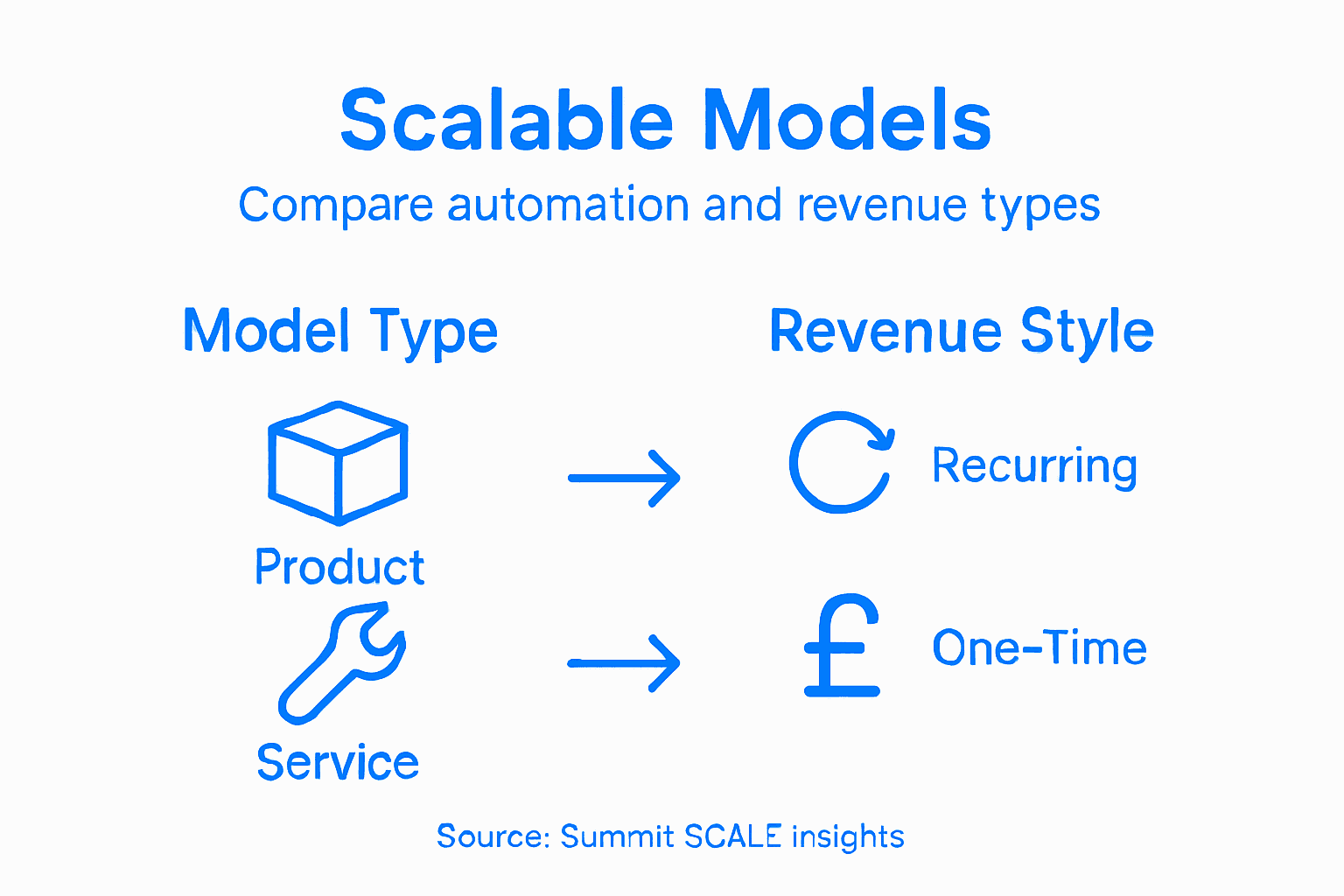
Pro tip: Choose a business model that naturally supports automation, recurring revenue, and minimal marginal costs to maximise your scaling potential.
Critical Factors for Sustainable Expansion
Sustainable business expansion requires far more than ambition—it demands a strategic and holistic approach. Entrepreneurs must navigate complex organisational dynamics, balancing growth objectives with operational resilience and long-term viability. Understanding the critical factors that enable consistent, meaningful scaling is essential for transforming potential into measurable progress.
Sustainable scaling strategies encompass multiple interconnected dimensions that business owners must systematically address:
-
Organisational Infrastructure
- Robust operational systems
- Scalable technology platforms
- Clear decision-making frameworks
-
Leadership and Talent
- Strategic vision alignment
- Continuous skills development
- Performance management processes
-
Financial Management
- Predictable revenue streams
- Strategic capital allocation
- Risk management protocols
The fundamental prerequisite for sustainable expansion is developing organisational capabilities that can absorb and integrate growth without compromising existing performance. This requires creating adaptable systems that can scale efficiently while maintaining quality and operational integrity.
Sustainable scaling is not about growing faster, but growing smarter with intentional, measured progression.
Successful entrepreneurs recognise that sustainable expansion involves more than numerical growth. It demands a comprehensive approach that considers technological readiness, stakeholder engagement, and the ability to consistently deliver value across increasingly complex operational environments.
Pro tip: Develop comprehensive documentation of your business processes and create scalable systems that can function independently of individual team members.
Risks, Costs and Common Pitfalls
Scaling a business is not a straightforward journey—it’s a complex landscape fraught with potential financial and operational challenges. Entrepreneurs must navigate these risks with strategic awareness, understanding that unchecked expansion can rapidly transform promising opportunities into costly setbacks.
Business scaling risks manifest across multiple critical dimensions:
-
Financial Risks
- Resource overextension
- Cash flow volatility
- Excessive capital investment
-
Operational Challenges
- Complexity management
- System integration failures
- Talent acquisition difficulties
-
Strategic Vulnerabilities
- Market misalignment
- Brand dilution
- Loss of core customer focus
The most dangerous pitfall is scaling prematurely without establishing robust organisational infrastructure. Many entrepreneurs mistake rapid growth for sustainable development, overlooking the fundamental need for systematic preparation and measured progression.
Scaling success demands discipline: moving forward strategically, not just quickly.
Comprehensive risk management requires entrepreneurs to continuously assess their organisational readiness, understanding that each growth phase introduces unique challenges. Maintaining agility while building strong foundational systems becomes crucial in mitigating potential scaling-related risks.
Pro tip: Conduct quarterly strategic reviews to identify potential scaling risks and create adaptive mitigation strategies before they become critical problems.
Coaching’s Role in Scaling Success
Entrepreneurs often struggle to transition from managing day-to-day operations to becoming strategic leaders capable of scaling their businesses. Professional coaching emerges as a transformative intervention, bridging critical knowledge and capability gaps that hinder sustainable business growth.
Strategic coaching interventions provide entrepreneurs with targeted support across multiple crucial dimensions:
-
- Strategic thinking enhancement
- Decision-making skill refinement
- Emotional intelligence cultivation
-
Organisational Capabilities
- Systems design and implementation
- Performance management strategies
- Team development frameworks
-
Personal Growth Areas
- Mindset transformation
- Confidence building
- Resilience enhancement
Critical to understanding coaching’s value is recognising it as more than traditional consulting. Coaches act as strategic partners, challenging entrepreneurs’ perspectives and providing accountability mechanisms that drive meaningful organisational transformation.
Effective coaching transforms entrepreneurs from technicians trapped in daily operations to visionary architects of scalable enterprises.
The most impactful coaching relationships focus on developing adaptive capabilities, helping business owners navigate complexity, and creating sustainable growth strategies that extend beyond immediate tactical challenges. By providing objective external perspectives, coaches help entrepreneurs identify blind spots and design innovative scaling approaches.
Pro tip: Select a business coach with proven experience in your specific industry, ensuring they understand the unique scaling dynamics of your business model.
Unlock Your Business’s True Potential with Strategic Coaching
Scaling a small business is a complex journey demanding more than just rapid growth—it requires building sustainable systems, improving leadership, and creating lasting freedom. If you find yourself trapped in day-to-day operations or overwhelmed by the challenges of scaling, you are not alone. Key obstacles like developing robust processes, managing operational complexity, and transitioning from technician to visionary leader can stall your progress.
Summit SCALE specialises in empowering business owners to overcome these exact struggles through tailored coaching that focuses on strategic growth, profitability, and personal freedom. With expert guidance on building scalable systems, enhancing leadership capabilities, and driving sustainable expansion, you can break free from operational constraints and unlock true business potential.
Take the next step towards transforming your business and life. Visit Summit SCALE today and explore how our professional coaching services can help you design systems that generate wealth while giving you back your time. Don’t wait to create the freedom and profit you deserve. Schedule your free 15-minute assessment call now and start leading your business with confidence.
Frequently Asked Questions
What does it mean to scale a small business?
Scaling a small business involves creating strategic systems and processes that allow an organisation to grow sustainably without correspondingly increasing operational costs. It’s a multidimensional transformation that requires careful planning and management.
Why is financial infrastructure important for scaling?
A solid financial infrastructure enables businesses to manage cash flow effectively, allocate resources strategically, and support growth initiatives. It helps ensure that revenue increases can be realised without jeopardising financial stability.
How can business owners reduce their operational dependency while scaling?
Business owners can reduce operational dependency by creating documented processes and systems that allow other team members to handle day-to-day activities. This delegation frees owners to focus on strategic decision-making and high-level growth initiatives.
What role does leadership play in successfully scaling a business?
Effective leadership is crucial for scaling a business, as it involves aligning the team with the organisation’s vision, fostering innovation, and managing the complexities of growth. Leaders must cultivate their skills and build strong teams to navigate the challenges of expansion.

