
TL;DR:
- Scalability allows revenue growth with minimal proportional increase in costs.
- Building repeatable processes and automation is key to creating a scalable business.
- Owner involvement and customized services often hinder business scalability.
Many small business owners pour everything into growing their business, only to find that more revenue brings more stress, more costs, and less freedom. Sound familiar? The truth is, growth and scalability are not the same thing, and confusing the two is one of the most common and costly mistakes in the SME world. Scalable businesses can increase revenue with incremental cost growth, achieving higher profitability and resilience. In this guide, you will discover exactly what scalability means, how it differs from ordinary growth, and the practical steps you can take to build a business that works harder so you do not have to.
Table of Contents
- Defining business scalability: more than just growth
- Core characteristics of a scalable business
- Practical steps to build scalability in your business
- Real-world examples: what scalable SMEs do differently
- Why most SMEs limit their own scalability (and how to escape the trap)
- Unlock your business scalability with expert support
- Frequently asked questions
Key Takeaways
| Point | Details |
|---|---|
| Scalability differs from growth | Business scalability means expanding efficiently, not just growing bigger. |
| Essential traits are systematisation and standardisation | Repeatable processes, automation, and streamlined offerings make scalability possible. |
| Take practical steps to scale | Assess your business and implement systems, technology, and team development. |
| Avoid owner bottlenecks | Transition from being the centre of operations to building a business that runs independent of you. |
| Expert support accelerates scalability | Coaching and proven frameworks help SMEs move from intention to scalable reality. |
Defining business scalability: more than just growth
Growth and scalability are often used interchangeably, but they describe very different realities. Growth simply means your business is getting bigger. More clients, more staff, more output. The problem? Costs tend to grow at the same rate as revenue, leaving your profit margins frustratingly thin. Scalability, by contrast, is about growing your capacity to generate revenue without a proportional rise in costs. Think of it as building a machine that becomes more efficient the harder it works.
According to the scalability definition used in business finance, a scalable model is one that can handle increased demand without a corresponding increase in operational costs. That distinction is everything. It is the difference between a business that traps you and one that liberates you.
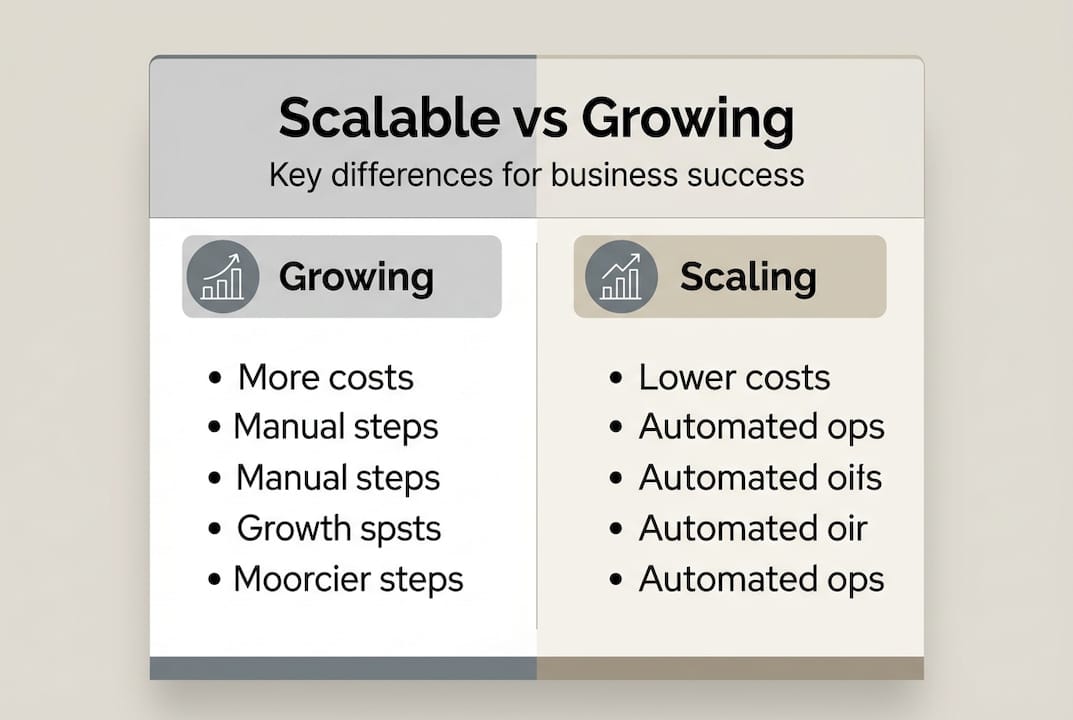
Here is a quick comparison to make this tangible:
| Factor | Growing a business | Scaling a business |
|---|---|---|
| Cost structure | Costs rise with revenue | Costs grow slowly as revenue rises |
| Resource demands | More staff, more spend | Systems and automation carry the load |
| Profit potential | Margins often stay flat | Margins improve as volume increases |
| Owner involvement | Increases with size | Decreases as systems take over |
| Resilience | Vulnerable to disruption | Adapts more easily to change |
Scalable businesses also enjoy a significant competitive advantage. When demand spikes or a new opportunity appears, they can respond quickly without scrambling to hire, spend, or restructure. That agility is priceless. Research consistently shows that scalable models yield up to three times higher profit margins on average compared to traditionally grown businesses.
The key benefits of building scalability into your business include:
- Greater profitability as revenue grows faster than costs
- More personal freedom because systems replace your constant involvement
- Stronger resilience when markets shift or demand fluctuates
- Higher business valuation when it comes time to sell or attract investment
- Confidence that your business can grow without breaking
If you want to understand the full picture, the scaling a business growth guide offers a thorough walkthrough of what this journey looks like in practice.
Core characteristics of a scalable business
With the difference between growth and scalability clarified, it is time to see exactly what makes a business truly scalable. Not every business is built to scale, but every business can be rebuilt with scalability in mind. The question is: does yours have the right foundations?
A scalable business model is one where an increase in customers or output does not lead to a significant increase in costs, as outlined in business scale-up traits. That principle shapes everything from how you deliver your service to how you hire and manage your team.
Here is a checklist of the core traits to look for and develop:
- Repeatable processes: Your delivery method is documented and consistent, not dependent on one person’s knowledge
- Automation: Routine tasks like invoicing, follow-ups, and reporting are handled by technology
- Modular services or products: Offerings are standardised enough to deliver at volume without bespoke reinvention each time
- Lean cost structure: Overheads are controlled, and variable costs are minimised wherever possible
- Strong team systems: Roles are clearly defined so the business does not collapse when you step back
| Trait | Scalable business | Non-scalable business |
|---|---|---|
| Sales process | Automated and systemised | Manual and owner-led |
| Service delivery | Standardised and repeatable | Bespoke for every client |
| Onboarding | Digital and self-serve | Time-intensive and manual |
| Decision-making | Delegated through clear systems | Bottlenecked at the owner |
| Technology use | Central to operations | Minimal or inconsistent |
Many SMEs are held back by warning signs they do not even recognise. If every new client requires a custom solution, if you cannot take a week off without things falling apart, or if your margins shrink as you get busier, these are signals that your business is growing but not scaling. The step-by-step business scaling framework can help you identify and address these gaps systematically.

Also, a scientific approach to scaling up from Harvard Business Review highlights that businesses which invest in process clarity before scaling are significantly more likely to sustain growth long term.
Pro Tip: Focus first on your core processes before attempting to scale anything else. Scaling chaos only creates bigger chaos. Get your foundations solid, then build upward.
Practical steps to build scalability in your business
Once you know the traits of scalability, the next step is taking clear actions to embed these capabilities in your own business. Knowing is one thing. Doing is another. Here is a sequenced approach that works.
- Systematise your core operations. Document every key process so it can be repeated without you. Start with your highest-volume activities. Adopting scalable systems is a leading factor in the sustainable growth of SMEs.
- Implement automation. Identify tasks that are repetitive and time-consuming. Use tools to automate invoicing, customer communications, scheduling, and reporting. This frees your team to focus on higher-value work.
- Standardise your offerings. The more bespoke your service, the harder it is to scale. Create tiered or packaged options that deliver consistent value without requiring a custom build every time.
- Invest in scalable technology. Choose platforms that grow with you. A CRM, project management tool, or marketing automation system can carry enormous operational load as your volume increases.
- Build a strong, empowered team. Hire people who can own their roles. Delegate with clarity. Your team should be able to make decisions without routing everything through you.
Common pitfalls to avoid include scaling too fast before your systems are ready, and ignoring bottlenecks in the hope they will resolve themselves. They will not. The five steps to scale your business outlined by Entrepreneur magazine reinforce that preparation always precedes sustainable expansion.
“The systems you build today are the freedom you enjoy tomorrow. Without robust processes, every new customer is a new problem rather than a new opportunity.”
If you want to explore this further, how to scale business and scalable growth best practices offer practical frameworks you can apply immediately.
Pro Tip: Test before you invest. Pilot any new scalable initiative on a small segment of your business first. Prove the model works, then roll it out more broadly.
Real-world examples: what scalable SMEs do differently
Concrete examples clarify theory, so let us look at what successful, scalable businesses actually do that others do not. The patterns are consistent, and once you see them, you will start recognising opportunities in your own operation.
Elevating processes such as automated customer onboarding or digital marketing allows SMEs to profitably handle higher customer volumes without proportional increases in staffing or cost. That is the scalable advantage in action.
Here is what scalable SMEs consistently do differently:
- They use systemised marketing funnels that generate and nurture leads without constant manual input
- Their client onboarding is digital and automated, reducing time-to-value for new customers
- They offer modular or productised services that can be delivered at volume without reinvention
- They track key performance indicators weekly so they can spot and fix bottlenecks early
- They invest in leadership development so managers can make quality decisions independently
Consider a small consultancy that moves from bespoke project work to a standardised three-tier service model. Suddenly, the team can onboard five clients in the time it previously took to onboard one. Revenue grows. Costs barely move. That is scalability working exactly as it should. Scaling success stories from Forbes illustrate how this pattern repeats across industries.
SMEs with standardised delivery grow revenue up to 60% faster than those relying on bespoke, owner-led approaches. That statistic alone should prompt a serious look at how your business currently delivers its core offering.
The role of leadership in this process cannot be overstated. Explore leadership’s role in scaling to understand how the right mindset and management approach accelerates every other element of scalability.
Why most SMEs limit their own scalability (and how to escape the trap)
Here is an uncomfortable truth: in most cases, the biggest obstacle to scalability is not the market, not the competition, and not the economy. It is the owner.
When every decision passes through you, when every client relationship depends on your personal involvement, and when every process lives in your head rather than a documented system, your business will never outgrow you. You become the ceiling.
Excessive customisation is another trap. Clients may love the bespoke touch, but if every engagement requires a unique solution, you are running a craft studio, not a scalable enterprise. Real freedom and maximised profit only come when you build systems that operate without your constant intervention.
The shift requires courage. It means trusting your team, standardising what feels personal, and accepting that letting go is not a loss of control but a gain of leverage. Coaching for scalability can be the catalyst that helps you make that shift with confidence and clarity.
Unlock your business scalability with expert support
Understanding scalability is a powerful first step. Turning that understanding into lasting change is where most business owners benefit from structured, expert support.
Summit SCALE® Coaching works with small and medium-sized business owners to move from theory to action, building the systems, strategies, and leadership clarity needed to scale profitably. Whether you are just beginning to think about scalability or you are ready to accelerate, our tailored coaching programmes are designed to meet you where you are. Explore the business coaching benefits and discover growth strategies for SMBs that align with your goals. You can also review our proven business growth steps to see the full journey ahead. Book your free 15-minute assessment call today and take the first real step toward a business that scales.
Frequently asked questions
What is the main difference between business growth and scalability?
Business growth means getting bigger, while scalability means expanding efficiently without greatly increasing costs. Scalable businesses can increase revenue without proportional increases in cost, which is what drives lasting profitability.
How do I know if my business is scalable?
If you can add customers or revenue without significant additional effort, resources, or costs, your business is likely scalable. A scalable model increases output with little cost growth, which is the clearest indicator of true scalability.
What is the first step to making a business scalable?
The first step is systematising your core operations so they can run repeatably without you. Systematising operations is a key initial step toward scalability and the foundation everything else is built upon.
Can small businesses really achieve scalability?
Absolutely. Small businesses regularly achieve scalability by focusing on automation, standardisation, and lean systems. SMEs leveraging scalable processes grow revenue faster and more sustainably than those relying on traditional, owner-led approaches.

