
TL;DR:
- Sustainable scaling grows revenue efficiently without increasing costs proportionally.
- It focuses on long-term viability by balancing economic, social, and environmental pillars.
- Strategic consolidation and system building are essential for durable business growth.
Most business owners assume that scaling means growing as fast as possible. But 92% of SaaS businesses fail within three years, often because they chased speed over substance. Sustainable business scaling is a different game entirely. It is about building a business that grows stronger with every step, not one that cracks under the pressure of its own ambition. This guide cuts through the confusion, explains what sustainable scaling truly means, and gives you a practical roadmap you can apply to your enterprise right now.
Table of Contents
- Defining sustainable business scaling
- The pillars of sustainable scaling: more than just profit
- Frameworks and strategies for SMEs: the roadmap to scale sustainably
- Pitfalls and edge cases: dangers of scaling too fast
- Maximising sustainable scaling: lessons from success stories
- A practical perspective: consolidation over relentless growth
- Set your sustainable scaling journey in motion
- Frequently asked questions
Key Takeaways
| Point | Details |
|---|---|
| Sustainable scaling | Grow your business by increasing revenue without proportional increases in cost, burnout, or complexity. |
| Pillars of sustainability | Embed economic, environmental, and social considerations for scaling that lasts and attracts talent. |
| Frameworks matter | Following structured roadmaps and setting clear goals make sustainable scaling practical for SMEs. |
| Avoid rapid scaling risks | Rapid, unchecked growth often leads to failure; prioritise solid systems and regular consolidation for success. |
| Expert guidance | Leverage real-world lessons, frameworks, and professional coaching to avoid pitfalls and maximise SME scaling. |
Defining sustainable business scaling
There is a critical difference between growing a business and scaling one. Most people use the words interchangeably, but they describe very different realities. Understanding this distinction could be the most important shift you make this year.
Growth, in the traditional sense, means your revenue and your costs rise together. You win more clients, so you hire more people, buy more equipment, and spend more on operations. The numbers go up, but so does the pressure on your margins. Scaling is fundamentally different. Scaling grows revenue without proportional cost increases, meaning your business becomes more efficient as it expands, not more expensive.
Sustainable business scaling is growing revenue and operations in a way that maintains long-term viability without burnout or quality compromise. It is the kind of growth that does not hollow out your team, erode your product standards, or leave you exhausted at the end of every quarter. For SMEs, this is not just a nice idea. It is a survival strategy.
Why does efficiency matter more than expansion speed? Because speed without systems creates chaos. When you scale sustainably, you build processes that can handle increased demand without requiring you to personally manage every moving part. You create a business that works for you, rather than one that consumes you.
Here are the key benefits of what scaling means done sustainably for SMEs:
- Improved profit margins as revenue grows faster than costs
- Stronger team retention because workloads remain manageable
- Consistent quality that protects your reputation and customer loyalty
- Greater resilience during market downturns or disruptions
- More personal freedom for the business owner
| Factor | Traditional growth | Sustainable scaling |
|---|---|---|
| Cost trajectory | Rises with revenue | Stays relatively flat |
| Team pressure | Increases significantly | Managed through systems |
| Quality control | Often compromised | Maintained or improved |
| Owner involvement | Grows with the business | Decreases over time |
| Long-term viability | Uncertain | Deliberately built in |
“Sustainable scaling is not about how fast you can grow. It is about how well your business can handle that growth without losing what made it great in the first place.”
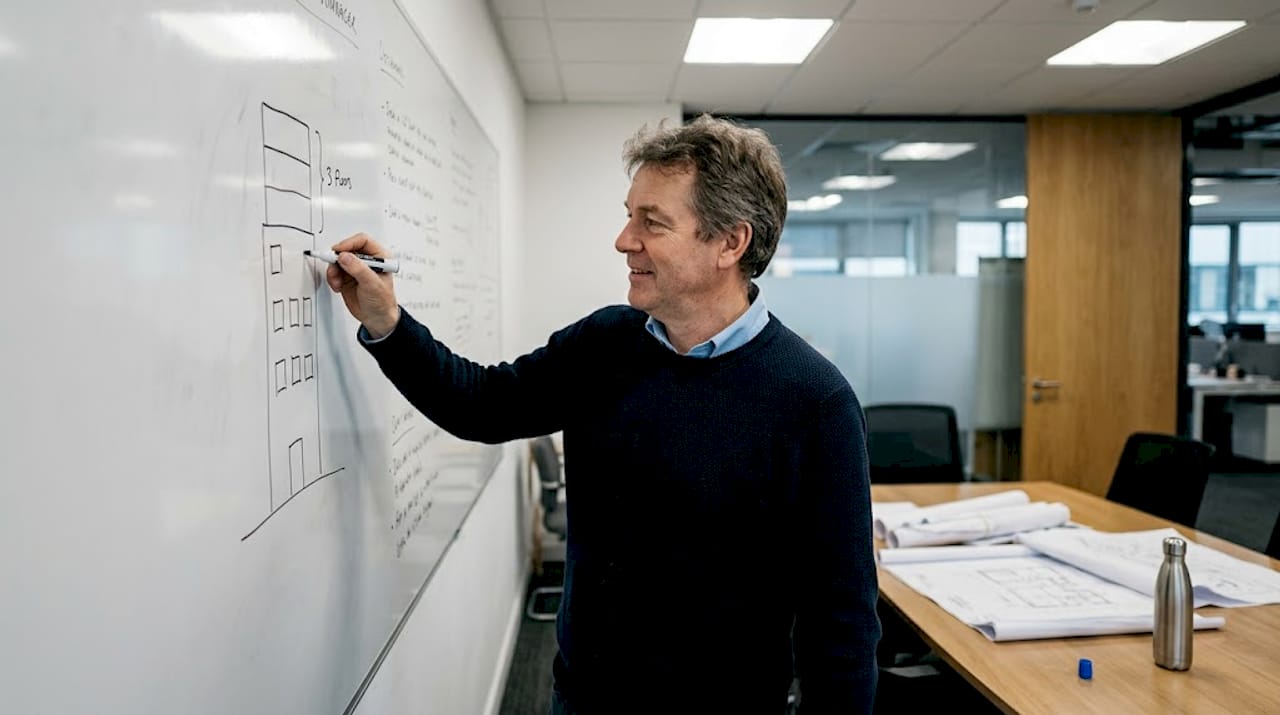
Think of your business as a structure. Growth adds floors quickly. Scaling reinforces the foundations so those floors do not collapse. For lasting growth strategies, the foundation always comes first.
The pillars of sustainable scaling: more than just profit
Sustainable scaling rests on three interconnected pillars: economic, social, and environmental. Many SME owners focus almost entirely on the economic pillar, which is understandable. Profit keeps the lights on. But businesses that neglect the other two pillars often find that short-term gains come at a long-term cost.
The economic pillar is about building profitable, efficient systems. It means controlling costs, diversifying revenue, and making decisions based on data rather than instinct alone.
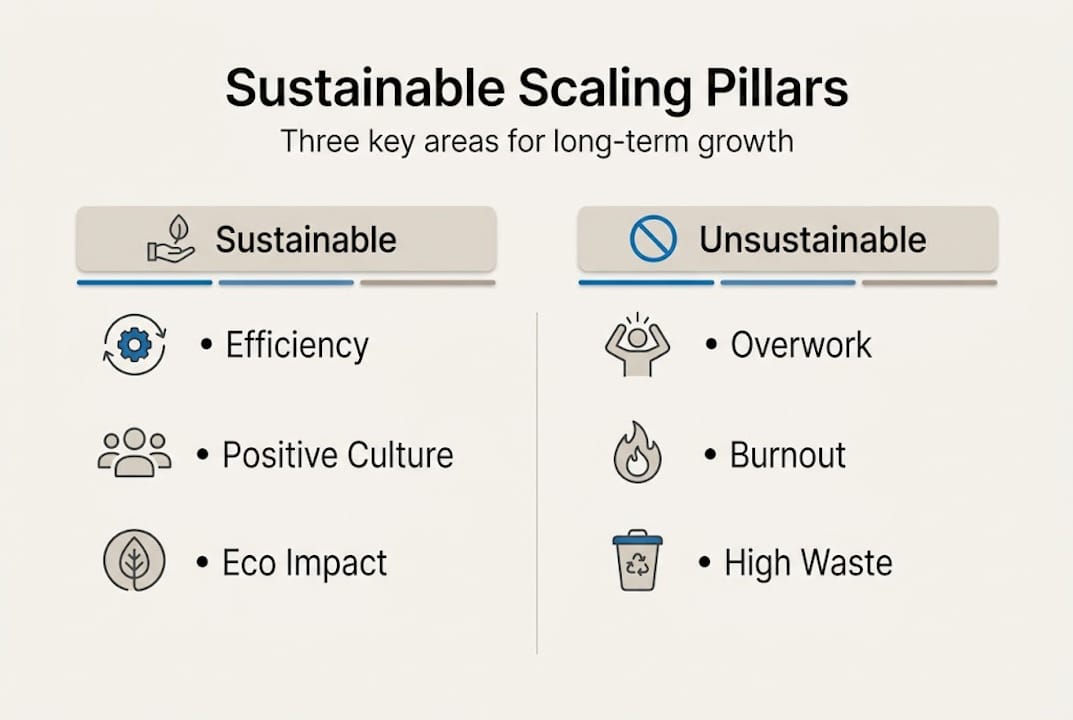
The social pillar covers your people, your culture, and your community impact. A business that burns out its team or ignores its community is not truly scaling sustainably, regardless of what the revenue figures say.
The environmental pillar is increasingly relevant for SMEs. Customers, investors, and talent are all paying closer attention to how businesses treat the planet. This is not just ethics. It is competitive advantage.
Setting SMART business goals across all three pillars is the starting point. According to the WEF’s 2025 SME roadmap, key methodologies include conducting audits, implementing practices across pillars, building systems, leveraging technology, and prioritising retention.
Here are practices to embed in each pillar:
- Economic: Automate repetitive processes, review pricing regularly, track key financial metrics monthly
- Social: Invest in team development, build a feedback culture, support flexible working where possible
- Environmental: Reduce waste in operations, choose sustainable suppliers, measure and report your carbon footprint
| Pillar | Sustainable approach | Unsustainable approach |
|---|---|---|
| Economic | Efficiency-led growth | Revenue at any cost |
| Social | Invest in people and culture | Overwork and high turnover |
| Environmental | Responsible sourcing | Ignore environmental impact |
Exploring sustainable scalability through this three-pillar lens transforms scaling from a purely financial exercise into a business-wide strategy. And it works. Businesses that align sustainability goals with profitability consistently outperform those that treat them as separate concerns. You can explore different growth model approaches to find the right fit for your enterprise.
Pro Tip: Aligning your sustainability goals with your profitability targets is not a compromise. It is a multiplier. Businesses that do this well attract better talent, win more loyal customers, and build stronger brands.
Frameworks and strategies for SMEs: the roadmap to scale sustainably
Knowing the principles is one thing. Having a clear roadmap is another. The World Economic Forum’s 5-stage SME roadmap offers a structured, practical approach that prioritises efficiency over raw growth. Here is how to apply it:
- Set goals. Define what sustainable scaling looks like for your business. Use SMART criteria: specific, measurable, achievable, relevant, and time-bound.
- Conduct an audit. Assess your current operations, costs, team capacity, and environmental impact. You cannot improve what you have not measured.
- Implement changes. Introduce systems, processes, and tools that support sustainable growth. Start with the highest-impact areas first.
- Monitor progress. Track your key metrics consistently. Adjust your approach based on real data, not assumptions.
- Engage stakeholders. Bring your team, customers, and suppliers into the journey. Sustainable scaling is a collective effort.
Here is a striking reality: SMEs represent 90% of all businesses globally and employ around 70% of the workforce. The way SMEs scale has an enormous impact on economies and communities. That is both a responsibility and an opportunity.
For a profitable step-by-step scaling approach, the roadmap above gives you a structure you can start applying this week. The key is consistency, not perfection.
Pro Tip: Technology and automation are your greatest allies under resource constraints. A well-chosen tool can replace hours of manual work, freeing your team to focus on higher-value activities. Look at practical scaling strategies that leverage automation from the outset.
Pitfalls and edge cases: dangers of scaling too fast
Scaling too quickly is one of the most common and costly mistakes SME owners make. The ambition is admirable. The execution, without the right foundations, can be devastating.
Here are the top pitfalls of scaling too quickly:
- Burnout among founders and key team members
- Loss of product or service quality as demand outpaces capacity
- Cultural dilution as rapid hiring erodes your core values
- Tech debt, where rushed digital solutions create long-term operational problems
- Cash flow crises from overextending before revenue catches up
The numbers are sobering. 92% of SaaS companies fail within three years, with 73% never reaching £1 million in annual recurring revenue. And only 12% of startups that receive Series A funding successfully scale to enterprise level.
“The blitzscale era is ending. Businesses that survived by burning cash and growing at all costs are now facing the consequences. Efficiency and consolidation are the new competitive advantages.”
The Zenefits story is a cautionary tale worth knowing. The HR software company grew from zero to £1.7 billion in valuation in just two years, then collapsed under the weight of compliance failures, cultural chaos, and operational dysfunction. Premature scaling led to 46% annual churn, cultural dilution, and crippling tech debt. The lesson is not that ambition is dangerous. It is that ambition without infrastructure is a liability.
For a deeper look at what scaling really involves, explore these business scale-up insights before committing to your next growth phase.
Maximising sustainable scaling: lessons from success stories
The good news is that sustainable scaling works. Businesses that get it right do not just survive. They thrive, often outperforming faster-growing competitors over the long term.
Key lessons from successful sustainable scalers:
- Focus before expansion. Master your core offering before diversifying. Depth beats breadth in the early stages.
- Build systems first. Document your processes, automate where possible, and create structures that do not depend entirely on you.
- Balance all three pillars. Economic, social, and environmental health reinforce each other. Neglect one and the others weaken.
- Measure what matters. Vanity metrics like follower counts mean little. Focus on profit margins, customer retention, and team engagement.
- Pace your hiring. Bring in the right people at the right time, not just when you feel overwhelmed.
The sustainable fashion sector offers a compelling data point. The sustainable fashion market was valued at $9.81 billion in 2025, growing at a 9.1% compound annual growth rate. This is powerful evidence that embedding sustainability into your business model is not a constraint. It is a growth engine.
| Metric | Unsustainable scaling | Sustainable scaling |
|---|---|---|
| Staff turnover | High (30%+) | Low (under 10%) |
| Profit margin trend | Declining | Stable or improving |
| Customer retention | Volatile | Consistently strong |
| Revenue growth | Spiky and unpredictable | Steady and compounding |
The path to small business profit scaling is rarely a straight line. But businesses that commit to sustainable principles consistently reach their destination with their culture, quality, and energy intact.
A practical perspective: consolidation over relentless growth
Here is something most scaling guides will not tell you: sometimes the bravest thing you can do is stop pushing and start consolidating.
The business world glorifies momentum. More clients, more revenue, more markets. But sustainable scaling often means pausing to fix operational debt before the next growth spurt. It means asking hard questions: Are our systems holding up? Is our team well? Are our customers still getting the experience we promised?
Strategic slowdowns are not failure. They are maintenance. A racing car that skips its pit stop does not win the race. It breaks down on the track. The same applies to your business. Pausing to reinforce your foundations, recalibrate your strategy, and restore your team’s energy is not a step backwards. It is what makes the next leap possible.
At Summit SCALE, we have seen this pattern repeatedly. The businesses that scale most durably are not always the fastest. They are the most deliberate. They know when to accelerate and, crucially, when to consolidate. Explore how coaching in scaling can help you make those judgement calls with clarity and confidence.
Pro Tip: Build a quarterly review into your calendar. Assess your systems, your team’s wellbeing, and your customer experience before deciding whether to push for the next growth phase.
Set your sustainable scaling journey in motion
You now have a clear picture of what sustainable business scaling looks like, why it matters, and how to apply it. The next step is making it real for your business.
At Summit SCALE, we specialise in helping SME owners build the clarity, systems, and confidence needed to scale without burning out. Whether you are just starting to think about scaling or you are already in the thick of it, our coaching programmes and growth strategies for SMBs are designed to meet you where you are. Discover why invest in coaching and how coaching for scaling can accelerate your results. Book your free 15-minute assessment call today and take the first deliberate step towards lasting growth.
Frequently asked questions
How does sustainable scaling differ from growing a business?
Sustainable scaling increases revenue without proportional costs or resource strain, while traditional growth usually expands both revenue and expenses at the same pace.
What is the first step for small businesses aiming to scale sustainably?
Begin by setting clear, measurable sustainability goals aligned with efficiency and long-term profitability, as outlined in the WEF SME roadmap.
Why do so many businesses fail when trying to scale?
Most failures occur from scaling too quickly without proper foundations. 92% of SaaS firms fail within three years, often due to operational debt and burnout.
Can environmental and social goals support SME profitability?
Yes. According to WEF research, environmental and social sustainability can reduce costs, attract stronger talent, and unlock entirely new revenue streams.

