
You’re putting in the hours, pushing hard every single day, yet your revenue seems to plateau and your costs keep climbing. Sound familiar? The frustration of working harder without seeing proportional results is one of the most common experiences among small and medium-sized business owners. The good news is that scaling your business is not about doing more of the same. It’s about doing things smarter, with the right structure, systems, and strategy in place. This guide walks you through six practical steps to grow your business profitably, covering everything from foundational readiness to sales optimisation.
Table of Contents
- Understand the foundations of scalable growth
- Prepare for scaling: planning, finances, and resources
- Step-by-step execution: building systems and teams
- Optimise sales, marketing, and revenue for rapid scaling
- What most business scaling guides miss
- Scale your business with expert support
- Frequently asked questions
Key Takeaways
| Point | Details |
|---|---|
| Plan before scaling | A clear plan, solid finances, and resource assessment are vital before growth. |
| Systematise for success | Documenting and automating processes lays the foundation for smooth expansion. |
| Grow sustainably | Aim for 15-30% annual revenue growth and avoid chasing scale at the expense of profit. |
| Sales and marketing matter | Well-optimised sales and diversified revenue are crucial to profitable scaling. |
| Get expert support | Coaching and strategic advice can dramatically improve your scaling outcomes. |
Understand the foundations of scalable growth
Before you can scale, you need to be clear on what scaling actually means. Many business owners confuse growth with scaling, but they are fundamentally different. Growth means adding revenue and resources at roughly the same rate. Scaling, on the other hand, means increasing revenue with flat costs. Think of it like this: if you double your clients but also double your headcount and overheads, you’ve grown. If you double your clients without doubling your costs, you’ve scaled.
Understanding where your business sits in its journey is equally important. The SMB growth stages typically follow this pattern:
- Startup (£0 to £100K): Proving product-market fit and finding your first customers
- Survival (£100K to £500K): Systematising delivery and stabilising cash flow
- Growth (£500K to £2M): Building teams and repeatable processes
- Expansion (£2M+): Entering new markets or adding new revenue streams
Knowing your stage helps you focus on the right priorities rather than leaping ahead before the foundations are solid.
| Factor | Growth | Scaling |
|---|---|---|
| Revenue | Increases | Increases significantly |
| Costs | Rise proportionally | Stay relatively flat |
| Headcount | Grows with revenue | Grows selectively |
| Systems | Ad hoc | Documented and automated |
| Profitability | Marginal gains | Exponential gains |
“Scaling is not just about getting bigger. It’s about getting smarter with every pound you spend and every hour your team invests.”
The prerequisite for unlocking lasting growth is a combination of solid product-market fit, core operational systems, and financial stability. Without these three pillars, any attempt to scale will likely create chaos rather than clarity. If you’re still asking why scale a small business at all, the answer is simple: done correctly, scaling gives you more revenue, more freedom, and a business that works for you rather than the other way around.
Prepare for scaling: planning, finances, and resources
With a clear picture of what scaling means and where you stand, the next step is preparation. Many business owners rush into expansion without a concrete plan, and that’s where costly mistakes begin. A solid scaling plan includes clear milestones, the metrics you’ll track, and a realistic view of the resources you’ll need. Creating a scaling plan with defined milestones and financial readiness checks is not optional. It’s essential.
Start by mapping your journey. What does success look like in 12 months? In 24? Set revenue targets, define the customer volume required to hit them, and identify the operational capacity you’ll need. Then work backwards to build your roadmap.
Key metrics to track during scaling include:
- Monthly Recurring Revenue (MRR): Are you building predictable income?
- Customer Acquisition Cost (CAC): How much does it cost to win a new client?
- Gross profit margin: Is revenue growth translating into actual profit?
- Employee productivity: Are your team members delivering consistent output?
- Cash conversion cycle: How quickly does revenue turn into cash in the bank?
Financial readiness is non-negotiable. You need strong cash flow, a reserve buffer of at least three to six months of operating costs, and a clear view of your funding options if growth accelerates faster than expected. Explore options such as business credit facilities, investor funding, or government-backed growth schemes.

| Resource area | What to prepare |
|---|---|
| People | Define roles needed for the next 12 months |
| Technology | Identify tools to automate manual tasks |
| Processes | Document core workflows before hiring |
| Finances | Secure reserves and funding options |
| Partnerships | Identify strategic alliances for capacity |
For a deeper look at what business scale-up explained really involves at this stage, it’s worth reviewing the key levers before committing budget. Equally, studying development best practices will sharpen your planning considerably.
Pro Tip: Resist the urge to hire before your processes are documented. Every new team member you bring in before your systems are solid will amplify existing inefficiencies rather than solve them.
Step-by-step execution: building systems and teams
Preparation sets the stage. Execution is where your scaling plan either gains momentum or stalls. The most common reason businesses struggle to scale is not a lack of ambition. It’s a lack of systems. Building scalable systems and hiring strategically for future needs are the two pillars of successful execution.
Here’s a practical step-by-step approach to building your systems:
- Identify your core processes. List every repeatable task in your business, from onboarding a client to processing an invoice.
- Document each process. Write clear, simple standard operating procedures (SOPs) that any team member can follow.
- Automate where possible. Use tools like CRM platforms, project management software, and accounting automation to remove manual effort.
- Test and refine. Run each system under real conditions and adjust based on what breaks or slows down.
- Train your team. Ensure every relevant team member understands and follows the documented processes consistently.
When it comes to technology, focus on tools that integrate well with each other. A CRM that connects to your email marketing platform, your invoicing software, and your project management tool creates a seamless operational backbone. This is how you scale output without scaling headcount at the same rate.
Hiring for scalability is a different mindset to hiring for today’s needs. Ask yourself: does this role support where we’re going, not just where we are? Prioritise versatile, adaptable people who can grow with the business. Avoid the trap of over-hiring in a growth surge and then cutting back when momentum slows.
For a detailed look at building a business team for growth, including which roles to prioritise and when, this resource offers a practical framework you can apply immediately.
Pro Tip: Cross-train your staff across at least two functional areas. This creates resilience, reduces single points of failure, and gives your team a broader understanding of how the business operates.
Optimise sales, marketing, and revenue for rapid scaling
With your systems and team in place, the focus shifts to fuelling growth through sales and marketing. This is where many business owners feel most comfortable, yet it’s also where costly mistakes are most common. Scaling your commercial efforts without the right foundations in place is like pressing the accelerator before checking the engine.
The goal here is to build predictable, repeatable revenue engines. That means developing sales processes that produce consistent results regardless of who is running them. It means marketing strategies that generate qualified leads at a cost that makes commercial sense. And it means diversifying your revenue so that no single client or channel represents more than 30% of your income.
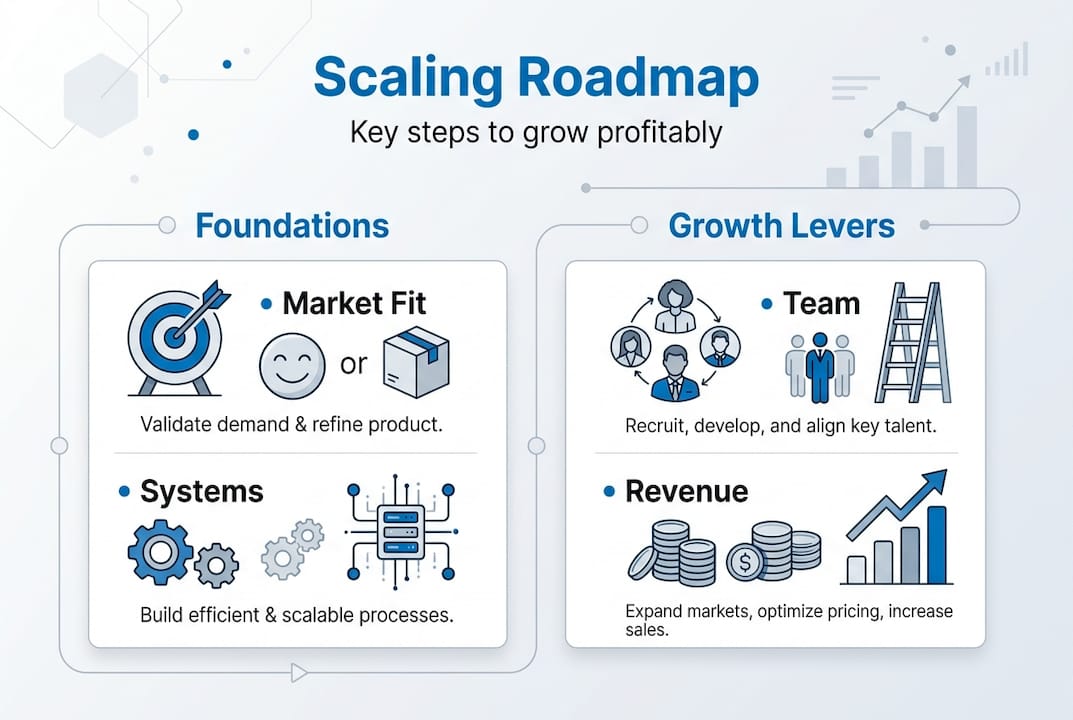
Sustainable revenue growth requires optimising your sales and marketing engines while protecting cash flow throughout expansion. For most SMBs, a sustainable annual growth rate sits between 15% and 30%. Chasing growth beyond this without the systems to support it often leads to quality issues, team burnout, and cash flow crises.
Top mistakes to avoid when ramping up commercial efforts:
- Discounting to win volume: This erodes margins and attracts price-sensitive clients who rarely stay long
- Neglecting existing clients: Acquiring new customers costs five times more than retaining current ones
- Scaling spend before proving ROI: Test marketing channels on a small budget before committing significant resource
- Ignoring upsell opportunities: Your existing client base is your most profitable growth lever
- Losing sight of cash flow: Revenue growth that outpaces collections is a fast route to financial stress
For practical guidance on optimising business development, prioritising sales growth, and exploring growth strategies for SMEs, these resources offer targeted, actionable direction. You’ll also find sales growth tips for 2026 particularly useful as you refine your commercial approach for the year ahead.
What most business scaling guides miss
Here’s the uncomfortable truth that most scaling guides gloss over: the majority of businesses that fail to scale don’t fail because of a bad product or a weak market. They fail because the owner tried to grow people before growing systems. We’ve seen this pattern repeatedly over five-plus years of helping SMEs scale. The business adds headcount, revenue ticks up, and then everything starts to crack. Delivery suffers. Clients complain. The owner ends up doing more work than before, not less.
Focusing on systems before teams is the single most important discipline in scaling. Yet it’s the step most often skipped in the excitement of early momentum.
The myth of ‘growth at any cost’ is seductive. Rapid revenue figures look impressive. But if your margins are shrinking, your team is exhausted, and your cash flow is unpredictable, that growth is a liability, not an asset. True scaling is disciplined. It’s intentional. It’s about building something that runs well without you having to be in every room at once.
Pause before your next hire. Ask yourself: have I documented this process? Can someone follow it without asking me three questions a day? If the answer is no, systematise first. The path to scale business for growth and freedom is paved with clarity, not just ambition.
Scale your business with expert support
Knowing the steps is one thing. Executing them consistently, under real business pressure, is another challenge entirely. That’s where having an experienced partner by your side makes a measurable difference.
At Summit SCALE, we work with business owners like you to build the clarity, systems, and strategy needed to scale profitably without burning out. Our business growth guide gives you a structured starting point, and our coaching programmes go deeper, offering accountability, frameworks, and real-world insight. If you’ve ever wondered why invest in coaching or how coaching in profitability actually works in practice, we’d love to show you. Book your free 15-minute assessment call today and take the first step towards a business that scales with confidence.
Frequently asked questions
What are the first signs my business is ready to scale?
Solid product-market fit, consistent cash flow, and repeatable delivery systems are the clearest signals. According to the SMB growth stages, businesses in the Survival phase (£100K to £500K) that have systematised their core operations are typically well-positioned to begin scaling.
How do I know if my systems can handle rapid growth?
If your processes are documented, largely automated, and produce consistent results under pressure, your systems are likely ready. Scalable systems are those that deliver the same quality output whether you’re serving 10 clients or 100.
What is a safe target for annual revenue growth?
For most SMBs, a sustainable annual growth rate of 15% to 30% is considered healthy and manageable. Growth beyond this without adequate systems and cash flow support can create more problems than it solves.
Is it better to hire early or wait until after building systems?
It’s almost always better to systematise and automate key processes before hiring. Focusing on systems first prevents the organisational chaos that comes from adding people to a business that isn’t yet structured to support them.

