
Most business owners in the United States and Australia underestimate the true impact of entrepreneurial coaching, with over 60 percent still confusing it with mentoring or consulting. For American or Australian entrepreneurs longing for rapid sales growth and smoother operations, understanding what sets entrepreneurial coaching apart is key. This article shines a light on common british misconceptions, uncovers the actual value of expert coaching, and guides you toward strategies that foster lasting business transformation.
Table of Contents
- Defining Entrepreneurial Coaching And Misconceptions
- Types Of Coaching For Business Owners
- Key Processes And Features Of Coaching
- Measurable Benefits For Entrepreneurs
- Common Pitfalls And How To Avoid Them
Key Takeaways
| Point | Details |
|---|---|
| Understanding of Entrepreneurial Coaching | Entrepreneurial coaching focuses on experiential learning and personal growth, distinguishing itself from traditional mentoring and consulting. |
| Types of Coaching | Three primary coaching types – developmental, strategic, and investor-related – cater to different stages and needs of entrepreneurs. |
| Collaborative Process | Successful coaching relies on a collaborative relationship built on mutual trust and transparent communication. |
| Avoiding Common Pitfalls | Entrepreneurs should establish clear objectives and ensure coach compatibility to maximise the effectiveness of their coaching experience. |
Defining entrepreneurial coaching and misconceptions
Entrepreneurial coaching represents a specialised professional development approach designed to support business founders in navigating complex strategic challenges. Unlike traditional mentoring or consulting, entrepreneurial coaching focuses on experiential learning that empowers entrepreneurs to develop critical self-efficacy skills through reflective practice.
The fundamental distinction lies in how entrepreneurial coaching differs from other business support interventions. While mentoring typically involves knowledge transfer from an experienced professional, coaching emphasises personal growth, strategic thinking, and skill development tailored to each entrepreneur’s unique context. Entrepreneurial coaches work collaboratively with business owners, helping them uncover internal resources, challenge limiting beliefs, and create actionable strategies for sustainable business growth.
Misconceptions about entrepreneurial coaching are widespread, often stemming from a lack of understanding about its nuanced approach. Many entrepreneurs mistakenly view coaching as a prescriptive service where an expert provides direct solutions. In reality, coaching involves a multifunctional developmental intervention that supports entrepreneurs across different stages of their business journey by facilitating personal and professional transformation through guided reflection and strategic questioning.
Here’s a concise comparison highlighting key differences between entrepreneurial coaching, mentoring, and consulting:
| Attribute | Entrepreneurial Coaching | Mentoring | Consulting |
|---|---|---|---|
| Primary Focus | Experiential learning, self-efficacy | Knowledge sharing, guidance | Direct problem-solving advice |
| Approach | Reflective dialogue, strategy | Experience-based answers | Recommendations and solutions |
| Role of Professional | Facilitate personal discovery | Share expertise and successes | Analyse and address specific tasks |
| Business Impact | Sustainable growth, mindset shift | Skill transfer, expanded network | Immediate tactical improvements |
Pro tip: When selecting an entrepreneurial coach, prioritise professionals who demonstrate a deep understanding of your specific industry and can provide personalised guidance aligned with your unique business challenges.
Types of coaching for business owners
Entrepreneurial coaching encompasses several distinct typologies designed to address the multifaceted challenges business owners encounter. Coaching approaches can be categorised within a two-dimensional framework that considers both consultation style and developmental focus, ensuring targeted support for diverse entrepreneurial needs.
Three primary coaching types emerge as particularly significant for business owners. Developmental coaching concentrates on personal skill enhancement, helping entrepreneurs build critical competencies like strategic thinking, emotional intelligence, and leadership capabilities. Strategic coaching focuses more directly on business growth, assisting owners in refining business models, identifying market opportunities, and developing robust scaling strategies. The third category, investor-related coaching, targets entrepreneurs seeking external funding, providing guidance on investment readiness, pitch development, and financial performance optimisation.
The nuanced differences between coaching types become crucial when selecting the most appropriate support. Different coaching functions emerge across entrepreneurial process stages, recognising that an entrepreneur’s needs evolve from initial concept development through to mature business operations. Some coaches specialise in early-stage startup challenges, while others excel in supporting established businesses navigating complex growth transitions. Understanding these distinctions allows business owners to select coaching interventions precisely matched to their current developmental requirements.
To clarify the main coaching types for business owners, see this summary table:
| Coaching Type | Main Emphasis | Suitable For | Example Outcome |
|---|---|---|---|
| Developmental | Personal skill growth | Early-stage entrepreneurs | Enhanced leadership ability |
| Strategic | Business expansion | Scaling/upgrading businesses | Refined business model |
| Investor-Related | Investment readiness | Funding-seeking founders | Improved investor pitch |
Pro tip: Before engaging a business coach, conduct a comprehensive self-assessment of your current business challenges and personal development goals to ensure you select a coaching approach that provides maximum strategic value.
Key processes and features of coaching
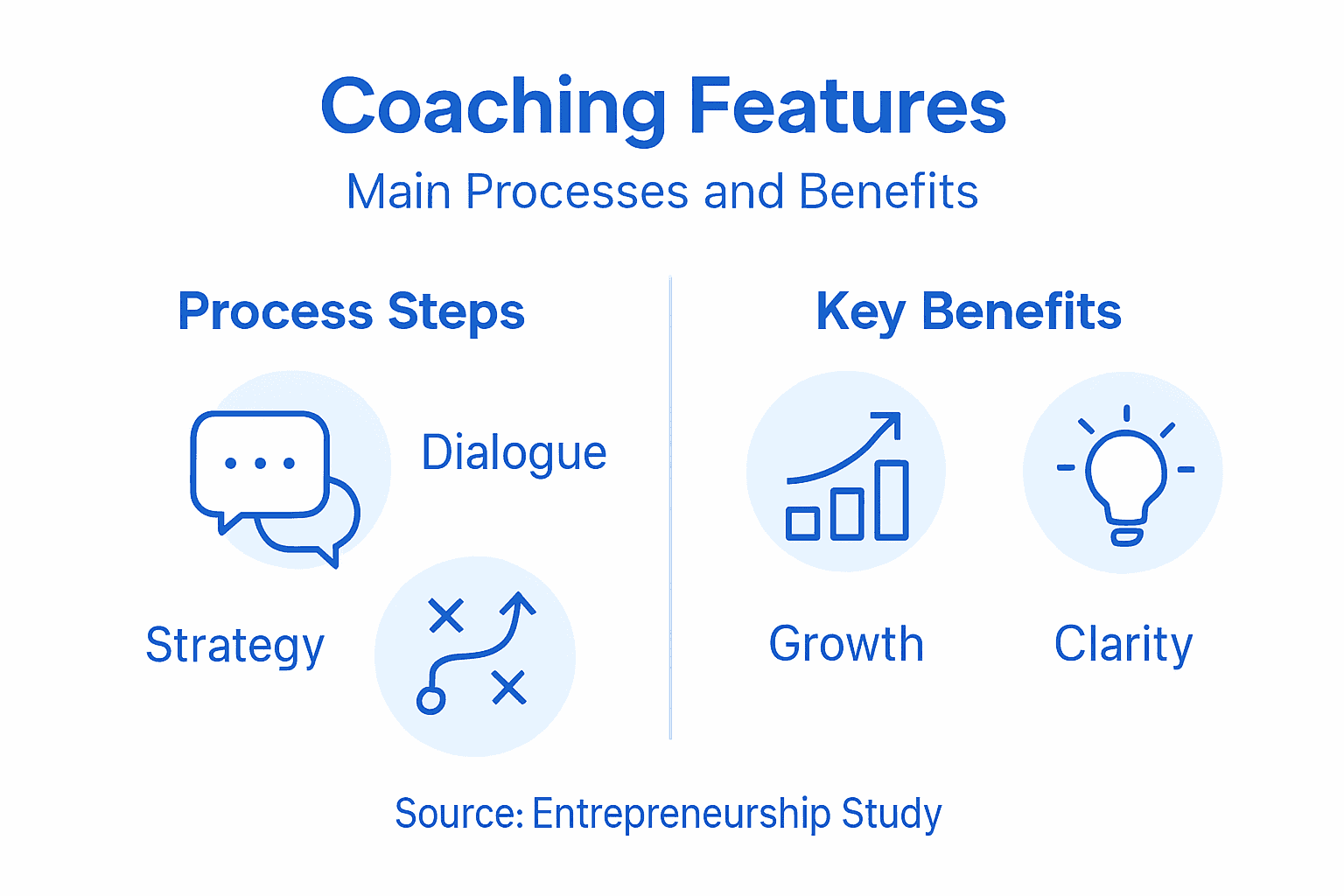
Collaborative relationships form the cornerstone of entrepreneurial coaching, establishing a dynamic framework that transcends traditional consulting approaches. These relationships are strategically designed to support entrepreneurs through complex business challenges, emphasising mutual trust, transparent communication, and personalised performance enhancement.
The key processes of entrepreneurial coaching involve several critical components. Reflective dialogue serves as the primary mechanism for uncovering insights, where coaches facilitate deep introspection about business strategies, personal limitations, and growth opportunities. Performance mapping represents another crucial feature, involving systematic tracking of business objectives, identifying potential barriers, and developing targeted interventions. Coaching success depends on entrepreneurs’ openness to change and coaches’ adaptive intervention strategies, ensuring that support mechanisms remain flexible and responsive to evolving business landscapes.
Entrepreneurial coaching distinguishes itself through its holistic approach, integrating psychological, strategic, and operational dimensions. Coaches employ sophisticated diagnostic tools to assess not just business performance, but also the entrepreneur’s mindset, leadership capabilities, and personal development trajectory. This multidimensional approach allows for nuanced, contextually informed guidance that addresses both immediate business challenges and long-term growth potential.
Pro tip: Document your coaching interactions and progress systematically, creating a reflective journal that tracks your personal and professional development milestones.
Measurable benefits for entrepreneurs
Entrepreneurial coaching delivers substantial, quantifiable outcomes that transform business performance and personal leadership capabilities. These benefits extend beyond traditional consulting, offering entrepreneurs a strategic approach to navigating complex business landscapes with measurable, data-driven improvements.

The most significant benefits manifest across several key performance dimensions. Innovation capacity receives a remarkable boost, with coaching enabling entrepreneurs to develop more creative problem-solving approaches and enhance product development strategies. Managerial competence improves dramatically, as coaching supports entrepreneurs in making better decisions and overcoming operational challenges. Entrepreneurs experience increased confidence, improved strategic thinking, and a more resilient approach to business uncertainties. Quantifiable metrics often include enhanced customer engagement, more effective team leadership, and accelerated business growth rates.
Beyond immediate performance indicators, entrepreneurial coaching generates long-term transformative impacts. Entrepreneurs develop heightened self-awareness, more sophisticated leadership skills, and a structured approach to continuous personal and professional development. The coaching relationship creates a reflective environment where business owners can critically analyse their strategies, challenge existing assumptions, and cultivate a growth-oriented mindset that transcends traditional business improvement methodologies.
Pro tip: Establish clear, measurable objectives with your coach at the outset of your engagement, ensuring you can systematically track and evaluate your personal and business development progress.
Common pitfalls and how to avoid them
Entrepreneurial coaching presents multiple potential challenges that can undermine the effectiveness of professional development interventions. Understanding these pitfalls is crucial for entrepreneurs seeking meaningful, transformative coaching relationships that drive genuine business growth.
One primary challenge involves the blurred boundaries between coaching and mentoring. Role confusion can lead to unrealistic expectations and ineffective support mechanisms. Entrepreneurs often mistakenly assume coaches will provide direct solutions, whereas effective coaching focuses on facilitating self-discovery and strategic thinking. Establishing clear communication and defining precise coaching objectives becomes essential in mitigating these misunderstandings. Key strategies include developing explicit coaching contracts, setting measurable goals, and maintaining transparent dialogue about expected outcomes and methodological approaches.
Another significant pitfall emerges from inadequate coach-entrepreneur compatibility. Successful coaching relationships require deep mutual understanding, trust, and alignment of communication styles. Entrepreneurs must invest time in selecting coaches who demonstrate not just professional expertise, but also a genuine ability to understand their unique business context and personal leadership challenges. This involves thorough initial consultations, reviewing coaches’ track records, and assessing their adaptability to different entrepreneurial contexts.
Pro tip: Conduct a comprehensive preliminary assessment with potential coaches, focusing on their experience, methodology, and ability to provide personalised guidance tailored to your specific business challenges.
Unlock Your Entrepreneurial Potential with Expert Coaching
The article highlights how entrepreneurial coaching goes beyond simple advice to foster deep personal growth and strategic business development. If you find yourself challenged by blurred roles between mentoring and coaching or need tailored support to boost your confidence, leadership, and business model refinement, then focused coaching is essential. At Summit SCALE, we understand these nuances and offer specialised business coaching designed to accelerate your journey towards sustainable growth and personal freedom. Our approach aligns perfectly with the article’s emphasis on experiential learning and strategic reflection.
Why struggle alone when proven coaching methods can transform your mindset and measurable business outcomes? Experience the power of reflective dialogue, strategic planning, and personalised performance tracking to overcome your unique challenges in sales growth, team building, and long-term valuation. Discover how you can develop sharper leadership skills, refine your business strategy, and increase innovation capacity through a collaborative coaching partnership.
Take the first step toward transforming your entrepreneurial journey today by booking a free 15-minute assessment call with us. Visit Summit SCALE to explore our tailored business coaching services and learn how we empower entrepreneurs just like you to achieve more time, more money, and true business freedom. Don’t wait to unlock your full potential—start scaling your business and life now by connecting with expert guidance here.
Frequently Asked Questions
What is entrepreneurial coaching?
Entrepreneurial coaching is a specialised professional development approach designed to help business founders navigate strategic challenges through experiential learning and reflective practice.
How does entrepreneurial coaching differ from mentoring and consulting?
Unlike mentoring, which focuses on knowledge transfer from experienced professionals, and consulting, which offers direct solutions, entrepreneurial coaching emphasises personal growth, strategic thinking, and skill development tailored to each entrepreneur’s unique context.
What are the main types of coaching available for business owners?
The primary types of coaching for business owners include developmental coaching (focusing on personal skill enhancement), strategic coaching (aimed at business growth), and investor-related coaching (targeting funding readiness and investor pitch development).
What measurable benefits can entrepreneurs expect from coaching?
Entrepreneurs can expect significant benefits, including enhanced innovation capacity, improved managerial competence, increased self-awareness, and a structured approach to continuous personal and professional development.

